
The legislative branch writes the laws, controls federal spending, and checks the power of the other two branches of the United States government. In the U.S. system, this branch is Congress, made up of the House of Representatives and the Senate.
This guide breaks down exactly what the legislative branch does, how it’s structured, how a bill becomes a law, and why this branch matters to everyday life.
Featured Image
Table of Contents
- What Is the Legislative Branch?
- How the Legislative Branch Is Structured
- The Main Powers and Functions of the Legislative Branch
- How a Bill Becomes a Law
- Checks and Balances: How Congress Limits the Other Branches
- Legislative vs. Executive vs. Judicial Branch
- Real Life Examples of the Legislative Branch at Work
- Common Misunderstandings About the Legislative Branch
- Quick Reference: Legislative Branch Powers
- FAQ
- Conclusion
What Is the Legislative Branch?
The legislative branch is the part of government responsible for creating, debating, and passing laws. At the federal level in the United States, this branch is called Congress, and it’s established under Article I of the Constitution.
The framers designed Congress to represent both the people and the states while preventing power from concentrating in a single branch. This is why the Constitution lists the legislative branch first, before the executive (the president) and judicial (the courts) branches.
At the state level, the same idea applies. Most states have their own legislature, often called a “state legislature” or “general assembly,” that writes state laws in a similar way.
Why Is the Legislative Branch Important?
The legislative branch plays a central role in American democracy because it represents the people and the states in the lawmaking process.Rather than allowing one person to create laws, Congress members debate proposed legislation, consider different viewpoints, and vote before they approve new laws.
Beyond writing laws, Congress decides how to spend federal money, oversees government agencies, and prevents any branch of government from becoming too powerful. These responsibilities make the legislative branch an essential part of the system of checks and balances established by the Constitution.
Who Leads the Legislative Branch?
Unlike the executive branch, which is led by the president, the legislative branch does not have a single overall leader.
Instead, leadership is divided among several officials, including:
- The Speaker of the House, who leads the House of Representatives.
- The Senate Majority Leader, who helps guide legislation in the Senate.
- The Vice President of the United States, who serves as President of the Senate and may cast a tie-breaking vote.
- Committee chairs, who oversee specific areas such as finance, agriculture, or national security.
This shared leadership reflects Congress’s role as a representative body rather than an executive office.
Why Was the Legislative Branch Created First?
The legislative branch appears first in the U.S. Constitution because the nation’s founders believed that the power to make laws should belong primarily to representatives elected by the people.
After gaining independence from a monarchy, the founders wanted to prevent a single individual from holding too much authority. They gave Congress primary responsibility for lawmaking to make the government more accountable and representative.
How the Legislative Branch Is Structured
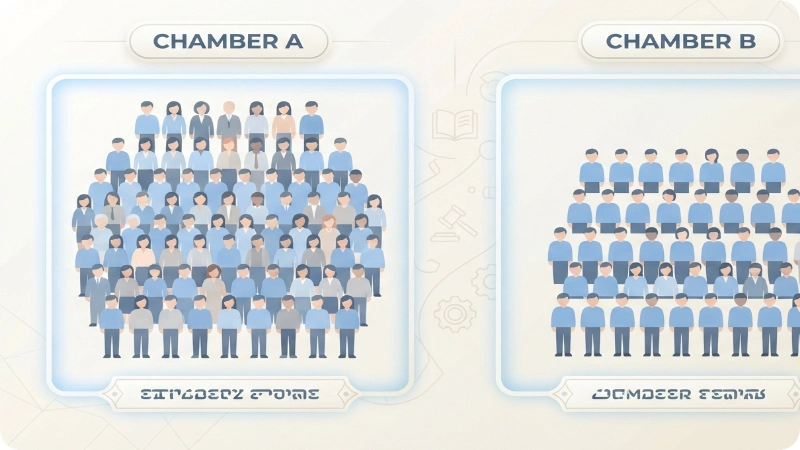
Congress is bicameral, meaning it has two separate chambers. This structure came out of a compromise between smaller and larger states during the writing of the Constitution.
The House of Representatives
The House has 435 voting members. Seats are distributed among states based on population, so more populated states get more representatives. Members serve two year terms, which means every seat is up for election frequently and representatives stay closely tied to their district’s current concerns.
The Senate
The Senate has 100 members, two from each state regardless of population. This gives smaller states equal footing with larger ones in this chamber. Senators serve six year terms, and elections are staggered so only about a third of the Senate is up for election in any given cycle.
Why Two Chambers Matter
Because a bill generally needs to pass both the House and the Senate in identical form before it can become law, this two chamber system forces compromise and slows down lawmaking on purpose. The framers saw this as a safeguard against hasty or poorly considered legislation.
The Main Powers and Functions of the Legislative Branch
Although lawmaking is its best-known responsibility, Congress also oversees federal spending, confirms key appointments, and holds the executive branch accountable. ” Its responsibilities fall into several distinct categories.
1. Lawmaking
This is the core job. Congress introduces, debates, amends, and votes on bills covering everything from healthcare and education to transportation and criminal justice.
2. Taxing and Spending
Congress holds what is often called the “power of the purse.” It creates taxes and decides how federal money is spent through the budget and appropriations process.
3. Declaring War and Funding the Military
The Constitution gives Congress, not the president, the formal power to declare war. Congress also funds and oversees the armed forces, deciding how much money the military receives each year.
4. Confirming Presidential Appointments
The Senate specifically reviews and votes on many presidential nominations, including federal judges, Supreme Court justices, cabinet secretaries, and ambassadors. A nominee typically needs Senate approval before officially taking office.
5. Ratifying Treaties
International treaties negotiated by the president need approval from the Senate, usually by a two thirds vote, before they take full legal effect for the country.
6. Impeachment
The House can impeach a federal official, including the president, for serious misconduct, which means formally charging them. The Senate then holds a trial and decides if to convict and remove that official from office.
7. Oversight of the Executive Branch
Congress holds hearings, requests documents, and investigates how federal agencies and the executive branch are carrying out existing laws. This oversight function helps catch waste, fraud, or abuse of power.
8. Representing Constituents
Every member of Congress represents a specific group of voters, if a congressional district or an entire state. Part of the job involves responding to constituent concerns, helping with federal agency issues, and bringing local priorities to national attention.
9. Amending the Constitution
Congress plays an important role in the constitutional amendment process. An amendment may be proposed when two-thirds of both the House of Representatives and the Senate approve it. It must then be ratified by three-fourths of the states before becoming part of the Constitution.
Although amendments are rare, this process allows the Constitution to evolve while requiring broad national agreement.
How a Bill Becomes a Law

Understanding each step helps explain why passing federal legislation often takes months or even years.
- Introduction A member of Congress introduces a bill in either the House or the Senate.
- Committee Review The bill goes to a relevant committee, where lawmakers study it, hold hearings, and often revise the language.
- Floor Debate and Vote If the committee approves the bill, the full chamber debates it and votes.
- Second Chamber The bill then moves to the other chamber, where it goes through a similar committee and floor process.
- Reconciliation If the House and Senate pass different versions, a conference committee works out the differences so both chambers can approve one final, identical bill.
- Presidential Action Once both chambers approve the same bill, it heads to the president, who can sign it into law, veto it, or let it become law without a signature after a set period.
- Veto Override If the president vetoes the bill, Congress can override that veto with a two thirds vote in both chambers, allowing the bill to become law anyway.
Most bills never make it through this entire process. Congressional committees often stall many bills, or lawmakers fail to gather enough votes to pass them, which is normal and expected because Congress introduces thousands of bills during each session.
Checks and Balances: How Congress Limits the Other Branches
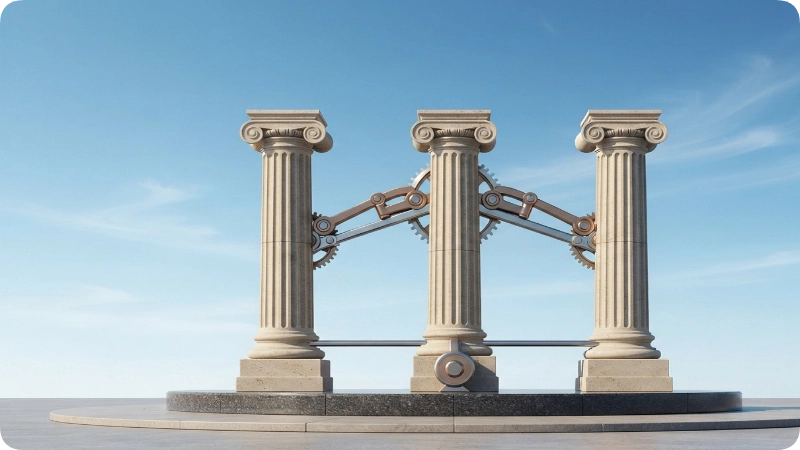
The legislative branch doesn’t operate alone. It’s part of a system where each branch limits the power of the others.
- Legislative checks on the executive branch: Congress can override presidential vetoes, refuse to approve nominations, control funding for executive programs, and impeach the president.
- Legislative checks on the judicial branch: Congress can create or restructure lower federal courts, determine the number of Supreme Court justices, and confirm or reject judicial nominees.
- Checks on Congress: The president can veto legislation, and the Supreme Court can rule a law unconstitutional through judicial review, striking it down entirely.
This constant back and forth is intentional. The goal is to prevent any single branch, including Congress, from accumulating too much unchecked power.
Legislative vs. Executive vs. Judicial Branch
| Branch | Main Role | Key Body | Term Length |
| Legislative | Writes and passes laws, controls spending | Congress (House and Senate) | 2 years (House), 6 years (Senate) |
| Executive | Enforces and carries out laws | President and federal agencies | 4 years (president) |
| Judicial | Interprets laws and reviews their constitutionality | Federal courts, Supreme Court | Lifetime (federal judges) |
This table highlights a common point of confusion: the legislative branch decides what the law says, the executive branch carries it out, and the judicial branch decides if it’s constitutional and how it applies in specific disputes.
House of Representatives vs. Senate
| Feature | House of Representatives | Senate |
| Members | 435 | 100 |
| Representation | Based on population | Two per state |
| Term length | 2 years | 6 years |
| Minimum age | 25 | 30 |
| Special powers | Initiates revenue bills, impeaches officials | Confirms nominees, ratifies treaties, tries impeachment cases |
Real Life Examples of the Legislative Branch at Work
Seeing the legislative branch in action helps make these powers feel less abstract.
- A new federal budget: Each year, committees in both chambers negotiate spending levels for defense, education, healthcare, and other programs before a final budget passes.
- A Supreme Court confirmation: When a Supreme Court seat opens, the Senate Judiciary Committee holds hearings, questions the nominee, and the full Senate eventually votes on confirmation.
- A local infrastructure request: A representative might push for federal funding for a bridge repair or public transit project in their district, showing how national lawmaking connects to local needs.
- An oversight hearing: A congressional committee might call agency officials to testify about how they manage a federal program, using its oversight power to demand accountability.
Common Misunderstandings About the Legislative Branch
A few mix ups come up again and again, even among adults who studied this in school.
- “Congress and the House are the same thing.” Congress refers to the entire legislative branch, including both the House and the Senate, not just one chamber.
- “The president makes laws.” The president signs or vetoes bills but doesn’t originate legislation. Only Congress can introduce and pass a bill.
- “Senators represent districts.” Senators represent an entire state, while representatives serve specific districts within a state.
- “Congress can do whatever it wants.” Congress’s power is limited by the Constitution, presidential vetoes, and judicial review, so it operates within real boundaries.
Examples of Laws Passed by Congress
Examples of major federal laws include:
- The Civil Rights Act of 1964
- The Americans with Disabilities Act (ADA)
- The Clean Air Act
- The Family and Medical Leave Act (FMLA)
These examples show how Congress creates laws that affect education, employment, healthcare, transportation, civil rights, and many other aspects of daily life.
Quick Reference: Legislative Branch Powers
| Power | Chamber Involved |
| Introduce and pass bills | Both House and Senate |
| Control federal taxing and spending | Both House and Senate |
| Declare war | Both House and Senate |
| Confirm presidential nominees | Senate only |
| Ratify treaties | Senate only |
| Impeach an official | House only |
| Try impeachment cases | Senate only |
| Override a presidential veto | Both House and Senate |
FAQs
What is the main job of the legislative branch?
The legislative branch writes, debates, and passes laws while controlling how the federal government raises and spends money.
Who is part of the legislative branch?
The legislative branch consists of the 435 members of the House of Representatives and the 100 members of the Senate.
Can the legislative branch remove the president?
Yes. The House can impeach the president, and the Senate can then hold a trial and vote to convict and remove them from office.
Does the legislative branch enforce laws?
No. Enforcing laws is the job of the executive branch. The legislative branch’s role ends once a law is passed and signed.
How is the legislative branch different from the judicial branch?
The legislative branch creates laws, while the judicial branch interprets those laws and decides if they align with the Constitution.
Why does Congress have two chambers instead of one?
Two chambers balance the interests of smaller and larger states and require broader agreement before a bill can become law.
Can Congress pass a law without the president’s approval?
Yes, if the president vetoes a bill, Congress can still pass it into law by overriding that veto with a two thirds vote in both chambers.
Why is Congress called the legislative branch?
Congress is called the legislative branch because its primary responsibility is creating and passing federal laws.
What are congressional committees?
Congressional committees are smaller groups of lawmakers that study bills, hold hearings, gather expert testimony, and recommend whether legislation should move forward.
Can anyone introduce a bill?
No. At the federal level, only members of the House of Representatives or the Senate can formally introduce legislation in Congress.
Conclusion
The legislative branch exists to turn the will of voters into actual law, control how public money gets spent, and hold the other branches of government accountable. Through the House and Senate, this branch debates, negotiates, and votes on the policies that shape daily life, from taxes to healthcare to national defense.
Understanding how Congress works makes it much easier to follow the news, evaluate elected officials, and see how the checks and balances system keeps power spread across the government rather than concentrated in one place.
This article is based on the structure and powers established by the United States Constitution and commonly taught U.S. civics and government curricula.