Imagine telling a friend, “Our journey to the mountains was unforgettable.” You could also say, “Our trip to the mountains was unforgettable.” Both sentences sound natural, but the word journey often emphasizes the experience of traveling, while trip usually refers to the travel occasion itself.
Now consider a different sentence: “Learning English has been a long journey.” Here, the word does not describe physical travel. Instead, it represents the time, effort, challenges, and progress involved in learning something new.
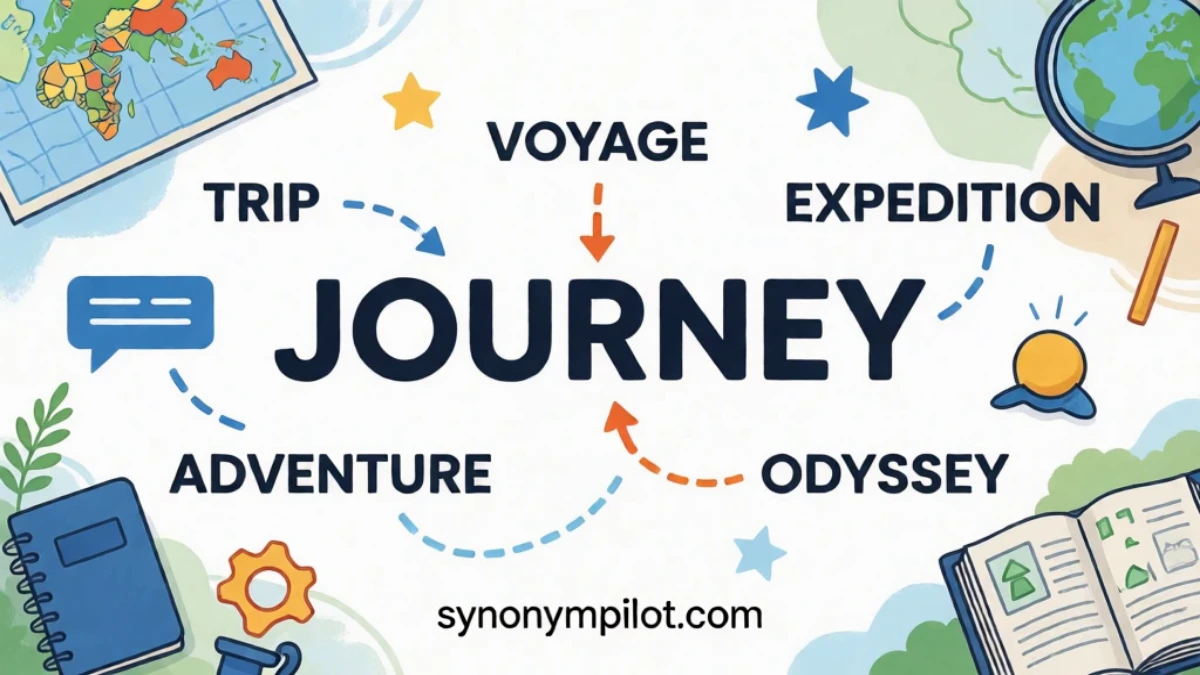
This flexibility makes journey a useful word in everyday English. However, choosing the right alternative can help you express your meaning more precisely. For instance, a voyage often involves a long journey by sea or through space, while an expedition usually involves organized exploration. Similarly, an odyssey suggests a long and eventful experience.
In this guide, you’ll learn more than 50 alternatives for journeys, explore their meanings, and discover how to use them naturally in conversations, school assignments, professional writing, and everyday situations.
Quick Answer
A journey is the act of traveling from one place to another, usually over some distance or period of time. It can also describe personal growth, life experiences, or progress toward a goal. Common synonyms include trip, voyage, expedition, adventure, passage, and odyssey, depending on the context.
Meaning, Tone & Context
The noun journey usually means traveling from one place to another. It can describe a short trip, a long-distance voyage, or an extended period of travel.
For example:
- “The journey from Lahore to Islamabad took several hours.”
- “She began her journey around the world.”
- “His journey toward becoming a doctor took many years.”
The word also has a figurative meaning. In this sense, it describes a process of change, learning, development, or personal achievement.
For instance, “Her journey to success inspired many people” describes progress toward a goal rather than physical movement.
Tone and Formality
Journey works in both everyday conversation and formal writing. It often sounds more descriptive or reflective than trip, especially when the speaker wants to emphasize experiences along the way.
In professional and academic contexts, journey can describe a process, such as a customer’s journey through a website or a student’s journey through education.
However, the best alternative depends on the situation. Trip suits ordinary travel, expedition fits organized exploration, and process may be clearer when discussing a series of steps.
When & How to Use “Journey”
You can use journeys in several common situations.
1. Physical Travel
Use journey when describing movement between places, especially when the travel takes time or involves a meaningful experience.
Example: “Our journey across the countryside was peaceful.”
For a short visit, a trip may sound more natural: “I took a trip to the market.”
2. Long-Distance Travel
When discussing a long voyage, especially by sea or through space, a journey can describe the overall experience.
Example: “The astronauts began their journey into space.”
In a more specific context, voyage may be the better choice.
3. Personal Growth
The word often describes personal development, recovery, education, or a change in someone’s life.
Example: “Learning to speak confidently has been a rewarding journey.”
Here, journey emphasizes the experience over time.
4. Career and Education
You can use the word to describe someone’s progress toward a career or qualification.
Example: “Her journey to becoming a teacher started at university.”
Alternatively, path or process may fit when you want to emphasize the steps involved.
5. Creative and Inspirational Writing
Writers often use journeys to describe emotional experiences or significant life changes.
Example: “The novel follows a young man’s journey toward self-discovery.”
This usage gives the sentence a reflective and meaningful tone.
Another Word for Journey
The best general synonym for journey is trip when you mean ordinary travel. However, other alternatives fit different situations.
- Trip: Travel to a place, often for a particular purpose.
- Voyage: A long journey, traditionally by sea or through space.
- Expedition: An organized journey for exploration, research, or a specific mission.
- Adventure: An exciting or unusual experience, often involving uncertainty.
- Passage: Movement from one place to another, sometimes over a particular route.
- Odyssey: A long, eventful journey involving many experiences or challenges.
- Trek: A long, difficult journey, usually on foot.
- Path: A route or, figuratively, a direction in life.
- Quest: A journey or determined search for something important.
- Itinerary: A planned schedule or route for a journey, rather than the journey itself.
Therefore, think about the type of travel or experience before choosing a replacement.
When Not to Use This Word
Although journey is versatile, it does not replace every word related to travel or progress.
For example, “I made a journey to the kitchen” is grammatically possible, but “I walked to the kitchen” sounds more natural in ordinary conversation.
Likewise, if you mean a planned schedule of destinations, use itinerary rather than journey.
In technical writing, process, progression, or sequence may describe a series of steps more precisely.
Finally, avoid using journey repeatedly in inspirational writing when simpler words would communicate the idea more clearly. Sometimes experience, development, or path expresses your meaning without sounding overly dramatic.
Words Commonly Confused With Journey
Several words overlap with journey, but their meanings differ.
- Trip: A general period of travel, often with a particular purpose.
- Travel: The activity of going from place to place; it usually functions as an uncountable noun or a verb.
- Voyage: A long journey, particularly by sea or through space.
- Expedition: An organized journey for exploration, research, or a specific objective.
- Adventure: An exciting or unusual experience, which may or may not involve travel.
- Itinerary: A plan showing destinations, routes, or travel arrangements.
- Commute: Regular travel between home and work or school.
- Migration: Movement from one region or country to another, often involving groups of people or animals.
Understanding these differences will help you select words that accurately describe the experience.
Best Synonym by Context
| Context | Best Synonym | Why It Fits |
| Everyday travel | Trip | Common and conversational |
| Long sea travel | Voyage | Emphasizes a long passage |
| Scientific exploration | Expedition | Suggests organized investigation |
| Difficult walking route | Trek | Highlights effort and distance |
| Exciting experience | Adventure | Emphasizes excitement and uncertainty |
| Personal development | Path | Suggests direction and progress |
| Search for a goal | Quest | Emphasizes a determined pursuit |
| Long, eventful experience | Odyssey | Suggests challenges and significant events |
| Regular work travel | Commute | Describes repeated daily travel |
| Planned travel schedule | Itinerary | Refers to the route or schedule |
| Movement through a country | Tour | Often involves visiting several places |
| Formal movement through a route | Passage | Emphasizes movement or crossing |
| Progress toward success | Progression | Focuses on development over time |
| Learning and development | Process | Highlights the steps involved |
Which Synonym Should You Choose?
Choosing the right synonym becomes easier when you identify your main idea.
For ordinary travel, trip is the best choice. For example, “We took a trip to the beach.”
When describing a long sea journey, use voyage. For instance, “The voyage across the Atlantic lasted several weeks.”
An organized journey for exploration or research is called an expedition. For example, “The research team planned an expedition to the Arctic.”
If the experience is exciting or unusual, adventure may fit better. For instance, “Their hiking holiday became an unforgettable adventure.”
A journey involving personal growth can be described as a path or process. For example, “Her path to success required patience.”
Finally, an odyssey describes a long, eventful experience, often filled with difficulties. For instance, “Finding the missing documents became a frustrating odyssey.”
The key is to match the synonym to the purpose, length, difficulty, and emotional tone of the experience.
Real-Life Examples of “Journey” in Sentences
School
“The students wrote about their journey through the history of ancient Egypt.”
Here, journey describes learning about a subject over time.
Workplace
“Our company is beginning a journey toward more sustainable business practices.”
The word describes a process of organizational change.
Writing
“The main character’s journey reveals how courage develops through difficult experiences.”
In storytelling, journey often represents personal transformation.
Conversation
“How was your journey home?”
This is a natural question about someone’s travel experience.
50 Synonyms for Journey: Meanings and Examples
These synonyms describe travel, exploration, holidays, and personal growth. Choose the word that best fits your context.
1. Travel and Exploration
| Synonym | Meaning | Example |
|---|---|---|
| Trip | Travel to a place | We took a trip to the coast. |
| Voyage | Long sea journey | The voyage lasted weeks. |
| Expedition | Organized exploration | They planned an expedition. |
| Adventure | Exciting experience | It was an adventure. |
| Trek | Difficult long walk | The trek took two days. |
| Odyssey | Long, eventful journey | Her search became an odyssey. |
| Passage | Movement between places | The passage was difficult. |
| Excursion | Short pleasure trip | We went on an excursion. |
| Tour | Visit to several places | They took a city tour. |
| Pilgrimage | Sacred journey | They made a pilgrimage. |
2. Different Ways of Traveling
| Synonym | Meaning | Example |
|---|---|---|
| Migration | Movement to another region | Birds began their migration. |
| Commute | Regular daily travel | My commute takes an hour. |
| Drive | Journey by car | The drive was beautiful. |
| Ride | Journey in a vehicle | We enjoyed the ride. |
| Flight | Journey by plane | Our flight left early. |
| Crossing | Travel from side to side | The crossing took hours. |
| Transit | Movement between places | We waited in transit. |
| Route | Way to a destination | We chose a scenic route. |
| Passageway | Connecting corridor | The passageway was narrow. |
| Trekking trip | Long walking trip | Our trekking trip was tiring. |
3. Walking and Outdoor Trips
| Synonym | Meaning | Example |
|---|---|---|
| Ramble | Leisurely walk | We rambled through the woods. |
| Hike | Long nature walk | The hike was challenging. |
| Walk | Travel on foot | We walked to the station. |
| Stroll | Relaxed walk | They strolled along the beach. |
| Jaunt | Short, enjoyable trip | We took a weekend jaunt. |
4. Holidays and Short Trips
| Synonym | Meaning | Example |
|---|---|---|
| Outing | Short recreational trip | We went on a family outing. |
| Getaway | Short holiday | We booked a weekend getaway. |
| Holiday | Time away for pleasure | Our holiday was memorable. |
| Vacation | Break from routine | She planned a vacation. |
| Sojourn | Temporary stay | His sojourn lasted six months. |
| Circuit | Route returning to the start | They completed a cycling circuit. |
| Voyage of discovery | Journey to discover | The voyage revealed new places. |
5. Personal Growth and Progress
| Synonym | Meaning | Example |
|---|---|---|
| Quest | Determined search | Her quest for knowledge continued. |
| Path | Direction in life | He chose a new career path. |
| Course | Direction or progression | Her course led to success. |
| Progression | Gradual advancement | His progression was steady. |
| Process | Series of steps | Learning takes time. |
| Passage through life | Life experiences | The book explores life’s passage. |
| Development | Growth or change | Her development continued. |
| Evolution | Gradual transformation | His character evolved. |
| Transition | Change from one state to another | Moving abroad was a transition. |
6. Goals, Tasks, and Discovery
| Synonym | Meaning | Example |
|---|---|---|
| Undertaking | Task requiring effort | It was a major undertaking. |
| Pursuit | Effort to achieve something | His pursuit of success continued. |
| Exploration | Investigation or discovery | Their exploration revealed caves. |
| Search | Attempt to find something | The search continued overnight. |
| Campaign | Organized effort | The campaign lasted years. |
| Mission | Task with a purpose | They began their mission. |
| Venture | Risky new undertaking | She started a bold venture. |
| Expeditionary journey | Mission-focused journey | The journey crossed remote lands. |
| Passage across | Movement across an area | Their passage across the desert was difficult. |
Usage note: Words such as trip, voyage, expedition, trek, and excursion can directly describe types of travel. Others, including process, evolution, transition, and development, work mainly as figurative alternatives. Terms such as route, itinerary, and passageway describe aspects of travel rather than the journey itself, so they should not replace journey in every sentence.
Synonym Groups & Usage Differences
Everyday and Conversational Words
Words such as trip, outing, ride, walk, drive, and getaway sound natural in everyday English.
For example, “We took a short trip to the countryside” is more conversational than “We undertook a passage through the countryside.”
Formal and Academic Alternatives
In formal writing, expedition, migration, transit, progression, and transition may suit particular subjects.
For instance, a biologist might describe animal migration, while an academic advisor might discuss a student’s progression through a degree program.
However, these words are not interchangeable. Each one identifies a specific kind of movement or development.
Professional Usage
In business writing, process, transition, progression, and customer journey often describe how people or organizations move through stages.
For example, “We improved the customer journey by simplifying the checkout process.”
Stronger and More Descriptive Words
Odyssey suggests a long and eventful experience. Trek emphasizes difficulty and physical effort, while expedition highlights organized exploration.
By contrast, a trip usually sounds more neutral and less dramatic.
Emotional and Neutral Alternatives
Adventure often conveys excitement. Pilgrimage can express spiritual devotion or a deeply meaningful visit, while journey can sound reflective.
Meanwhile, trip, commute, and transit are generally more neutral.
Informal and Slang Usage
English has no single essential slang synonym for journey. Informal speakers more commonly use words such as trip, getaway, and road trip.
The phrase epic journey is also common in casual storytelling, but it emphasizes the scale or excitement of the experience rather than providing an exact synonym.
Antonyms of Journey
Journey has no single perfect antonym because it can describe both physical travel and personal development. Nevertheless, the following words express contrasting ideas in suitable contexts.
| Antonym | Meaning | Example |
| Stay | Remain in one place | We decided to stay at home. |
| Stasis | A state without movement or change | The project remained in stasis for months. |
| Immobility | The condition of not moving | The injury caused temporary immobility. |
| Stillness | A state of being still | The stillness of the room was calming. |
| Inactivity | A lack of action or movement | Inactivity slowed the project. |
| Halt | A stop in movement or progress | Construction came to a halt. |
| Standstill | A complete stop in progress | Negotiations reached a standstill. |
| Retreat | Movement away from a position or place | The troops began their retreat. |
These are contextual contrasts rather than exact antonyms. For instance, stay contrasts with physical travel, whereas stasis contrasts with development or progress.
Journey vs. Trip
Subtle Meaning Differences
A trip usually describes a particular instance of travel. A journey often emphasizes the travel itself, including its length, experience, or challenges.
Example: “Our trip lasted three days” focuses on the travel occasion. “The journey was exhausting” emphasizes the experience.
Tone Differences
Trip sounds direct and conversational. Journey can sound more descriptive or reflective.
Emotional Intensity
Journey sometimes carries greater emotional meaning, especially when describing personal growth. However, the words are often interchangeable in physical travel contexts.
Formality Level
Both words work in everyday and professional English. The choice depends more on meaning than formality.
Natural Usage Situations
Use trips for holidays, business visits, and short travel plans. Choose a journey when you want to emphasize the route, duration, or experience.
Journey vs. Voyage
Subtle Meaning Differences
A voyage usually describes a long journey, especially by sea or through space. Journey has a broader meaning.
Example: “The voyage across the Pacific took several weeks.”
Tone Differences
Voyage can sound more literary or adventurous, while journey works in more situations.
Emotional Intensity
Voyage may suggest exploration or discovery, although it can also describe ordinary travel by sea.
Formality Level
Both words appear in formal writing. Voyage is more specialized.
Natural Usage Situations
Use voyage for sea travel, space travel, and some long exploratory trips. Use journey for general travel or personal development.
Journey vs. Adventure
Subtle Meaning Differences
A journey involves movement or progress. An adventure emphasizes excitement, unusual experiences, or uncertainty.
Example: “The journey took six days, and the adventure included camping in the mountains.”
Tone Differences
Adventure sounds more exciting and energetic. Journey can be neutral.
Emotional Intensity
An adventure usually suggests a stronger emotional experience, although not every adventure is enjoyable.
Formality Level
Both words work in descriptive and conversational writing.
Natural Usage Situations
Choose a journey for travel or development over time. Use adventure when the experience involves excitement, challenge, or discovery.
Common Phrases & Expressions
“A long journey”
This describes travel that covers a considerable distance or takes a significant amount of time.
Example: “It was a long journey, but we arrived safely.”
“The journey of life”
This expression refers to the experiences, changes, and challenges people encounter throughout their lives.
Example: “The journey of life teaches us to become more patient.”
“A journey of discovery”
This describes an experience that helps someone learn new things or understand something more deeply.
Example: “Traveling alone became a journey of discovery.”
“Safe journey”
This is a friendly expression used to wish someone a safe trip.
Example: “Have a safe journey, and call me when you arrive.”
“Journey to success”
This phrase describes the effort, learning, and challenges involved in achieving a goal.
Example: “Her journey to success began with a small online business.”
“Go on a journey”
This means to travel somewhere or begin an experience that involves exploration.
Example: “They decided to go on a journey through South America.”
“Enjoy the journey”
This expression encourages people to appreciate the experience rather than focusing only on the final result.
Example: “Keep working toward your degree, but remember to enjoy the journey.”
Common Mistakes to Avoid
1. Using “journey” for every short movement.
For ordinary situations, walk, drive, or trip may sound more natural.
2. Confusing a journey with an itinerary.
A journey is the travel experience; an itinerary is the planned route or schedule.
3. Treating “voyage” and “expedition” as identical.
A voyage emphasizes a long journey, while an expedition usually involves exploration, research, or a specific mission.
4. Using “adventure” when no excitement is implied.
A routine commute is usually not an adventure unless something unusual happens.
5. Overusing figurative “journey.”
Although journey works well for personal growth, process, progress, or development can sound more precise in academic and professional writing.
6. Assuming every alternative is a direct synonym.
Words such as route, course, and itinerary describe related aspects of travel, not the entire experience.
FAQs
What is the best synonym for journey?
Trip is a useful general alternative for ordinary travel. However, voyage, expedition, trek, and adventure are better when the context involves a specific type of experience.
What is another word for a long journey?
You can use voyage, trek, or odyssey, depending on the situation. A voyage often involves long-distance travel, a trek suggests a difficult journey, and an odyssey emphasizes a long, eventful experience.
What is a synonym for journey in life?
Path, process, progression, and personal development can describe aspects of life’s journey. For example, “Her path to independence was challenging.”
Is the journey formal or informal?
Journey works in both formal and informal English. It sounds natural in conversation, travel writing, professional communication, and figurative descriptions of personal growth.
What is the opposite of a journey?
There is no universal opposite. Stay contrasts with physical travel, while stasis or standstill can contrast with progress toward a goal.
Conclusion
Learning synonyms for journey helps you describe travel and personal experiences with greater accuracy. For everyday travel, a trip is often the simplest choice.
When you describe a long sea voyage, voyage may fit better, while expedition emphasizes organized exploration. Meanwhile, adventure adds excitement, and odyssey suggests a long, eventful experience.
For figurative meanings, words such as path, process, progression, and development can explain how someone moves toward a goal or changes over time. However, remember that these alternatives have different meanings and cannot always replace journey directly.