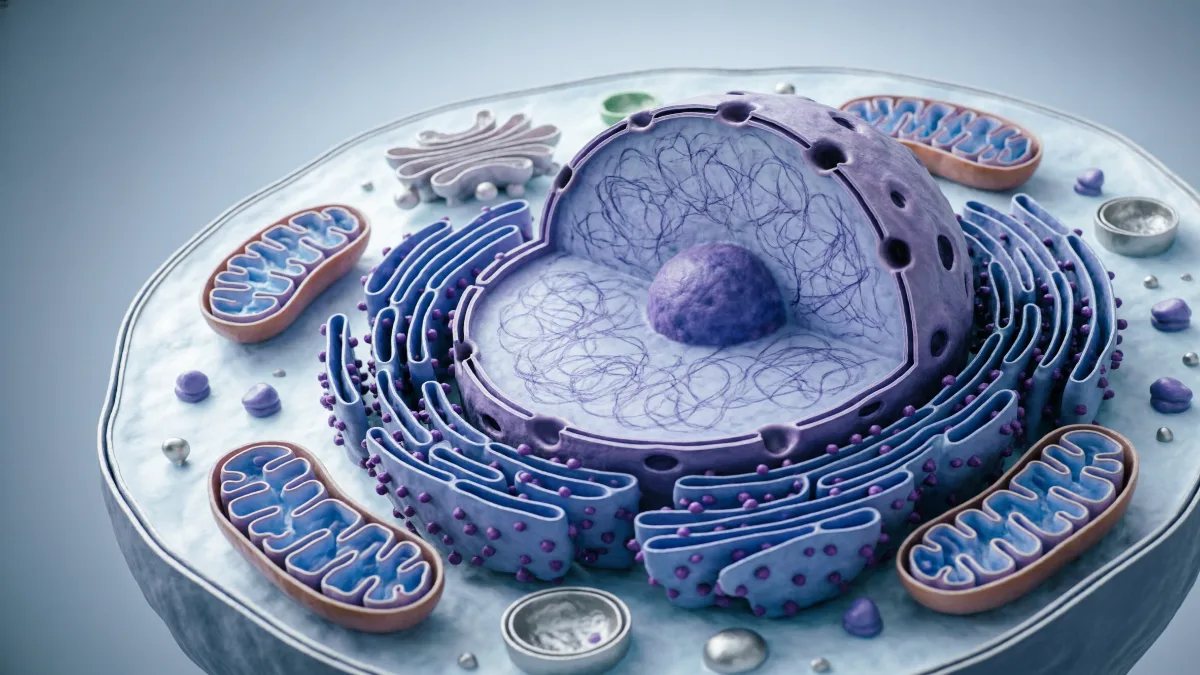
The nucleus stores a cell’s DNA and directs almost everything the cell does, from growth to reproduction to daily repairs. Think of it as the command office inside a much larger building. It doesn’t do every job itself, but it holds the master blueprints and issues the instructions that keep the rest of the operation running.
This guide breaks down exactly how the nucleus performs that role, what’s inside it, and why a cell without one behaves very differently from a cell with one.
By the end, you’ll understand the nucleus’s structure, its main jobs, how it compares to other cell parts people often confuse it with, and what happens when it’s damaged or absent.
Table of Contents
- What the Nucleus Is, in Simple Terms
- The Main Jobs of the Nucleus
- Inside the Nucleus: Key Parts and What They Do
- Nucleus vs. Nucleolus vs. Nucleoid: Clearing Up the Confusion
- What Happens to Cells Without a Nucleus
- Common Misunderstandings About the Nucleus
- Quick Reference Summary Table
- FAQ
- Conclusion
What the Nucleus Is, in Simple Terms
The nucleus is a membrane bound structure found inside eukaryotic cells meaning cells with a “true” nucleus, like the ones in plants, animals, and fungi. It houses the cell’s DNA, the molecule that carries genetic instructions for building proteins and running the cell.
Scientists usually describe the nucleus as the “control center” of the cell because nearly every major decision a cell makes when to grow, when to divide, which proteins to build traces back to instructions read from the DNA stored there. Robert Brown, a Scottish botanist, first described the nucleus in plant cells in 1831, and later research confirmed it as a defining feature of eukaryotic life.
Not every cell has one. Bacteria and archaea, known as prokaryotes, keep their DNA loose in the cytoplasm in a region called the nucleoid, without a surrounding membrane. That structural difference is one of the biggest dividing lines in biology.
The Main Jobs of the Nucleus
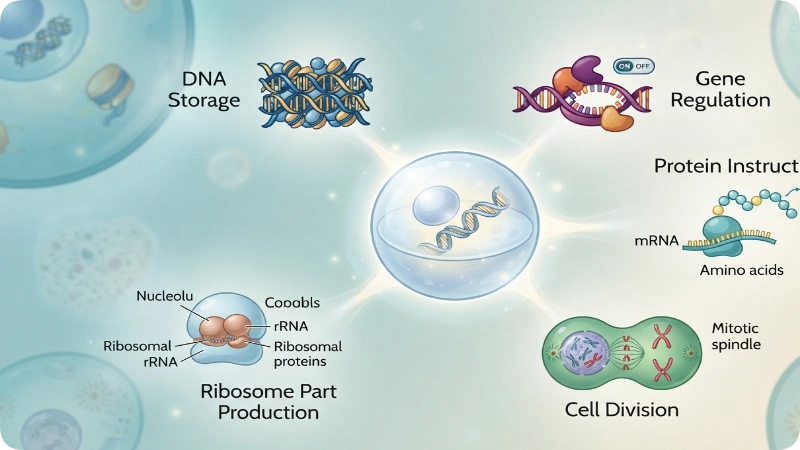
It handles several distinct responsibilities, and each one matters for keeping a cell alive and functioning correctly.
1. Storing and Protecting Genetic Material
It keeps DNA organized and shielded from the busy chemical activity happening elsewhere in the cell. This protection matters because DNA damage can lead to faulty proteins or uncontrolled cell growth.
2. Controlling Gene Expression
Not every gene in a cell’s DNA is active all the time. It regulates which genes get “switched on” or “switched off,” a process called gene expression. This is why a skin cell and a liver cell can carry identical DNA yet look and behave completely differently; it controls which instructions each cell type actually follows.
3. Directing Protein Production
Proteins do most of the physical work in a cell, but they’re built outside the nucleus, in structures called ribosomes. It’s role is to copy genetic instructions from DNA into a related molecule called messenger RNA (mRNA), which then exits the nucleus and travels to the ribosomes for protein assembly. This copying step is called transcription.
4. Coordinating Cell Division
Before a cell divides, it ensures that it copies the DNA accurately and organizes it into structures called chromosomes. It then oversees the even distribution of those chromosomes between the two new cells, which prevents genetic errors from building up over generations.
5. Producing Ribosomal Components
Inside the nucleus sits a smaller structure, the nucleolus, which builds parts of ribosomes themselves. Without this step, a cell wouldn’t have the machinery needed to make proteins at all.
Why Is the Nucleus Called the Control Center of the Cell?
Many biology textbooks describe the nucleus as the control center of the cell because it stores DNA and regulates which genes are active. Instead of performing every cellular task itself, it sends genetic instructions that tell other organelles what proteins to make and when to make them.
This coordination allows cells to grow, repair damage, respond to signals, and divide correctly. While organelles like mitochondria produce energy and ribosomes build proteins, it provides the genetic instructions that guide those activities.
Which Cells Have a Nucleus?
Most plant, animal, fungal, and protist cells contain a nucleus because they are eukaryotic cells.
Examples include:
- Skin cells
- Muscle cells
- Nerve cells
- Liver cells
- Plant leaf cells
However, there are important exceptions.
- Mature human red blood cells lose their nucleus during development.
- Bacteria and archaea never have a nucleus because they are prokaryotes.
Knowing whether a cell has a nucleus is one of the easiest ways to distinguish eukaryotic cells from prokaryotic cells.
Why Is the Nucleus Important?
Without a functioning nucleus, most cells cannot:
- Store genetic information safely
- Produce new proteins
- Divide correctly
- Repair damaged DNA
- Control normal growth
Because it coordinates these essential activities, damage to it can interfere with normal cell function and may contribute to aging, genetic disorders, or diseases such as cancer.
Inside the Nucleus: Key Parts and What They Do
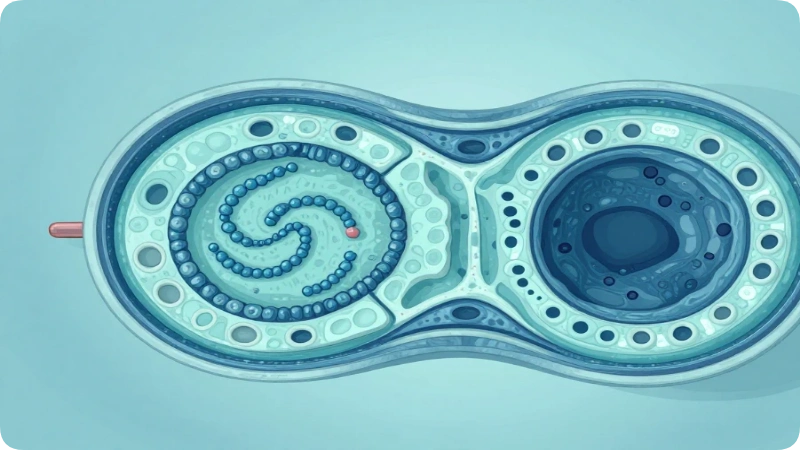
It isn’t a single blob; it has distinct internal parts, each with its own function.
- Nuclear envelope: A double layered membrane that separates the nucleus from the rest of the cell (the cytoplasm). It keeps DNA in a controlled environment.
- Nuclear pores: Small openings in the nuclear envelope that let specific molecules, like mRNA and proteins, pass in and out. Nothing crosses without regulation.
- Chromatin: A mix of DNA and proteins that condenses into visible chromosomes when a cell is preparing to divide. Most of the time, chromatin stays loosely packed so genes remain accessible for reading.
- Nucleolus: A dense region inside the nucleus responsible for producing ribosomal RNA (rRNA) and assembling ribosome subunits.
- Nucleoplasm: The gel like fluid filling the nucleus, similar in concept to cytoplasm but specific to the nuclear interior. It supports and cushions the structures floating within it.
Each part depends on the others. A nuclear envelope with no pores would trap everything inside; pores with no envelope would offer no protection at all.
Chromosomes Inside the Nucleus
Most of the time, DNA inside the nucleus exists as loose chromatin so genes remain accessible. When a cell prepares to divide, this chromatin coils tightly into visible chromosomes. Packaging DNA this way helps ensure each new cell receives a complete set of genetic information during cell division.
Nucleus vs. Nucleolus vs. Nucleoid: Clearing Up the Confusion
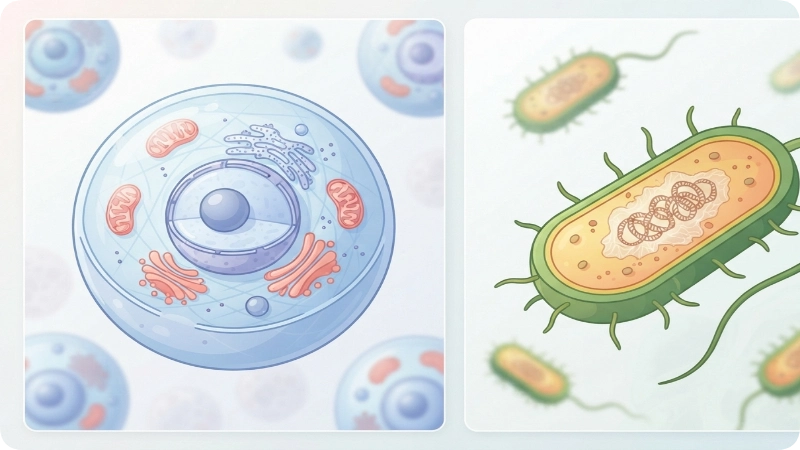
These three terms sound alike, which trips up a lot of students. Here’s how they actually differ.
| Term | What It Is | Found In | Main Function |
| Nucleus | Membrane bound organelle storing DNA | Eukaryotic cells (plants, animals, fungi) | Stores genetic material, controls gene activity |
| Nucleolus | A dense region inside the nucleus | Inside the nucleus of eukaryotic cells | Builds ribosomal RNA and ribosome parts |
| Nucleoid | An unbound region of DNA | Prokaryotic cells (bacteria, archaea) | Holds genetic material without a membrane |
A simple way to remember it: the nucleolus lives inside the nucleus, while the nucleoid exists only in cells that have no nucleus at all.
Nucleus vs. Cytoplasm
| Feature | Nucleus | Cytoplasm |
| Contains DNA | Yes | No |
| Surrounded by membrane | Yes | No |
| Main function | Controls genetic activity | Site of many cellular reactions |
| Contains organelles | Nucleolus | Most other organelles |
What Happens to Cells Without a Nucleus
Not every cell in the human body keeps its nucleus for life. Mature red blood cells are the clearest example they lose their nucleus during development so they can carry more oxygen binding hemoglobin and squeeze through narrow blood vessels more easily.
The trade off is significant. Without a nucleus, a red blood cell can’t produce new proteins or repair itself, which is part of why these cells only survive around 120 days before the body replaces them.
Prokaryotic cells, like bacteria, never had a nucleus to begin with. Their DNA sits in the nucleoid region, and while this makes their internal organization simpler, it also means less compartmentalized control over gene activity compared to eukaryotic cells.
Common Misunderstandings About the Nucleus
“It makes proteins.” Not directly. It copies instructions into mRNA, but actual protein assembly happens at ribosomes, often located in the cytoplasm or attached to the endoplasmic reticulum.
“Every cell has a nucleus.” Plenty of cells don’t. Mature red blood cells and all prokaryotic cells lack one, as covered above.
“The nucleus and the nucleolus are the same thing.” The nucleolus is a smaller structure found inside the nucleus, not a separate organelle on its own.
“It controls the cell in real time, like a brain making instant decisions.” It’s more accurate to say the nucleus sets long term instructions through gene expression rather than reacting instantly to every event in the cell.
Quick Reference Summary Table
| Nucleus Function | Why It Matters |
| Stores DNA | Keeps genetic instructions safe and organized |
| Controls gene expression | Determines which proteins a cell produces |
| Directs transcription | Converts DNA instructions into usable mRNA |
| Coordinates cell division | Ensures accurate DNA distribution to new cells |
| Builds ribosome parts (via nucleolus) | Supplies materials needed for protein synthesis |
FAQs
Does the nucleus control the entire cell?
It plays the central role in regulating gene activity and cell division, but it works together with other organelles like mitochondria and ribosomes, each handling separate tasks.
Can a cell survive without a nucleus?
Some specialized cells, like mature red blood cells, survive for a limited time without one, but they lose the ability to repair themselves or produce new proteins.
Is the nucleus the same size in every cell?
No. Nucleus size varies by cell type and often scales with how much genetic activity that cell needs to support.
How does DNA fit inside such a small nucleus?
DNA winds tightly around proteins called histones, a packaging system that compresses long strands into a manageable, organized structure called chromatin.
What’s the difference between the nucleus and mitochondria?
The nucleus stores and manages genetic information, while mitochondria generate the energy (ATP) a cell needs to function. Mitochondria even contain a small amount of their own separate DNA.
Why is the nucleus often called the “brain” of the cell?
It’s a helpful comparison because the nucleus houses the instructions that guide the cell’s behavior, though unlike a brain, it doesn’t process real time sensory information.
Why is the nucleus surrounded by a membrane?
The nuclear membrane protects DNA from the rest of the cell and controls which molecules can enter or leave through nuclear pores.
What is inside the nucleus?
The nucleus contains DNA, chromatin, chromosomes (during cell division), nucleoplasm, the nucleolus, and the nuclear envelope with pores.
Can bacteria have a nucleus?
No. Bacteria are prokaryotes and do not have a membrane-bound nucleus. Their DNA is located in a region called the nucleoid.
Do all human cells contain DNA?
Nearly all human cells contain DNA. Mature red blood cells are a notable exception because they lose their nucleus during development.
Is the nucleus found in plant and animal cells?
Yes. Both plant and animal cells are eukaryotic and contain a membrane-bound nucleus that stores genetic information.
Conclusion
The nucleus keeps a cell’s genetic instructions safe, decides which genes get used, and guides the process that turns those instructions into working proteins. It also oversees cell division, making sure genetic material passes on accurately.
If you’re studying biology for the first time or refreshing what you learned years ago, the core idea holds steady: no nucleus, no reliable genetic control and no genetic control, no properly functioning cell.