Imagine your teacher says, “Learning a new language can be a challenge.” You understand the sentence, but perhaps you want to express the same idea in a different way. You might say, “Learning a new language can be difficult,” or “Learning a new language takes effort.”
Both sentences communicate a similar idea, although they use different structures.
Now consider another situation. Your manager says, “We face a major challenge this month.” In this case, obstacles, difficulty, or problems might fit. However, if a friend says, “I challenge you to a race,” the meaning changes completely. Here, challenge means inviting someone to compete.
These examples show why choosing the right synonym matters. Although many words share a connection with challenge, they do not all express the same meaning.
In this guide, you will learn useful synonyms for challenge, understand their differences, and discover which alternatives sound natural in school, professional writing, and everyday conversation.
Quick Answer
A challenge is a difficult task, situation, or problem that requires effort, skill, or determination. It can also mean an invitation to compete or an act of questioning an idea, decision, or authority. Common alternatives include difficulty, obstacle, test, trial, hurdle, demanding task, and competition, depending on the context.
Meaning, Tone & Context
The word challenge works as both a noun and a verb.
As a noun, it describes something that tests your abilities, requires effort, or makes a task difficult.
- “Passing the final exam was a challenge.”
- “Finding a new job can be a challenge.”
- “The team overcame several challenges during the project.”
As a verb, challenge can mean to test someone’s ability, invite someone to compete, or question an idea or decision.
- “My coach challenged me to improve my speed.”
- “She challenged the decision during the meeting.”
- “They challenged the defending champions.”
The word sounds natural in casual conversations, academic writing, business communication, and motivational discussions. Moreover, it often suggests an opportunity to learn or improve rather than simply a negative experience.
For example, a difficult assignment may be a challenge because it helps you develop new skills. In contrast, an obstacle usually emphasizes something that stands in your way.
Therefore, the best synonym depends on whether you mean a difficult task, a barrier, a test of ability, a competition, or an act of questioning something.
When & How to Use “Challenge”
1. Describing a difficult task
Use challenges when an activity requires effort, patience, or skill.
Example: “Learning to drive was a challenge at first.”
You could also say, “Learning to drive was difficult.” However, the noun challenge often emphasizes the experience of working through the difficulty.
2. Talking about problems at work
In professional situations, challenge often describes a problem that requires a solution.
Example: “Our biggest challenge is meeting the deadline.”
Alternatively, you could say, “Our biggest obstacle is the limited time.” This version focuses more specifically on what prevents the team from finishing.
3. Describing personal growth
The word frequently appears in discussions about goals, education, fitness, and self-improvement.
Example: “Running five kilometers was a new challenge for me.”
Here, the word suggests an activity that tests your current abilities.
4. Inviting someone to compete
As a verb, challenge can introduce a contest or competition.
Example: “I challenge you to a game of chess.”
In this sentence, alternatives such as invite or dare may work, but each creates a different tone.
5. Questioning an idea or decision
Use the verb when you disagree with something and want to question its validity.
Example: “The employee challenged the manager’s decision.”
Depending on the situation, question, dispute, or contest may communicate the meaning more precisely.
Another Word for Challenge
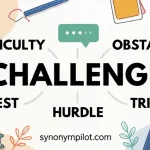
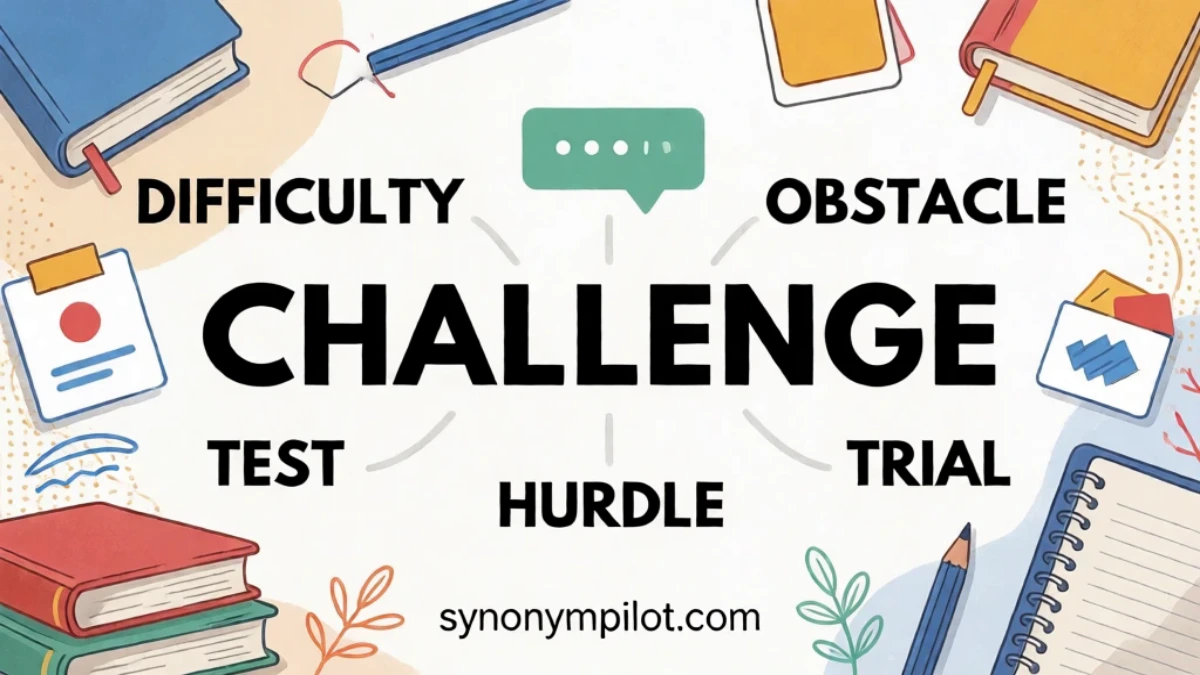
The best general alternative is often difficulty, obstacle, or test, but each word suits a different situation.
- Difficulty: emphasizes how hard something is.
- Obstacle: describes something that blocks progress.
- Test: emphasizes the need to demonstrate ability or knowledge.
- Hurdle: describes a problem that must be overcome.
- Trial: suggests a difficult experience that tests patience or strength.
- Demanding task: emphasizes the effort required.
- Competition: fits situations involving rivals or contestants.
- Dispute: fits a disagreement or challenge to a claim.
- Question: works when someone challenges an idea or decision.
For example, “The exam was a challenge” can become “The exam was a test of my knowledge.” Meanwhile, “A lack of funding was our biggest challenge” may become “A lack of funding was our biggest obstacle.”
When Not to Use This Word
Avoid using challenges as a replacement for every kind of problem. Sometimes, a more specific word makes your meaning clearer.
For example, “I have a challenge with my computer” sounds less natural than “I’m having a problem with my computer.”
Similarly, use competition when you mean a contest between people, not simply a difficult experience.
In formal writing, avoid vague statements such as “The company has many challenges” when you can explain the actual issues. Instead, identify the specific difficulties, such as rising costs, staff shortages, or delayed deliveries.
Finally, remember that the verb has several meanings. “She challenged the decision” means she questioned it, while “She challenged me to a race” means she invited me to compete.
Words Commonly Confused With Challenge
- Problem: Something that needs attention or a solution.
- Difficulty: The state of being hard to do, understand, or manage.
- Obstacle: Something that blocks progress.
- Test: An activity that measures knowledge, skill, or ability.
- Trial: A difficult experience or, in some contexts, a formal legal proceeding.
- Competition: A contest in which people or teams try to win.
- Dispute: A disagreement about a fact, decision, or claim.
- Risk: The possibility of harm, loss, or an unwanted outcome.
Although these words sometimes overlap, they focus on different aspects of a situation. A challenge may involve a problem, but not every problem is a challenge. Likewise, a risk may make a task more challenging, but the words are not interchangeable.
Best Synonym by Context
| Context | Best Alternative | Why It Fits |
| Difficult schoolwork | Test | Emphasizes ability or knowledge |
| Workplace problems | Obstacle | Highlights something blocking progress |
| Personal growth | Trial | Suggests a demanding experience |
| A difficult assignment | Demanding task | Emphasizes effort |
| A sports event | Competition | Refers to a contest |
| A minor difficulty | Hurdle | Suggests a manageable barrier |
| Questioning a claim | Dispute | Expresses disagreement |
| Questioning a decision | Contest | Means formally opposing or challenging it |
| Testing someone’s skills | Trial | Emphasizes a test of ability |
| An uncertain situation | Difficulty | Focuses on what makes the situation hard |
| A bold invitation | Dare | Adds a provocative or playful tone |
| A difficult objective | Test | Highlights what must be demonstrated |
Which Synonym Should You Choose?
First, identify what you want to emphasize.
If you mean something is hard, choose difficulty. If something prevents progress, use obstacles or barriers. For an activity that measures skill, choose a test or trial.
Meanwhile, use competition for a contest, dispute for a disagreement, and question when someone doubts an idea or decision.
Consider these examples:
- “The project presents a challenge.” → “The project presents a difficulty.”
- “A lack of experience is a challenge.” → “A lack of experience is an obstacle.”
- “The assignment challenged my abilities.” → “The assignment tested my abilities.”
- “She challenged the claim.” → “She disputed the claim.”
Notice that some replacements require changing the sentence structure. Therefore, choose a synonym based on the complete sentence, not just the individual word.
Real-Life Examples of “Challenge” in Sentences
School
“Writing my first research paper was a challenge, but I learned how to organize my ideas.”
Here, challenge describes a demanding learning experience.
Workplace
“Our biggest challenge is completing the project before Friday.”
In a more specific report, you might write, “The main obstacle is the delay in receiving the required materials.”
Writing
“The novel explores the challenges young people face when making important decisions.”
The word describes difficult situations rather than one specific problem.
Conversation
“I know the workout looks difficult, but I enjoy a good challenge.”
This natural expression suggests that the speaker welcomes opportunities to test their abilities.
50 Synonyms and Contextual Alternatives for Challenge
Some alternatives fit the noun challenge, while others work better with the verb. These groups explain their meanings and show how to use them naturally.
Synonyms for Difficulties and Obstacles
| Synonym | Simple Meaning | Example Sentence |
|---|---|---|
| 1. Difficulty | Something hard to manage | We faced difficulties during the project. |
| 2. Obstacle | Something blocking progress | Funding was our biggest obstacle. |
| 3. Hurdle | A problem to overcome | The exam was her first hurdle. |
| 4. Problem | Something needing a solution | We solved the problem quickly. |
| 5. Struggle | A difficult effort | Learning the software was a struggle. |
| 6. Ordeal | A painful experience | The delay became an ordeal. |
| 7. Adversity | Difficult circumstances | She succeeded despite adversity. |
| 8. Setback | A delay in progress | The injury caused a setback. |
| 9. Barrier | Something preventing progress | Language became a barrier. |
| 10. Hardship | Serious difficulty | The family faced financial hardship. |
| 11. Complication | Something making matters harder | Technical issues delayed the launch. |
| 12. Issue | A matter needing attention | We discussed the main issue. |
Synonyms for Tasks and Responsibilities
| Synonym | Simple Meaning | Example Sentence |
|---|---|---|
| 13. Demanding task | Work requiring effort | Organizing the event was demanding. |
| 14. Assignment | A task given to someone | Our teacher assigned a difficult task. |
| 15. Undertaking | A project requiring effort | The website was a major undertaking. |
| 16. Mission | An important goal | Their mission was to deliver supplies. |
| 17. Endeavor | A serious effort | Learning English is a worthwhile endeavor. |
| 18. Burden | A difficult responsibility | The workload became a burden. |
| 19. Responsibility | A duty to manage | Leading the team was a responsibility. |
| 20. Demand | Something requiring effort | The job places heavy demands on staff. |
| 21. Requirement | Something necessary | Meeting the deadline was essential. |
| 22. Strenuous task | Work requiring great effort | Moving the equipment was strenuous. |
Synonyms for Tests and Competitions
| Synonym | Simple Meaning | Example Sentence |
|---|---|---|
| 23. Test | A measure of ability | The interview tested his confidence. |
| 24. Trial | A difficult experience | The journey tested her patience. |
| 25. Examination | A formal knowledge test | The examination tested our knowledge. |
| 26. Trial run | A preliminary test | We completed a trial run. |
| 27. Experiment | A test of an idea | The experiment challenged our assumptions. |
| 28. Competition | A contest between participants | She entered a writing competition. |
| 29. Contest | An event involving competitors | The contest tested each team’s skills. |
| 30. Match | A competitive encounter | Tomorrow’s match will test our skills. |
| 31. Trial of strength | A test of power | The final round tested their strength. |
| 32. Test of endurance | A test of stamina | The hike tested our endurance. |
| 33. Test of skill | A measure of ability | The final task tested her skills. |
| 34. Test of character | A test of values | The crisis tested his character. |
| 35. Trial by fire | A difficult first experience | Her first week was a trial by fire. |
| 36. Test of ability | A measure of capability | The presentation tested his ability. |
Synonyms for Disagreement and Opposition
| Synonym | Simple Meaning | Example Sentence |
|---|---|---|
| 37. Dare | A bold challenge | He accepted the dare. |
| 38. Provocation | An action causing annoyance | His remark felt like a provocation. |
| 39. Confrontation | A direct disagreement | The argument led to a confrontation. |
| 40. Dispute | A disagreement | The lawyer disputed the claim. |
| 41. Objection | An expression of disagreement | She raised an objection. |
| 42. Question | An expression of doubt | The journalist questioned the decision. |
| 43. Contestation | The act of disputing | The decision faced contestation. |
| 44. Opposition | Resistance to an idea | The plan faced strong opposition. |
| 45. Resistance | An effort to oppose | Employees showed resistance to the policy. |
| 46. Criticism | Expression of disapproval | Experts criticized his proposal. |
Synonyms for Examination and Barriers to Success
| Synonym | Simple Meaning | Example Sentence |
|---|---|---|
| 47. Scrutiny | Careful examination | The report faced public scrutiny. |
| 48. Examination of a claim | Reviewing an assertion | Researchers examined the claim. |
| 49. Barrier to success | Something blocking achievement | Poor planning became a barrier to success. |
| 50. Difficulty level | How hard something is | The difficulty level increased. |
Usage note: The best alternative depends on context. Use obstacle for something blocking progress, ordeal for a painful experience, and test for something that measures ability. Some entries are contextual phrases rather than direct synonyms.Usage note: These alternatives are not interchangeable in every situation. For example, obstacle emphasizes something blocking progress, ordeal describes a painful experience, and test refers to something that measures ability. Choose the word that best matches your intended meaning.Usage note: These 50 alternatives are not interchangeable in every sentence. Some describe difficult tasks, others identify barriers or tests, and several relate to the verb challenge, meaning to question or oppose something. Choose the alternative that matches your intended meaning.
Synonym Groups & Usage Differences
Formal and Academic Alternatives
In academic writing, difficulty, obstacle, examination, scrutiny, resistance, and objection can express specific ideas clearly.
For example:
“The researchers questioned the original findings.”
This is more precise than saying, “The researchers challenged the findings,” when you want to emphasize the act of questioning.
Similarly, scrutiny describes close examination, while objection identifies an expression of disagreement.
Professional Alternatives
At work, use obstacles, issue, setback, requirement, demanding task, or undertaking, depending on the situation.
For example:
“The main obstacle is the limited budget.”
This identifies the specific barrier instead of using the more general word challenge.
Conversational Alternatives
In everyday conversation, problems, struggles, hurdles, tests, and difficulties often sound natural.
For example:
“Getting used to my new schedule has been a struggle.”
Alternatively, “Getting used to my new schedule has been a challenge” sounds slightly more neutral and may suggest personal growth.
Stronger vs. Weaker Alternatives
A difficulty may be relatively minor, while an ordeal suggests an extremely unpleasant experience.
Likewise, a hurdle often sounds manageable, whereas adversity can describe serious hardship.
Therefore, choose a word that matches the actual severity of the situation.
Positive vs. Negative Meaning
The word challenge can sound positive when it describes an opportunity to improve.
For example: “I welcome the challenge of learning something new.”
By contrast, ordeal and hardship emphasize suffering or difficulty. Meanwhile, obstacles focus on something that blocks progress.
Informal and Slang Usage
There is no single slang synonym that replaces challenge in every context. However, expressions such as “give it a shot” and “take on the challenge” work naturally in casual conversation.
For example:
“I’m not sure I can finish the puzzle, but I’ll give it a shot.”
This expresses willingness to attempt something difficult without sounding formal.
Antonyms of Challenge
The opposite depends on which meaning of challenge you have in mind. If you mean a difficult task, an antonym should suggest ease. If you mean questioning or opposition, an antonym should suggest agreement or acceptance.
| Antonym | Meaning | Example |
| Ease | A state of being comfortable or effortless | She completed the task with ease. |
| Simplicity | The quality of being easy to understand or do | The simplicity of the exercise surprised us. |
| Convenience | The quality of being easy or practical | Online registration offers greater convenience. |
| Agreement | A shared opinion or acceptance | Both parties reached an agreement. |
| Acceptance | Willingness to approve or receive something | The proposal received acceptance from the committee. |
| Support | Help or approval for an idea | The plan received strong support. |
| Compliance | Acting according to a rule or request | The company demonstrated compliance with the regulations. |
| Cooperation | Working together toward a shared purpose | Cooperation helped the team finish early. |
Challenge vs. Difficulty
Subtle Meaning Differences
A challenge often suggests something that tests your abilities. A difficulty focuses more directly on how hard something is.
Example: “The assignment was a challenge” may suggest a valuable learning experience. “The assignment was difficult” simply describes its level of difficulty.
Tone Differences
Challenge can sound encouraging, while difficulty is more descriptive.
Emotional Intensity
Neither word is always stronger. However, challenges may frame a demanding experience more positively.
Formality Level
Both words work in casual, academic, and professional English.
Natural Usage Situations
Use challenges for goals and demanding experiences. Use difficulty when explaining what makes a task hard.
Challenge vs. Obstacle
Subtle Meaning Differences
A challenge is something that tests you. An obstacle is something that stands in your way.
Tone Differences
Challenge may sound motivating, while obstacle emphasizes a barrier.
Emotional Intensity
An obstacle can be serious or minor, depending on the situation.
Formality Level
Both words work well in professional writing.
Natural Usage Situations
“The tight deadline is a challenge” describes the demanding situation. “The missing documents are an obstacle” identifies a specific barrier.
Challenge vs. Test
Subtle Meaning Differences
A test measures knowledge, skill, or ability. A challenge may require effort without formally measuring anything.
Tone Differences
Test sounds more direct and measurable.
Emotional Intensity
A challenge may feel more demanding when it involves several obstacles.
Formality Level
Both are suitable for academic and everyday use.
Natural Usage Situations
Use test for examinations, skill assessments, and trials of ability. Use challenges for broader experiences that require effort.
Challenge vs. Problem
Subtle Meaning Differences
A problem needs attention or a solution. A challenge often emphasizes the effort needed to deal with a situation.
Tone Differences
Challenge can sound more constructive, while problem directly identifies something wrong or difficult.
Emotional Intensity
A problem can be urgent or minor. A challenge can also vary in severity.
Formality Level
Both words suit professional and informal settings.
Natural Usage Situations
Say, “We have a problem with the software” when something is not working. Say, “Adapting to the new software is a challenge” when learning it requires effort.
Challenge vs. Competition
Subtle Meaning Differences
A competition is an event or situation in which people try to win. A challenge can be a contest, but it can also describe any difficult task.
Tone Differences
Competition emphasizes rivals or winning. Challenge emphasizes effort, ability, or opposition.
Emotional Intensity
Both words can describe exciting or stressful experiences.
Formality Level
Both are common in professional, educational, and everyday English.
Natural Usage Situations
Use competition for a race, tournament, or contest. Use challenges for a demanding goal or when inviting someone to compete.
Common Phrases & Expressions
Take on a challenge
Meaning: Accept a difficult task or responsibility.
Example: “She decided to take on the challenge of leading the new project.”
Rise to the challenge
Meaning: Respond successfully to a difficult situation.
Example: “The team rose to the challenge and finished the work on time.”
Face a challenge
Meaning: Deal with a difficult situation.
Example: “Every student faces challenges when learning a new subject.”
Overcome a challenge
Meaning: Successfully deal with a difficulty.
Example: “He overcame the challenge of speaking confidently in public.”
A major challenge
Meaning: A particularly difficult or important task.
Example: “Finding affordable housing remains a major challenge for many families.”
Challenge yourself
Meaning: Try something that pushes you beyond your usual abilities.
Example: “Challenge yourself to learn five new English words every day.”
Meet the challenge
Meaning: Respond adequately to a demanding situation.
Example: “The school introduced new resources to meet the challenge of larger classes.”
Common Mistakes to Avoid
- Using “obstacle” for every challenge: An obstacle blocks progress, whereas a challenge may simply test your skills.
- Confusing “challenge” with “competition”: A challenge does not always involve opponents or a winner.
- Using “ordeal” for a minor difficulty: An ordeal usually describes a particularly unpleasant experience.
- Ignoring the verb’s meaning: “Challenge a decision” means question or oppose it, not make it more difficult.
- Choosing vague alternatives: In professional writing, explain the specific challenge whenever possible.
- Assuming every challenge is negative: A challenge can be an opportunity to learn, improve, or achieve something meaningful.
FAQs
What is the best synonym for challenge?
Difficulty is a useful general alternative when you mean something hard. However, an obstacle is better for a barrier, while a test fits an activity that measures ability.
What is another word for challenge in professional writing?
Use obstacles, difficulty, issue, setback, or demanding task, depending on the meaning. For example, “The primary obstacle is the limited budget” sounds clear and professional.
What is a stronger word for challenge?
Ordeal, hardship, and struggle can express more serious difficulty. Nevertheless, their meanings differ: an ordeal is particularly unpleasant, hardship involves difficult conditions, and struggle emphasizes effort.
What is the opposite of a challenge?
For a difficult task, possible opposites include ease and simplicity. For the verb meaning to question or oppose, accept, agree with, or support may fit, depending on the sentence.
Is challenge a noun or a verb?
It can be both. In “The exam was a challenge,” it is a noun. In “I challenge you to a race,” it is a verb. As a verb, it can also mean questioning an idea or decision.
Conclusion
Learning synonyms for challenge helps you describe difficult experiences with greater accuracy. Instead of repeating the same word, you can choose difficulty when something is hard, obstacle when something blocks progress, or test when an activity measures your ability.
Similarly, competition fits a contest, while dispute works when someone questions a claim. Each alternative adds a slightly different meaning to your sentence.
To build your vocabulary, start by practicing three or four alternatives each day. Write a sentence about school, work, or an experience in your life, then replace challenge with a suitable synonym. Notice how the meaning and tone change.