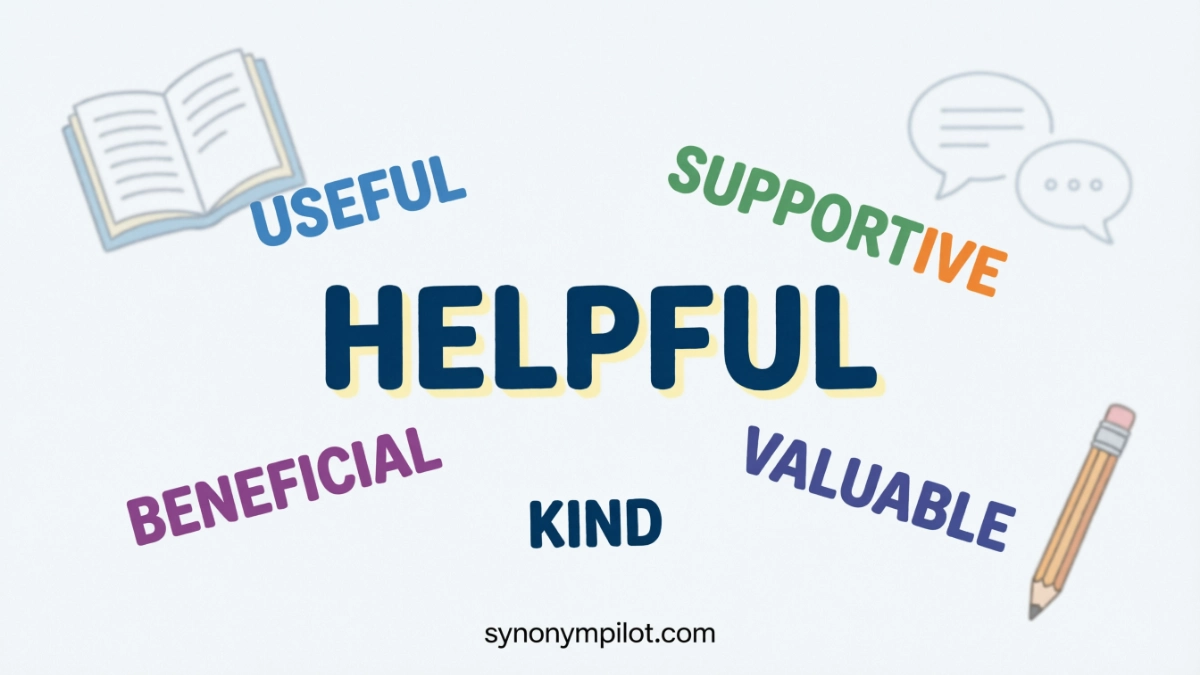
Imagine a classmate explains a difficult lesson before an exam. You might say, “She was very helpful.” However, if you want to describe her knowledge, you could say she was informative. If you want to highlight her kindness, supportive might fit better.
These small differences can make your English sound more natural. In this guide, you’ll discover helpful synonyms, their meanings, and examples for everyday conversations, school assignments, professional emails, and other real-life situations.
Quick Answer
The word helpful describes someone or something that makes a task easier, provides useful information, or gives support. Common synonyms include useful, supportive, beneficial, valuable, cooperative, and kind. The best alternative depends on whether you mean practical assistance, emotional support, or something that produces a positive result.
Meaning, Tone & Context
Helpful is an adjective that describes a person, action, piece of information, or resource that makes something easier or improves a situation.
For example:
- The teacher gave me helpful advice.
- This website is helpful for learning English.
- My colleagues were helpful during the project.
The word has a positive, friendly, and generally neutral tone. You can use it in casual conversations, academic writing, workplace communication, and formal emails.
However, its meaning changes slightly with context. A helpful person offers assistance, while helpful information provides knowledge that someone can use. A helpful suggestion gives someone a practical idea or solution.
Therefore, choose a synonym that expresses the exact kind of help you mean.
When & How to Use “Helpful”
Use helpful when a person, action, or resource makes a task easier or helps someone understand what to do.
1. Talking About People
Use the word when someone offers assistance, guidance, or support.
Example: My teacher was helpful when I struggled with grammar.
Other options include supportive, cooperative, and accommodating. Each highlights a different kind of assistance.
2. Describing Information or Advice
When information makes a problem easier to understand or solve, helpful is a natural choice.
Example: The article contains helpful tips for improving vocabulary.
You could also say useful information, valuable advice, or practical guidance.
3. Writing Professional Emails
The word works well in polite workplace communication.
Example: Thank you for your helpful feedback on my report.
For a more formal tone, consider valuable feedback or constructive suggestions, depending on what you mean.
4. Describing Tools and Resources
Use helpful for apps, books, websites, instructions, and other resources that make a task easier.
Example: This dictionary is helpful for beginner English learners.
In this context, useful, effective, and practical may also work.
Another Word for Helpful
The best alternative depends on the situation.
- Useful: Something that serves a practical purpose.
- Supportive: Someone who offers encouragement or assistance.
- Beneficial: Something that produces a positive result.
- Valuable: Something important or worthwhile.
- Kind: Someone who shows care and consideration.
- Informative: Something that provides useful knowledge.
- Cooperative: Someone who willingly works with others.
- Practical: Something that works well in real situations.
For example, you might describe a dictionary as useful, a friend as supportive, and regular reading as beneficial.
When Not to Use “Helpful”
Although helpful fits many situations, another word may express your meaning more accurately.
- Choose effective when something achieves the desired result. A helpful method provides guidance, whereas an effective method gets the job done.
- Use generous to describe someone who willingly shares their time, money, or resources.
- Choose kind when you want to highlight someone’s caring nature or good intentions.
- Use informative when something teaches you facts or gives you new knowledge.
- Use supportive when someone offers encouragement or emotional comfort during a difficult time.
For example, “The presentation was informative” is a better choice when you want to highlight the facts and knowledge it provided. However, “The presentation was helpful” is more suitable when it gave the audience practical advice or assistance.ntation was helpful” when your main point is that it taught the audience something new.
Words Commonly Confused With Helpful
Some related words overlap with helpful, but they do not always mean the same thing.
| Word | Main Difference | Example |
| Useful | Serves a practical purpose | This guide is useful for beginners. |
| Supportive | Offers encouragement or assistance | My family is supportive of my goals. |
| Beneficial | Produces a positive effect | Exercise is beneficial to your health. |
| Effective | Achieves the intended result | This is an effective study method. |
| Kind | Shows care or consideration | She was kind to the new student. |
| Informative | Provides knowledge or facts | The lecture was informative. |
| Cooperative | Works willingly with others | The team was cooperative. |
| Generous | Gives freely or willingly | He was generous with his time. |
Notice that these words describe different qualities. A person can be kind without offering practical assistance, and a resource can be useful without being informative.
Best Synonym by Context
Choose the word that matches your intended meaning.
| Context | Best Synonym | Example |
| Practical tools | Useful | This app is useful for learning vocabulary. |
| Emotional support | Supportive | She was supportive during my exams. |
| Positive results | Beneficial | Reading daily is beneficial for learners. |
| Important advice | Valuable | He gave me valuable advice. |
| Friendly behavior | Kind | It was kind of you to help. |
| Clear instructions | Informative | The guide was informative. |
| Teamwork | Cooperative | Everyone was cooperative during the task. |
| Solving problems | Effective | This is an effective solution. |
| Everyday tasks | Practical | Her practical advice saved time. |
| Professional feedback | Constructive | My manager gave constructive feedback. |
Which Synonym Should You Choose?
Ask yourself what kind of help you want to describe.
If something makes a task easier, choose something useful. If a person gives encouragement, supportive is usually more suitable. When an action improves someone’s situation, it communicates the positive effect.
For advice that matters, use valuable information. If you want to emphasize friendliness or compassion, choose kind. Meanwhile, effective work best when a method produces the intended result.
Consider these examples:
- “Your notes were helpful.” General assistance.
- “Your notes were useful.” They served a practical purpose.
- “Your notes were informative.” They provided knowledge.
- “Your notes were valuable.” They were especially important or worthwhile.
All four sentences are natural, but each emphasizes a slightly different quality.
Real-Life Examples of Helpful in Sentences
School
- My teacher gave me helpful advice before the exam.
- This vocabulary book is useful for beginners.
- My classmate was supportive when I found the lesson difficult.
Workplace
- Thank you for your helpful feedback.
- Her practical suggestions helped us finish the project.
- The manager provided valuable guidance to the new employees.
Writing
- The article offers useful tips for improving grammar.
- This guide contains informative examples for English learners.
- A clear introduction can make an essay easier to understand.
Conversation
- Thanks for being so helpful!
- That was a really useful suggestion.
- It was kind of you to explain everything.
- Your advice was exactly what I needed.
These examples show how the right alternative can make your meaning more precise without changing the main message.
50 Synonyms for Helpful With Meanings and Examples
The following words can replace helpful in appropriate contexts. However, some describe practical usefulness, while others emphasize encouragement, cooperation, or positive results. Check the meaning before choosing an alternative.
| Synonym | Simple Meaning | Example Sentence |
| 1. Useful | Serving a practical purpose | This guide is useful for new learners. |
| 2. Supportive | Giving encouragement or assistance | My friends were supportive during a difficult week. |
| 3. Beneficial | Producing a positive effect | Daily reading is beneficial for children. |
| 4. Valuable | Important or worthwhile | She gave me valuable advice. |
| 5. Kind | Showing care and consideration | It was kind of him to offer help. |
| 6. Effective | Producing the intended result | This is an effective way to remember new words. |
| 7. Practical | Useful in real situations | The teacher shared practical study tips. |
| 8. Informative | Providing useful knowledge | The website has informative articles. |
| 9. Cooperative | Willing to work with others | Our colleagues were cooperative throughout the project. |
| 10. Accommodating | Willing to adjust to others’ needs | The receptionist was accommodating when we changed our booking. |
| 11. Constructive | Helping improve something | She offered constructive feedback on my writing. |
| 12. Encouraging | Giving confidence or hope | His encouraging words helped me continue. |
| 13. Generous | Willing to give time or resources | She was generous with her time. |
| 14. Considerate | Thinking about other people’s needs | It was considerate of you to explain the instructions. |
| 15. Thoughtful | Showing care through attention or action | He gave me a thoughtful suggestion. |
| 16. Caring | Showing concern for others | The caring teacher listened to every student. |
| 17. Compassionate | Showing concern for suffering | The compassionate nurse comforted the patient. |
| 18. Understanding | Showing sympathy or patience | My manager was understanding about the delay. |
| 19. Empathetic | Understanding another person’s feelings | An empathetic friend listens without judging. |
| 20. Attentive | Paying close attention | The attentive assistant noticed my mistake. |
| 21. Responsive | Reacting quickly or appropriately | The support team was responsive to my questions. |
| 22. Reliable | Able to be trusted | This is a reliable source of information. |
| 23. Dependable | Consistently doing what is expected | Our dependable colleague always meets deadlines. |
| 24. Resourceful | Finding clever ways to solve problems | The resourceful student found another way to complete the task. |
| 25. Competent | Having the ability to do something well | A competent adviser explained the available options. |
| 26. Capable | Having the ability to perform a task | She is capable of handling the assignment. |
| 27. Skilled | Having developed an ability | A skilled tutor can explain difficult concepts clearly. |
| 28. Knowledgeable | Having a lot of knowledge | The knowledgeable librarian recommended useful books. |
| 29. Experienced | Having practical knowledge from past work | An experienced teacher can offer useful guidance. |
| 30. Proficient | Skilled at a particular activity | A proficient editor can improve the clarity of a report. |
| 31. Instructive | Teaching something useful | The mistake was instructive for the whole class. |
| 32. Enlightening | Giving new understanding | The discussion was enlightening. |
| 33. Educational | Providing learning or knowledge | The museum offers educational activities for children. |
| 34. Valuable-minded | — | — |
| 34. Insightful | Showing a deep understanding | Her insightful comments improved the discussion. |
| 35. Advisable | Worth considering or recommended | It is advisable to review your notes before the test. |
| 36. Recommended | Suggested as a good choice | This is a recommended resource for beginners. |
| 37. Favorable | Producing or indicating a positive situation | We received favorable feedback on the proposal. |
| 38. Advantageous | Giving someone an advantage | A flexible schedule is advantageous for working students. |
| 39. Profitable | Producing financial gain or benefit | The training proved profitable for the business. |
| 40. Productive | Producing useful work or results | We had a productive meeting. |
| 41. Efficient | Achieving results without wasting resources | This efficient system saves time. |
| 42. Worthwhile | Worth the time or effort | The course was worthwhile for my career. |
| 43. Appreciated | Recognized as valuable or welcome | Her appreciated guidance made the task easier. |
| 44. Friendly | Acting in a pleasant way | The friendly assistant showed me where to go. |
| 45. Hospitable | Welcoming guests warmly | Our hospitable hosts made everyone comfortable. |
| 46. Reassuring | Reducing worry or fear | The doctor’s reassuring words calmed the family. |
| 47. Motivating | Encouraging someone to act | His motivating speech inspired the team. |
| 48. Uplifting | Making someone feel more hopeful | Her uplifting message brightened my day. |
| 49. Sympathetic | Showing understanding of another’s trouble | The sympathetic adviser listened patiently. |
| 50. Serviceable | Adequate for a practical purpose | The old laptop is still serviceable for basic tasks. |
Important usage note: Not every word above is a direct synonym in every sentence. Words such as hospitable, profitable, and serviceable apply only in specific contexts. Likewise, appreciated describes something valued or welcomed, rather than directly meaning helpful. Choose words that preserve your intended meaning.
Synonym Groups and Usage Differences
Everyday and Conversational Words
Words such as useful, kind, friendly, and supportive sound natural in everyday English. They work well when talking to friends, classmates, family members, or colleagues.
Example: Thanks for your useful advice.
Professional Words
In workplace communication, valuable, constructive, responsive, and effective often sound appropriate. They describe contributions, feedback, services, and results.
Example: Thank you for your valuable feedback on the report.
Academic Words
For school assignments and educational writing, beneficial, informative, instructive, and educational can express more specific meanings.
Example: The research provides informative details about language learning.
Words for Emotional Support
Use supportive, encouraging, compassionate, understanding, or reassuring when describing how someone helps another person emotionally.
Example: Her reassuring words helped me feel confident.
Words for Practical Results
Choose useful, practical, effective, efficient, or productive when the main idea concerns completing a task or achieving a result.
Example: The new system is efficient and saves time.
Stronger or More Specific Alternatives
The word helpful is broad and neutral. By contrast, invaluable emphasizes exceptional value, constructive highlights improvement, and resourceful describes the ability to find solutions.
Example: Her invaluable guidance helped me make a difficult decision.
These alternatives are not automatically stronger in every context; their meanings differ. Choose the one that best reflects the situation.
Antonyms of Helpful
An antonym expresses an opposite or contrasting meaning. The most suitable opposite depends on whether you are describing a person, an action, or a resource.
| Antonym | Meaning | Example |
| Unhelpful | Not providing useful assistance | His unhelpful response left me confused. |
| Useless | Having no practical value in a situation | This broken tool is useless for the job. |
| Harmful | Causing damage or negative effects | Harmful advice can make the situation worse. |
| Counterproductive | Producing the opposite of the intended result | Constant interruptions are counterproductive. |
| Obstructive | Making progress difficult | The obstructive rules delayed the project. |
| Uncooperative | Unwilling to work with others | The uncooperative team member refused to share information. |
| Unsupportive | Not providing needed encouragement or assistance | I felt alone because my colleagues were unsupportive. |
| Inconsiderate | Not thinking about other people’s needs | It was inconsiderate to ignore her request. |
| Misleading | Giving an incorrect impression | The misleading instructions caused confusion. |
| Ineffective | Not producing the intended result | The ineffective method wasted everyone’s time. |
Remember that harmful and useless do not mean exactly the same as unhelpful. Something can be unhelpful without causing harm, and something can be useful in one situation but useless in another.
Comparison: Helpful vs. Closely Related Words
Helpful vs. Useful
Helpful emphasizes assistance, while useful emphasizes practical value.
- The teacher was helpful when I needed guidance.
- This dictionary is useful for checking spellings.
A person can be helpful, and an object can be useful, although both words can describe people and things.
Helpful vs. Supportive
Supportive often highlights encouragement, understanding, or ongoing assistance. Helpful can refer to a single practical action.
- My friend was helpful with my homework.
- My friend was supportive when I felt nervous about the exam.
Helpful vs. Beneficial
Beneficial focuses on a positive effect or advantage. Helpful more directly suggests assistance.
- The feedback was helpful.
- Regular practice is beneficial for language learners.
Helpful vs. Effective
Effective means that something achieves the result it is supposed to achieve. Helpful means that it provides assistance or makes a situation easier.
- The instructions were helpful.
- The method was effective because it reduced errors.
Helpful vs. Kind
Kind emphasizes caring behavior and good intentions. Helpful emphasizes assistance.
- She was kind to the new student.
- She was helpful when the student couldn’t find the classroom.
Helpful vs. Constructive
Constructive usually describes feedback, criticism, or suggestions that help improve something. It is especially common in educational and professional contexts.
- My editor gave constructive feedback on the article.
- Her explanation was helpful because it clarified the instructions.
Common Phrases and Expressions
1. Helpful Advice
Meaning: Suggestions that make a situation easier to handle.
Example: My teacher gave me helpful advice about preparing for the interview.
2. Helpful Tips
Meaning: Short, practical suggestions that guide someone.
Example: This article shares helpful tips for improving English vocabulary.
3. Helpful Information
Meaning: Facts or details that assist someone in understanding or completing something.
Example: The website provides helpful information for new students.
4. A Helpful Suggestion
Meaning: An idea that offers a useful solution or improvement.
Example: Your suggestion about organizing the files was really helpful.
5. A Helpful Reminder
Meaning: A message that helps someone remember something important.
Example: Thank you for the helpful reminder about tomorrow’s meeting.
6. Be of Help
Meaning: To provide assistance.
Example: Please let me know if I can be of help.
7. Find Something Helpful
Meaning: To consider something useful or beneficial.
Example: I hope you find these examples helpful.
8. More Helpful Than Expected
Meaning: Providing greater assistance than someone anticipated.
Example: The short tutorial was more helpful than I expected.
Common Mistakes to Avoid
- Using every synonym interchangeably: Kind describes caring behavior, whereas effective describes successful results.
- Confusing helpful with beneficial: A helpful person offers assistance; a beneficial activity produces a positive effect.
- Using overly formal vocabulary in casual conversation: “Thanks for your help” sounds more natural among friends than “I appreciate your invaluable assistance.”
- Calling something effective without evidence: A method is effective when it achieves its intended result, not simply because it looks useful.
- Using unhelpful when you mean harmful: Unhelpful means not providing enough assistance; harmful means causing damage or negative effects.
- Forgetting natural word combinations: English speakers commonly say helpful advice, useful information, valuable feedback, and constructive criticism.
FAQs About Helpful Synonyms
1. What is the best synonym for helpful?
Useful is one of the most versatile alternatives. However, supportive suits emotional assistance, beneficial describes positive effects, and valuable emphasizes importance.
2. What is a more professional word for helpful?
Words such as valuable, constructive, effective, and beneficial often work well in professional writing. Choose based on whether you mean important advice, useful feedback, successful results, or a positive effect.
3. What is another word for a helpful person?
You can describe a helpful person as supportive, kind, cooperative, considerate, or accommodating. For someone who solves problems creatively, resourcefulness may be more accurate.
4. What is the opposite of helpful?
Unhelpful is the most direct opposite. Depending on the context, useless, harmful, ineffective, and unsupportive can also express contrasting meanings.
5. Can I use it helpful in academic writing?
Yes. Helpful is acceptable in academic writing, especially when explaining how a resource or explanation assists learners. However, beneficial, informative, valuable, or effective may be more precise when the context supports those meanings.
Conclusion
Learning synonyms for helpful can make your English more precise and natural. Although useful, supportive, beneficial, valuable, and kind share a positive meaning, each word describes a different quality.
For example, a useful tool makes a task easier, a supportive friend offers encouragement, and a beneficial habit produces positive results.
Start by choosing three alternatives that you can use in everyday conversations.