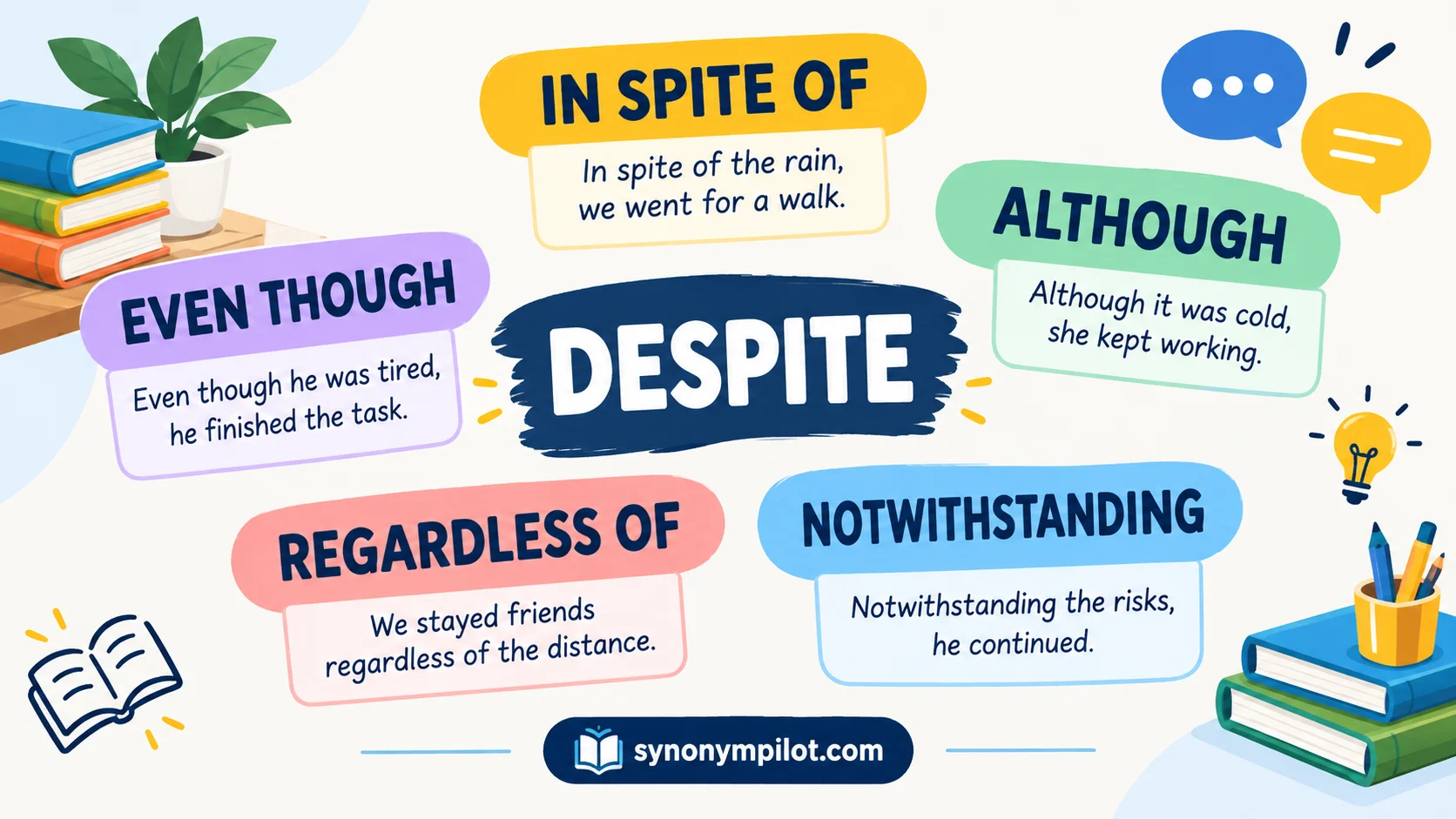
Imagine telling a friend, “Despite the rain, we went for a walk.”
You could express the same idea differently: “In spite of the rain, we went for a walk.” Both sentences show that the rain did not stop you from going outside.
Now consider a workplace example: “Despite the delay, the team completed the project on time.” In a formal report, you might write, “Notwithstanding the delay, the team completed the project on time.”
These sentences communicate a similar idea, but their wording and tone differ.
Learning synonyms for despite helps you avoid repetition, write more naturally, and express contrast clearly. However, not every alternative fits every sentence. Some expressions require a noun, while others introduce a complete clause with a subject and verb.
In this guide, you will learn the meanings, examples, grammatical differences, and best alternatives for despite, along with useful expressions for everyday English, academic writing, and professional communication.
Quick Answer
Despite means “without being affected or prevented by something” or “even though something is true.” Common alternatives include in spite of, regardless of, notwithstanding, even with, and irrespective of. Depending on the sentence, you can also use although, even though, or while to express a similar contrast.
Meaning, Tone & Context
Despite is a preposition that means something happens or remains true even when another situation might have prevented it.
For example:
- Despite the cold, we played outside.
- She passed the exam despite her nervousness.
- Despite working long hours, he remained cheerful.
In each sentence, it introduces a difficulty, condition, or unexpected circumstance. The main action happens anyway.
Tone and formality
Despite is neutral and works in formal, academic, professional, and conversational English. It often sounds slightly more polished than in spite of, although both expressions are natural.
For example:
- Conversational: “Despite being tired, I went shopping.”
- Professional: “Despite the technical difficulties, the presentation continued.”
- Academic: “Despite these limitations, the study provides useful findings.”
Grammar rules
Use despite before a noun, pronoun, or gerund (the -ing form of a verb).
- Despite the weather, we continued.
- Despite her, he remained calm.
- Despite feeling tired, she kept studying.
You can also use the phrase despite the fact that before a complete clause.
– Despite the fact that it was raining, we continued walking.
However, do not write “despite the rain.” The correct forms are despite the rain and in spite of the rain.
When & How to Use “Despite”
Use despite when you want to show that one situation did not prevent another from happening.
1. Describing an unexpected result
Despite the heavy traffic, we arrived on time.
The traffic might have caused a delay, but it did not.
2. Talking about difficulties
Despite facing several challenges, she completed her degree.
Here, the difficulties did not stop her progress.
3. Describing contrasting qualities
Despite his young age, he manages the business confidently.
The sentence highlights a contrast between his age and his responsibilities.
4. Writing professional or academic sentences
Despite the limited budget, the organization expanded its services.
This construction is useful when discussing obstacles, limitations, results, and achievements.
5. Using “despite the fact that”
Despite the fact that the task was difficult, everyone completed it.
This expression introduces a complete clause. However, it is often more concise to write:
Although the task was difficult, everyone completed it.
Another Word for Despite
The closest direct alternative is in spite of. Both expressions usually have the same meaning and follow the same grammatical pattern.
Other useful alternatives include:
- Regardless of not allowing something to influence a decision or outcome.
- Notwithstanding a formal alternative meaning despite.
- Irrespective of without considering a particular factor.
- Even with despite having or experiencing something.
- Although introduces a contrasting clause.
- Even though emphasizes a contrast between two facts.
- While introduces a contrast in suitable sentences.
For example:
- Despite the rain, we played.
- In spite of the rain, we played.
- Although it was raining, we played.
All three sentences communicate a similar idea, but their grammatical structures differ.
When Not to Use This Word
Although it is versatile, it does not fit every situation.
1. When you want to explain a reason
Use because of or due to when something happens as a result of a cause.
- Despite the rain, we stayed home.
- Because of the rain, we stayed home.
The first sentence emphasizes contrast, while the second gives a reason.
2. Before a complete clause without “the fact that”
Do not write:
“Despite it being raining, we went out.”
Instead, write:
- Despite the rain, we went out.
- Despite the fact that it was raining, we went out.
- Although it was raining, we went out.
3. When a shorter alternative sounds clearer
Although “despite the fact that” is correct, it can make a sentence unnecessarily long. In many cases, although or even though communicates the same idea more directly.
Words Commonly Confused With Despite
In spite of: The closest equivalent. It follows the same grammatical pattern as despite.
Although: Introduces a clause containing a subject and verb.
Even though: Similar to although, but often emphasizes the contrast more strongly.
Regardless of: Emphasizes that something does not affect a decision, action, or outcome.
Nevertheless: A linking adverb meaning “despite that” or “even so.” It connects ideas rather than functioning like the preposition despite.
Because of: Expresses a reason rather than a contrast. It is not a synonym, but learners sometimes confuse the two.
Best Synonym by Context
| Context | Best Alternative | Example |
| Everyday English | In spite of | In spite of the rain, we went out. |
| Formal writing | Notwithstanding | Notwithstanding the delay, work continued. |
| Academic writing | Although | Although the sample was small, the results were useful. |
| Professional communication | Despite | Despite the setback, we met our target. |
| Ignoring a condition | Regardless of | Everyone may apply regardless of experience. |
| Emphasizing a contrast | Even though | Even though she was tired, she continued. |
| Concise writing | Despite | Despite the cost, they purchased it. |
| Connecting two sentences | Nevertheless | The task was difficult. Nevertheless, we finished it. |
| Explaining a cause | Because of | Because of the rain, the match was canceled. |
| Expressing a concession | Even with | Even with limited resources, they succeeded. |
Which Synonym Should You Choose?
The best alternative depends on your sentence structure and intended meaning.
- Choose in spite of when you want a direct replacement for despite.
- Choose although when the next part contains a subject and verb.
- Choose even though to give the contrast extra emphasis.
- Choose regardless of when a factor should not influence a decision.
- Choose notwithstanding for a formal or legal tone.
- Choose nevertheless when connecting two contrasting statements.
- Choose because of when you want to explain why something happened, not express contrast.
For example, “Despite the cost, she bought it” and “Regardless of the cost, she bought it” are similar. However, the first highlights a difficulty, while the second emphasizes that cost did not affect her decision.
Real-Life Examples of “Despite” in Sentences
School
Despite studying hard, Amir did not pass the exam.
The sentence shows that his effort did not lead to the expected result.
Workplace
Despite the tight deadline, our team delivered the project on time.
Here, despite introduces a challenge that did not prevent success.
Writing
Despite its simple design, the website offers many useful features.
This sentence highlights a contrast between simplicity and functionality.
Conversation
Despite being tired, I stayed up to watch the movie.
This is a natural way to explain why you did something even when you had a reason not to.
50 Synonyms and Context-Based Alternatives for Despite
The following table includes direct equivalents, close alternatives, and useful sentence-level replacements. Some require a different grammatical structure, so they are not interchangeable in every sentence.
| Synonym or Alternative | Simple Meaning | Example Sentence |
| In spite of | Without being prevented by | In spite of the rain, we played. |
| Regardless of | Without considering | She applied regardless of her age. |
| Notwithstanding | Despite; in spite of | Notwithstanding the risks, they proceeded. |
| Irrespective of | Without regard to | The rule applies irrespective of income. |
| Even with | Despite having or experiencing | Even with help, the task was difficult. |
| Even in the face of | Despite confronting | They remained hopeful even in the face of adversity. |
| In the face of | When confronted by | In the face of criticism, she stayed calm. |
| Against the backdrop of | Despite or amid a wider situation | Against the backdrop of uncertainty, sales increased. |
| Against all odds | Despite very low chances | Against all odds, the team won. |
| Come what may | Whatever happens | Come what may, we will finish the work. |
| Although | Despite the fact that | Although it was late, we continued. |
| Even though | Despite the fact that; with emphasis | Even though he was ill, he attended. |
| Though | Although; despite the fact that | Though tired, she kept working. |
| While | Although; in contrast | While the plan was risky, it succeeded. |
| Whereas | While; in contrast | Whereas costs rose, demand remained steady. |
| Even if | If or not a condition occurs | Even if it rains, we will go. |
| For all | Despite; considering | For all his experience, he made mistakes. |
| With all | Despite having or being | With all her talent, she remained humble. |
| Despite the fact that | Although something is true | Despite the fact that it was cold, we swam. |
| In spite of the fact that | Although something is true | In spite of the fact that he apologized, she left. |
| Regardless | Despite that; anyway | The route was difficult. We went regardless. |
| All the same | Despite that | It was expensive. I bought it all the same. |
| Nevertheless | Despite that | The task was hard; nevertheless, we finished. |
| Nonetheless | In spite of that | The evidence was limited; nonetheless, it helped. |
| Even so | Despite what was just said | It was raining. Even so, we went out. |
| Still | Despite that; nevertheless | She was exhausted. Still, she continued. |
| Yet | Nevertheless; but | The plan was risky, yet it worked. |
| However | Despite that; in contrast | The road was busy. However, we arrived early. |
| All the same | Even so | I disagreed, but I respected her choice all the same. |
| Be that as it may | Even if that is true | Be that as it may, we must continue. |
| That said | Despite the previous point | The phone is expensive. That said, it works well. |
| Having said that | Despite what was just mentioned | The task was difficult. Having said that, it was worthwhile. |
| At the same time | While acknowledging a contrast | The plan is costly. At the same time, it may save time. |
| Even then | Despite that situation | He had little time. Even then, he helped us. |
| For all that | Despite everything mentioned | For all that, she remained optimistic. |
| In any event | Whatever happens; regardless | In any event, we need a backup plan. |
| Either way | Regardless of which possibility | Either way, we must make a decision. |
| Come what may | Regardless of what happens | Come what may, I will support you. |
| No matter what | Regardless of circumstances | No matter what happens, stay calm. |
| No matter how | Regardless of degree or manner | No matter how tired she felt, she studied. |
| Whatever the circumstances | Regardless of the situation | Whatever the circumstances, remain respectful. |
| Whatever the case | Regardless of the facts or situation | Whatever the case, we should investigate. |
| In any case | Regardless; whatever happens | In any case, the meeting starts at nine. |
| Despite everything | In spite of all difficulties | Despite everything, they stayed together. |
| In defiance of | In deliberate opposition to | In defiance of the warning, he continued. |
| Against | Contrary to or in opposition to | Against expectations, the small team won. |
| Contrary to | Opposite to what was expected | Contrary to predictions, profits increased. |
| Not deterred by | Not discouraged or stopped by | Not deterred by failure, she tried again. |
| Unfazed by | Not troubled or affected by | He remained unfazed by the criticism. |
Important: Some entries, such as nevertheless, however, and that said, connect ideas rather than replace despite directly. Others, such as in defiance of, suggest deliberate opposition. Choose an alternative that preserves the original meaning.
Synonym Groups & Usage Differences
Formal and Academic Alternatives
In academic writing, although, notwithstanding, irrespective of, despite the fact that, and regardless of can help express contrast precisely.
For example:
“Although the sample was small, the results were consistent.”
This sounds natural in a research paper. Meanwhile, notwithstanding is more formal and can feel unnecessarily stiff in everyday writing.
Professional Alternatives
In reports, presentations, and workplace emails, despite, regardless of, and even with are useful choices.
For example:
“Despite the budget limitations, the team completed the project.”
For a sentence emphasizing a policy or decision, regardless of may fit better:
“All applications will be reviewed regardless of background.”
Conversational Alternatives
In everyday speech, people commonly use in spite of, even though, though, even so, still, and all the same.
For example:
“Even though I was tired, I went out.”
Or:
“I was tired. I went out all the same.”
These expressions sound natural and are easy to understand.
Stronger and Weaker Expressions
Some alternatives add emphasis or a particular attitude.
- Even though it emphasizes a contrast.
- Against all odds highlights an unlikely success.
- In defiance suggests deliberate resistance.
- Notwithstanding, it sounds formal rather than emotionally stronger.
- Even with often presents a condition or limitation.
Therefore, choose based on meaning rather than simply trying to sound more advanced.
Neutral and Formal Expressions
Despite and in spite of are generally neutral. Regardless emphasizes independence from a factor, while notwithstanding often appears in formal, legal, or official writing.
There is no need to force slang into this topic. Most natural alternatives for despite are standard English expressions rather than slang.
Antonyms of Despite
Despite does not have a perfect one-word antonym because it expresses a relationship between ideas. However, phrases that express a cause or a reason can provide the opposite relationship in suitable sentences.
| Antonym or Contrast | Meaning | Example |
| Because of | As a result of | Because of the rain, we stayed home. |
| Due to | Caused by | The delay was due to bad weather. |
| Owing to | Because of | Owing to illness, she missed class. |
| Thanks to | Because of, often positively | Thanks to your help, we finished early. |
| As a result of | Because something happened | As a result of the storm, roads closed. |
| On account of | Because of | On account of the delay, we rescheduled. |
| As a consequence of | As a result of | As a consequence of the error, costs increased. |
Compare these sentences:
- Despite the rain, we went outside.
- Because of the rain, we stayed inside.
The first expresses contrast; the second gives a reason.
Comparison Section
Despite vs. In Spite Of
Meaning: Both usually mean the same thing.
Tone: Both sound neutral. Despite is slightly more concise.
Emotional intensity: Neither is inherently stronger.
Formality: Both work in formal and informal writing.
Usage: Use either before a noun or gerund.
Example: “Despite the noise, I slept.” / “In spite of the noise, I slept.”
Despite vs. Although
Meaning: Both express contrast.
Tone: Both are neutral and widely used.
Emotional intensity: Neither is inherently stronger.
Formality: Both suit academic and everyday English.
Usage: Despite takes a noun or gerund; although introduces a clause.
Example: “Despite the rain, we left.” / “Although it was raining, we left.”
Despite vs. Regardless Of
Meaning: Despite highlighting a difficulty or contrasting fact. Regardless of emphasis, a factor does not affect a decision or outcome.
Tone: Both are neutral.
Emotional intensity: Neither is necessarily stronger.
Formality: Both work in professional writing.
Usage: Choose regardless of when the factor should not influence the result.
Example: “Regardless of the cost, we will proceed.”
Despite vs. Nevertheless
Meaning: Both can express contrast, but their grammar differs.
Tone: Nevertheless often sounds more formal or deliberate.
Emotional intensity: Neither is inherently stronger.
Formality: Both appear in formal writing.
Usage: Nevertheless connects statements or clauses; despite introduces a contrasting circumstance.
Example: “The task was difficult. Nevertheless, we finished.”
Despite vs. Because Of
Meaning: Despite expresses contrast; because of expresses cause.
Tone: Both are neutral.
Emotional intensity: Neither is stronger.
Formality: Both suit everyday and professional writing.
Usage: Use despite when something happens anyway; use because of when something happens as a result.
Example: “Despite the rain, we played.” / “Because of the rain, we canceled the game.”
Common Phrases & Expressions
“Despite the fact that”
Meaning: Although something is true.
Example: “Despite the fact that he was nervous, he gave an excellent speech.”
“In spite of everything”
Meaning: Even after facing many difficulties.
Example: “In spite of everything, they remained hopeful.”
“Regardless of the circumstances”
Meaning: Without allowing the situation to change your decision or behavior.
Example: “Regardless of the circumstances, treat everyone fairly.”
“Against all odds”
Meaning: Despite very low chances of success.
Example: “Against all odds, the team reached the final.”
“Even in the face of”
Meaning: Despite having to confront a difficult situation.
Example: “She remained confident even in the face of criticism.”
“Notwithstanding the fact that”
Meaning: Despite the fact that; a formal expression.
Example: “Notwithstanding the fact that funds were limited, the project continued.”
“Despite all efforts”
Meaning: Even though people tried hard to achieve something.
Example: “Despite all efforts, the team could not meet the deadline.”
Common Mistakes to Avoid
- Writing “despite of.” Write despite the rain or in spite of the rain.
- Using despite before a clause. Write despite the delay or although we were delayed.
- Confusing contrast with cause. Despite means something happens anyway; because it explains why it happens.
- Using nevertheless as a direct preposition. Write “Despite the rain, we left” or “It rained. Nevertheless, we left.”
- Overusing “despite the fact that.” In many sentences, although it is shorter and clearer.
- Assuming every alternative has exactly the same meaning. In defiance suggests resistance, while regardless of emphasizes that something does not affect a decision.
FAQs
What is the best synonym for despite?
In spite of is the closest direct synonym. Other choices, such as although and regardless of, can work depending on the sentence structure and intended meaning.
Can I use although instead of despite?
Yes, but you may need to change the sentence. Write “Despite the rain, we went out” or “Although it was raining, we went out.”
Is it formal or informal?
Despite being neutral. It works in everyday conversation, academic writing, business communication, and formal documents.
What is the difference between despite and regardless of?
Despite emphasizes a contrast between a circumstance and an outcome. Regardless of emphasis, a particular factor does not influence a decision or result.
What is the opposite of despite?
There is no exact one-word opposite. Expressions such as because of, due to, and owing to can express a contrasting cause-and-effect relationship.
Conclusion
Learning synonyms for despite can make your English clearer, more natural, and more flexible. Start with in spite of, the closest direct alternative, and then practice using although, even though, and regardless of in different sentence structures.
For formal writing, notwithstanding may be useful, while nevertheless helps connect contrasting statements. However, remember that these expressions do not all work in the same grammatical position.
Some introduce nouns or gerunds, while others require a complete clause or connect two sentences. As you read articles, write emails, or speak with others, notice how these expressions show contrast.