Imagine your friend asks, “How was your exam?” You might reply, “It was extremely difficult.” However, you could also say, “It was incredibly difficult,” “It was exceptionally challenging,” or simply, “It was really hard.”
These sentences express similar ideas, but each word creates a slightly different tone.
The word extremely appears frequently in everyday conversations, school assignments, professional emails, and academic writing. It helps you describe strong feelings, difficult situations, impressive achievements, and unusual conditions. However, using the same intensifier repeatedly can make your writing sound repetitive.
Learning suitable alternatives gives you more ways to express yourself clearly. For example, deeply concerned sounds natural when discussing feelings, while severely damaged describes serious physical harm. Similarly, absolutely certain expresses confidence more naturally than many other combinations.
In this guide, you will learn 50 useful alternatives, their meanings, example sentences, antonyms, common expressions, and differences in tone and usage. You will also discover how to choose the right word for conversations, schoolwork, professional communication, and everyday writing.
Quick Answer:
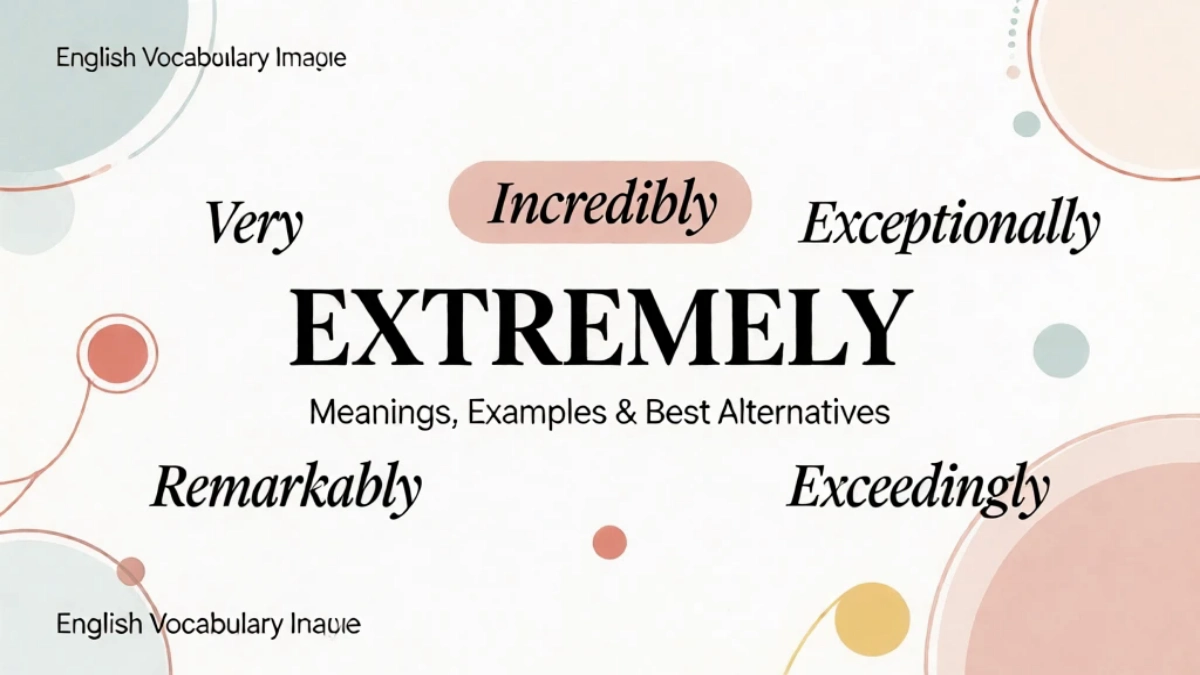
Extremely means to a very high degree or to an unusually great extent. Common synonyms include very, incredibly, exceptionally, remarkably, and exceedingly. The best alternative depends on the context, tone, and word you want to emphasize.
Meaning, Tone & Context
Extremely is an adverb of degree. It modifies adjectives and other adverbs to show that a quality or action exists to a very high degree.
Consider these examples:
- The weather is extremely hot.
- She is extremely talented.
- He finished the task extremely quickly.
- We are extremely grateful for your support.
In each sentence, it extremely strengthens the description that follows it.
Tone and formality
The word works in both formal and informal English. However, some alternatives sound more natural in specific situations.
| Context | Example |
| Everyday conversation | I’m really tired. |
| Academic writing | The results were significantly different. |
| Professional communication | She is highly qualified. |
| Emotional expression | I am deeply disappointed. |
| Formal writing | The issue is exceedingly complex. |
For example, it really sounds conversational, while exceedingly sounds more formal. Meanwhile, deeply often emphasizes emotions, and significantly frequently describes meaningful differences or changes.
When & How to Use “Extremely”
Use extremely when you want to emphasize a strong quality, condition, feeling, or action.
1. To describe a strong quality
Extremely works well with adjectives that describe difficulty, temperature, importance, size, or ability.
- The instructions were extremely clear.
- This road becomes extremely dangerous during heavy rain.
- The project is extremely important to our team.
2. To express strong feelings
You can use extremes to describe emotions, although another adverb may sometimes sound more natural.
- She was extremely happy with her results.
- I felt extremely nervous before the interview.
- They were extremely disappointed by the decision.
For a more specific meaning, consider deeply disappointed, bitterly upset, or intensely nervous.
3. To describe how an action happens
Extremely can also modify another adverb.
- The train was moving extremely slowly.
- She answered the questions extremely confidently.
- He handled the situation extremely well.
However, a more precise word can sometimes communicate your meaning better. For instance, rapidly may replace extremely quickly, while brilliantly may replace extremely well when describing an impressive performance.
Another Word for Extremely
The best alternative depends on what you want to emphasize.
| Meaning or situation | Alternative | Example |
| A high degree | Very | The room is very warm. |
| Strong conversational emphasis | Really | I’m really pleased with the news. |
| Something surprising | Incredibly | The view was incredibly beautiful. |
| An unusually high standard | Exceptionally | She is exceptionally skilled. |
| A noticeable quality | Remarkably | He recovered remarkably quickly. |
| Strong feelings | Deeply | We are deeply concerned. |
| A complete state | Utterly | The explanation was utterly confusing. |
| Serious damage | Severely | The building was severely damaged. |
| Strong certainty | Absolutely | I am absolutely certain. |
Remember that these alternatives are not interchangeable in every sentence. For example, severely injured is natural, whereas deeply injured usually suggests emotional harm.
When Not to Use This Word
Although extremely useful, excessive emphasis can weaken your writing.
Avoid unnecessary intensifiers. Instead of writing “The result was extremely amazing,” choose “The result was amazing” or “The result was extraordinary.”
Avoid exaggeration in professional writing. Rather than calling every problem extremely serious, describe its actual consequences or use a precise term such as critical when appropriate.
Check common word combinations. English speakers naturally say deeply grateful, severely damaged, and absolutely certain. However, severely grateful sounds unnatural.
Avoid repeating the same word. If several sentences contain extremes, vary your language with suitable alternatives. Sometimes, removing the intensifier altogether makes the sentence clearer.
Words Commonly Confused With Extremely
Several words express a high degree, but their meanings differ.
- Very: A common, neutral intensifier. Example: “The room is very cold.”
- Too: Means more than is desirable or acceptable. Example: “The bag is too heavy to carry.”
- Highly: Often emphasizes ability, achievement, or evaluation. Example: “She is highly qualified.”
- Absolutely: Emphasizes completeness or certainty. Example: “I am absolutely certain.”
- Exceptionally: Suggests an unusually high degree or a quality beyond the norm.
- Quite: Can mean fairly or very, depending on context and variety of English.
- Really: Often emphasizes a quality in conversational English. Example: “That was really helpful.”
Notice that too does not simply mean extremely. If you say, “The coffee is too hot,” you usually mean its temperature is higher than you want. In contrast, “The coffee is extremely hot” describes its high temperature without necessarily suggesting a problem.
| Context | Best alternative | Example |
| Everyday speech | Really | I’m really pleased with the news. |
| Formal writing | Exceedingly | The instructions were exceedingly clear. |
| Academic writing | Significantly | The results differed significantly. |
| Professional praise | Exceptionally | She delivered exceptionally strong work. |
| Emotional concern | Deeply | We are deeply concerned about the delay. |
| Physical damage | Severely | The storm severely damaged the roof. |
| Surprise | Incredibly | The view was incredibly beautiful. |
| Complete failure | Utterly | The plan was utterly unsuccessful. |
| Strong certainty | Absolutely | I am absolutely certain. |
| Unusual performance | Remarkably | The student performed remarkably well. |
Best Synonym by Context
Use this table to select a natural alternative for different situations.
Some words have specific uses. For example, significantly often describes meaningful differences, especially in research or statistics. Likewise, absolutely works naturally with certain, essential, and impossible, but it does not fit every adjective.
Which Synonym Should You Choose?
Follow these guidelines to select the right word.
- Choose very for a simple, neutral alternative.
- Choose really for natural, conversational English.
- Choose incredibly when expressing surprise or strong emphasis.
- Choose exceptionally when something stands out from the usual standard.
- Choose deeply when describing strong feelings or attitudes.
- Choose severely when describing serious damage, injury, or restrictions.
- Choose utterly when emphasizing a complete state, especially in negative descriptions.
- Choose absolutely when emphasizing certainty or completeness.
- Choose remarkably when a result or quality deserves special attention.
The most important rule is to learn common word combinations. For instance, highly effective, deeply concerned, severely injured, and utterly ridiculous sound natural because English speakers commonly use these combinations.
Real-Life Examples of “Extremely” in Sentences
School
- The science experiment was extremely interesting.
- Our teacher explained the topic remarkably clearly.
- The final examination was exceptionally difficult.
Workplace
- We are extremely grateful for your support.
- The new system is highly effective.
- The deadline is critically important to the project.
Writing
- The evidence was remarkably convincing.
- The results were significantly different from our predictions.
- The author presents an exceptionally detailed argument.
Conversation
- I’m really excited about the trip.
- That restaurant is incredibly popular.
- The weather is absolutely freezing.
These examples show how context affects word choice. In casual speech, really often works well. In academic writing, significantly may be more precise when discussing measured differences.
Synonyms and Contextual Alternatives for “Extremely”
| Synonym | Simple Meaning | Example Sentence |
|---|---|---|
| 1. Very | To a high degree | The water is very cold. |
| 2. Really | To a strong degree; informal | I’m really happy with the result. |
| 3. Incredibly | To a surprising degree | The mountain view was incredibly beautiful. |
| 4. Exceptionally | To an unusually high degree | She is exceptionally talented. |
| 5. Exceedingly | To a very high degree; formal | The instructions were exceedingly clear. |
| 6. Remarkably | To a noticeable or unusual degree | He recovered remarkably quickly. |
| 7. Extraordinarily | To an unusual or exceptional degree | The building is extraordinarily tall. |
| 8. Unusually | More than is normal | It was unusually quiet today. |
| 9. Particularly | To a notable degree; especially | This chapter is particularly useful. |
| 10. Especially | More than usual or more than others | The advice was especially helpful. |
| 11. Highly | To a great degree | She is highly skilled. |
| 12. Immensely | To a very great degree | We enjoyed the trip immensely. |
| 13. Enormously | To a very large degree | The support helped enormously. |
| 14. Tremendously | To a very great degree | Her confidence improved tremendously. |
| 15. Hugely | To a very large degree; informal | The campaign was hugely successful. |
| 16. Massively | On a very large scale | The company massively expanded its operations. |
| 17. Profoundly | In a deep or powerful way | The experience profoundly changed her outlook. |
| 18. Deeply | Strongly, especially emotionally | He was deeply disappointed. |
| 19. Intensely | With great strength | She felt intensely nervous. |
| 20. Strongly | With great force or conviction | I strongly disagree with that decision. |
| 21. Severely | To a serious or harsh degree | The storm severely damaged the roof. |
| 22. Seriously | To a significant or concerning degree | The patient was seriously ill. |
| 23. Acutely | Very strongly or sharply | She was acutely aware of the risk. |
| 24. Bitterly | With intense sadness, anger, or resentment | He was bitterly disappointed. |
| 25. Desperately | With an urgent or extreme need | They desperately needed help. |
| 26. Utterly | Completely, often with strong emphasis | The instructions were utterly confusing. |
| 27. Absolutely | Completely or without doubt | I am absolutely certain. |
| 28. Completely | Fully or in every respect | The room was completely silent. |
| 29. Entirely | Wholly or fully | The decision was entirely unexpected. |
| 30. Totally | Completely; common in conversation | I totally agree with you. |
| 31. Thoroughly | Completely or in every detail | We were thoroughly impressed. |
| 32. Downright | Clearly and emphatically; often negative | His behavior was downright rude. |
| 33. Flat-out | Directly or completely; informal | That claim is flat-out wrong. |
| 34. Outright | Completely or openly | The proposal was an outright failure. |
| 35. Astonishingly | To a degree that causes great surprise | The team worked astonishingly quickly. |
| 36. Amazingly | To a surprising or impressive degree | She performed amazingly well. |
| 37. Unbelievably | To a degree that seems hard to believe | The tickets were unbelievably expensive. |
| 38. Phenomenally | To an extraordinary degree | The business grew phenomenally fast. |
| 39. Fantastically | To an extremely impressive degree | The team played fantastically well. |
| 40. Strikingly | In a very noticeable way | The two designs are strikingly similar. |
| 41. Markedly | To a clearly noticeable degree | Her writing improved markedly. |
| 42. Notably | To a degree worth noticing | The second version is notably better. |
| 43. Significantly | To a meaningful or considerable degree | The costs increased significantly. |
| 44. Considerably | By a substantial amount | The journey was considerably shorter. |
| 45. Substantially | To a large or important degree | The new policy substantially reduced waste. |
| 46. Outrageously | To an excessive or shocking degree | The hotel charged outrageously high prices. |
| 47. Ridiculously | To an unreasonable or surprising degree | This bag is ridiculously expensive. |
| 48. amazingly | To an extraordinary degree; informal | The roller coaster was amazingly fast. |
| 49. Terribly | Very much, often with negative feelings | I’m terribly sorry for the delay. |
| 50. Awfully | Very; often informal | It’s awfully kind of you to help. |
Synonym Groups & Usage Differences
Formal and academic alternatives
Words such as exceedingly, extraordinarily, markedly, significantly, and substantially can suit formal or academic writing. However, their meanings differ. Use significantly for a meaningful difference and substantially for a considerable amount or change.
Example: “The new method significantly improved the results.”
Professional alternatives
In workplace communication, highly, exceptionally, considerably, and deeply often sound appropriate.
- The candidate is highly qualified.
- We are deeply grateful for your assistance.
- The new process is considerably more efficient.
For professional writing, a precise description often sounds stronger than an exaggerated intensifier.
Conversational and informal alternatives
Really, totally, hugely, flat-out, ridiculously, and ferociously appear in casual speech. They make sentences sound relaxed, emphatic, or playful.
Example: “That concert was ferociously good!”
However, avoid slang-heavy expressions in formal reports, academic assignments, and sensitive professional messages.
Stronger and weaker alternatives
The strength of an intensifier depends on the adjective and situation. Very usually sounds neutral, while utterly emphasizes completeness and unbelievably suggests surprise.
Compare these sentences:
- The test was very difficult.
- The test was incredibly difficult.
- The test was unbelievably difficult.
The last two communicate stronger emphasis or a greater sense of surprise.
Emotional and neutral alternatives
Some alternatives highlight feelings rather than degree alone. Deeply, bitterly, profoundly, and intensely often express emotional or psychological strength.
For example, “She was deeply hurt” emphasizes emotional pain. By contrast, “The room was extremely cold” describes a physical condition without necessarily expressing emotion.
Slang and exaggerated expressions
ferociously, ridiculously, and flat-out can sound emphatic or informal. They often exaggerate for effect rather than provide a precise measurement.
Example: “The phone is ridiculously expensive.”
Use these expressions when the audience and tone suit them. They are less appropriate in formal academic writing.
Antonyms of Extremely
Because extremely expresses a high degree, its opposites often communicate a low degree or limited intensity. The most suitable opposite depends on the sentence.
| Antonym | Meaning | Example |
| Slightly | By a small amount | The room is slightly warmer today. |
| Somewhat | To a limited degree | The task is somewhat difficult. |
| A little | By a small degree | I’m a little tired. |
| Moderately | To an average or limited degree | The test was moderately challenging. |
| Fairly | To a reasonable degree | The weather is fairly pleasant. |
| Relatively | Compared with something else | This exercise is relatively easy. |
| Mildly | To a small or gentle degree | She was mildly surprised. |
| Barely | Only just; almost not | I could barely hear him. |
| Hardly | Almost not at all | The room was hardly warm. |
| Minimally | To the smallest necessary degree | The change minimally affected the results. |
Strictly speaking, these are not direct antonyms in every context. They reduce the degree of a description, while barely and hardly can suggest that something almost does not happen or exist.
Comparison: Extremely vs. Similar Words
Extremely vs. Very
Both words emphasize adjectives and adverbs. However, very is the more common, neutral choice, while extremely often suggests a particularly high degree.
- The room is very cold.
- The room is extremely cold.
The second sentence emphasizes the cold more strongly.
Extremely vs. Incredibly
Incredibly often adds surprise or admiration. It is especially natural when describing impressive results, unusual qualities, or surprising experiences.
- She is extremely talented.
- She is incredibly talented.
Both are correct, but incredibly can sound more expressive.
Extremely vs. Exceptionally
Exceptionally highlights something that goes beyond the usual standard. It often suits ability, performance, quality, or unusual conditions.
- He is extremely good at mathematics.
- He is exceptionally good at mathematics.
The second sentence more clearly suggests that his ability stands out.
Extremely vs. Absolutely
Absolutely emphasizes completeness, certainty, or a strong judgment. It works naturally with words such as certain, essential, and impossible.
- I am absolutely certain.
- The task is extremely difficult.
You can say extremely certain in some contexts, but absolutely certain is the more natural expression.
Extremely vs. Too
Too usually indicates an undesirable or excessive degree. In contrast, extremely emphasizes a high degree without necessarily judging it negatively.
- The coffee is extremely hot.
- The coffee is too hot to drink.
The second sentence suggests that the temperature prevents you from drinking the coffee comfortably.
Extremely vs. Highly
Highly often emphasizes evaluation, ability, probability, or degree within a familiar word combination.
- She is highly respected.
- The system is highly effective.
Although extremely respected is grammatically possible in some contexts, highly respected sounds more natural in standard English.
Common Phrases & Expressions With Extremely
Extremely important
Meaning: Having very great importance.
Example: “It is extremely important to save your work before closing the program.”
Extremely difficult
Meaning: Very hard to complete, understand, or manage.
Example: “The final question was extremely difficult, so I spent extra time on it.”
Extremely grateful
Meaning: Feeling a great deal of gratitude.
Example: “I am extremely grateful for your help with my application.”
Extremely happy
Meaning: Feeling a very high degree of happiness.
Example: “Her family was extremely happy when she passed the examination.”
Extremely rare
Meaning: Uncommon to a very high degree.
Example: “This bird is extremely rare in our region.”
Extremely well
Meaning: To a very high standard or with great success.
Example: “The students performed extremely well in the competition.”
Extremely close
Meaning: Very near in distance or having a strong relationship.
Example: “The two friends are extremely close.”
Extremely useful
Meaning: Providing a great deal of practical help or value.
Example: “This dictionary is extremely useful for English learners.”
Common Mistakes to Avoid
1. Treating every synonym as interchangeable. You can say deeply concerned and severely injured, but switching the adverbs may sound unnatural.
2. Confusing extremely with too. Extremely describes a high degree, whereas too often indicates more than is wanted or acceptable.
3. Overusing intensifiers. Repeating extremely in every paragraph makes writing less varied. Choose precise adjectives and stronger verbs where appropriate.
4. Using informal words in formal writing. Expressions such as ferociously good and ridiculously cheap work in casual conversation but may not suit an academic report.
5. Combining words unnaturally. English has familiar word combinations, including highly effective, deeply grateful, severely damaged, and absolutely essential. Learn these combinations as complete phrases.
6. Adding an intensifier when it contributes little. “The result was perfect” is often clearer than “The result was extremely perfect.” In standard usage, perfect already expresses completeness.
FAQs About Synonyms for Extremely
1. What is the best synonym for extremely?
Very is the simplest general alternative. However, incredibly, exceptionally, remarkably, and exceedingly may fit better when you want stronger emphasis or a more specific tone.
2. What is a stronger word than extremely?
There is no single strongest word for every context. Utterly emphasizes completeness, unbelievably conveys surprise, and phenomenally suggests an extraordinary degree. Choose according to the adjective you want to modify.
3. Is “highly” a synonym for “extremely”?
Sometimes. Highly works naturally with words such as effective, skilled, qualified, and successful. Nevertheless, it does not replace extremely in every sentence.
4. What is a formal word for extremely?
Exceedingly and extraordinarily are useful formal alternatives. Depending on the context, significantly, substantially, and markedly may also work, especially when discussing measurable changes or differences.
5. What is the opposite of extremely?
There is no single opposite that works in every sentence. Words such as slightly, somewhat, mildly, and moderately express lower degrees. Meanwhile, barely and hardly suggest that something almost does not happen or exist.
Conclusion
Learning synonyms for extreme helps you express ideas with greater accuracy and variety. Although very and really work well in everyday conversation, alternatives such as incredibly,
exceptionally, deeply, and remarkably allow you to communicate more specific meanings. For professional and academic writing, words such as significantly, substantially, and exceedingly may be more suitable, depending on the context.
However, remember that synonyms do not always have the same tone or meaning. For example, it severely describes serious harm, while deeply often emphasizes strong feelings