A student once handed me an essay that read: “The company was able to sustain its profits, but it could not sustain its employees during the layoffs.” She’d used the same word for two completely different ideas: keeping profits steady over time, and supporting people financially and asked me afterward, “Isn’t that the same thing? Isn’t ‘sustain’ just a fancy word for ‘keep going’?”
Not quite. That question is actually a great entry point into this word, because “sustain” carries two related but distinct senses: maintaining something over time and providing support so something (or someone) doesn’t collapse and knowing which sense you mean determines which synonym actually fits.
Quick Answer
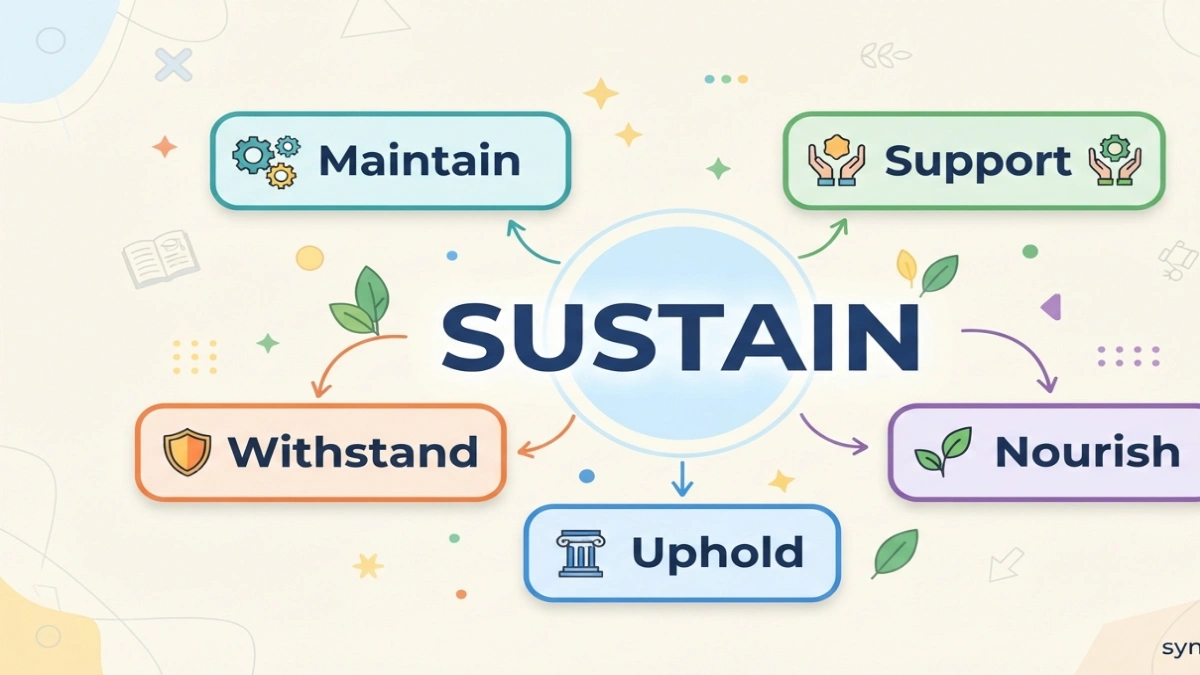
“Sustain” means to keep something going over a period of time, or to provide the support that keeps someone or something from failing or collapsing. Common alternatives include maintain, support, uphold, withstand, and nourish, depending on if you’re talking about a process, a person, a structure, or an injury.
Meaning, Tone & Context
At its core, “sustain” has three overlapping meanings:
- To keep something going or at a certain level The economy sustained steady growth for a decade.
- To provide the physical, emotional, or financial support that keeps something alive or functioning: A small trust fund sustained the family after his death.
- To suffer or undergo something, especially an injury She sustained a fracture during the match.
The tone is fairly formal to neutral. You’ll hear it often in academic writing, legal contexts (a judge “sustains” an objection), medical reports, journalism, and business language. It’s not the word people reach for in casual conversation. Nobody says “I sustained a headache,” they say “I got a headache.” That gap between formal and everyday usage is actually the biggest thing beginners get wrong about this word.
When & How to Use It
- Business/economics: The startup couldn’t sustain its growth rate once funding dried up.
- Legal: The judge sustained the objection. (meaning: upheld it, allowed it to stand)
- Medical/injury: He sustained minor injuries in the accident.
- Environmental: The wetland sustains a wide variety of bird species.
- Emotional/relational: Their friendship was sustained by weekly phone calls, even across time zones.
Another Word for Sustain
The single best all purpose substitute depends on context, but “maintain” is the closest general match when you mean “keep something at a steady level.” “Support” is closest when you mean “keep something from failing.” There isn’t one word that captures all three senses of “sustain” at once which is exactly why this list matters.
When Not to Use This Word
Avoid “sustain” in casual speech or informal writing; it can sound stiff. Don’t say “I sustained a cold”; say “I caught a cold” or “I got a cold.” Also avoid it when you simply mean “endure briefly” “sustain” implies ongoing support or continuation, not a one off moment of toughing something out (that’s closer to “withstand” or “bear”).
Words Commonly Confused With Sustain
- Sustain vs. Maintain “Maintain” is more neutral and everyday; “sustain” often implies effort against pressure or difficulty (sustaining growth despite a downturn).
- Sustain vs. Endure “Endure” is about surviving something difficult, often passively; “sustain” is about actively keeping something going.
- Sustain vs. Sustained (adjective) Students often misuse the participle. “A sustained effort” is correct (an effort kept up over time); “a sustaining effort” changes the meaning entirely, implying the effort itself provides nourishment.
How to Choose the Right Synonym for “Sustain”
Content
If you’re unsure which alternative to use, think about what you’re trying to express.
- If you mean keep something continuing, choose maintain, keep up, or carry on.
- If you mean give support, choose support, bolster, provide for, or nourish.
- If you’re talking about laws or decisions, use uphold, ratify, or sanction.
- If you mean resist pressure, use withstand or bear.
- If you’re referring to injuries or losses, use suffer or incur.
Choosing a synonym based on context makes your writing more natural and prevents awkward word choices.
Best Synonym by Context
| Context | Best Synonym | Why |
| Keeping a process/rate steady | Maintain | Neutral, precise, widely understood |
| Supporting a person financially/emotionally | Support | Direct and warm |
| A structure bearing weight or pressure | Withstand / Bear | Implies physical or figurative load |
| Suffering an injury | Suffer / Incur | Standard in medical and legal writing |
| A legal ruling standing | Uphold | Standard legal usage |
| Providing nourishment | Nourish | Implies life sustaining support, often literal |
Which Synonym Should You Choose?
Ask yourself two questions: Am I talking about a process continuing, or about support preventing collapse? If it’s a process (growth, momentum, a habit), reach for maintain or keep up. Assume it’s support preventing something from failing (a person, a relationship, a structure), reach for support, uphold, or bolster. If you’re describing an injury, use suffer or incur instead “sustain” is technically correct here but very formal, almost clinical.
Different Forms of “Sustain”
The word sustain appears in several grammatical forms.
| Form | Example |
| sustain | Plants sustain life on Earth. |
| sustains | The company sustains steady growth. |
| sustained | She sustained a shoulder injury. |
| sustaining | Healthy habits are sustaining his recovery. |
| sustainable | Solar energy is more sustainable than fossil fuels. |
| sustainability | Sustainability has become a global priority. |
Understanding these forms helps you choose the correct version when speaking or writing.
Everyday Ways to Say “Sustain”
Instead of using the formal word sustain, everyday conversations often use simpler alternatives.
For example:
- keep going
- keep up
- continue
- help
- support
- stick with
- carry on
- get through
Example:
Formal:
The organization sustained its operations.
Natural:
The organization kept operating.
Using simpler words makes casual conversations sound more natural.
Real Life Examples
School: The debate team sustained its winning streak by rehearsing every weekend.
Workplace: Leadership worked hard to sustain morale during the restructuring.
Writing: The novel sustains its tension right up to the final chapter.
Conversation: “Honestly, I don’t know how she sustains that schedule; she’s not seeing her family at all!”
Synonyms Table
| Synonym | Simple Meaning | Example Sentence |
| Maintain | Keep something at the same level | She maintained a calm tone throughout the meeting. |
| Support | Help something/someone keep going | His parents supported him through medical school. |
| Uphold | Keep a standard, decision, or law standing | The court upheld the previous ruling. |
| Withstand | Resist damage or pressure without failing | The bridge was built to withstand strong winds. |
| Bear | Carry weight, physically or emotionally | These columns bear the weight of the entire roof. |
| Nourish | Provide what’s needed to live or grow | The soil nourishes the roots year round. |
| Endure | Continue existing despite difficulty | The tradition has endured for centuries. |
| Preserve | Keep something from being lost or damaged | Efforts to preserve the coral reef are ongoing. |
| Prolong | Make something last longer | Regular maintenance prolongs the machine’s life. |
| Keep up | Continue at the same pace or level (informal) | Can you keep up this pace for another mile? |
| Carry on | Continue, often despite difficulty (informal) | They carried on the family business for three generations. |
| Perpetuate | Keep something (often negative) continuing | The policy perpetuates inequality. |
| Foster | Encourage the growth or development of something | The program fosters creativity in young students. |
| Bolster | Strengthen or support something under strain | New investment bolstered the local economy. |
| Underpin | Form the basis or support of something | Trust underpins every healthy relationship. |
| Prop up | Support something that’s struggling (often informal/critical) | Subsidies are propping up the failing industry. |
| Suffer | Experience something unpleasant, like an injury | She suffered a minor sprain during practice. |
| Incur | Become subject to something as a result of an action | He incurred a fine for late payment. |
| Sanction | Officially approve or allow something to stand | The board sanctioned the new proposal. |
| Ratify | Formally confirm or approve | Congress ratified the treaty. |
| Feed | Provide sustenance, literally or figuratively | Curiosity feeds a lifelong love of learning. |
| Provide for | Supply what’s needed for survival | He works two jobs to provide for his family. |
Synonym Groups & Usage Differences
Formal/legal: uphold, sanction, ratify used in courts, governance, official documents.
Neutral/everyday: maintain, support, keep up safe for most writing and speech.
Physical/structural: withstand, bear, underpin used for weight, pressure, or foundations.
Emotional/relational: nourish, foster, support, provide for used for people and relationships.
Slightly negative connotation: perpetuate, prop up often used critically, implying something shouldn’t be continued (prop up a failing system, perpetuate a stereotype).
Antonyms Table
| Antonym | Meaning | Example |
| Abandon | Give up on completely | They abandoned the project halfway through. |
| Neglect | Fail to give proper care or attention | Years of neglect left the building unsafe. |
| Weaken | Make less strong | The scandal weakened public trust. |
| Collapse | Fail suddenly and completely | The negotiations collapsed within hours. |
| Discontinue | Stop doing or providing something | The airline discontinued the route last year. |
| Undermine | Weaken gradually, often secretly | Constant criticism undermined her confidence. |
Common Collocations with “Sustain”
Certain words naturally appear with sustain.
Some of the most common include:
- sustain growth
- sustain momentum
- sustain pressure
- sustain damage
- sustain injuries
- sustain losses
- sustain attention
- sustain interest
- sustain performance
- sustain relationships
- sustain demand
- sustain success
- sustain effort
- sustain operations
- sustain productivity
Learning these common word combinations makes your English sound more natural.
Examples of “Sustain” in Different Situations
Business
The company struggled to sustain profits during the recession.
Education
Daily reading helps students sustain steady improvement.
Sports
The runner sustained an ankle injury during practice.
Environment
Forests sustain thousands of plant and animal species.
Relationships
Regular communication helps sustain long distance friendships.
Using “Sustain” in Academic and Professional Writing
“Sustain” is common in formal writing because it sounds precise and objective.
Examples include:
- sustain economic growth
- sustain public confidence
- sustain long term development
- sustain innovation
- sustain productivity
In essays, reports, research papers, and business documents, sustain often sounds more appropriate than keep going or carry on.
Comparison Section
Sustain vs. Maintain: Both mean “keep going,” but “sustain” often carries a sense of effort or resistance against pressure (sustain morale during a crisis), while “maintain” is more neutral and mechanical (maintain a database).
Support vs. Sustain: “Support” is broader and more common in everyday speech; “sustain” leans formal and often implies ongoing, structural support rather than a single act of help.
Sustain vs. Endure: “Endure” centers on the subject surviving hardship; “sustain” centers on an external force keeping something alive. A person endures a hard winter; a well sustains a village through it.
Common Phrases & Expressions
- “Sustain a loss” to experience financial or personal loss. The company sustained heavy losses last quarter.
- “Sustain an injury” to be injured. He sustained a knee injury during training.
- “Sustained applause” clapping that continues for an unusually long time. The speech was met with sustained applause.
- “Sustainable development” growth that doesn’t deplete future resources. The city is investing in sustainable development.
- “Objection sustained” a legal phrase meaning a judge agrees with an objection. “Objection, Your Honor.” “Sustained.”
- “Sustain momentum” to keep progress or energy going. It’s hard to sustain momentum after a big win.
Quick Summary of the Best Alternatives
| If you mean… | Best Word |
| Keep going | Maintain |
| Give support | Support |
| Continue | Keep up |
| Resist pressure | Withstand |
| Carry weight | Bear |
| Encourage growth | Foster |
| Strengthen | Bolster |
| Feed or nourish | Nourish |
| Approve legally | Uphold |
| Experience injury | Suffer |
Common Mistakes to Avoid
- Don’t use “sustain” for brief, one time actions (“I sustained the door open” wrong; use held).
- Don’t confuse “sustained” (adjective, meaning continuous) with “sustaining” (present participle, meaning currently providing support) they aren’t interchangeable.
- Avoid using “sustain” in casual speech where “keep up” or “get through” would sound far more natural.
FAQs
Is “sustain” formal or informal?
It leans formal. You’ll see it often in academic, legal, business, and medical writing, but it can sound stiff in casual conversation.
What’s the difference between “sustain” and “sustainable”?
“Sustain” is the verb (to keep something going); “sustainable” is the adjective describing something that can be sustained long term, especially environmentally.
Can “sustain” mean “to injure”?
Yes in formal or medical contexts, “sustain an injury” is standard usage, though “suffer an injury” is slightly more common in everyday speech.
Is “maintain” always a good substitute for “sustain”?
Often, but not always. “Maintain” fits well for processes and levels, but it doesn’t work for injuries (“maintained a fracture” is incorrect) or for legal rulings.
What’s a more casual way to say “sustain”?
“Keep up,” “carry on,” or “get through” all work well in everyday speech, depending on context.
Can “sustain” have different meanings?
Yes. Depending on the context, sustain can mean to keep something going, provide support, experience an injury, or uphold a legal objection. Understanding the sentence helps determine which meaning is intended.
What is the best synonym for “sustain” in business writing?
In business writing, maintain is usually the closest synonym when referring to growth, profits, productivity, or performance. If you’re talking about supporting employees or customers, support is often the better choice.
Is “sustain” a positive or negative word?
Neither. The meaning depends on the context. It can describe positive ideas such as sustaining growth or relationships, but it can also describe negative situations such as sustaining injuries or financial losses.
What is the opposite of “sustain”?
Common opposites include abandon, neglect, discontinue, collapse, undermine, and weaken. The best antonym depends on the sentence.
Can I use “sustain” in everyday conversation?
You can, but native speakers often prefer simpler alternatives like keep up, continue, support, or carry on in casual conversations.
Conclusion
“Sustain” is one of those words that looks simple on the surface but actually asks you to think carefully about what’s really happening in your sentence: is something continuing, or is something being held up by outside support? Once you notice that distinction, choosing between maintain, support, uphold, or withstand becomes much easier, and your writing starts to sound more precise instead of just more formal.
The best way to make these words stick is to use them in real sentences about your own life this week, your workout routine, a friendship, a work project. Try swapping “sustain” for a more specific alternative each time, and notice how the meaning sharpens. That small habit, repeated consistently, is how vocabulary actually grows.