Imagine your teacher says, “Finish your homework after dinner.” You understand that you should complete your homework when dinner ends. However, when writing an essay or explaining a series of events, you may want a different word to avoid repeating after in every sentence.
For example, instead of writing, “After the meeting, we went home,” you could write, “Following the meeting, we went home.” Similarly, “We discussed the problem and afterward created a plan” sounds natural when describing events in order.
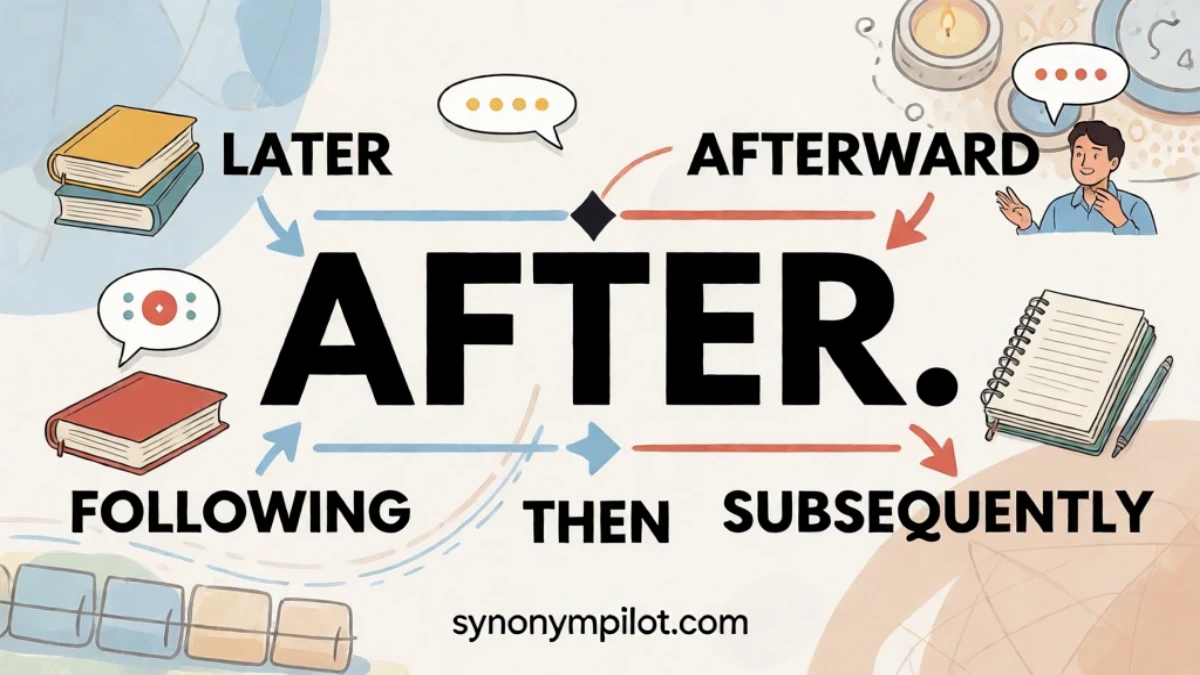
Although these expressions share similar meanings, they do not always work in the same situations. Later emphasizes time, following often introduces something that comes next, and subsequently sounds more formal.
Learning synonyms for after can help you write clearer sentences, connect ideas smoothly, and express the order of events more naturally. This guide explains 50 alternatives, their meanings, and how to use them in everyday English, schoolwork, professional communication, and formal writing.
Quick Answer
After means later than a particular time, event, or action. Depending on the sentence, you can use alternatives such as following, later, afterward, subsequently, next, or thereafter. The best choice depends on whether you describe time, order, a sequence of events, or something that happens as a result.
Meaning, Tone & Context
The word after describes something that happens later than another event, time, or action. It can function as a preposition, conjunction, or adverb.
After as a preposition
A preposition connects a noun or noun phrase to another part of a sentence.
- We went for a walk after lunch.
- She arrived after the meeting.
- Please call me after work.
After as a conjunction
A conjunction connects clauses and explains the order of events.
- After I finished my homework, I watched television.
- We went home after the rain stopped.
After as an adverb
An adverb can describe when something happens without directly introducing a noun.
- He arrived shortly after.
- I met her a few days afterward.
In everyday English, after sounds natural, simple, and conversational. It also works well in professional and academic writing.
However, the best alternative depends on context. For example, following the announcement sounds appropriate in a formal report, while later works better when discussing a future time.
When and How to Use “After”
Use after when you want to explain that one event happens later than another.
1. To describe time
Use after to identify a time that follows another time or event.
Example: “I’ll finish the assignment after lunch.”
You could also say, “I’ll finish the assignment later,” if the exact time is not important.
2. To describe a sequence of actions
When explaining steps or events, after helps readers understand what happens first and what follows.
Example: “After checking the answers, the teacher collected the papers.”
Another option is, “Following the review, the teacher collected the papers.”
3. To describe events in writing
Writers often use afterward, subsequently, or thereafter to connect events without repeating the same word.
Example: “The company introduced a new policy. Subsequently, employee attendance improved.”
Here, subsequently gives the sentence a more formal tone.
4. To describe a period of time
Use after when an event happens once a certain amount of time has passed.
Example: “She returned after two weeks.”
You could also write, “She returned two weeks later.”
5. To discuss events in professional communication
In workplace emails and reports, following and subsequent to can introduce events that occur later.
Example: “Following the interview, we will contact the successful candidates.”
This sounds professional without being unnecessarily complicated.
Another Word for After
The most useful alternative depends on what you want to communicate.
| Alternative | Best Use | Example |
| Later | A future or subsequent time | I’ll call you later. |
| Afterward | An event that happens after another | We ate dinner and went for a walk afterward. |
| Afterwards | The same meaning as afterward, common in British English | We visited the museum afterward. |
| Following | Something that comes after an event | Following the meeting, we sent an email. |
| Subsequently | Formal writing and reports | The policy subsequently changed. |
| Thereafter | Formal descriptions of what happens from a particular point onward | Thereafter, payments were made monthly. |
| Next | The following step or event | Next, add the flour. |
| Then | The next point in a sequence | We finished the lesson, then went home. |
| Once | When something has happened or been completed | Once you finish, you can leave. |
| At a later time | A time further in the future | We can discuss the matter at a later time. |
Remember that these words are not interchangeable in every sentence. For example, after lunch cannot always become lunch. Instead, you may need to restructure the sentence.
When Not to Use This Word
Although after is versatile, avoid replacing it with a synonym that changes the original meaning.
For example, “I’ll see you later” expresses a future meeting. Replacing later with following would not produce a natural sentence.
Similarly, subsequent to sounds formal and may feel unnecessarily complicated in everyday conversation.
Compare these examples:
- Natural: “After dinner, we watched a movie.”
- More formal: “Following dinner, we watched a movie.”
- Unnatural: “After dinner, we watched a movie.”
Also, distinguish between time and cause. The phrase after the accident identifies when something happened. It does not automatically mean that the accident caused the event.
Choose the expression that preserves both the meaning and the grammar of your original sentence.
Words Commonly Confused With After
Several words describe time or order, but each has a different function.
- Before: Refers to an earlier time or event.
- Later: Refers to a time in the future or beyond a particular point.
- Then: Identifies the next event or stage.
- Following: Introduces something that comes after another event, often as a preposition or adjective.
- Afterward: Refers to a time after an event.
- Since: Can refer to the period beginning at a past time and continuing to the present.
- Until: Describes the point when an action or situation ends.
- Subsequently: Means afterward, especially in formal or organized accounts of events.
For example, “I worked until five” means the work continued up to five o’clock. In contrast, “I worked after five” means the work happened later than five.
Best Synonym by Context
| Context | Best Alternative | Example |
| Everyday conversation | Later | I’ll speak to you later. |
| Events in a story | Then | We arrived, then unpacked our bags. |
| Actions after a meal | Afterward | We went shopping afterward. |
| Formal reports | Subsequently | The results subsequently improved. |
| Professional emails | Following | Following our discussion, I revised the document. |
| Legal or formal documents | Thereafter | Thereafter, the agreement remained in force. |
| Instructions | Next | Next, press the green button. |
| Academic writing | Subsequent to | Subsequent to the experiment, the team analyzed the data. |
| Future arrangements | At a later time | The review will take place at a later time. |
| Completed conditions | Once | Once the work is complete, submit the report. |
Which Synonym Should You Choose?
Use these simple guidelines to select the right alternative.
- Choose later when you mean a time in the future.
- Choose afterward when you refer to what happens after an event.
- Choose the following before a noun, especially in professional writing.
- Choose subsequently when describing events in formal writing.
- Choose thereafter when explaining what happens from a particular point onward.
- Choose then when listing steps or actions.
- Choose next when identifying the following step.
- Choose once when one event depends on another being completed.
For most everyday situations, after remains the easiest and clearest option. Use a synonym when it improves the sentence rather than simply making the vocabulary more complicated.
Real-Life Examples of “After” in Sentences
School
“After the teacher explained the lesson, we completed the exercise.”
Alternative: “Following the explanation, we completed the exercise.”
Workplace
“After the meeting, the manager sent everyone a summary.”
Alternative: “Following the meeting, the manager sent everyone a summary.”
Writing
“After the storm passed, the villagers returned to their homes.”
Alternative: “Once the storm had passed, the villagers returned to their homes.”
Conversation
“What are you doing after work?”
Alternative: “What are you doing later?”
Notice that the alternatives sometimes require changes to the sentence structure. Choosing a good synonym means expressing the same idea naturally, not merely substituting one word for another.
50 Synonyms and Related Alternatives for After
The table includes common synonyms, time expressions, and closely related alternatives. Some work only in particular grammatical structures, so check the examples before using them.
| Synonym or Alternative | Simple Meaning | Example Sentence |
| 1. Later | At a time afterward | I’ll finish the report later. |
| 2. Afterward | After an event or action | We had lunch and walked afterward. |
| 3. Afterwards | At a later time | Afterwards, we returned to the hotel. |
| 4. Following | Coming after something | Following the ceremony, guests enjoyed dinner. |
| 5. Subsequently | At a later point | The team subsequently revised its plan. |
| 6. Thereafter | From that time onward | Thereafter, the office opened at nine. |
| 7. Then | At that time or next | We finished dinner, then watched a film. |
| 8. Next | Immediately following in a sequence | Next, write your name on the form. |
| 9. Once | When something has happened | Once the rain stopped, we went outside. |
| 10. Eventually | After some time or delay | Eventually, she found the missing key. |
| 11. Later on | At a later time | We can discuss this later on. |
| 12. After this | Following the present event | After this, we will review the answers. |
| 13. After that | Following a previously mentioned event | We visited the park and ate afterward. |
| 14. From then on | Starting at that time | From then on, he kept a daily journal. |
| 15. At a later time | At a future point | The committee will meet at a later time. |
| 16. In due course | At the appropriate time | You will receive a response in due course. |
| 17. In the aftermath of | During the period following an event, often a serious one | In the aftermath of the storm, volunteers distributed food. |
| 18. Subsequent to | Following an event; formal | Subsequent to the inspection, repairs began. |
| 19. Post- | A prefix meaning after | The patient attended a post-treatment review. |
| 20. Thereupon | Immediately after that; formal or literary | She signed the document and thereupon left the room. |
| 21. Hereafter | From this time forward, or in the future | Hereafter, all requests must be submitted online. |
| 22. At the conclusion of | At the end of something | At the conclusion of the course, students received certificates. |
| 23. Upon completion of | When something has been completed | Upon completion of the task, save your work. |
| 24. Once finished | When an activity is complete | Once finished, place the books on the shelf. |
| 25. When finished | At the time an activity ends | When finished, send me the document. |
| 26. As soon as | Immediately when something happens | Call me as soon as you arrive. |
| 27. Shortly afterward | A short time later | The bus arrived shortly afterward. |
| 28. Soon afterward | Not long after an event | Soon afterward, the weather improved. |
| 29. Before long | Within a short time afterward | Before long, everyone joined the conversation. |
| 30. In the wake of | Following an event, often with consequences | In the wake of the announcement, shares fell. |
| 31. Post-event | Occurring after an event | The team held a post-event review. |
| 32. Post-meeting | Occurring after a meeting | We scheduled a post-meeting discussion. |
| 33. Postwar | Relating to the period after a war | The novel explores postwar life. |
| 34. Postoperative | Relating to the period after surgery | The nurse explained the postoperative instructions. |
| 35. Postgraduate | Relating to study after a first university degree | She applied for a postgraduate course. |
| 36. Thereafterward | In the period following something; uncommon | The term is rarely needed because thereafter is more natural. |
| 37. At a later stage | At a subsequent point in a process | We will discuss the details at a later stage. |
| 38. In the following period | During the time that comes next | Sales increased in the following period. |
| 39. From that point onward | Starting at a particular point and continuing | From that point onward, communication improved. |
| 40. In the next stage | During the following phase | In the next stage, we will test the design. |
| 41. At the next opportunity | The next suitable time | Please contact me at the next opportunity. |
| 42. On completion | When something finishes | On completion, the system will display a confirmation. |
| 43. In the next step | At the following step | In the next step, enter your password. |
| 44. At the end of | When something finishes | At the end of the lesson, students asked questions. |
| 45. Later that day | At a later time on the same day | Later that day, she called her friend. |
| 46. The following day | On the day after | The following day, we visited the museum. |
| 47. The day after | One day later | The day after the exam, I relaxed at home. |
| 48. The following week | During the week after | The following week, classes resumed. |
| 49. In the days that followed | During the subsequent days | In the days that followed, the news spread. |
| 50. From that time forward | Beginning at a past point and continuing | From that time forward, they worked together. |
Important usage note: These 50 expressions are not all direct, interchangeable synonyms. Some are formal phrases, time expressions, or words formed with the prefix post-. For example, postoperative relates specifically to the period after surgery, while eventually emphasizes a result reached after some time. Use each alternative only when its meaning fits the sentence.
Synonym Groups and Usage Differences
Formal and Academic Alternatives
In academic writing, choose subsequently, subsequent to, thereafter, following, and upon completion of when they accurately describe the sequence.
Example:
“Following the initial assessment, researchers collected additional data.”
These alternatives help organize a report, but too many formal transitions can make your writing sound stiff.
Professional Alternatives
For workplace emails, following, after the meeting, subsequently, and at a later stage often sound appropriate.
Example:
“Following our discussion, I have updated the proposal.”
This wording connects the action to an earlier conversation.
Conversational Alternatives
In everyday speech, later, afterward, then, next, and after that are usually the most natural choices.
Example:
“Let’s have lunch, then go shopping.”
You rarely need a formal word such as thereafter when talking with friends.
Stronger and More Specific Alternatives
Some expressions emphasize how much time passes or what happens next.
- Shortly afterward: A short time later.
- Eventually: After a period of time, often following delays.
- Thereafter: From a particular point onward.
- Immediately afterward: Directly following an event.
- As soon as: Immediately when a condition or event occurs.
These alternatives add useful details that the simple word after may not express.
Modern and Traditional Usage
After, later, then, afterward, and following remain common in modern English.
Hereafter and thereupon sound more formal, literary, or legal in many contexts. Meanwhile, afterwards is particularly common in British English, although American English speakers also understand it.
There is no need to avoid traditional expressions entirely. Just make sure they fit your audience and writing style.
Antonyms of After
The main opposite of after is before, although other expressions can express an earlier time or position depending on the sentence.
| Antonym | Meaning | Example |
| Before | Earlier than a time or event | Please arrive before noon. |
| Earlier | At a previous time | I saw her earlier today. |
| Previously | At an earlier time | The building previously served as a school. |
| Formerly | In an earlier period or role | He formerly worked as a teacher. |
| In advance | Before an expected event | Please book your tickets in advance. |
| Ahead of | Earlier than or in front of a point in a sequence | She finished ahead of schedule. |
| Prior to | Before; formal | Submit the form prior to the deadline. |
| Until | Up to a particular time or point | We waited until noon. |
Note that until does not always function as a direct antonym of after. It expresses a time limit, so use it when the sentence describes how long something continues.
Comparison: After vs. Related Words
After vs. Before
Meaning: After refers to a later time; before refers to an earlier time.
Tone: Both are neutral and common.
Usage: “We ate after the meeting” means the meal followed the meeting. “We ate before the meeting” means the meal came first.
After vs. Later
Meaning: After often connects one event to another. Later refers to a subsequent time.
Tone: Both sound natural in conversation.
Usage: “After dinner, I studied” identifies the event that came first. “I’ll study later” refers to a future time without specifying what happens first.
After vs. Following
Meaning: Both can introduce something that comes later in a sequence.
Tone: Following often sounds more formal or professional.
Usage: “Following the interview, we contacted the candidates” suits a formal email. “After the interview, we contacted the candidates” is simpler and equally correct.
After vs. Afterwards
Meaning: Afterwards means at a later time, usually after an event already mentioned.
Tone: Both are neutral.
Usage: “We visited the library and had lunch afterwards.” The word afterwards avoids repeating the event that came first.
After vs. Subsequently
Meaning: Both can describe events in sequence, but subsequently emphasizes that something happened later.
Tone: Subsequently sounds more formal.
Usage: “The company subsequently changed its policy” works well in a report. In conversation, “The company changed its policy later” sounds more natural.
Common Phrases and Expressions
1. After a while
Meaning: Following a period of time.
Example: “After a while, the children stopped arguing.”
2. Shortly after
Meaning: A short time after an event.
Example: “Shortly after the train arrived, the passengers boarded.”
3. Soon after
Meaning: Not long after something happens.
Example: “She found a job soon after graduation.”
4. Long after
Meaning: A considerable amount of time after an event.
Example: “Long after the concert ended, we were still talking about the music.”
5. Day after day
Meaning: Repeatedly over many days.
Example: “He practiced day after day until he improved.”
6. After all
Meaning: Used to introduce a reason, reminder, or conclusion that supports a point.
Example: “Let’s give her another chance. After all, everyone makes mistakes.”
7. One after another
Meaning: In succession, with each thing following the previous one.
Example: “The students entered the room one after another.”
8. The day after tomorrow
Meaning: Two days from today.
Example: “Our final exam begins the day after tomorrow.”
Common Mistakes to Avoid
1. Using “following” without the right structure.
Correct: “Following the meeting, we went home.”
Incorrect: “After we finished the meeting, we went home.”
Use after or once before a full clause: “After we finished the meeting, we went home.”
2. Confusing “afterward” with “after.”
Correct: “We went shopping afterward.”
Correct: “We went shopping after lunch.”
The first word stands alone as an adverb; the second introduces a time or event.
3. Using “eventually” for every meaning of after.
Eventually suggests that something happens after a period of time, often following a delay. It does not simply mean that one event comes immediately next.
4. Overusing formal expressions.
Words such as thereafter and subsequent to can make ordinary sentences unnecessarily complicated. Choose clear language for everyday communication.
5. Confusing time with cause.
“After the announcement, prices increased” establishes sequence. It does not prove that the announcement caused the increase.
FAQs
What is the best synonym for after?
Later, afterward, following, and subsequently are useful alternatives. Choose later for time, afterward for a subsequent event, following for formal descriptions, and subsequently for reports.
What is a formal word for after?
Subsequently, thereafter, and following can work in formal writing. For example, “Subsequently, the committee reviewed the findings.”
What is the difference between after and afterward?
After often introduces a noun or clause, as in “after lunch” or “after we arrived.” Afterward usually stands alone, as in “We had lunch and left afterward.”
Is following a synonym for after?
Yes, when it describes something that comes later in time or order. For example, “Following the ceremony, guests enjoyed dinner.” However, it cannot replace after in every grammatical structure.
What is the opposite of after?
The most direct opposite is before. Depending on the context, earlier, previously, or prior to may also express an earlier time.
Conclusion
Learning synonyms for after can make your English clearer and more natural, especially when you describe events, write stories, explain instructions, or prepare professional documents.
Start with a few everyday alternatives: later, afterward, then, and following. Once you feel comfortable using them, practice more formal expressions such as subsequently and thereafter in suitable writing situations.
Remember that these words do not all work in the same way. Some introduce a noun, others connect clauses, and some describe a later time without naming the event that came first.