Imagine your English teacher asks you to explain the difference between a noun and a verb. Instead of giving a long definition, you write, “The word teacher is a noun, and teach is a verb.” Your teacher might say, “That is a good example.”
Now imagine writing an academic assignment. You may need a more specific expression, such as illustration, instance, or case. Although these words share a connection with examples, they do not always mean exactly the same thing.
For instance, a sample represents a small part of something larger, while a model can show how something should work or serve as a standard to follow. Similarly, an illustration makes an idea easier to understand, and an instance refers to a particular occurrence.
Learning these differences will help you choose more accurate words in everyday conversations, school assignments, professional emails, and academic writing. Instead of repeating examples in every sentence, you can express your ideas more naturally and precisely.
Quick Answer
An example is something that helps explain an idea, show how something works, or demonstrate a particular situation. Common synonyms include instance, case, illustration, sample, model, and demonstration. The best alternative depends on whether you want to explain an idea, describe a situation, or show a typical example.
Meaning, Tone & Context
The noun example refers to a person, thing, situation, or action that helps explain an idea, demonstrate a rule, or show what something is like.
For example:
- “The teacher gave an example of a compound sentence.”
- “Her honesty is an example for other students.”
- “This report provides an example of effective teamwork.”
The word has several related uses. It can explain a concept, demonstrate a particular case, or describe someone whose behavior others may follow.
In everyday English, example sounds natural, neutral, and widely appropriate. You can use it in conversations, presentations, essays, business documents, and academic discussions.
However, the best synonym changes with the context. Use illustration when explaining an idea, instance when referring to a particular occurrence, sample when discussing a representative portion, and model when describing something worth copying.
Therefore, consider the purpose of the word before choosing a replacement.
When & How to Use “Example”
1. Explaining an idea
Use examples when you want to make an explanation easier to understand.
“Can you give me an example of a renewable energy source?”
You could answer, “Solar power is an example of renewable energy.”
2. Describing a particular situation
The word can also refer to a specific case.
“For example, students may learn faster when they practice regularly.”
Here, for example, introduces a situation that supports your point.
3. Describing good behavior
Use examples when someone’s actions provide a standard for others.
“My older sister sets a good example for me.”
In this context, role models may be a more precise alternative.
4. Writing academic assignments
Examples help support arguments and explain abstract concepts.
“For instance, regular exercise can improve physical fitness.”
Both for example and for instance introduce supporting details. The latter often sounds slightly more formal, although both work in academic writing.
5. Demonstrating how something works
A demonstration shows a process or action in practice.
“The instructor gave a demonstration of the new software.”
This word is more suitable than an example when someone actively shows how to perform a task.
Another Word for Example
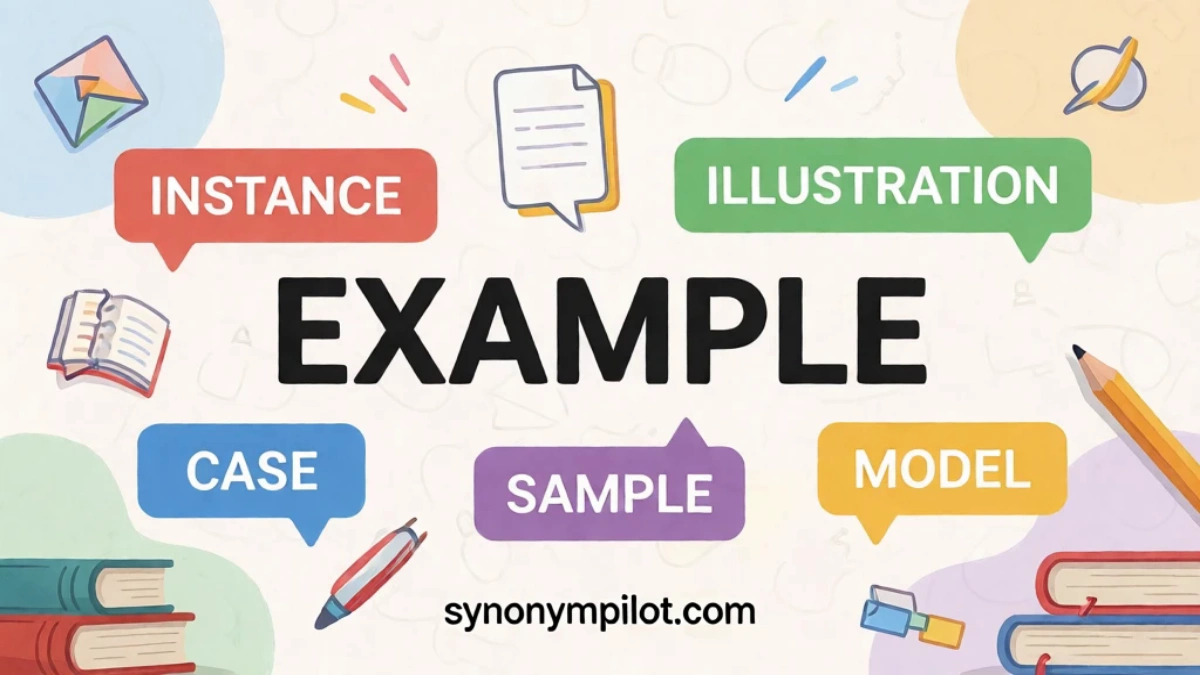
The best general alternatives include instance, case, illustration, sample, model, demonstration, and specimen.
Each word has a particular purpose:
- Instance: One particular occurrence of something.
- Case: A specific situation or set of circumstances.
- Illustration: An explanation that makes an idea clearer.
- Sample: A small or representative part of something.
- Model: An example used as a standard or pattern.
- Demonstration: A practical display of how something works.
- Specimen: A particular example collected or examined for study.
In ordinary conversation, for instance is often an easy replacement for for example. However, when describing a person worth following, a role model may fit better than any of these alternatives.
When Not to Use This Word
Although an example works in many situations, a more precise word may communicate your meaning better.
- Use illustration when you want to clarify an idea through a description, comparison, or visual.
- Use instance when referring to one particular occurrence.
- Use a sample when discussing a portion selected from a larger group.
- Use a model when something serves as a standard or pattern.
- Use demonstration when someone shows a process in action.
- Use case study when discussing a detailed examination of a real or hypothetical situation.
For example, “The trainer showed an example of the procedure” is understandable. However, “The trainer demonstrated the procedure” sounds more natural if the trainer actually performed it.
Likewise, avoid using role models for an ordinary object or situation. This expression usually refers to a person whose behavior others admire or want to imitate.
Words Commonly Confused With Example
Several words overlap with examples, but their meanings differ.
Instance refers to a particular occurrence: “This is one instance of poor planning.”
Illustration helps clarify a point: “The teacher used a diagram as an illustration.”
The sample represents a portion of a larger group: “We examined a sample of the soil.”
The model provides a pattern or standard: “The school follows a model of collaborative learning.”
Evidence supports a claim or conclusion. It is not simply another word for example, although an example can sometimes provide evidence.
Case study offers a detailed examination of a particular situation. It usually contains more information than a simple example.
These differences matter because replacing one word with another can change the meaning of your sentence.
Best Synonym by Context
| Context | Best Alternative | Why It Fits |
| Everyday conversation | Instance | Refers to a particular occurrence |
| School assignments | Illustration | Makes an idea easier to understand |
| Academic writing | Instance | Introduces a specific case |
| Professional training | Demonstration | Shows how something works |
| Research | Specimen | Refers to an item examined or studied |
| Statistics | Sample | Represents part of a population |
| Good behavior | Role model | Describes someone worth following |
| Teaching a method | Model | Provides a pattern to follow |
| Real-world problem | Case | Refers to a particular situation |
| Supporting an argument | Evidence | Helps support a claim |
| Explaining a process | Practical example | Shows how a concept applies |
| Introducing a point | For instance | Adds a specific supporting detail |
Which Synonym Should You Choose?
Start by identifying what you want the word to do.
If you want to explain an idea, choose illustration. If you are talking about one occurrence, use an instance. When you refer to a particular situation, case may be more suitable.
Meanwhile, choose a sample when you mean a small part of a larger whole. Use a model when something provides a pattern, and demonstration when someone shows a process in action.
For example:
- “The teacher gave an illustration of the grammar rule.”
- “This is one instance of the problem.”
- “The company studied a sample of customer feedback.”
- “She is a role model for younger students.”
- “The instructor gave a demonstration of the equipment.”
The most effective choice is not necessarily the most sophisticated word. Instead, choose the one that communicates your meaning clearly and naturally.
Real-Life Examples of “Example” in Sentences
School
“Our teacher gave three examples of adjectives.”
“Use an illustration to explain your answer.”
Workplace
“The manager shared an example of excellent customer service.”
“During training, the supervisor demonstrated the correct procedure.”
Writing
“For example, reading daily can help improve vocabulary.”
“For instance, a short story can illustrate how a character changes.”
Conversation
“Can you give me another example?”
“That’s a good case of teamwork.”
These sentences show how context influences word choice. In particular, for example and for instance introduce supporting information, while demonstration emphasizes showing an action.
Synonyms and Contextual Alternatives for “Example”
Common Alternatives for Example
| Synonym | Simple Meaning | Example Sentence |
|---|---|---|
| Instance | A particular occurrence | This is one instance of the problem. |
| Case | A specific situation | This case shows why planning matters. |
| Illustration | Something that clarifies an idea | The diagram provides an illustration of the process. |
| Sample | A small or representative part | We tested a sample of the material. |
| Model | A pattern or standard to follow | Her leadership provides a model for others. |
| Demonstration | A practical display of how something works | The instructor gave a demonstration of the tool. |
| Specimen | An individual item studied or examined | The scientist examined a specimen under a microscope. |
| Exemplar | A person or thing worthy of imitation | She is an exemplar of professional integrity. |
| Prototype | An early version used to test a design | The engineers tested the prototype before production. |
| Archetype | A typical or original pattern | The character represents the archetype of a hero. |
Words for Standards, Patterns, and Evidence
| Synonym | Simple Meaning | Example Sentence |
|---|---|---|
| Paradigm | A model or framework | The study introduced a new research paradigm. |
| Precedent | An earlier case used as a guide | The decision established a precedent for future cases. |
| Benchmark | A standard for comparison | The team used last year’s results as a benchmark. |
| Standard | An accepted level or model | The school sets a high standard for writing. |
| Pattern | A repeated or recognizable form | The report revealed a pattern of mistakes. |
| Representation | Something that depicts or stands for another thing | The chart is a representation of the data. |
| Depiction | A description or visual portrayal | The painting offers a depiction of village life. |
| Display | Something presented for viewing | The museum arranged a display of ancient tools. |
| Evidence | Information that supports a claim | The results provide evidence of improvement. |
| Proof | Information that establishes something as true | The document provided proof of ownership. |
Examples for Real-Life and Professional Situations
| Synonym or Alternative | Simple Meaning | Example Sentence |
|---|---|---|
| Use case | A situation in which something is used | The team described a use case for the software. |
| Case study | A detailed examination of a situation | The case study examined a successful business. |
| Practical example | An example based on real application | The teacher gave a practical example of the formula. |
| Representative example | An example that reflects a larger group | This result is a representative example of the trend. |
| Typical case | A situation that reflects what usually happens | This is a typical case of poor communication. |
| Real-life example | An example from everyday experience | The article includes a real-life example of budgeting. |
| Counterexample | An example that challenges or disproves a claim | One counterexample challenged the theory. |
| Exception | Something that does not follow a general rule | This unusual result is an exception to the rule. |
| Analogy | A comparison that helps explain something | The teacher used an analogy to explain electricity. |
| Comparison | An examination of similarities or differences | The comparison helped clarify the concept. |
Expressions That Help Explain an Idea
| Synonym or Alternative | Simple Meaning | Example Sentence |
|---|---|---|
| Metaphor | A figure of speech that describes one thing as another | “Time is a thief” is a familiar metaphor. |
| Case in point | A specific example that supports an argument | Her progress is a case in point. |
| Exemplification | The act of explaining something through examples | The essay uses exemplification to explain the idea. |
| Role model | A person whose behavior others admire | My mother is a role model for me. |
| Ideal | A standard worth trying to achieve | Their teamwork represents an ideal of cooperation. |
| Proof of concept | A test showing that an idea can work | The team built a proof of concept for its new app. |
| Scenario | A possible or imagined situation | The trainer discussed a scenario involving a customer complaint. |
| Explanatory example | An example that makes an idea clearer | The textbook provides an explanatory example of the rule. |
| Worked example | A problem solved step by step | The textbook includes a worked example of the equation. |
| Reference case | A case used for consultation or comparison | The team kept a reference case for future reviews. |
Additional Contextual Alternatives
| Synonym or Alternative | Simple Meaning | Example Sentence |
|---|---|---|
| Sample case | One case selected for examination | The report discussed a sample case from the survey. |
| Concrete example | A specific example rather than an abstract idea | The speaker gave a concrete example of responsible leadership. |
| Anecdote | A short story about a real incident or experience | She shared an anecdote about her first day at work. |
| Illustration by example | An explanation supported by a specific instance | The teacher clarified the rule by giving an example. |
| Instance of behavior | A particular occurrence of an action | The teacher recorded an instance of helpful behavior. |
| Demonstrative case | A case used to demonstrate a point | The report included a case to explain the procedure. |
| Model answer | An example of a high-quality answer | The teacher shared a model answer with the class. |
| Sample sentence | A sentence used to demonstrate a word or rule | The dictionary provides a sample sentence for each meaning. |
| Worked solution | A solution explained step by step | The workbook includes a worked solution to the problem. |
| Exemplary instance | An occurrence that demonstrates a quality particularly well | Her response was an exemplary instance of professional conduct. |
Synonym Groups & Usage Differences
Formal and Academic Alternatives
In essays, reports, and research papers, instance, illustration, case, specimen, paradigm, and exemplar may fit depending on the subject.
For example:
“Several instances of the pattern appeared in the results.”
In a scientific context, however, specimen may refer to an actual item under examination, while paradigm refers to a conceptual framework. Therefore, don’t use either word merely to make your writing sound more formal.
Professional Alternatives
At work, case study, benchmark, model, demonstration, and use case can communicate more specific meanings.
For example:
“The team reviewed a case study before launching the new service.”
A benchmark provides a standard for comparison, while a demonstration shows how a tool or process works.
Conversational Alternatives
In everyday speech, example, instance, case, and for instance sound natural.
For example:
“Can you give me an example?”
“Here’s one instance where that approach worked.”
The first sentence is more familiar for beginners, while the second can sound slightly more formal.
Stronger vs. More Specific Alternatives
Some words do not make an example stronger; instead, they make the meaning more precise.
- Illustration emphasizes explanation.
- Specimen emphasizes examination.
- Precedent emphasizes an earlier case that guides later decisions.
- Counterexample challenges a general claim.
- Benchmark provides a comparison standard.
Consequently, precision matters more than choosing a complicated word.
Positive and Neutral Alternatives
Role model, exemplar, and ideal can communicate admiration or a positive standard.
By contrast, instance, case, sample, and illustration usually remain neutral.
For example:
“She is a role model for new employees.”
“This is an instance of effective teamwork.”
Both sentences describe something useful, but the first emphasizes a person worth following.
Modern and Technical Expressions
Expressions such as use case, proof of concept, benchmark, and prototype are common in business, technology, and product development.
However, they have specific meanings. A prototype is an early version of a product, while a proof of concept tests whether an idea is feasible. Neither is a general replacement for example.
Antonyms of Example
The noun example has no single perfect antonym in every context. However, the following words express contrasting ideas in particular situations.
| Antonym or Contrast | Meaning | Example |
| Counterexample | An example that contradicts a claim | This counterexample disproves the general rule. |
| Exception | Something outside the general pattern | Her result is an exception to the usual trend. |
| Contradiction | A statement or fact that conflicts with another | The new evidence presents a contradiction. |
| Opposite | Something completely different in meaning or character | The second case shows the opposite outcome. |
| Generalization | A broad claim rather than a specific example | The writer made a generalization without giving evidence. |
| Abstraction | An idea considered apart from concrete details | The lesson began with an abstraction before moving to examples. |
These are contextual contrasts, not universal antonyms. For instance, a counterexample directly challenges a claim, whereas an abstraction moves away from specific details.
Comparison Section
Example vs. Instance
An example can explain a concept, demonstrate a rule, or show a pattern. An instance usually refers to one particular occurrence.
“Give me an example of a verb.”
“This is one instance of a spelling mistake.”
The first asks for an illustration of a category; the second identifies a particular occurrence.
Example vs. Illustration
An illustration makes a point easier to understand. It may take the form of a written description, comparison, diagram, or picture.
“The teacher gave an example of a metaphor.”
“The diagram provides an illustration of the process.”
The words overlap, but the illustration emphasizes clarification.
Example vs. Sample
An example helps explain or demonstrate an idea. A sample represents a portion of a larger group or collection.
“Here is an example of a formal email.”
“The researcher tested a sample of the water.”
Use a sample when selection from a larger whole matters.
Example vs. Model
An example may simply demonstrate something. A model often serves as a pattern or standard that others can follow.
“This paragraph is an example of descriptive writing.”
“This paragraph is a model of excellent descriptive writing.”
The second sentence expresses stronger approval.
Example vs. Evidence
An example illustrates a point, while evidence supports a claim or helps establish whether it is true.
“For example, several students improved their scores.”
“The students’ test results provide evidence of improvement.”
An example can contribute to an argument, but one example may not prove a general claim.
Common Phrases & Expressions
“For example”
Use this common expression to introduce a specific illustration of an idea.
“Many fruits contain vitamin C. For example, oranges and kiwis are good sources.”
“For instance”
This expression has almost the same meaning as for example and works well in speech and writing.
“Some activities improve concentration. For instance, reading can encourage sustained attention.”
“Set an example”
This means behaving in a way that others can learn from or follow.
“Teachers should set a good example for their students.”
“Take something as an example”
Use this expression when selecting a person, situation, or object to explain a point.
“Take this sentence as an example of the present perfect tense.”
“A case in point”
This phrase introduces a particular case that supports what you have just said.
“Several small businesses grew through online sales. This shop is a case in point.”
“Make an example of someone”
This expression means punishing someone publicly to discourage others from similar behavior. It often has a negative or severe tone.
“The manager wanted to make an example of the employee who repeatedly ignored safety rules.”
“Follow someone’s example”
This means copying someone’s behavior or using it as a guide.
“I try to follow my father’s example of honesty.”
Common Mistakes to Avoid
1. Replacing “example” with any related word
Sample, instance, and illustration have different meanings. Check the context before making a substitution.
2. Confusing “example” with “evidence”
An example explains or illustrates an idea. Evidence supports a claim. A single example does not automatically prove a general statement.
3. Using “model” when you only mean “example”
A model often serves as a standard or pattern. Use examples when no special standard or recommendation is intended.
4. Using “for example” and “for instance” unnaturally
Both expressions introduce supporting details. Avoid placing them repeatedly in every sentence; vary your sentence structure when appropriate.
5. Confusing “sample” with “specimen”
A sample often represents part of a larger group. A specimen is an individual item collected or examined, especially in scientific contexts.
6. Overusing synonyms
Using a different word in every sentence can make writing sound unnatural. Repeating an example is perfectly acceptable when it remains the clearest choice.
FAQs
What is the best synonym for example?
Instance is a useful alternative when referring to a particular occurrence. However, illustration, case, sample, and model may be better in other contexts.
What is a more formal word for example?
Instance, illustration, exemplar, and specimen can work in formal writing, depending on the intended meaning. In many academic sentences, examples remain perfectly appropriate.
What is another word for “for example”?
The most common alternative is for instance. Depending on the sentence, you can also use such as, to illustrate, or as an illustration.
What is the difference between an example and a case?
An example demonstrates or explains an idea. A case refers to a particular situation, occurrence, or set of circumstances.
What is the opposite of this example?
There is no single direct opposite. A counterexample contradicts a claim, while an exception falls outside a general rule. The correct choice depends on the context.
Conclusion
Choosing the right synonym for example can make your English clearer, more natural, and more precise. Words such as instance, case, illustration, sample,
and model are useful, but each serves a different purpose. An illustration clarifies an idea, an instance identifies an occurrence, and a sample represents part of a larger group. Meanwhile, a model provides a pattern that others can follow.
Rather than memorizing every alternative at once, start by practicing a few words in everyday sentences.