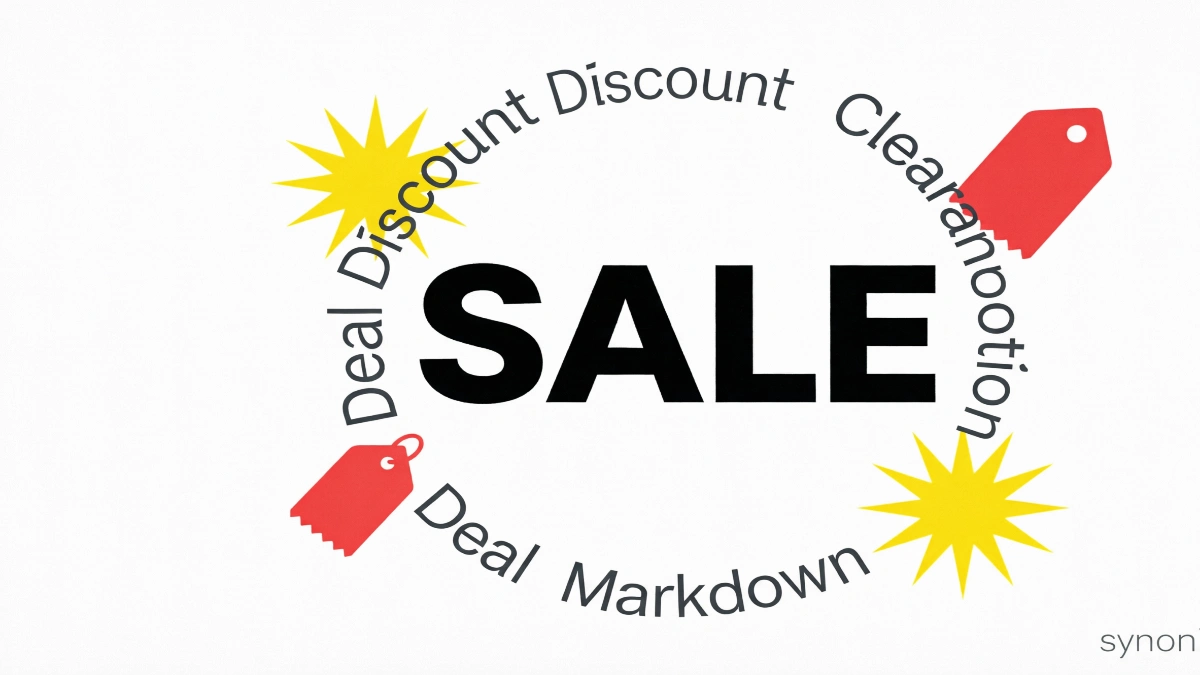
Many English learners search for “another word for sale” expecting one perfect replacement. In reality, English uses different words depending on whether you’re talking about shopping discounts, business transactions, legal contracts, or marketing promotions. Choosing the wrong one can make your writing sound unnatural. This guide explains which words really work and when to use each one.
Quick Answer
“Sale” most commonly means the act of selling something, or a temporary event where goods are offered at reduced prices. Close synonyms include discount, clearance, promotion, deal, and transaction but each carries its own tone, from casual shopping talk to formal legal writing.
Meaning, Tone & Context
Sale has two everyday meanings, and this is where a lot of learners get tripped up:
- The general act of selling “The sale of the house took three months to finalize.” (Formal, transactional, often legal or financial.)
- A discount event “There’s a sale at the mall this weekend.” (Casual, retail, consumer facing.)
In American and British English, both meanings are standard, though “sale” as a discount event is more common in everyday spoken conversation, while “sale” as a transaction shows up more in contracts, real estate, and business writing.
Image Prompt (H2 illustration): A simple two panel graphic left panel shows a store window with a “SALE” sign and price tags, right panel shows a handshake over a document labeled “Contract of Sale,” illustrating the two meanings side by side.
Sale vs. Sales: What’s the Difference?
Many English learners confuse sale and sales because the words look almost identical, but they have different meanings.
Sale usually refers to one transaction or one shopping event where goods are sold.
Examples
- The sale of the apartment took several weeks.
- The store is having a summer sale.
Sales usually refers to overall selling activity, total revenue, or the sales department of a business.
Examples
- Our online sales increased by 20% this year.
- She works in the sales department.
- Holiday sales were stronger than expected.
A simple way to remember the difference is:
- Sale = one event or transaction
- Sales = ongoing business activity or total selling results
Sale vs. Sell
Although sale and sell are closely related, they belong to different parts of speech.
| Word | Part of Speech | Example |
| Sale | Noun | The store had a big sale. |
| Sell | Verb | They sell fresh vegetables every day. |
Remember:
✔ I want to sell my old laptop.
✔ The laptop is for sale.
❌ I want to sale my old laptop.
If you’re talking about the action, use sell. If you’re talking about the event or transaction, use sale.
When & How to Use It
- Retail/shopping: “I got this jacket during the winter sale.”
- Business/legal: “The sale of the company was finalized last quarter.”
- Real estate: “The sale fell through after the inspection.”
- Everyday casual talk: “Is that dress still on sale?”
A quick teaching note: students often write “in sale” instead of “on sale.” The correct preposition is “on sale” (“This is on sale”) “in sale” isn’t natural English, even though many other languages use an equivalent of “in” for this idea.
Common Grammar Patterns with “Sale”
Certain prepositions are commonly used with sale, and using the wrong one can make your English sound unnatural.
On Sale
Use on sale when something is being sold at a reduced price.
- These shoes are on sale today.
- The TV will be on sale next week.
For Sale
Use for sale when something is available to buy.
- The house is for sale.
- Their old car is still for sale.
Sale of
Use sale of when referring to a specific transaction.
- The sale of the business was completed last month.
- The sale of tickets starts tomorrow.
One common mistake is saying “in sale.” Native English speakers almost always say “on sale.”
Another Word for “Sale”
The best alternative depends on what you mean.
- Discount focuses on a reduced price rather than the selling event itself.
- Deal emphasizes getting good value and is common in everyday conversation.
- Promotion usually refers to a temporary marketing campaign designed to increase sales.
- Transaction is the preferred choice in business, finance, and legal writing.
- Clearance refers to selling remaining stock, often at heavily reduced prices.
Choosing the right word depends more on the situation than on finding a perfect synonym.
When Not to Use This Word
Avoid “sale” when you actually mean “purchase.” Students often confuse the two directions: sale is from the seller’s side, purchase is from the buyer’s side. “I made a sale of a laptop” (as a buyer) is incorrect you’d say “I made a purchase.”
Also avoid “sale” in contexts describing an ongoing service or subscription “sale” implies a completed or one time exchange of goods, not a recurring one.
Words Commonly Confused With “Sale”
| Word | Why People Confuse It | Correct Usage |
| Sail | Homophone sounds identical | “Sail” refers to boats/wind, “sale” refers to selling |
| Purchase | Opposite direction of transaction | “Sale” = selling; “purchase” = buying |
| Discount | Discount is a type of sale, not a synonym in all contexts | “Discount” refers to reduced price, not the event itself |
| Auction | Both involve selling, but auction implies bidding | Use “auction” only when price is determined by competitive bids |
Best Synonym by Context
| Context | Best Synonym | Why |
| Retail shopping | Discount / Clearance | Everyday, consumer friendly tone |
| Legal/contracts | Transaction / Disposal | Formal, precise |
| Real estate | Closing / Transfer | Industry standard terms |
| Marketing | Promotion / Deal | Reflects marketing language |
| Casual conversation | Deal / Bargain | Light, informal |
Which Synonym Should You Choose?
If you’re writing a cover letter, resume, or business report, lean toward transaction, disposal, or transfer these sound professional and precise. If you’re chatting with a friend about shopping, deal, bargain, or discount fit naturally. Reserve clearance specifically for situations where a business is trying to get rid of leftover inventory using it outside retail contexts sounds odd.
Real Life Examples
School: “Our economics class studied how a sale affects supply and demand.”
Workplace: “Q3 sales numbers were up 12% compared to last year.”
Writing: “The sale of his childhood home marked the end of an era for the family.”
Conversation: “Did you see? Everything’s 40% off it’s a huge sale!”
Synonyms Table
| Synonym | Simple Meaning | Example Sentence |
| Discount | Reduced price | “I got a discount on my new phone.” |
| Clearance | Selling off remaining stock | “The store’s clearance rack had great deals.” |
| Promotion | Temporary marketing offer | “The promotion ends this Friday.” |
| Deal | A good price or arrangement | “That’s a great deal on a used car.” |
| Bargain | An especially cheap purchase | “This coat was a real bargain.” |
| Transaction | Formal exchange of goods/money | “The transaction was completed online.” |
| Disposal | Formal act of selling off assets | “The disposal of company assets took months.” |
| Transfer | Passing ownership to another party | “The property transfer is now official.” |
| Auction | Sale through competitive bidding | “The painting sold at auction for $2 million.” |
| Markdown | Price reduction on goods | “The markdown brought the price to $15.” |
| Closeout | Final sale to clear inventory | “It’s a closeout sale before the store shuts down.” |
| Liquidation | Selling assets quickly, often urgently | “The company held a liquidation sale.” |
| Offer | A proposed price or deal | “They made an offer we couldn’t refuse.” |
| Exchange | Trading goods or currency | “The exchange of goods happened smoothly.” |
| Vending | Selling, typically informal/small scale | “Street vending is common in this city.” |
| Trade | General exchange of goods | “International trade relies on many sales.” |
| Blowout | Informal, very large discount sale | “It’s a blowout sale everything must go!” |
| Rummage sale | Sale of secondhand/used items | “We found old books at the rummage sale.” |
| Flash sale | Very short, urgent discount event | “The flash sale only lasted two hours.” |
| Yard sale | Informal sale of household items at home | “We’re having a yard sale this Saturday.” |
Which Synonyms Are True Synonyms?
Not every word associated with sale is a true synonym.
Some words describe different types of sales, while others describe related business concepts.
True or Close Synonyms
- Transaction
- Deal (depending on context)
- Disposal (formal)
- Transfer (limited legal contexts)
Related Retail Terms
- Discount
- Promotion
- Markdown
- Clearance
- Closeout
- Liquidation
Types of Sales
- Flash sale
- Yard sale
- Garage sale
- Rummage sale
- Auction
Understanding these differences helps you choose more natural English instead of replacing every word automatically.
Synonym Groups & Usage Differences
Formal/Legal: transaction, disposal, transfer used in contracts, court documents, business reports.
Casual/Everyday: deal, bargain, discount used in daily conversation and shopping.
Retail Specific: clearance, markdown, closeout, liquidation, flash sale used specifically in stores and e-commerce.
Informal/Community: yard sale, rummage sale, garage sale used for small, personal, secondhand sales.
Which Word Should You Choose?
If you’re unsure which word to use, this quick guide can help.
- Choose sale for everyday shopping and general conversation.
- Choose discount when emphasizing lower prices.
- Choose transaction in legal or business writing.
- Choose deal when talking casually about getting good value.
- Choose clearance when a store is selling leftover inventory.
- Choose promotion when referring to a marketing campaign.
Using the most natural word for the situation makes your English sound much more fluent.
Antonyms Table
| Antonym | Meaning | Example |
| Purchase | The act of buying | “The purchase was made online.” |
| Acquisition | Formally obtaining something | “The acquisition of new equipment took weeks.” |
| Retention | Keeping instead of selling | “The company chose retention over sale of the asset.” |
| Donation | Giving away without payment | “Instead of a sale, they made a donation.” |
Comparison Section
Sale vs. Discount: “Sale” refers to the event or transaction itself; “discount” refers specifically to the price reduction within that event. You can have a sale without a discount (a fixed price sale), though this is less common in retail usage.
Sale vs. Auction: A sale usually has a fixed or negotiated price; an auction determines price through competitive bidding. Auctions are a type of sale, but not all sales are auctions.
Sale vs. Transaction: “Transaction” is broader it can include sales, transfers, and even non monetary exchanges. “Sale” specifically implies money changing hands for goods or services.
Common Phrases & Expressions
- “For sale” available to be bought. “This house has been for sale for two months.”
- “On sale” currently discounted. “These shoes are on sale this week.”
- “Sale of the century” an exceptionally good deal (often used humorously or in advertising). “They called it the sale of the century, but it was just 10% off.”
- “Fire sale” a sale at very low prices, often due to urgent circumstances. “The struggling business held a fire sale before closing.”
- “Point of sale” the location or moment where a transaction is completed. “The point of sale system crashed during checkout.”
- “Hard sell” an aggressive sales approach (note: this uses “sell,” not “sale”). “The salesman gave us a hard sell we didn’t appreciate.”
Common Collocations with “Sale”
Some of the most common include:
- annual sale
- clearance sale
- flash sale
- holiday sale
- summer sale
- weekend sale
- retail sale
- sales promotion
- point of sale
- sale price
Examples:
- The furniture store is holding a holiday sale.
- Customers lined up before the flash sale started.
- The point-of-sale system stopped working.
- I bought it at the sale price.
Learning these combinations will help your English sound more natural than memorizing single words alone.
Common Mistakes to Avoid
- Sale vs. Sail these are homophones; don’t mix them in writing.
- “In sale” instead of “on sale” always use “on sale” for discounted items.
- Using “sale” for buying remember, “sale” is from the seller’s perspective; use “purchase” for the buyer’s side.
- Overusing “clearance” outside retail it sounds unnatural in legal or real estate writing; use “disposal” or “transfer” instead.
- Confusing “sale” (noun) with “sell” (verb) “I will sale this car” is incorrect; the correct verb form is “sell” (“I will sell this car”).
Teacher Tip
Many learners think they should replace sale with a different word to sound more advanced. In reality, sale is already the standard word in everyday English. Only choose another term when the context changes for example, transaction in legal writing, clearance for leftover stock, or promotion in marketing. Using the simplest correct word usually sounds more natural than forcing a synonym.
FAQs
Is “sale” formal or informal?
It depends on context “sale” as a business transaction is formal, while “sale” as a shopping discount is casual and used constantly in everyday speech.
What’s the difference between “sale” and “clearance”?
“Clearance” specifically means a store is trying to sell off old or excess inventory, often at steep discounts, while “sale” is the broader, general term for any discount event.
Can “sale” be used as a verb?
No “sale” is only a noun. The verb form is “sell” (“I sell my products online,” not “I sale my products online”).
What’s a polite way to say “sale” in a professional email?
Use “transaction,” “offer,” or “promotion,” depending on if you’re referring to the exchange itself, a discount, or a marketing campaign.
Is “for sale” the same as “on sale”?
No “for sale” means something is available for purchase (at any price), while “on sale” specifically means it’s discounted.
Conclusion
“Sale” looks simple, but as we’ve seen, its synonyms split across very different worlds: retail shopping, legal contracts, and everyday conversation. Getting the right word for the right context makes your writing sound more precise and natural, if you’re drafting a business report or chatting about a weekend shopping trip. Try swapping “sale” for “discount,” “transaction,” or “deal” the next time you write, and notice how each word shifts the tone of your sentence.
The more you practice choosing the right synonym for the situation, the more confident and native sounding your English will become. Keep a small list of these words handy, and reach for a new one each time you write that’s how vocabulary really sticks.