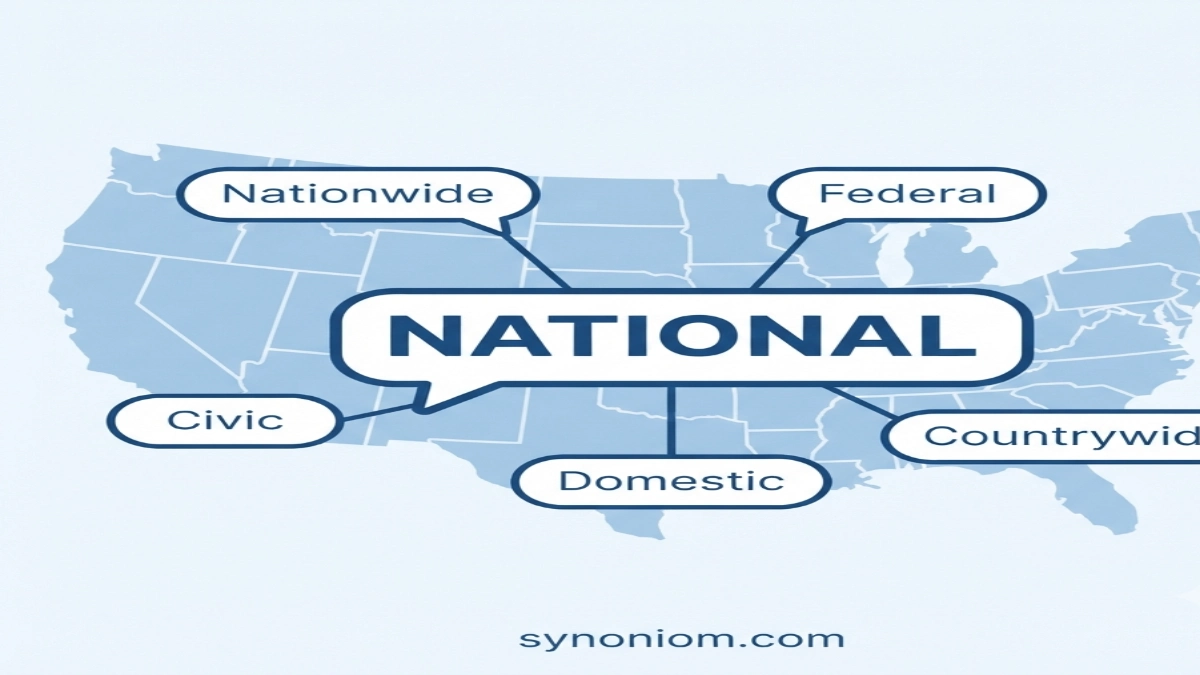
Picture a newsroom the night before a big holiday. One editor writes “national holiday,” another crosses it out and writes “nationwide celebration,” and a third mutters, “isn’t ‘federal holiday’ more accurate here?”
I’ve watched this exact argument happen in a writing workshop I ran for journalism students, and it’s a good reminder that “national” is one of those words that feels simple until you actually have to choose the right replacement for it.
It shows up in news headlines, government forms, school essays, and everyday conversation, but its synonyms don’t all mean quite the same thing and mixing them up is an easy, common mistake.
Quick Answer (Featured Snippet)
National describes something that belongs to, represents, or affects an entire country, rather than just one region, city, or private group. Common synonyms include nationwide, countrywide, federal, domestic, and state, though each carries a slightly different shade of meaning depending on if you’re talking about government, geography, or identity. As a noun, “national” can also mean a citizen of a particular country (as in “a British national”).
Meaning, Tone & Context
At its core, “national” is an adjective meaning relating to a whole nation as opposed to local, regional, or international. You’ll hear it in phrases like national security, national holiday, national anthem, and national park.
The tone of “national” itself is neutral and fairly formal; it fits news writing, government documents, academic papers, and everyday speech equally well. It doesn’t carry the emotional charge that a word like “patriotic” does, and it’s less bureaucratic sounding than “federal.” That neutrality is exactly why it’s so overused: writers reach for it by default, even when a more precise word would serve the sentence better.
What Does National Mean?
The word national relates to a whole country, its people, government, culture, or interests. It describes something connected to a nation rather than a smaller area like a city or state.
Examples:
- National holiday → a holiday recognized across a country.
- National team → a team representing an entire country.
- National language → a language connected with a country’s identity.
- National policy → a policy affecting the country as a whole.
However, the exact meaning depends on context. In government writing, national often describes the country’s overall interests, while federal refers specifically to the central government system.
When & How to Use It
Use “national” when you’re describing something that applies to an entire country as a single unit:
- The national election will be held in November.
- She represented her country at the national level in gymnastics.
- The museum houses a collection of national significance.
Avoid it when you actually mean something narrower (a single state or province) or broader (spanning multiple countries) in those cases, “national” quietly misleads the reader about scale.
National vs. Nationwide: What’s the Difference?
Many writers use national and nationwide interchangeably, but there is a small difference.
National can describe anything connected with a country:
- national identity
- national anthem
- national security
Nationwide focuses mainly on geographical coverage:
- nationwide campaign
- nationwide survey
- nationwide shortage
A simple rule:
- Use national for identity, importance, or country-level concepts.
- Use nationwide when something happens everywhere in the country.
Examples:
✔ The government announced a national policy.
✔ The company launched a nationwide advertisement campaign.
Another Word for “National”
If you need a quick, natural substitute, “nationwide” is usually the safest swap; it keeps the same meaning of “across the whole country” without sounding like a government memo. “Countrywide” works almost identically and reads a touch more conversational. For contexts involving government structure specifically, “federal” is the better fit, though as explained below it isn’t a perfect synonym.
True Synonyms of “National”
Not every word connected to a country is a direct synonym for national. Some words describe related ideas, such as patriotism, citizenship, or government.
The closest replacements for national are:
| Synonym | Best Used For |
| Nationwide | Something happening across the entire country |
| Countrywide | A more casual version of nationwide |
| Federal | Central government matters |
| Domestic | Internal affairs compared with foreign affairs |
| Statewide | Across an entire state (not the whole country) |
Examples:
- The company launched a nationwide campaign.
- The federal government introduced new rules.
- The country saw a rise in domestic tourism.
When Not to Use This Word
Don’t use “national” when you mean:
- Regional or local a “national” college fair that only covers three states is a factual overstatement.
- International “national cooperation” and “international cooperation” describe very different scopes; swapping them changes the meaning, not just the tone.
- Federal (in countries with strong state/provincial governments) “national law” and “federal law” aren’t always the same thing. In the US, for example, some matters are federal but administered differently at the state level, and calling something “national policy” can blur that distinction.
In my experience grading policy writing assignments, this is the single most common mix up: students use “national” and “federal” interchangeably in American government essays, when in fact “federal” specifically refers to the central government’s authority, while “national” can describe anything shared across the whole country including things states, not the federal government, actually run, like most public schooling.
Words Commonly Confused With “National”
National vs. Federal
“National” describes scope (the whole country); “federal” describes a system of government (central authority as opposed to state/regional authority). A national park is national in scope; if it’s federally managed is a separate fact, even though in the US the two usually overlap.
National vs. Domestic
“Domestic” is often used as a near opposite framing tool “domestic policy” is contrasted with “foreign policy,” while “national policy” doesn’t inherently make that foreign/home distinction. Domestic also carries a household or internal affairs connotation that “national” doesn’t.
National vs. Nationalist / Nationalistic
This is a formality and tone trap, not just a meaning one. “National” is neutral. “Nationalist” or “nationalistic” introduces ideology, often a critical or politically loaded one about prioritizing one’s nation above others. Students frequently reach for “nationalistic pride” when they mean “national pride,” not realizing they’ve added a political judgment that wasn’t intended.
National vs. Domestic
Although national and domestic can overlap, they emphasize different ideas.
National focuses on the country as a whole.
Example:
- national economy
- national interest
- national identity
Domestic usually means inside one’s own country, especially when compared with foreign or international matters.
Example:
- domestic flights
- domestic policy
- domestic market
Compare:
“The country increased national security spending.”
“The company focuses on the domestic market.”
The first refers to the country’s interests. The second refers to activity within the country.
Best Synonym by Context
| Context | Best Synonym | Why It Works |
| News/media (scope) | Nationwide | Clear, neutral, widely understood |
| Government/legal | Federal | Signals a specific level of government |
| Everyday speech | Countrywide | Sounds natural, less formal |
| Economics (“domestic”) | Domestic | Standard pairing with “foreign” |
| Identity/citizenship (noun) | Citizen | Clearer than “national” as a noun in casual writing |
| Formal/academic writing | State (adj.) | Common in “state level,” “state run” phrasing |
Formal and Informal Alternatives for National
Different situations require different levels of formality.
Formal:
- federal
- sovereign
- domestic
- official
Used in:
- government reports
- academic writing
- legal documents
Everyday:
- nationwide
- countrywide
Used in:
- news
- conversations
- marketing
Example:
Formal:
“The federal government released a new policy.”
Everyday:
“The company opened nationwide stores.”
Which Synonym Should You Choose?
Ask yourself three quick questions:
- Am I describing scope (whole country) or government structure (which level runs it)? Scope → nationwide/countrywide. Structure → federal/state.
- Am I contrasting with “foreign” or “international”? If yes, “domestic” is usually more precise than “national.”
- Am I describing a person’s citizenship, not a country wide scope? Use “citizen” or “subject” instead of “national” as a noun, unless you’re writing in a legal or immigration context, where “national” is actually the standard, correct term (e.g., “a US national”).
Real Life Examples
School: “For my civics project, I compared national voter turnout with turnout in our own state.”
Workplace: “Marketing wants to launch this as a nationwide campaign, not just a regional test.”
Writing (news): “The federal government announced new funding, though implementation will vary state by state.”
Conversation: “Did you see the national news tonight? It was all about the storm.”
Synonyms of National by Context
The best replacement for national depends on what you are describing.
| Context | Best Alternative |
| Across the whole country | Nationwide |
| Casual writing | Countrywide |
| Government authority | Federal |
| Economy/business | Domestic |
| Citizenship | Citizen |
| State-level comparison |
Synonyms Table
| Synonym | Simple Meaning | Example Sentence |
| Nationwide | Across the entire country | The sale is nationwide, not just local. |
| Countrywide | Same as nationwide, slightly more casual | Countrywide protests were reported yesterday. |
| Federal | Relating to the central/national government | Federal agents investigated the case. |
| Domestic | Relating to one’s own country (vs. foreign) | Domestic flights are cheaper than international ones. |
| Public | Belonging to or funded by the state/government | It’s a public holiday, so schools are closed. |
| Civic | Relating to citizenship or civic duty | Voting is a basic civic responsibility. |
| Governmental | Relating to government generally | The decision came from governmental offices. |
| State (adj.) | Relating to a national or provincial government | This is a state run enterprise. |
| Central | Relating to the main governing authority | The central bank set new interest rates. |
| Patriotic | Showing love or loyalty for one’s country | He gave a patriotic speech on Independence Day. |
| Native | Belonging to a place by birth or origin | Rice is a native crop in this region. |
| Widespread | Occurring over a large area (broader, not country specific) | The shortage became widespread within weeks. |
| Universal | Applying to everyone, everywhere (broader than national) | Clean water access should be universal. |
| General | Broad, not specific to one place (weaker, vaguer) | There’s general support for the new law. |
| Sovereign | Independent and self governing | Every sovereign nation sets its own trade laws. |
| Communal | Shared by a community (smaller scale than national) | They use a communal garden behind the building. |
| Statewide | Across an entire state (narrower than national) | A statewide curfew was announced. |
| Territorial | Relating to a specific territory or land area | The dispute was over territorial waters. |
| Official | Sanctioned by authority (often paired with “national”) | The national anthem is the country’s official song. |
| Citizen (noun) | A legally recognized member of a country | She became a citizen after five years. |
| Subject (noun) | A person under a monarch’s rule | He is a British subject. |
Words Related to “National” (Not Always Synonyms)
Some words are connected to the idea of a nation but cannot replace national in every sentence.
| Word | Meaning | Example |
| Patriotic | Showing love for one’s country | She gave a patriotic speech. |
| Civic | Related to citizenship or community duties | Voting is a civic responsibility. |
| Sovereign | Independent and self-governing | A sovereign nation controls its borders. |
| Official | Approved by authority | The official national language was announced. |
Synonym Groups & Usage Differences
Formal / Legal
Federal, sovereign, territorial, official these appear in legal documents, treaties, and government communication.
Everyday / Conversational
Nationwide, countrywide used naturally in speech and casual writing without sounding stiff.
Broader Than “National” (Use With Caution)
Universal, widespread, general these describe scope beyond one country, so don’t use them as direct swaps unless you mean something bigger than “national.”
Narrower Than “National”
Statewide, communal these describe something smaller than the whole country and should never substitute for “national” without changing the meaning.
Identity Focused (Noun Forms)
Citizen, subject, native used when talking about people rather than policies, holidays, or scope.
Antonyms Table
| Antonym | Meaning | Example |
| Local | Relating to a specific, small area | This is a local issue, not a national one. |
| Regional | Relating to a particular region within a country | The festival is a regional tradition, not a national one. |
| International | Involving more than one country | Trade talks moved from national to international level. |
| Private | Belonging to an individual or group, not the state | It’s a private matter, not a national concern. |
| Foreign | Belonging to another country | Foreign policy differs from domestic policy. |
| Personal | Relating to an individual, not a collective | That’s a personal decision, not a national mandate. |
Common Phrases & Expressions
- National treasure someone or something highly valued by an entire country. “The retired broadcaster is considered a national treasure.”
- National security the protection of a country from threats. “The leak raised concerns about national security.”
- Of national importance significant to the whole country, not just one area. “The bridge collapse was declared a matter of national importance.”
- National pride, a sense of satisfaction and loyalty toward one’s country. “Winning the World Cup filled the country with national pride.”
- State of the nation an overview of a country’s current condition, often political. “The president delivers a state of the nation address every year.”
Comparison Section
National vs. Federal: Both often appear in the same government sentence, but they answer different questions. “National” answers how wide is the scope? “Federal” answers which level of government is acting? A national holiday can be declared without any single federal law behind it, depending on the country’s system.
National vs. Nationalist: Tone is the whole story here. “National” is descriptive and neutral. “Nationalist” is ideological and often used critically in modern journalism, implying an aggressive or exclusionary form of patriotism.
National vs. International: These are near opposites in scope, not synonyms one describes a single country, the other describes relationships or events spanning multiple countries.
Common Mistakes to Avoid
- Confusing “national” with “federal” remember, one describes scope, the other describes governmental structure.
- Using “national” when you mean “international” check if other countries are actually involved before defaulting to “national.”
- Turning “national” into “nationalistic” by accident adding ” istic” changes a neutral description into a politically loaded one; don’t use them interchangeably.
- Treating “widespread” or “universal” as exact synonyms describe something broader than one country and can overstate your claim.
Common Collocations With National
English commonly uses national with these words:
- national security
- national interest
- national identity
- national anthem
- national holiday
- national economy
- national average
- national championship
- national park
- national language
- national team
Examples:
- The issue became a matter of national security.
- She played for the national team.
- The park has national importance.
FAQs
Is “national” formal or informal?
It’s neutral and comfortable in both formal writing (legal, academic, news) and everyday conversation.
What’s the difference between “national” and “nationwide”?
They’re very close in meaning, but “nationwide” leans slightly more conversational and is often preferred in marketing or casual news writing, while “national” fits more formal or official contexts.
Can “national” describe a person?
Yes, as a noun, “a national” means a citizen or legal member of a specific country, common in legal and immigration contexts (e.g., “a foreign national”).
Is “federal” always a good substitute for “national”?
No. “Federal” refers to central government authority specifically, while “national” simply describes country wide scope. They overlap often but aren’t interchangeable.
Can national describe a person?
Yes. As a noun, national can mean a citizen or legal member of a country.
Example:
“He is a Canadian national.”
In everyday English, citizen is usually more common.
Is nationwide a synonym for national?
Nationwide is a close synonym when talking about something happening across the whole country. However, national has a broader meaning and can also describe identity, importance, or government matters.
Why do people confuse “national” and “nationalistic”?
Because they share a root word, but “nationalistic” adds an ideological, often negative, connotation that plain “national” doesn’t carry; it’s a tone shift, not just a spelling one.
Conclusion
“National” is a flexible word, but its alternatives are not interchangeable. Use nationwide when you mean something happening across a country, federal when you mean central government authority, and domestic when contrasting with foreign matters.
The best synonym is not always the most advanced word it is the one that matches your exact meaning.”