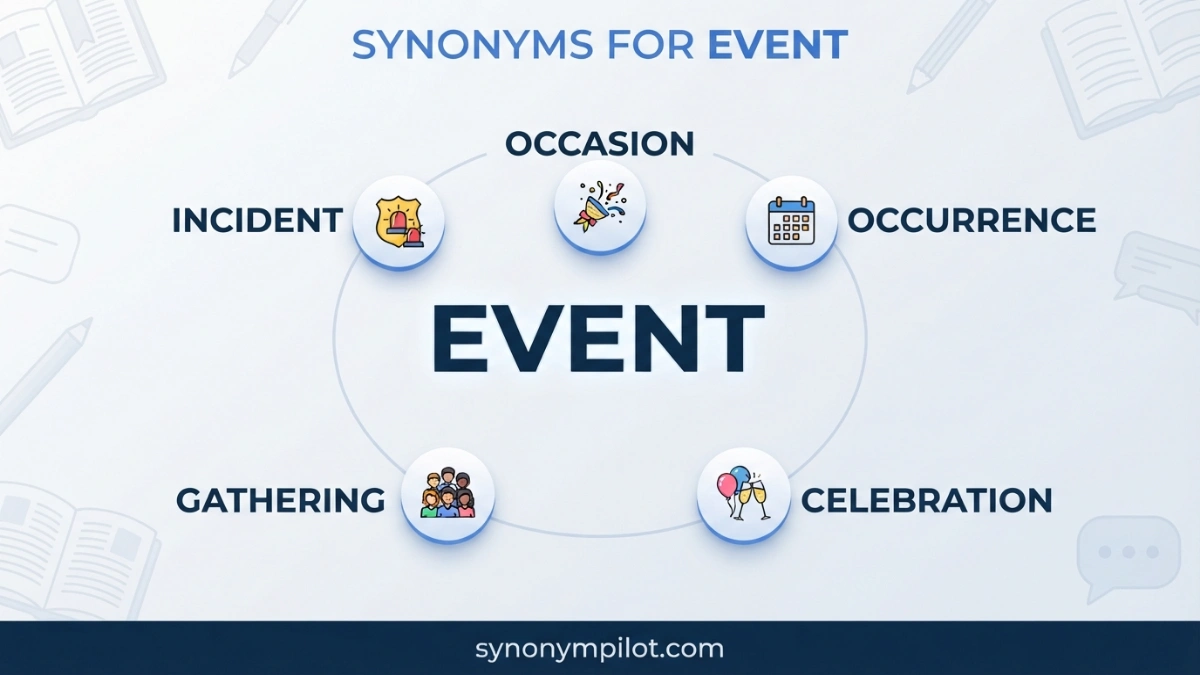
For example, a wedding is a special occasion, while an unexpected event occurred yesterday. The best synonym depends on what kind of event you mean.
Imagine telling a friend, “There is a big event at school tomorrow.” Your friend might immediately ask, “What kind of event?” Is it a sports competition, a school function, a concert, or a meeting?
That is why choosing the right alternative to event matters.
The word event has several meanings in everyday English. You can use it for something that happens, such as an unexpected accident. You can also use it for something planned, such as a wedding, conference, festival, or charity function. In sports, an event can mean a particular competition, such as the 100-meter race.
So, replacing an event with any random synonym can change the meaning of your sentence.
In this guide, you will learn 50 useful alternatives for events, including their meanings, examples, formality, and natural contexts. You will also learn which words work best in school, workplace, academic, social, and everyday conversations
Quick Answer
An event is something that happens, especially something important, planned, or noticeable. It can mean an occurrence, a happening, a special occasion, a public function, or a competition, depending on the context.
Meaning, Tone & Context
The core meaning of an event is something that happens or takes place.
For example:
- The event happened on Monday.
- We attended a charity event.
- The wedding was a beautiful event.
- The race is the final event of the competition.
The meaning changes slightly according to context.
Event as something that happens
Here, an event means an occurrence or happening.
The unexpected event caused a delay.
This use is common in news, academic writing, history, and formal descriptions.
Event as a planned occasion
Here, an event refers to an organized activity or special occasion.
The school is organizing a cultural event.
This meaning is common in everyday English, business, education, entertainment, and social situations.
Event as a competition
In sports, events can describe one particular competition within a larger program.
She won the 400-meter event.
This meaning is especially common in athletics, swimming, gymnastics, and other organized competitions.
Tone and formality
Event is a neutral word. It works comfortably in casual conversation, professional communication, academic writing, and formal announcements.
Some alternatives, however, have more specific tones:
- Occasion often sounds more social or ceremonial.
- Function can sound formal or organizational.
- Happening is more casual.
- Occurrence is more formal and factual.
- Incident usually refers to something notable or unusual.
- Conference is specific to an organized meeting or professional gathering.
- Competition is appropriate when people compete against each other.
Therefore, context should guide your choice.
When & How to Use “Event”
Use an event when you need a broad, neutral word for something that happens or something that people organize or attend.
For planned activities
The university will hold a career event next Friday.
For celebrations
Their wedding was a memorable event.
For professional gatherings
More than 200 people attended the business event.
For unexpected occurrences
The event changed the course of the investigation.
For sports
The 100-meter race is the most popular event today.
For historical situations
The event had a lasting effect on the country.
The word is particularly useful when the exact type of activity is already clear from the surrounding sentence.
Another Word for “Event”
The best alternative depends on the meaning.
If you mean something that happens, try:
- occurrence
- happening
- incident
- development
- episode
- circumstance
Fou mean a planned social or public activity, try:
- occasion
- function
- gathering
- celebration
- ceremony
- festival
If you mean a professional or educational gathering, try:
- conference
- convention
- seminar
- workshop
- meeting
- session
If you mean a competitive activity, try:
- competition
- contest
- match
- race
- tournament
Notice that these words are not perfect replacements in every sentence. For example, you can call a football match an event in a broad sense, but you cannot normally replace an event with a match unless the context involves a game or competition.
When Not to Use This Word
Although the event is flexible, it can sometimes be too general.
Instead of saying:
We attended an event.
you could say:
We attended a wedding.
The second sentence gives the reader much more information.
Similarly:
There was an event at work.
is vague.
If you mean a training session, conference, meeting, or office celebration, use the specific word when possible.
Avoid using events when the more precise term is obvious and useful.
For example, a doctor might describe a medical incident, while a company might organize a conference. Calling both simply an event is grammatically correct, but less informative.
Words Commonly Confused With “Event”
Event vs Occasion
An occasion usually refers to a particular time or situation, especially one that is special or meaningful.
Her graduation was a special occasion.
An event is broader.
The graduation event attracted hundreds of guests.
Event vs Incident
An incident is usually an unusual, unexpected, or noteworthy occurrence.
There was a minor security incident.
An event does not necessarily suggest a problem.
The company held a successful event.
Event vs Activity
An activity is something people do. An event is usually a particular occurrence, occasion, or organized gathering.
Painting is an activity.
The school art exhibition was an event.
Event vs Function
A function often means a formal or organized social occasion.
The company held a formal dinner function.
In everyday English, events are generally more flexible.
Event vs Situation
A situation describes a set of circumstances or conditions rather than one particular occurrence.
We need to understand the situation.
The accident was a serious event.
Event vs Ceremony
A ceremony is a formal activity that follows a traditional or official pattern.
The award ceremony began at 7 p.m.
A ceremony can be an event, but not every event is a ceremony.
Best Synonym by Context
| Context | Best Alternative | Why It Fits |
| Something that happened | Occurrence | Clearly describes something taking place |
| Unexpected situation | Incident | Suggests a notable or unusual occurrence |
| Everyday informal use | Happening | Natural and conversational |
| Special social occasion | Occasion | Highlights importance or celebration |
| Formal social gathering | Function | Fits organized formal occasions |
| Public gathering | Gathering | Emphasizes people coming together |
| Professional meeting | Conference | Specific to organized discussion or information sharing |
| Educational meeting | Seminar | Usually involves teaching or discussion |
| Practical learning | Workshop | Focuses on active participation |
| Celebration | Celebration | Directly describes a celebratory event |
| Formal ritual | Ceremony | Fits official or traditional occasions |
| Sports competition | Competition | Emphasizes competing participants |
| Two-team sports | Match | Appropriate for games between opponents |
| Running or swimming | Race | Appropriate for timed competition |
| Multiple-round competition | Tournament | Describes an organized series of contests |
| Academic paper context | Occurrence | Formal and objective |
Which Synonym Should You Choose?
Start by asking yourself one simple question:
What exactly do I mean by “event”?
When talking about something that happened, choose occurrence, happening, or incident.
For a special occasion, occasion, celebration, or ceremony may be the best choice.
When people come together, consider gathering, conference, convention, or meeting.
For a competition, natural choices include competition, contest, match, race, or tournament.
Finally, if you are unsure, the event is usually a safe neutral choice. It is broad enough to work in many contexts without sounding overly formal or informal.
Real-Life Examples of “Event” in Sentences
School
The annual sports event starts on Monday.
Our teacher asked us to help organize the school event.
Workplace
The company is hosting a networking event.
Please register for the employee training event.
Writing
The historical event changed the direction of the country.
The novel begins with an unexpected event.
Conversation
Are you going to the event tonight?
That was one of the most exciting events of the year.
50 Synonyms for “Event”
General Synonyms for Event
| Synonym | Simple Meaning | Example Sentence |
|---|---|---|
| 1. Occurrence | Something that happens | The occurrence was reported to the manager. |
| 2. Happening | Something taking place | The strange event surprised everyone. |
| 3. Incident | A notable or unusual occurrence | The incident caused a short delay. |
| 4. Episode | A particular occurrence or period | The episode changed her opinion. |
| 5. Development | A new change or occurrence | The latest development affected the project. |
| 6. Circumstance | A particular condition or situation | Under these circumstances, we postponed the event. |
| 7. Experience | Something that happens to someone | The trip was an unforgettable experience. |
| 8. Situation | A set of existing circumstances | The situation developed quickly. |
| 9. Case | A particular example or occurrence | This case requires further investigation. |
| 10. Phenomenon | A notable fact or occurrence | The phenomenon attracted scientific attention. |
Synonyms for Social Events and Celebrations
| Synonym | Simple Meaning | Example Sentence |
|---|---|---|
| 11. Occasion | A special time or situation | Her graduation was a memorable occasion. |
| 12. Function | An organized social occasion | The hotel hosted a formal function. |
| 13. Gathering | People meeting together | The family gathering lasted all afternoon. |
| 14. Celebration | An activity marking something special | The anniversary celebration was wonderful. |
| 15. Ceremony | A formal traditional occasion | The award ceremony begins at six. |
| 16. Festivity | An activity connected with celebration | The town was full of holiday festivities. |
| 17. Festival | A public celebration | Thousands attended the music festival. |
| 18. Affair | An organized social occasion | The charity affair raised money for schools. |
| 19. Reception | A formal social gathering | Guests attended the wedding reception. |
| 20. Engagement | A planned activity or appointment | The speaker has a public engagement tonight. |
Synonyms for Meetings and Professional Events
| Synonym | Simple Meaning | Example Sentence |
|---|---|---|
| 21. Conference | An organized professional meeting | She spoke at an international conference. |
| 22. Convention | A large organized meeting | Experts gathered at the industry convention. |
| 23. Seminar | A meeting for discussion or learning | Students attended a writing seminar. |
| 24. Workshop | A practical learning session | I joined a photography workshop. |
| 25. Meeting | People gathering for discussion | Our staff meeting is scheduled for tomorrow. |
| 26. Session | A period devoted to an activity | The training session lasted two hours. |
| 27. Summit | A high-level meeting | World leaders came together at the summit. |
| 28. Forum | A place or meeting for discussion | The university organized a public forum. |
| 29. Rally | An organized public gathering | Thousands of people attended the community rally. |
| 30. Demonstration | A public display or protest | The demonstration took place peacefully. |
Synonyms for Shows, Competitions, and Sports Events
| Synonym | Simple Meaning | Example Sentence |
|---|---|---|
| 31. Showcase | An event displaying talent or products | The exhibition was a showcase for young artists. |
| 32. Exhibition | A public display | The art exhibition opened on Friday. |
| 33. Performance | A public presentation of entertainment | The theater hosted a live performance. |
| 34. Competition | An activity involving competitors | She entered the writing competition. |
| 35. Contest | A competition to determine a winner | He won the photography contest. |
| 36. Match | A competitive game | The football match starts at eight. |
| 37. Race | A competition based on speed | She won the 100-meter race. |
| 38. Tournament | A series of organized competitions | Our team reached the final of the tournament. |
| 39. Game | A competitive or recreational activity | The championship game attracted many fans. |
| 40. Fixture | A scheduled sports match | The next league fixture is on Sunday. |
| 41. Meet | An organized sports competition | She competed in a swimming meet. |
Synonyms for Significant Events and Experiences
| Synonym | Simple Meaning | Example Sentence |
|---|---|---|
| 42. Adventure | An unusual or exciting experience | The journey became a surprising adventure. |
| 43. Milestone | An important stage or achievement | Graduation was a major milestone. |
| 44. Turning point | An event that causes major change | The discovery became a turning point. |
| 45. Landmark | An important event or achievement | The agreement was a landmark in the negotiations. |
| 46. Breakthrough | An important discovery or advance | The scientists announced a major breakthrough. |
| 47. Episode | A distinct part of an experience | The difficult episode taught him patience. |
| 48. Experience | Something personally encountered | It was a valuable learning experience. |
| 49. Occasioning | Causing something to happen | The announcement occasioned considerable discussion. |
| 50. Incidentality | A secondary or accidental occurrence | The report discussed the incidentality of the change. |
Note: Some entries above are context-specific alternatives rather than perfect dictionary replacements. For example, race, conference, ceremony, and incident have much narrower meanings than event. Similarly, milestone, turning point, and breakthrough describe particular kinds of significant events rather than every event.
Synonym Groups & Usage Differences
Formal
For formal writing, especially reports and academic contexts, words such as occurrence, incident, development, phenomenon, occasion, and circumstance can work well.
The occurrence was documented in the official report.
These words sound more precise than the casual happening.
Informal and Conversational
Happening, things that happened, and sometimes episodes can sound natural in casual conversation.
Did you hear about that strange happening downtown?
However, happening can sound less polished in formal writing.
Academic
Academic writing often uses occurrence, phenomenon, development, episode, and case, depending on the subject.
The phenomenon has attracted considerable scientific interest.
Do not automatically replace events with phenomenon. A phenomenon normally refers to something observed or studied, not simply any planned activity.
Professional
In business, conference, convention, seminar, workshop, session, forum, engagement, and function are useful when they describe the exact type of professional activity.
The company organized a leadership workshop.
Stronger or More Specific Alternatives
Some words add information that event does not provide.
- Incident suggests something notable or unusual.
- Milestone suggests an important stage.
- Turning point suggests major change.
- Breakthrough suggests significant progress.
- Landmark suggests historical or lasting importance.
Therefore, these are more specific rather than simply “stronger synonyms.”
Emotional vs Neutral
The event is generally neutral.
Occasion can sound warm or meaningful:
It was a joyful occasion.
Celebration clearly suggests happiness or recognition:
The graduation celebration continued into the evening.
By contrast, incident can suggest concern or trouble:
The security incident was investigated.
Modern vs Old-Fashioned
Words such as event, gathering, conference, workshop, festival, and competition are modern and common.
Affair can still be used, particularly for formal social occasions, but it may sound somewhat traditional depending on the sentence.
Slang
There is no widely useful slang synonym for event that works naturally across all contexts. In casual English, people often simply say things, gig, show, or get-together when the context supports it.
For example:
We’re going to a gig tonight.
Here, gig means a musical performance, not an event in general.
Antonyms
Because events can mean several different things, it does not have one universal opposite.
| Antonym | Meaning | Example |
| Inactivity | Lack of activity | The office was quiet during the period of inactivity. |
| Nonoccurrence | Something that did not happen | The nonoccurrence of the predicted event surprised researchers. |
| Nothing | No particular thing happening | Nothing happened during the afternoon. |
| Continuity | An ongoing state rather than a separate occurrence | The study focuses on continuity rather than isolated events. |
| Routine | Regular, repeated activity | The day followed its normal routine. |
| Stillness | A state without movement or activity | The room returned to stillness after the performance. |
The best opposite depends on which meaning of event you are using.
Comparison: Event and Related Words
Subtle Meaning Differences
Event is broad, while words such as incident, occasion, and ceremony are more specific.
The wedding was an event.
The wedding ceremony began at noon.
The second sentence identifies the specific part of the occasion.
Tone Differences
Happening is more conversational, while occurrence sounds more formal.
What was that strange happening?
The occurrence was recorded by researchers.
Emotional Intensity
The event is neutral, but the incident can suggest something unusual or concerning.
The event attracted many visitors.
The security incident was investigated.
Meanwhile, celebration creates a positive emotional meaning.
The celebration lasted all evening.
Formality Level
Events, meetings, and gatherings are flexible.
Occurrence, phenomenon, and circumstance are more common in formal or academic contexts.
The occurrence was statistically significant.
Natural Usage Situations
Use the most specific word available:
- Conference for professional information-sharing
- Workshop for practical learning
- Ceremony for a formal ritual
- Festival for a public cultural celebration
- Match for a sports game
- Race for speed-based competition
- Incident for an unusual occurrence
- Occasion for a special social moment
Common Phrases & Expressions
Major Event
A major event is something important, large, or influential.
The Olympics are a major international sporting event.
Special Occasion
A special occasion is an important or memorable time.
We usually eat together on special occasions.
Public Event
A public event is organized for members of the public.
The museum is hosting a free public event.
Social Event
A social event gives people an opportunity to meet and interact.
The company organized a social event for new employees.
Sporting Event
A sporting event is a competition or activity involving sports.
Millions watched the sporting event on television.
Live Event
Live event takes place in real time before an audience.
Tickets for the live event sold out quickly.
Current Events
Current events means recent news and important things happening in the world.
Our teacher asks us to discuss current events every Monday.
In the Event of
In the event it means “if something happens,” especially in formal instructions.
In the event of an emergency, leave the building immediately.
Common Mistakes to Avoid
1. Treating every synonym as interchangeable
Events, incidents, ceremonies, and competitions have different meanings.
2. Using “occasion” for every occurrence
Occasion usually has a social, special, or situational meaning.
Incorrect choice:
The accident was a happy occasion.
Better:
The accident was a serious incident.
3. Using “incident” for positive planned activities
A birthday party is normally an event or occasion, not an incident.
4. Confusing “event” with “activity”
An activity is something people do, while an event often refers to a particular organized occasion or occurrence.
5. Using very formal vocabulary unnecessarily
In everyday conversation, events are often more natural than occurrence.
Instead of:
What was the nature of that occurrence?
a friend would usually say:
What happened?
6. Forgetting the sports meaning
In sports, events can refer to one specific competition.
The high jump is one of the events at the athletics meet.
FAQs
What is the best synonym for “event”?
There is no single best synonym. Occurrence works when you mean something that happened, while occasion works for a special time. For a planned public activity, function, gathering, or celebration may be more appropriate.
Is “occasion” the same as “event”?
Not exactly. An occasion often emphasizes a special or meaningful time, while an event has a broader meaning. A wedding can be both an occasion and an event.
What is a formal word for “event”?
Occurrence is a useful formal alternative when you mean something that happened. However, conference, ceremony, or function may be more appropriate when you mean a specific type of organized occasion.
What is the difference between an event and an incident?
An event is a neutral, broad term. An incident usually refers to an unusual, noteworthy, or sometimes problematic occurrence.
What is the difference between an event and a happening?
Both can describe something that takes place. Event is more neutral and widely useful, whereas happening tends to sound more casual and conversational.
Conclusion
The word event is useful because it can describe many different situations, from a school celebration to a historical occurrence or a sports competition. However, choosing a more specific alternative can make your English clearer and more natural.
If something simply happens, try occurrence or happening. If it is unusual, the incident may fit better. For a special social moment, consider an occasion, while a formal gathering may be a function, conference, or ceremony.
In sports, words such as match, race, contest, and tournament can give your sentence much more precise meaning. Therefore, do not memorize synonyms as interchangeable lists. Instead, learn them through real sentences and situations.