CRM stands for Customer Relationship Management. It refers to the strategies, processes, and software tools that businesses use to manage interactions with current and potential customers. If you saw the term in a job listing, a software ad, or a business meeting, this guide breaks down exactly what it means, where it came from, and how it works in the real world.
By the end of this article, you’ll understand not just the definition of CRM, but how the term is used across sales, marketing, and customer service plus the common mix ups people run into when they first encounter it.
CRM Meaning and Definition
CRM stands for Customer Relationship Management. At its core, it describes any system or approach a business uses to organize information about its customers and manage the relationship over time.
The term covers two related ideas:
- A business philosophy: putting the customer relationship at the center of how a company operates, rather than focusing only on individual transactions.
- A software category: digital tools that store customer data, track communications, and help teams follow up at the right time.
Most people today use “CRM” to mean the software, since that’s the form the concept takes in daily work. A CRM platform typically holds contact details, purchase history, support tickets, and notes from past conversations, all in one searchable place.
Where the Term CRM Came From
Businesses have tracked customer information since long before computers existed through ledgers, index cards, and rolodexes. The formal term “Customer Relationship Management” emerged in the 1990s, as companies started building software specifically to manage sales contacts and customer data digitally.
Early systems focused mostly on contact management and sales tracking. Over time, the category expanded to include marketing automation, customer service tools, and data analytics, which is why modern CRM platforms often do far more than the original tools did.
Understanding this history helps explain why CRM can sound like a narrow acronym but actually touches nearly every customer facing part of a business.
How CRM Is Used in Different Contexts
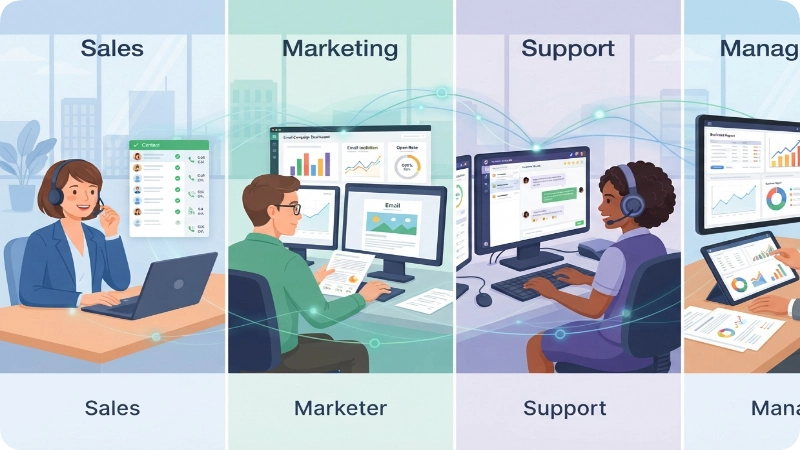
The letters CRM don’t change, but what people mean by them shifts depending on the setting.
In Sales
Sales teams use CRM to refer to the specific software they log calls, deals, and follow ups into. A sales rep might say, “I updated the CRM after the call,” meaning they added notes to a customer’s record.
In Marketing
Marketing teams often use CRM to describe the customer database that fuels email campaigns and audience segmentation. Here, CRM data helps decide who receives which message and when.
In Customer Support
Support teams use CRM to track tickets, complaints, and resolution history, so any team member can see a customer’s full history before responding.
In Job Listings and Business Strategy
When CRM appears in a job description, it usually refers to a specific tool (like a named platform) or to the broader skill of managing customer relationships and data responsibly.
Real Life Examples of CRM in a Sentence
Seeing CRM used naturally makes the concept easier to remember:
- Workplace: “Before you call the client, check the CRM for their last support ticket.”
- Job posting: “Experience with CRM software is preferred for this sales coordinator role.”
- Small business owner: “I finally moved my customer list from spreadsheets into a proper CRM.”
- Team meeting: “Our CRM shows a drop in repeat purchases this quarter.”
- Social media / LinkedIn: “Just completed a certification in CRM strategy excited to apply it at work.”
What a CRM System Actually Does
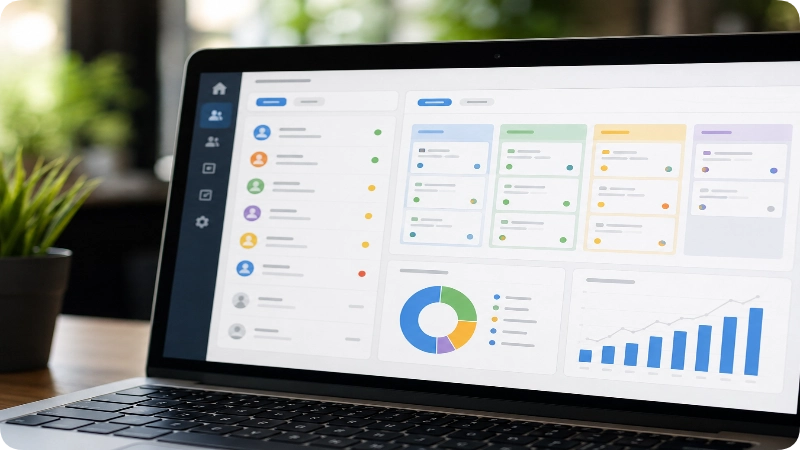
A CRM platform is built around a few core functions that support the customer relationship from first contact through long term loyalty.
| Function | What It Does | Who Uses It Most |
| Contact management | Stores names, emails, phone numbers, and company details | Sales, support |
| Interaction history | Logs calls, emails, meetings, and notes | Sales, marketing, support |
| Pipeline tracking | Shows where each deal or lead stands | Sales |
| Task and follow up reminders | Alerts teams when to reach out again | Sales, account managers |
| Reporting and analytics | Summarizes trends like sales performance or churn | Managers, business owners |
| Marketing integration | Connects customer data to email or ad campaigns | Marketing |
A small business might use a simple CRM mainly for contact storage, while a large company may rely on it for forecasting revenue and coordinating dozens of team members.
Common Misunderstandings About CRM
Because CRM is used loosely in everyday conversation, a few misunderstandings come up often.
- “CRM is just software.” It started as a business philosophy, and the software is only the tool that supports it. A company can have a CRM mindset without expensive software, especially when it’s small.
- “CRM is only for sales.” Marketing and customer support depend on CRM data just as heavily as sales does.
- “Any customer database counts as a CRM.” A basic spreadsheet can store contacts, but it lacks the automation, tracking, and history features that define true CRM software.
- “CRM and ERP are the same thing.” They are related but distinct, as explained below.
CRM vs. Similar Terms
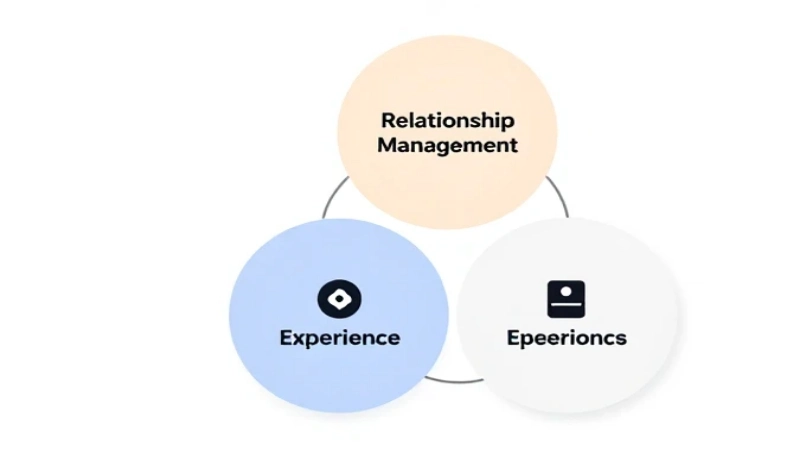
CRM is sometimes confused with other business acronyms. Here’s how they differ.
| Term | Full Meaning | Main Focus |
| CRM | Customer Relationship Management | Managing customer interactions and data |
| ERP | Enterprise Resource Planning | Managing internal operations like finance, inventory, and HR |
| CDP | Customer Data Platform | Unifying customer data from many sources for analytics |
| CX | Customer Experience | The overall feeling a customer has when interacting with a brand |
A simple way to remember the difference: CRM manages relationships, ERP manages resources, CDP unifies data, and CX describes the outcome. All of these aim to improve.
When to Use the Term CRM (and When to Be More Specific)
“CRM” works well as a general term when describing the category of tool or the discipline of managing customer relationships. It’s less useful when you need to name a specific action or platform.
- Use CRM when discussing the concept broadly: “We need a CRM strategy for the new product line.”
- Be more specific when naming a tool or task: “Update the deal stage in [Platform Name],” rather than just saying “update the CRM,” if precision matters for the audience.
This distinction matters most in professional writing, where vague references to “the CRM” can confuse readers unfamiliar with the specific system a team uses.
Common Mistakes People Make with the Term
A few small errors show up often when people write or say “CRM”:
- Writing “CRM’s” as a plural (it should be “CRMs,” without the apostrophe, when referring to multiple systems).
- Assuming CRM refers only to a single well known platform, when it’s actually a whole category of software from many providers.
- Using “CRM” and “customer service” interchangeably, when customer service is just one function a CRM can support.
Expert Tips for Understanding and Talking About CRM
- When learning a new job that mentions CRM, ask specifically which platform the company uses, since day to day usage varies widely between systems.
- If you’re evaluating CRM software for a business, focus first on what problem you’re solving (organizing contacts, tracking sales, automating marketing) rather than picking a tool based on popularity alone.
- Remember that a CRM is only as useful as the data entered into it; consistent updates matter more than advanced features.
Quick Summary
CRM stands for Customer Relationship Management. It describes both the strategy of managing customer relationships and the software that supports it, spanning sales, marketing, and customer service. While people often use it as shorthand for a specific software tool, its true meaning is broader: it’s about organizing and improving every interaction a business has with its customers.
FAQs
What does CRM stand for in business?
CRM stands for Customer Relationship Management, referring to how a business organizes and manages interactions with customers and prospects.
Is CRM a software or a strategy?
CRM refers to both. It began as a business strategy focused on customer relationships, and today it also describes the software tools that support that strategy.
What does CRM mean in a job description?
In a job listing, CRM usually refers to experience using customer relationship management software, or the general skill of managing customer data and communications.
Do small businesses need a CRM?
Many small businesses benefit from a CRM once they have more customers or leads than a spreadsheet can manage clearly, though the right timing depends on the business.
What’s the difference between CRM and a customer database?
A basic customer database stores contact information, while a CRM adds features like interaction history, task reminders, and reporting on top of that data.
Can CRM be used outside of sales?
Yes. Marketing teams use CRM data for campaigns, and support teams use it to track customer issues and history.
Is CRM the same as CX (customer experience)?
No. CRM refers to the system and process for managing relationships, while CX refers to the overall experience a customer has, which CRM tools can help improve.
Conclusion
CRM stands for Customer Relationship Management, a term that covers both a business approach and the software built to support it.
Understanding this dual meaning makes it easier to follow conversations in sales, marketing, and customer service, and to recognize why the term shows up across so many different professional contexts.
At its heart, CRM is simply about keeping track of customers well enough to serve them better over time.