A student once handed me an essay that used the word gap six times in four paragraphs: a gap in the wall, a gap in her knowledge, a gap in the schedule, and a gap between generations. Every sentence was technically correct, but the repetition made the writing feel dull.
That’s when I explain that gap is a useful word, but English offers many alternatives depending on whether you’re describing a physical space, a break in time, missing information, or a difference between people.
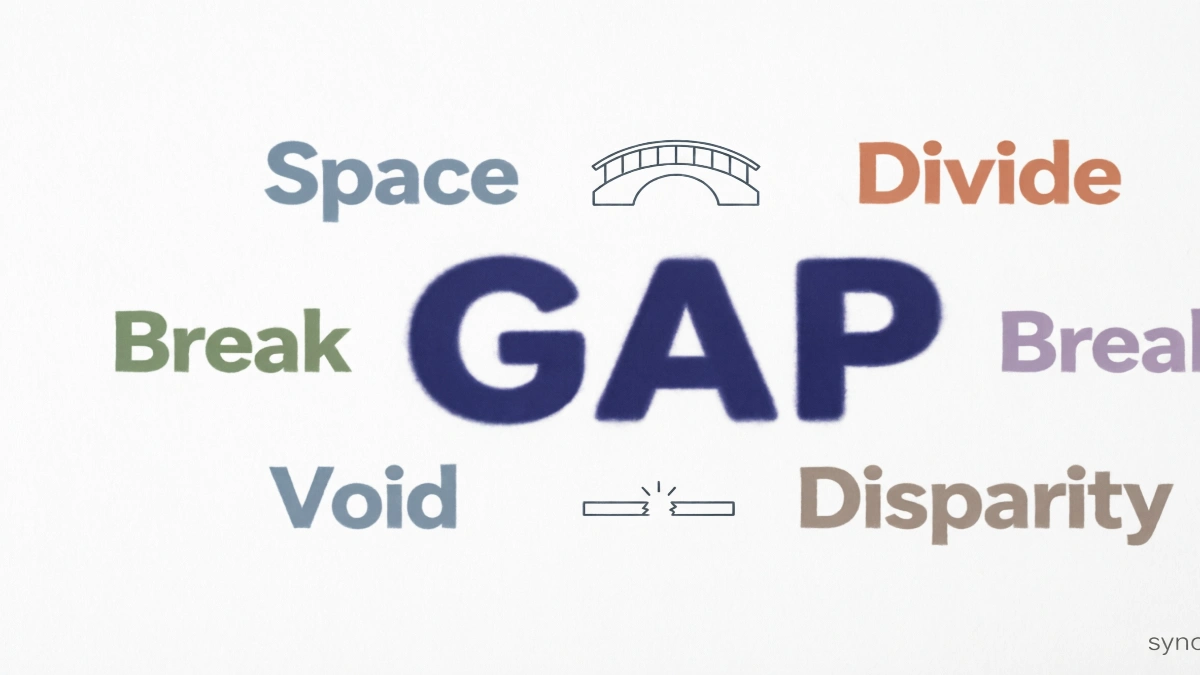
In this guide, you’ll learn more than 25 synonyms for gap, along with their meanings, examples, and tips for choosing the right one in every situation.
Quick Answer
“Gap” means an empty space, a break, or a difference between two things. Depending on context, you can replace it with words like space, opening, break, interval, void, hole, or divide. The right choice depends on if you’re describing a physical space, a break in time, or a difference between people, ideas, or amounts.
Meaning, Tone & Context
At its core, “gap” describes an interruption in something that would otherwise be continuous, a physical space between two objects, a break in time, or a difference in level, opinion, or amount between two things or groups.
The word itself is neutral and works comfortably across registers. You’ll hear it in casual conversation (“there’s a gap in the fence”), in academic writing (“a gap in the literature”), and in business reports (“a skills gap”). It doesn’t carry the formality of “interstice” or the emotional weight of “void” it’s the plain, reliable choice, which is exactly why writers often reach for something more specific once they’ve used it a couple of times.
How to Choose the Right Synonym for “Gap”
Choosing the best alternative depends on what kind of gap you’re describing.
- Use space, opening, or crevice for a physical gap.
- Choose break, interval, or pause for a gap in time.
- Use divide, disparity, or discrepancy for differences between groups or statistics.
- Choose void or emptiness when describing emotional absence.
- Use omission, blank, or deficiency when information or knowledge is missing.
Thinking about the context first helps you choose a synonym that sounds more natural and precise.
Synonyms for “Gap” by Context
The best synonym for gap depends on what kind of gap you’re describing. Here’s a quick guide to help you choose the most natural word.
| If you mean… | Best Synonyms |
| A physical space | space, opening, crevice, crack |
| A break in time | break, interval, pause, lull |
| Missing knowledge | deficiency, shortfall, omission |
| Difference between groups | disparity, divide, discrepancy |
| Emotional distance | void, emptiness, disconnect |
| Missing information | blank, omission |
| Business opportunity | opening, market opportunity |
Choosing a synonym based on the situation makes your writing sound more natural and precise.
Is “Gap” a Positive or Negative Word?
The word gap is usually neutral. It simply describes a space, break, or difference without suggesting whether it’s good or bad.
For example:
- “There is a gap between the chairs.” (neutral)
- “The company found a gap in the market.” (positive opportunity)
- “There is a large wage gap.” (negative difference)
The surrounding context determines whether the word has a positive, negative, or neutral meaning.
When & How to Use It
- Physical space: “There’s a gap between the curtains letting light in.”
- Time: “She took a two year gap between school and university.”
- Knowledge or skill: “The course is designed to close the gap in students’ grammar.”
- Difference between groups: “The wage gap between the two roles is significant.”
- Missing information: “There’s a gap in the timeline nobody can explain.”
Another Word for Gap
If you need one quick substitute, space or opening works for anything physical, break or interval works for time, and divide or disparity works for differences between people or groups. None of these is a perfect one size fits all replacement that’s really the point of this whole list.
No single synonym replaces gap in every situation. The best alternative depends on what you’re describing.
- Space → physical distance
- Opening → entrance or hole
- Break → interruption in time
- Interval → measured pause
- Disparity → unequal difference
- Divide → separation between groups
- Void → emotional absence
- Shortfall → missing amount
- Omission → something left out
- Crevice → narrow crack
If you’re unsure which word to choose, ask yourself whether you’re describing a place, a period of time, a missing piece of information, or a difference between people.
Can “Gap” Be Used as a Verb?
Although gap is mainly used as a noun, it occasionally appears as a verb in specialized contexts.
Examples include:
- The dentist gapped the teeth slightly.
- The earthquake gapped the road surface.
In everyday English, however, people almost always use gap as a noun. When describing an action, writers usually choose verbs such as:
- separate
- divide
- interrupt
- split
How to Avoid Repeating “Gap” in Your Writing
If you find yourself using gap several times in the same paragraph, replace it with more specific words instead of repeating the same noun.
Instead of writing:
The report identified a gap in skills, a gap in communication, and a gap in training.
You could write:
The report identified a skills deficiency, a communication divide, and a training shortfall.
Using more precise alternatives improves readability and keeps your writing from sounding repetitive.
Formal and Informal Alternatives to “Gap”
Some synonyms sound more natural in conversation, while others fit academic or professional writing.
Formal
- disparity
- discrepancy
- omission
- deficiency
- shortfall
Neutral
- gap
- space
- opening
- break
Informal
- hole
- blank
- empty spot
When Not to Use This Word
“Gap” can feel too casual or too vague in a few situations:
- Formal or academic writing about differences in data: “disparity” or “discrepancy” sounds more precise than “gap” in a research paper.
- Emotional or philosophical contexts: describing an emptiness after loss, “void” or “emptiness” carries weight that “gap” doesn’t.
- Legal or technical documents: “gap” is often too informal; “omission” or “lacuna” (in legal writing specifically) is more exact.
Words Commonly Confused With Gap
In my experience marking essays, three mix ups come up again and again:
- Gap vs. Hole A hole usually implies something went through or was removed (a hole in a sock, a hole in an argument). A gap is more often a space that was always there or that separates two edges. Students often use them interchangeably, but “a hole in the wall” and “a gap in the wall” suggest different causes.
- Gap vs. Void “Void” is emotionally or philosophically loaded (a void left after someone dies). Using “void” for something mundane, like a scheduling gap, sounds overdramatic.
- Gap vs. Rift A rift implies a break caused by conflict or disagreement, not just distance. “A gap between friends” is neutral; “a rift between friends” tells you something went wrong.
Examples of “Gap” in Different Contexts
Education
Teachers created extra lessons to close the knowledge gap before the exams.
Business
The company identified a gap in the market for affordable electric bicycles.
Healthcare
The new program aims to reduce the gap in healthcare access between rural and urban areas.
Relationships
Honest conversations helped bridge the communication gap between the two friends.
Technology
Many older devices have a compatibility gap with modern software.
Everyday Ways to Say “Gap”
In everyday English, people often replace gap with simpler words depending on the situation.
Some common alternatives include:
- space
- break
- opening
- room
- pause
- distance
- empty spot
Examples:
Formal:
There is a gap between the meetings.
Natural:
There is a break between the meetings.
Formal:
There is a gap in the fence.
Natural:
There is an opening in the fence.
These alternatives sound more conversational while keeping the meaning clear.
Different Forms of “Gap”
The word gap is mainly used as a noun, but it also appears in several common expressions.
| Form | Example |
| gap | There is a gap in the wall. |
| gaps | The report highlights several gaps. |
| gapped | The teeth are slightly gapped. |
| gapless | The album plays without any pauses between songs. |
| gap-filled | The presentation was gap-filled and needed more evidence. |
You’ll also see gap used in phrases such as gap year, skills gap, and generation gap.
| Form | Meaning | Example |
| gaping | wide open | A gaping hole appeared in the road. |
| gapless | without interruptions | The album plays gapless. |
| gap-filled | containing many missing parts | The report was gap-filled. |
| gapped | having spaces | She has slightly gapped teeth. |
Common Collocations with “Gap”
Certain words frequently appear with gap in English.
Some of the most common include:
- knowledge gap
- skills gap
- wage gap
- gender gap
- income gap
- communication gap
- generation gap
- price gap
- credibility gap
- gap in understanding
- gap in information
- gap in memory
- gap in employment
- gap in experience
- gap between ideas
- close the gap
- bridge the gap
- narrow the gap
- fill the gap
- identify a gap
- achievement gap
- education gap
- language gap
- experience gap
- wealth gap
- information gap
- performance gap
- digital gap
- technology gap
- expectation gap
- perception gap
- generation gap
Learning these natural word combinations will help you use gap more confidently in speaking and writing.
Best Synonym by Context
| Context | Best Synonym | Why |
| Physical space | Space, opening, crevice | Describes literal distance or an empty area |
| Time | Break, interval, lull | Works for pauses or breaks in a sequence |
| Knowledge/skill | Deficiency, shortfall | Common in education and business writing |
| Difference between groups | Divide, disparity | Standard in social and economic contexts |
| Emotional absence | Void, emptiness | Carries the weight of loss or longing |
| Missing information | Omission, blank | Useful when something specific is missing |
Which Synonym Should You Choose?
Ask yourself three questions: Is it physical, temporal, or abstract? Is the tone formal or casual? And does the situation carry emotional weight? A literal, casual space gets “opening” or “space.” A formal comparison between statistics gets “disparity” or “discrepancy.” A deeply felt absence gets “void” or “emptiness.” When in doubt, “gap” itself is rarely wrong; it’s just rarely the most precise choice either.
Real Life Examples
School: “There’s a noticeable gap between what the textbook covers and what’s actually tested.” → “There’s a noticeable discrepancy between what the textbook covers and what’s actually tested.”
Workplace: “We need to close the gap between departments.” → “We need to close the divide between departments.”
Writing: “A gap in the plot left readers confused.” → “An inconsistency in the plot left readers confused.”
Conversation: “There’s a gap in my schedule on Thursday.” → “There’s an opening in my schedule on Thursday.”
Synonyms Table
| Synonym | Simple Meaning | Example Sentence |
| Space | An empty area between things | “Leave a space between each row of plants.” |
| Opening | A gap that allows entry or access | “There’s an opening in the fence big enough to crawl through.” |
| Break | A pause or interruption | “We took a short break between meetings.” |
| Interval | A pause between two events, often measured | “There’s a ten minute interval between the acts.” |
| Gap year | A break, usually a year, before further study or work | “He took a gap year before college.” |
| Void | A complete emptiness, often emotional | “Her passing left a void in the family.” |
| Hole | An opening created by something missing or removed | “There’s a hole in the plan we haven’t addressed.” |
| Divide | A significant difference separating two groups | “The digital divide affects rural communities.” |
| Disparity | A noticeable, often unfair difference | “There’s a disparity in pay between the two teams.” |
| Discrepancy | A difference between things that should match | “There’s a discrepancy in the two reports.” |
| Shortfall | An amount by which something falls short | “There’s a shortfall in the budget this quarter.” |
| Deficiency | A lack of something necessary | “The test revealed a deficiency in basic math skills.” |
| Chasm | A very large, often dramatic gap | “A chasm opened up between their political views.” |
| Rift | A gap caused by disagreement or conflict | “The decision created a rift between the two founders.” |
| Lull | A temporary quiet period between busier times | “There was a lull in the conversation before dinner.” |
| Interlude | A short period between two events, often in performance | “The interlude gave the actors time to change costumes.” |
| Crevice | A narrow physical gap or crack | “Water seeped through a crevice in the rock.” |
| Crack | A narrow opening, often unintended | “Light came through a crack in the door.” |
| Interruption | A break in continuity | “The interruption in service lasted an hour.” |
| Blank | A missing piece of information | “There’s a blank in her memory of that day.” |
| Omission | Something left out, often on purpose or by mistake | “The report contained a significant omission.” |
| Vacancy | An unfilled position or space | “There’s a vacancy on the board this year.” |
| Distance | Separation, physical or emotional | “There’s a growing distance between the two of them.” |
| Pause | A brief stop | “He left a pause before answering.” |
Using “Gap” in Academic and Professional Writing
The word gap frequently appears in research papers, reports, and business documents because it describes areas where information, performance, or understanding is incomplete.
Common examples include:
- research gap
- knowledge gap
- skills gap
- evidence gap
- learning gap
- funding gap
In formal writing, authors often replace gap with words such as disparity, deficiency, shortfall, or omission when greater precision is needed.
Synonym Groups & Usage Differences
Formal / Academic: disparity, discrepancy, deficiency, omission common in reports, essays, and research.
Everyday / Conversational: space, break, hole, opening natural in spoken English and casual writing.
Emotionally Loaded: void, chasm, rift reserved for situations involving loss, conflict, or strong feeling; avoid using these for mundane gaps, as it can sound melodramatic.
Business / Professional: shortfall, disparity, divide frequently used in corporate and economic contexts (e.g., “skills gap,” “wage gap”).
Physical / Spatial: crevice, crack, opening, space describe literal, measurable gaps.
Antonyms Table
| Antonym | Meaning | Example |
| Continuity | An unbroken flow or connection | “The bridge restored continuity between the two neighborhoods.” |
| Connection | A link joining two things | “There’s a strong connection between the two departments now.” |
| Unity | A state of being joined as one | “The merger brought unity to the two companies.” |
| Wholeness | A complete, unbroken state | “The restoration returned the sculpture to wholeness.” |
| Completion | The state of being finished or filled | “The final report brought a sense of completion to the project.” |
Comparison Section
Gap vs. Void: “Gap” is neutral and can apply to anything from a fence to a schedule. “Void” is heavier, almost always emotional or philosophical, and rarely used for small or practical matters.
Disparity vs. Gap: “Disparity” is more formal and usually implies unfairness or inequality; it’s the standard term in discussions of income, opportunity, or treatment. “Gap” can describe the same thing more casually.
Gap vs. Rift: A rift specifically implies a break caused by disagreement between people. A gap is neutral because it might just be distance, not conflict.
Interval vs. Gap: “Interval” is more precise and often measured (a ten minute interval), while “gap” is looser and can refer to any unspecified length of time or space.
Quick Guide to the Best Synonyms for “Gap”
| If you mean… | Best Word |
| Empty space | Space |
| Opening | Opening |
| Break in time | Interval |
| Missing information | Omission |
| Difference between groups | Disparity |
| Separation | Divide |
| Emotional absence | Void |
| Conflict between people | Rift |
| Budget shortage | Shortfall |
| Narrow crack | Crevice |
Common Phrases & Expressions
- “Mind the gap” a warning to be careful of a physical space, famously used on the London Underground. “Mind the gap between the platform and the train.”
- “Gap year” a break, typically a year, taken between school and further study or work. “She’s taking a gap year to travel before university.”
- “Bridge the gap” to reduce or eliminate a difference between two things. “This program aims to bridge the gap between theory and practice.”
- “Fill the gap” to provide something that was missing. “The new hire fills the gap left by the last manager.”
- “Gap in the market” an unmet need or opportunity in business. “They spotted a gap in the market for affordable eco friendly packaging.”
- “Generation gap” a difference in attitudes or understanding between older and younger people. “The generation gap made the conversation about social media awkward.”
- “Close the gap” to make progress toward eliminating a difference. “The team worked hard to close the gap in the final quarter.”
Common Mistakes to Avoid
- Using “void” for small, everyday gaps. “There’s a void in my schedule” sounds odd save “void” for genuinely significant absences.
- Confusing “gap” with “hole” in cause and effect contexts. A hole often implies something was removed or damaged; a gap often implies something was never there or naturally separates two parts.
- Overusing “gap” in academic writing. In research or formal essays, repeating “gap” (as in “gap in the literature”) across multiple paragraphs reads as repetitive, varying it with “shortfall,” “deficiency,” or “omission” where appropriate.
- Using “rift” when there’s no actual conflict. A rift implies disagreement; don’t use it just to sound more dramatic about a neutral separation.
FAQs
Is “gap” formal or informal?
It’s neutral and comfortable in both casual conversation and formal writing, though very formal or academic writing sometimes prefers more specific terms like “disparity” or “discrepancy.”
What’s the difference between a gap and a void?
A gap is neutral and can describe anything from a physical space to a difference in opinion. A void is emotionally heavier and usually describes a deep, often painful, absence.
What does “gap year” mean exactly?
It refers to a break, typically about a year, that someone takes between finishing school and starting university or a job, often used for travel, work, or personal development.
Is “chasm” just a stronger word for “gap”?
Yes, largely. “Chasm” describes a much larger or more dramatic gap, often used figuratively to describe deep differences in opinion, understanding, or circumstance.
Can “gap” be used for people’s feelings, not just facts or space?
Yes you’ll often hear “emotional gap” or “gap in understanding” to describe a distance between people’s feelings or perspectives, though “distance” or “disconnect” are also common in that context.
What is the best synonym for “gap”?
The best synonym depends on the context. Space works well for physical gaps, interval for breaks in time, disparity for differences between groups, and void for emotional absence.
Is “gap” a formal word?
No. Gap is considered neutral and works well in both everyday conversation and formal writing. In highly academic or technical writing, more specific alternatives such as discrepancy, deficiency, or omission may be preferred.
What is another word for “gap” in business?
In business writing, common alternatives include shortfall, disparity, opening, vacancy, divide, and market opportunity, depending on the situation.
What is the difference between “gap” and “disparity”?
A gap is a general separation or difference, while disparity usually describes a significant or unfair difference between two groups, amounts, or situations.
Can “gap” describe emotions?
Yes. People often use expressions such as emotional gap, communication gap, or gap in understanding. However, if the absence is deep or permanent, void may express the feeling more strongly.
What is another word for a knowledge gap?
Words such as deficiency, shortfall, lack, and information gap are commonly used when discussing missing knowledge or skills. In education and research, knowledge gap remains the most natural phrase.
What is another word for a gap in time?
For a break in time, common alternatives include interval, pause, break, lull, and interlude. The best choice depends on how long the break lasts and the context.
What is another word for a gap between people?
Depending on the situation, you can use divide, distance, disconnect, rift, or disparity. A rift suggests conflict, while distance often refers to emotional separation.
What is another word for a gap in writing?
When referring to missing information in writing, common alternatives include omission, blank, missing section, inconsistency, or lacuna in formal academic contexts.
Is “gap” a noun or an adjective?
Gap is primarily a noun. It describes a space, difference, or break between two things. Although it appears in compound adjectives such as gap-year student, the word itself is generally used as a noun.
Conclusion
Gap is a flexible word that describes spaces, breaks, differences, and missing pieces in many situations. However, choosing a more specific synonym such as space, interval, disparity, void, or omission can make your writing clearer and more engaging. The best alternative depends on whether you’re talking about a physical space, a period of time, missing information, or a difference between people. As you build your vocabulary, focus on understanding each word’s meaning and tone instead of memorizing long lists. With practice, you’ll naturally choose the synonym that fits your sentence best and make your writing sound more precise and confident.