Imagine your teacher asks whether social media is good or bad for students. You could answer, “Social media is bad because it wastes time.” However, a more thoughtful response might be, “Social media can distract students, but it also provides educational resources and opportunities to connect with others.”
The second answer is more nuanced because it recognizes different sides of the same issue.
You may also encounter this word in professional reports, book reviews, academic essays, workplace discussions, and everyday conversations. For example, a writer might offer a nuanced explanation of a difficult topic, while a manager might take a nuanced approach to resolving a disagreement.
But what does nuanced mean, and which words can replace it?
In this guide, you’ll learn 50 synonyms of nuance, their meanings, practical examples, common expressions, and the differences between closely related words. You’ll also discover how to choose the right alternative for school, work, writing, and speaking.
Quick Answer
Nuanced means showing small but important differences in meaning, feeling, opinion, or understanding. Synonyms include subtle, sophisticated, detailed, balanced, complex, refined, and discerning, depending on the context. A nuanced explanation considers different perspectives instead of presenting an issue as entirely simple or one-sided.
Meaning, Tone & Context
The adjective nuanced describes something that recognizes or expresses subtle differences, small distinctions, or different aspects of a subject.
A nuanced opinion, for example, considers more than one perspective. Similarly, a nuanced explanation explores details that a simple explanation might overlook.
Consider these examples:
- Nuanced opinion: “Online learning offers flexibility, although some students need more direct support.”
- Nuanced description: “The painting combines warm colors with subtle shadows.”
- Nuanced understanding: “She understands that people can disagree without being completely wrong.”
The word often appears in academic, professional, and intellectual discussions. However, it also works in everyday English whenever you want to describe a thoughtful, balanced, or detailed view.
Its tone is generally positive because it suggests careful thinking and attention to detail.
Nevertheless, nuanced does not always mean balanced. A nuanced description can recognize several details without giving equal weight to every side. The precise meaning depends on the context.
When & How to Use “Nuanced”
Use nuanced when a person, explanation, argument, interpretation, or description recognizes meaningful differences.
1. Describing opinions
A nuanced opinion considers different perspectives instead of making an overly simple judgment.
Example: “She offered a nuanced opinion about the benefits and risks of artificial intelligence.”
2. Explaining complex topics
When an issue has several connected causes or consequences, a nuanced explanation can show how those factors interact.
Example: “The documentary presents a nuanced account of poverty and education.”
3. Discussing emotions
People often experience mixed feelings rather than one simple emotion.
Example: “His nuanced reaction showed both relief and disappointment.”
4. Writing academic essays
Students can use nuance when discussing arguments, interpretations, evidence, or historical events.
Example: “The essay develops a nuanced interpretation of the novel.”
5. Giving feedback at work
A manager might recognize both the strengths and weaknesses of an employee’s performance.
Example: “The review provides a nuanced assessment of the team’s progress.”
In each situation, nuanced suggests that the subject deserves careful consideration.
Another Word for Nuanced
The best alternative depends on the meaning you want to emphasize.
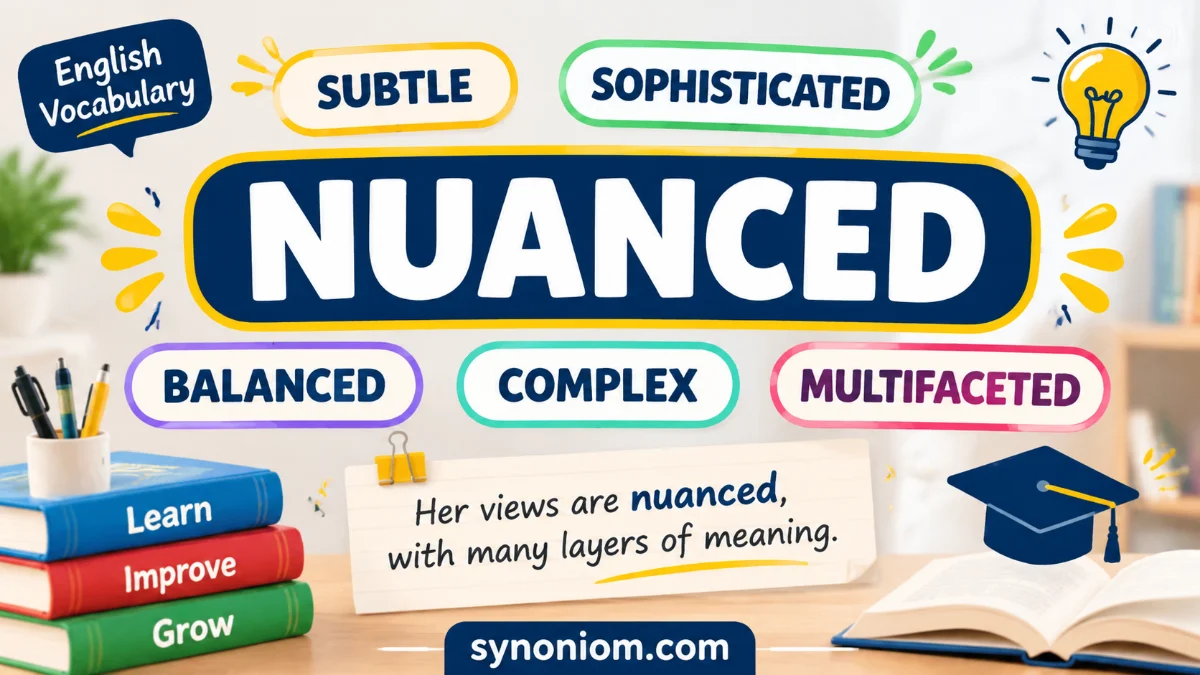
- Subtle: Small but meaningful differences.
- Complex: Several connected parts or factors.
- Detailed: Plenty of specific information.
- Sophisticated: Advanced, thoughtful, or carefully developed.
- Balanced: Fair consideration of different sides.
- Refined: Carefully developed or sensitive to fine distinctions.
- Discerning: Able to recognize meaningful differences in quality or character.
- Multifaceted: Having several different aspects.
- Perceptive: Showing a strong ability to notice or understand things.
- Thoughtful: Showing careful consideration.
For example, a nuanced argument might be a balanced argument, a sophisticated argument, or a multifaceted argument. However, these alternatives emphasize different qualities, so they are not always interchangeable.
When Not to Use This Word
Avoid nuance when you simply mean that something contains many facts or is difficult to understand.
For example, “The report is nuanced” does not necessarily mean that the report is long or full of statistics. It means that the report recognizes subtle distinctions or different aspects of its subject.
If you mean that a report includes many facts, detailed is more accurate.
If the subject involves many interconnected parts, the complex may fit better.
Similarly, don’t call an argument nuanced simply because it mentions two opposing opinions. The argument should show meaningful distinctions or a thoughtful understanding of the issue.
In casual conversation, the word may also sound unnecessarily academic. Sometimes, “She understands both sides” communicates the idea more naturally.
Words Commonly Confused With Nuanced
Several words share part of the nuanced meaning of nuanced, but each has its own emphasis.
- Subtle: Focuses on small or difficult-to-notice differences.
- Complex: Focuses on multiple connected parts or factors.
- Detailed: Focuses on the amount and specificity of information.
- Balanced: Focuses on fair consideration of different perspectives.
- Sophisticated: Suggests advanced understanding, skill, or development.
- Multifaceted: Highlights the several aspects of a subject.
- Perceptive: Describes someone who notices or understands things well.
- Ambiguous: Describes something that has more than one possible meaning or is unclear.
Importantly, ambiguous is not a direct synonym for nuanced. A nuanced statement can be precise and clear, while an ambiguous statement may leave its meaning uncertain.
Best Synonym by Context
| Context | Best Synonym | Why It Fits |
| Opinions | Balanced | Recognizes different perspectives fairly |
| Academic writing | Sophisticated | Shows developed reasoning |
| Detailed explanations | Elaborate | Presents an idea with careful development |
| Emotional descriptions | Subtle | Captures small emotional differences |
| Complex issues | Multifaceted | Recognizes several aspects |
| Professional reports | Comprehensive | Covers the relevant subject broadly |
| Literary analysis | Perceptive | Shows insight into meaning |
| Artistic descriptions | Refined | Emphasizes careful detail and sensitivity |
| Critical thinking | Discerning | Recognizes important distinctions |
| Everyday conversation | Thoughtful | Suggests careful consideration |
Which Synonym Should You Choose?
First, decide what makes the original statement nuanced.
If it recognizes small differences, choose subtle. If it explores several connected factors, choose complex or multifaceted. For an opinion that considers opposing viewpoints fairly, balanced may be the best option.
Meanwhile, detailed works when the emphasis falls on specific information. Choose sophisticated when an idea demonstrates advanced understanding, and use perceptive when someone notices something others might miss.
For example:
- “She gave a nuanced answer.” → “She gave a thoughtful, balanced answer.”
- “The novel offers a nuanced portrayal of family life.” → “The novel offers a subtle, multifaceted portrayal of family life.”
- “He has a nuanced understanding of the issue.” → “He has a sophisticated understanding of the issue.”
The best synonym preserves the original meaning rather than merely sounding impressive.
Real-Life Examples of “Nuanced” in Sentences
School
“The student developed a nuanced argument about the advantages and disadvantages of online education.”
Workplace
“Our manager offered a nuanced assessment of the project’s results, recognizing both the progress and the remaining challenges.”
Writing
“The author provides a nuanced portrayal of friendship, showing how affection and jealousy can exist together.”
Conversation
“I appreciate your nuanced view because you understand why both people feel frustrated.”
These examples show how nuanced adds depth to discussions, writing, and personal opinions.
50 Synonyms of Nuanced
The following words are useful alternatives in specific contexts. Some are close synonyms, while others express one particular quality often associated with a nuanced idea.
| Synonym | Simple Meaning | Example Sentence |
| 1. Subtle | Showing small but meaningful differences | The writer captures the subtle changes in her mood. |
| 2. Sophisticated | Advanced or carefully developed | She presented a sophisticated analysis of the issue. |
| 3. Complex | Involving several connected factors | The book explores a complex social problem. |
| 4. Detailed | Including specific information | He provided a detailed explanation of the decision. |
| 5. Balanced | Considering different sides fairly | The article offers a balanced view of the debate. |
| 6. Refined | Carefully developed or sensitive to distinctions | Her refined interpretation reveals the poem’s deeper meaning. |
| 7. Discerning | Able to recognize important differences | A discerning reader notices the author’s subtle clues. |
| 8. Thoughtful | Showing careful consideration | She gave a thoughtful response to the criticism. |
| 9. Perceptive | Showing insight and understanding | His perceptive comments improved the discussion. |
| 10. Multifaceted | Having several different aspects | The documentary explores a multifaceted issue. |
| 11. Elaborate | Carefully developed with many details | The researcher offered an elaborate explanation. |
| 12. Comprehensive | Covering the relevant aspects broadly | The report provides a comprehensive assessment. |
| 13. Intricate | Containing many connected details | The novel presents an intricate picture of family relationships. |
| 14. Discriminating | Able to judge fine differences in quality | A discriminating critic recognizes the strengths of the performance. |
| 15. Insightful | Showing a deep understanding | Her insightful analysis changed our perspective. |
| 16. Considered | Thoughtfully examined before a decision | The committee reached a considered conclusion. |
| 17. Qualified | Limited or adjusted by important conditions | He offered a qualified endorsement of the proposal. |
| 18. Contextual | Connected to the circumstances surrounding something | A contextual reading explains the character’s decision. |
| 19. Sophisticated | Showing advanced knowledge or skill | The team developed a sophisticated approach to the problem. |
| 20. Fine-grained | Recognizing very small distinctions | The study provides a fine-grained analysis of language use. |
| 21. Layered | Containing several levels of meaning | The film offers a layered portrayal of grief. |
| 22. Many-sided | Involving several perspectives | The debate raised many-sided questions about fairness. |
| 23. Well-rounded | Including several relevant aspects | Her well-rounded assessment considers costs and benefits. |
| 24. Tempered | Moderated by caution or restraint | He gave a tempered response to the disappointing news. |
| 25. Measured | Careful and controlled | The director made a measured statement about the changes. |
| 26. Reflective | Showing careful thought | His reflective essay explores the meaning of success. |
| 27. Analytical | Examining parts and relationships carefully | She took an analytical approach to the debate. |
| 28. Perceptual | Related to the way something is perceived | The research examines perceptual differences between viewers. |
| 29. Dispassionate | Not strongly influenced by emotion | The report provides a dispassionate review of the evidence. |
| 30. Impartial | Not favoring one side unfairly | The judge offered an impartial assessment of the arguments. |
| 31. Even-handed | Treating opposing sides fairly | The journalist wrote an even-handed account of the dispute. |
| 32. Discreet | Careful and tactful about what is said or done | She made a discreet distinction between the two concerns. |
| 33. Delicate | Involving fine distinctions or sensitivity | The discussion required a delicate understanding of cultural differences. |
| 34. Nuance-aware | Attentive to subtle differences in meaning | A nuance-aware editor preserves the writer’s intended tone. |
| 35. Discriminative | Able to distinguish between different things | The test has discriminative power across the two groups. |
| 36. Exacting | Requiring great care and precision | The editor applied an exacting standard to the analysis. |
| 37. Precise | Clear and exact | Her precise explanation separates the two ideas. |
| 38. Specific | Clearly identified rather than general | The report gives a specific account of the circumstances. |
| 39. Qualified in tone | Expressing a claim with suitable limits | His qualified statement leaves room for exceptions. |
| 40. Context-sensitive | Taking surrounding circumstances into account | A context-sensitive interpretation considers the speaker’s intention. |
| 41. Sophisticated in thought | Demonstrating advanced reasoning | Her sophisticated thinking helped resolve the disagreement. |
| 42. Fine | Sensitive to small distinctions | The critic showed a fine understanding of the painting’s style. |
| 43. Complex-minded | Able to consider complicated ideas | The discussion benefited from a complex-minded approach to the issue. |
| 44. Discerning in judgment | Able to make careful distinctions | Her discerning judgment helped the team evaluate the options. |
| 45. Balanced in tone | Avoiding an overly one-sided presentation | The review remains balanced in tone throughout. |
| 46. Thought-provoking | Encouraging deeper thought | The essay offers a thought-provoking interpretation of the event. |
| 47. Interpretive | Involving an explanation of meaning | The critic provided an interpretive reading of the poem. |
| 48. Dispassionate in approach | Examining an issue without strong emotional bias | The investigator maintained a dispassionate approach to the evidence. |
| 49. Qualified in scope | Limited to particular conditions or circumstances | The conclusion is qualified in scope because the sample was small. |
| 50. Carefully differentiated | Clearly distinguishing related ideas | The essay presents carefully differentiated views of justice. |
Vocabulary note: The closest natural substitutes in most situations are subtle, sophisticated, balanced, detailed, thoughtful, perceptive, and multifaceted. Some entries in the table are descriptive expressions rather than direct one-word synonyms, and technical terms such as discriminative have specialized uses. Choose an alternative that fits the sentence instead of treating all 50 as interchangeable.
Synonym Groups & Usage Differences
Formal and Academic Synonyms
In essays, research papers, and academic discussions, words such as sophisticated, multifaceted, contextual, analytical, and fine-grained can describe careful reasoning or detailed interpretation.
For example: “The study offers a fine-grained analysis of regional language differences.”
These choices sound precise, but technical expressions work best when they accurately describe the method or idea.
Professional Synonyms
At work, balanced, comprehensive, measured, considered, and impartial can communicate careful judgment.
For example: “The team produced a balanced assessment of the proposed changes.”
Use comprehensive when coverage matters, impartial when fairness matters, and measured when restraint matters.
Conversational Synonyms
In everyday speech, thoughtful, subtle, complex, and balanced usually sound natural.
For example: “That’s a thoughtful way to look at the situation.”
You can also say, “It’s more complicated than that,” when you want a simple alternative to a more academic phrase.
Stronger vs. Weaker Alternatives
The word nuanced does not have a simple scale of strength. Instead, different synonyms highlight different qualities.
- Subtle emphasizes small distinctions.
- Detailed emphasizes information.
- Complex emphasizes interconnected parts.
- Sophisticated emphasizes advanced development.
- Multifaceted emphasizes several aspects.
Therefore, choose according to meaning rather than intensity.
Emotional vs. Neutral Alternatives
Thoughtful, perceptive, and insightful often sound approving because they praise someone’s understanding.
By contrast, analytical, contextual, and dispassionate are more descriptive. They explain how someone approaches an issue without automatically praising the result.
Modern vs. Old-Fashioned Language
Most common alternatives, including subtle, complex, detailed, balanced, and thoughtful, remain natural in modern English.
Expressions such as fine-grained are also common in specialist discussions, especially when writers need to distinguish small categories or differences. However, expressions such as nuance-aware and complex-minded are less established and usually work better as descriptive phrases than as standard synonyms.
Antonyms of Nuanced
The opposite of nuanced depends on what quality you want to contrast.
| Antonym | Meaning | Example |
| Simplistic | Treating a complicated subject as too simple | The article gives a simplistic explanation of poverty. |
| Oversimplified | Leaving out important details or distinctions | His oversimplified argument ignores several causes. |
| One-sided | Considering only one perspective | The report presents a one-sided view of the disagreement. |
| Unbalanced | Failing to give appropriate consideration to different aspects | The review offers an unbalanced assessment of the evidence. |
| Crude | Lacking refinement or careful detail | The model provides a crude estimate of the results. |
| Blunt | Expressed directly without much subtlety | Her blunt response left little room for interpretation. |
| Superficial | Focusing on the surface rather than deeper meaning | The article gives a superficial treatment of the subject. |
| Undifferentiated | Not distinguishing between relevant categories | The analysis treats several different groups as undifferentiated. |
| Black-and-white | Treating an issue as having only two clear sides | His black-and-white view ignores the middle ground. |
| Unqualified | Expressed without limits, reservations, or conditions | She gave the proposal her unqualified support. |
Note that unqualified is an antonym only in certain contexts. A nuanced statement may include qualifications, but unqualified can also mean complete or unconditional, so it is not always the opposite of nuanced.
Nuanced vs. Subtle
Meaning Differences
Nuanced describes the recognition or expression of meaningful distinctions. Subtle describes differences or qualities that are small, delicate, or not immediately obvious.
Example: “The essay offers a nuanced argument.”
Example: “The essay contains subtle changes in tone.”
Tone Differences
Both words can sound thoughtful and analytical. However, nuanced more often describes reasoning, interpretation, and opinions, while subtle also describes colors, sounds, emotions, and gestures.
Emotional Intensity
Neither word is inherently stronger. A subtle detail may be easy to miss, while a nuanced argument may contain many important distinctions.
Formality Level
Both words work in formal and informal English.
Natural Usage Situations
Use nuanced for an argument or understanding. Use subtle for a small difference, a quiet hint, or a slight emotional change.
Nuanced vs. Complex
Meaning Differences
Complex means involving several connected parts or factors. Nuanced means recognizing or expressing meaningful distinctions.
Example: “The problem is complex.”
Example: “Her response to the problem was nuanced.”
Tone Differences
Both words are common in professional and academic writing. However, complex describes the subject, while nuanced often describes the way someone understands or presents it.
Emotional Intensity
Complex can suggest difficulty. Nuanced usually suggests careful understanding, although the two qualities can appear together.
Formality Level
Both are suitable for academic, professional, and everyday contexts.
Natural Usage Situations
Choose a complex when a subject has many connected parts. Choose nuanced when an explanation recognizes subtle differences within that subject.
Nuanced vs. Detailed
Meaning Differences
Detailed means including many specific facts or pieces of information. Nuanced means recognizing distinctions that affect interpretation.
Example: “The report contains detailed statistics.”
Example: “The report offers a nuanced interpretation of those statistics.”
Tone Differences
Detailed is straightforward and descriptive. Nuanced often sounds more analytical.
Emotional Intensity
Neither word is inherently emotional, but nuanced can suggest a deeper understanding.
Formality Level
Both work well in formal writing and professional communication.
Natural Usage Situations
Use detail when information is extensive. Use nuance when the information shows important distinctions.
Common Phrases & Expressions
A Nuanced Approach
Meaning: A way of handling something that considers different factors and circumstances.
Example: “The school adopted a nuanced approach to student discipline.”
A Nuanced Understanding
Meaning: An understanding that recognizes subtle differences or complications.
Example: “Reading different perspectives gave her a nuanced understanding of the issue.”
A Nuanced Perspective
Meaning: A viewpoint that considers several aspects rather than oversimplifying.
Example: “His nuanced perspective helped the group move beyond the disagreement.”
A Nuanced Argument
Meaning: An argument that recognizes distinctions, limitations, or competing considerations.
Example: “She presented a nuanced argument about the benefits of remote work.”
A Nuanced Portrayal
Meaning: A description or representation that shows complexity and subtle differences.
Example: “The film offers a nuanced portrayal of a difficult family relationship.”
A Nuanced View of Something
Meaning: An opinion that accounts for different aspects of a subject.
Example: “Travel gave him a more nuanced view of other cultures.”
A Nuanced Interpretation
Meaning: An explanation of meaning that recognizes subtle distinctions.
Example: “The critic offers a nuanced interpretation of the poem’s final scene.”
Common Mistakes to Avoid
1. Using “complex” for every instance of “nuanced.” A complex issue has several connected parts, but a nuanced explanation specifically recognizes important distinctions.
2. Confusing “nuanced” with “ambiguous.” Nuanced language can be precise. Ambiguous language leaves room for multiple interpretations.
3. Assuming that nuanced always means balanced. A nuanced argument recognizes relevant differences, but it does not necessarily give every viewpoint equal weight.
4. Using academic language unnecessarily. In casual conversation, “thoughtful” or “carefully considered” may sound more natural than nuanced.
5. Treating detailed information as nuanced reasoning. A long explanation can still oversimplify an issue. Nuance depends on how well the explanation recognizes meaningful differences.
FAQs
What does nuance mean in simple words?
Nuanced means recognizing small but important differences in an idea, opinion, feeling, or situation. A nuanced answer looks beyond a simple yes-or-no judgment.
What is the best synonym for nuanced?
Subtle, balanced, sophisticated, thoughtful, and multifaceted are useful alternatives. The best choice depends on whether you mean small differences, fair consideration, advanced reasoning, or several aspects.
Is nuanced a positive word?
Usually, yes. It often praises careful thinking and a detailed understanding. However, the word itself is descriptive, so the surrounding sentence determines the overall meaning.
What is the difference between nuanced and complex?
Complex describes something with several connected parts. Nuanced describes an understanding or presentation that recognizes meaningful distinctions. A subject can be complex without anyone explaining it in a nuanced way.
What is the opposite of nuanced?
Depending on the context, useful opposites include simplistic, oversimplified, one-sided, superficial, and black-and-white. These words describe explanations or opinions that overlook important distinctions.
Conclusion
Learning synonyms of nuance can help you express ideas more accurately in essays, workplace discussions, reviews, and everyday conversations. However, the most effective alternative depends on the meaning you want to convey.
Choose subtle for small but meaningful differences, complex for interconnected factors, detailed for specific information, and balanced for fair consideration of different perspectives. Meanwhile, sophisticated, perceptive, and multifaceted can describe more developed ways of understanding a subject.
Rather than memorizing every alternative, practice using a few in your own sentences. For example, describe a book with a nuanced portrayal, a discussion with a balanced perspective, or an explanation with subtle distinctions. As you read articles and listen to natural English, notice how writers use these words..