“I have a goal to improve my English this year.”
That sentence sounds natural, but you may not want to use goal every time. For example, in a workplace report, the objective may sound more professional. In a sports conversation, the target may fit better. When talking about a big personal dream, ambition or aspiration can express the idea more clearly.
So, what is another word for goal?
The answer depends on what you mean. Some alternatives describe a specific result, while others describe a personal dream, purpose, plan, or desired destination.
In this guide, you will learn 50 useful synonyms for goals, how their meanings differ, when to use them, and which alternatives sound natural in school, work, writing, and everyday conversation.
Quick Answer
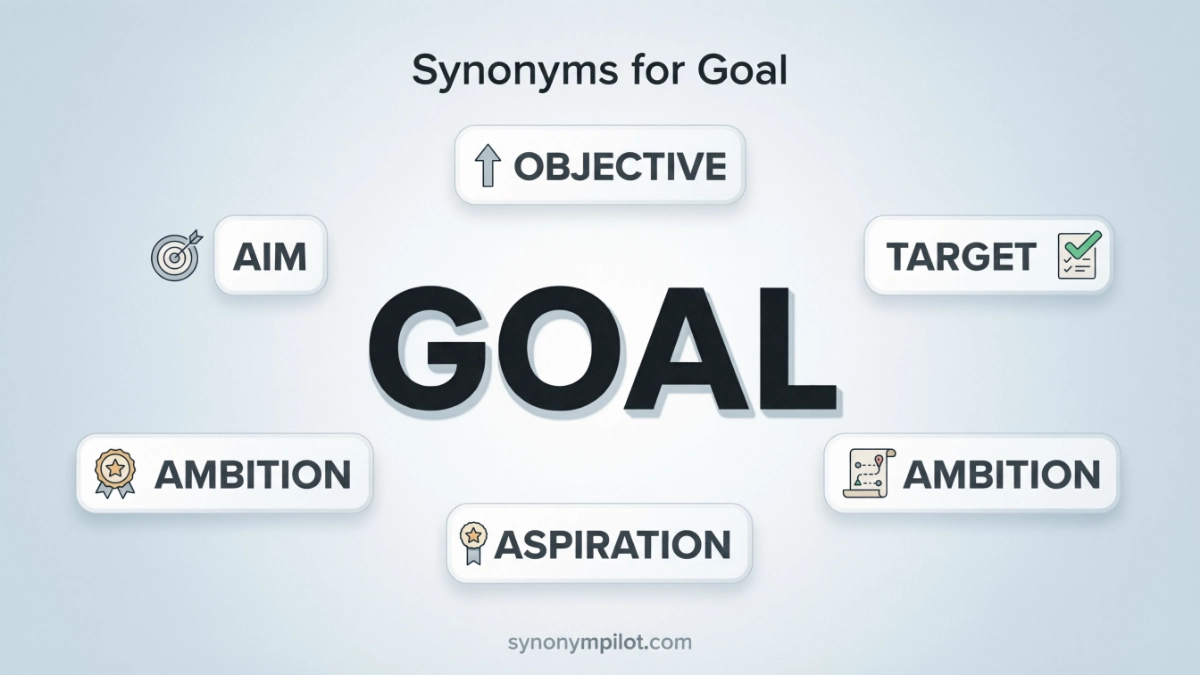
A goal is something you want to achieve, complete, or accomplish. Depending on the situation, you can use words such as aim, objective, target, purpose, ambition, aspiration, intention, or milestone instead.
Meaning, Tone & Context
The noun goal refers to something a person, group, or organization wants to achieve.
For example:
- My goal is to pass the English exam.
- The team’s goal is to increase sales.
- She set a personal goal to read 20 books this year.
The word is neutral, so you can use it in casual conversation, academic writing, professional documents, and personal discussions.
Goal in personal situations
When you talk about something you want to achieve personally, the goal is very natural.
My goal is to become more confident when speaking English.
Goal in professional situations
Businesses often use goals for desired results.
Our main goal is to improve customer satisfaction.
However, objective, target, or business aim can sometimes sound more precise in professional writing.
Goal in academic situations
Students can use goals to describe something they want to accomplish.
My goal is to complete my research project before Friday.
In formal academic writing, objective or aim may sometimes be more suitable.
Goal in sports
In sports, goals can have two meanings. It can mean something a player or team wants to achieve, or it can refer to the scoring area or a point scored in some sports.
The team’s goal is to win the championship.
Because of this second meaning, context matters.
When & How to Use “Goal”
Use a goal when you are talking about a desired achievement or result.
1. Personal goals
My goal is to learn 20 new English words every week.
2. Career goals
Her career goal is to become a software developer.
3. Financial goals
We set a goal of saving $5,000 this year.
4. Educational goals
His goal is to earn a master’s degree.
5. Business goals
The company’s goal is to attract more customers.
6. Team goals
Our goal is to finish the project on time.
Useful patterns with goal
Some common structures make the word especially easy to use:
- set a goal
- achieve a goal
- reach a goal
- accomplish a goal
- work toward a goal
- pursue a goal
- have a goal
- meet a goal
- specific goal
- long-term goal
- short-term goal
- personal goal
- career goal
- main goal
For example:
I set a goal to improve my writing.
She is working toward her career goal.
Another Word for Goal
The best alternative depends on the context.
If you mean something you want to achieve, try an aim, objective, target, or desired result.
For a big personal dream, ambition, aspiration, or dream may work better.
If you mean a specific step toward a larger result, use a milestone.
If you mean the reason behind an action, purpose or intention may be more accurate.
Therefore, there is no single synonym that works perfectly in every sentence.
When Not to Use This Word
Although goal is a flexible word, another term can sometimes communicate your meaning more precisely.
For example, don’t automatically use a goal when you mean the reason for an action.
❌ My goal for helping her was because she was struggling.
A clearer sentence is:
✓ My purpose in helping her was to support her.
Also, avoid using goals when you specifically mean a small stage in a longer process.
✓ Completing the first chapter was an important milestone.
Finally, in very formal writing, objective or aim may sometimes fit better than the general word goal.
Words Commonly Confused With Goal
Goal vs Aim
Both refer to something you want to achieve. However, aim can sound slightly more formal and often describes the intended result of an action or activity.
The aim of the study is to examine language development.
My goal is to become a better writer.
Goal vs Objective
An objective is usually more specific and measurable.
Our goal is to improve sales.
Our objective is to increase sales by 10% this year.
Goal vs Target
A target usually describes a specific level, number, date, or result that someone wants to reach.
My goal is to improve my fitness.
My target is to run five kilometers without stopping.
Goal vs Purpose
A purpose explains why something exists or why someone does something.
The purpose of the meeting is to discuss the new project.
A goal, however, describes what you want to achieve.
Our goal is to finish the project this month.
Goal vs Dream
A dream often describes something you strongly wish for, while a goal usually suggests something you are actively trying to achieve.
Becoming a famous singer is her dream.
Recording her first album is her current goal.
Best Synonym by Context
| Context | Best Alternative | Why It Fits |
| Everyday conversation | Aim | Natural and simple |
| School | Objective | Clear and specific |
| Academic writing | Aim | Common in formal academic contexts |
| Workplace | Objective | Often precise and professional |
| Business planning | Target | Often measurable |
| Personal development | Goal | Natural and flexible |
| Big personal dream | Ambition | Suggests strong desire |
| Long-term dream | Aspiration | Suggests a desired future |
| Reason for an action | Purpose | Explains why |
| Planned result | Intended result | Focuses on what is expected |
| Project progress | Milestone | Marks an important stage |
| Sports | Target | Often refers to a result or score |
| Life direction | Calling | Suggests meaningful personal direction |
Which Synonym Should You Choose?
Start by asking yourself what you actually mean.
If you are talking about something you want to achieve, choose a goal.
For a slightly more formal, choose aim.
If you need to describe a specific and measurable result, choose objective or target.
If you are describing a big dream for your future, choose ambition or aspiration.
To explain why someone does something, choose a purpose.
If you are describing an important stage in a longer process, choose a milestone.
Therefore, the best synonym is not simply the most formal word. Instead, choose the word that matches your exact meaning.
Real-Life Examples of “Goal” in Sentences
School
My main goal is to get a high score on the English test.
One of our class goals is to complete the project before the deadline.
Workplace
The team’s goal is to improve customer service.
Our monthly goal is to complete 100 orders.
Writing
The main goal of this article is to explain the topic clearly.
The author’s goal was to help beginners understand difficult vocabulary.
Conversation
What’s your goal for this year?
My goal is to speak English more confidently.
I’m working toward a personal goal right now.
50 Synonyms for Goal
Not every alternative below works in every sentence. Instead, each word or phrase represents a meaning or context that can overlap with the goal.
Common Synonyms for Goal
| Synonym | Meaning | Example |
|---|---|---|
| Aim | Something you want to achieve | Our aim is to improve the service. |
| Objective | A specific result to achieve | Our objective is to reduce costs. |
| Target | A result you plan to reach | Our sales target is $50,000. |
| Purpose | The reason for doing something | The purpose is to help students. |
| Ambition | A strong desire to succeed | Her ambition is to become a doctor. |
| Aspiration | A strong hope for the future | His aspiration is to study abroad. |
| Intention | Something you plan to do | My intention is to finish today. |
| Dream | Something you hope to achieve | Her dream is to own a business. |
| Desired result | The result you want | The desired result is better performance. |
| Desired outcome | The outcome you hope for | Peace is the desired outcome. |
For Results and Achievements
| Synonym | Meaning | Example |
|---|---|---|
| End | The result you seek | They worked toward the same end. |
| End result | The final result | The end result was successful. |
| Outcome | The result of an action | We hope for a positive outcome. |
| Objective point | A point to achieve | The team reached its objective point. |
| Destination | An end point you seek | Success was his destination. |
| Milestone | An important stage | Passing the exam was a milestone. |
| Purposeful aim | A clear intended goal | The project has a purposeful aim. |
| Plan | A way to achieve something | Our plan is to expand next year. |
| Intention | A planned action | She had every intention of succeeding. |
| Mission | An important task or purpose | Our mission is to protect nature. |
Goal Synonyms for Plans and Projects
| Synonym | Meaning | Example |
|---|---|---|
| Pursuit | Effort toward something | His pursuit of excellence continued. |
| Endeavor | A serious effort | The project was a major endeavor. |
| Enterprise | A planned project | The enterprise aims to create jobs. |
| Undertaking | A committed task or project | The renovation was a huge undertaking. |
| Project | Planned work | The project aims to improve transport. |
| Objective | A result guiding an activity | Each lesson has an objective. |
| Benchmark | A standard for measuring progress | The test provides a benchmark. |
| Quota | A fixed amount to reach | She met her monthly quota. |
| Standard | A level to reach | We maintain a high standard. |
| Ideal | A desired condition | Peace was their ideal. |
For Hopes and Motivation
| Synonym | Meaning | Example |
|---|---|---|
| Vision | A desired future | She shared her vision for the company. |
| Hope | Something you want to happen | My hope is to find a better job. |
| Wish | Something you want | His wish is to travel the world. |
| Desire | A strong wish | She has a desire to succeed. |
| Motivation | A reason to act | His motivation is to help his family. |
| Drive | Strong energy to succeed | Her drive helped her build a career. |
| Calling | A meaningful sense of purpose | Teaching feels like his calling. |
| Direction | A course toward a result | We need clear direction. |
| Focus | The main thing receiving attention | Customer satisfaction is our focus. |
| Priority | Something especially important | Finishing the report is my priority. |
Goal Synonyms for Long-Term Objectives
| Synonym | Meaning | Example |
|---|---|---|
| Intention | A planned purpose | His intention was to solve it. |
| Commitment | Dedication to an objective | Her commitment is to improve daily. |
| Pursuit | Active effort toward something | The pursuit of knowledge takes time. |
| Aspiration | A desired future achievement | Her aspiration is to lead a team. |
| Mission | An important purpose | Their mission is to provide education. |
| Purpose | The intended reason | The purpose is to build confidence. |
| Desired achievement | Something you want to accomplish | Graduation was his achievement. |
| Desired destination | The end point you want | Success was her destination. |
| Long-term aim | A future achievement | Becoming a manager is his aim. |
| Intended outcome | The result you plan | Better communication is the outcome. |
Important note: Several entries above, such as purpose, outcome, plan, mission, priority, and milestone, overlap with goal only in particular contexts. They are not interchangeable in every sentence. Choosing accurately means checking the exact meaning first.
Synonym Groups & Usage Differences
Formal and Academic
The most useful formal alternatives are aim, objective, purpose, intended outcome, desired result, and objective.
Academic writing frequently uses aim and objective because they clearly introduce what a study, experiment, or project intends to accomplish.
The aim of this study is to examine vocabulary development.
Professional and Business
In workplace settings, objective, target, benchmark, priority, mission, and milestone are especially useful.
For example:
Our quarterly target is to increase customer retention.
Here, target sounds more specific than the general word goal.
Conversational
In everyday speech, goal, aim, dream, hope, wish, and plan sound natural.
My goal is to travel more.
My dream is to live near the sea.
Stronger or More Personal
Ambition, aspiration, drive, desire, and dream can communicate stronger personal feelings.
For example:
Her ambition is to build her own company.
The word ambition often suggests determination and a desire for achievement.
Neutral vs Emotional
Goal, aim, objective, target, and purpose are generally neutral.
On the other hand, dream, hope, wish, aspiration, and ambition can carry more personal or emotional meaning.
My objective is to complete the course.
My dream is to become a writer.
The first sentence sounds practical. The second sounds more personal.
Modern vs Old-Fashioned
Most common alternatives, including goal, aim, objective, target, ambition, aspiration, purpose, and milestone, remain current in modern English.
Some literary words, such as end when used to mean an intended result, can sound more formal or old-fashioned depending on the sentence.
They worked toward a common end.
In everyday English, goal or aim would usually sound more natural.
Slang
There is no major slang synonym for goal that works naturally across standard English. Some informal expressions can describe goals, but they are context-dependent and should not replace goal in formal writing.
Antonyms of Goal
| Antonym | Meaning | Example |
| Aimlessness | Lack of direction or purpose | He felt a sense of aimlessness after graduation. |
| Inaction | Failure to take action | Inaction prevented the team from making progress. |
| Failure | Lack of success in achieving something | Failure to meet the target caused concern. |
| Disinterest | Lack of interest in achieving something | Her disinterest made the project difficult. |
| Pointlessness | Lack of useful purpose | Without a clear plan, the task seemed pointless. |
| Abandonment | Giving up an objective or plan | The abandonment of the project surprised everyone. |
| Stagnation | Lack of progress | Stagnation can make long-term projects difficult. |
These are not always direct grammatical opposites of goal, but they express ideas that contrast with having or pursuing a goal.
Goal vs Aim: Subtle Meaning Differences
Both goal and aim describe something you want to achieve.
However, aim often emphasizes the intended result of an action, activity, study, or project.
The aim of this lesson is to improve pronunciation.
Meanwhile, goals works especially well for personal achievements.
My goal is to improve my pronunciation.
Goal vs Objective: Tone Differences
Objective usually sounds more formal, specific, and measurable.
Our goal is to improve productivity.
Our objective is to increase productivity by 15%.
Therefore, use objectives when precision matters, especially in business, education, and project planning.
Goal vs Ambition: Emotional Intensity
The goal is neutral. Ambition often suggests a strong personal desire to achieve something important.
My goal is to learn Spanish.
Her ambition is to become a leading researcher.
The second sentence suggests a larger and more demanding personal aspiration.
Goal vs Purpose: Formality and Meaning
Purpose answers the question “Why?”
Goal usually answers “What do you want to achieve?”
The purpose of the meeting is to discuss the budget.
The goal is to approve the new budget.
Therefore, these words are related but not interchangeable.
Goal vs Target: Natural Usage Situations
Use a target when the desired result is often measurable.
Our goal is to grow the business.
Our target is to gain 1,000 new customers.
The second sentence gives a specific measurement.
Common Phrases & Expressions
Set a Goal
Meaning: Decide what you want to achieve.
I set a goal to read one English book each month.
Achieve a Goal
Meaning: Successfully reach something you wanted to accomplish.
She worked hard to achieve her goal.
Reach a Goal
Meaning: Successfully arrive at a desired result.
He finally reached his goal of running a marathon.
Work Toward a Goal
Meaning: Take actions that gradually move you closer to something.
We are working toward our goal of improving customer service.
Pursue a Goal
Meaning: Continue making an effort to achieve something.
She decided to pursue her goal of becoming a teacher.
Meet a Goal
Meaning: Successfully accomplish a planned requirement or target.
The team met its sales goal this month.
Long-Term Goal
Meaning: Something you plan to achieve over a long period.
Buying a home is one of my long-term goals.
Short-Term Goal
Meaning: Something you want to achieve relatively soon.
My short-term goal is to finish this course.
Common Mistakes to Avoid
1. Treating every synonym as interchangeable
Goal, purpose, target, and objective overlap, but they do not always mean exactly the same thing.
2. Using “purpose” when you mean “achievement”
❌ My purpose is to get a promotion.
✓ My goal is to get a promotion.
Here, the goal describes the achievement you want.
3. Using “target” for every personal dream
My target is to become a famous writer.
This sounds less natural if you are describing a personal dream. Goal, ambition, or aspiration may fit better.
4. Confusing a milestone with the final goal
A milestone is usually one important stage along the way.
Getting my first 100 customers was a milestone.
The larger goal may be to build a successful business.
5. Making formal writing unnecessarily complicated
You do not need to replace goal with a complicated word just to sound intelligent. In many cases, goal is the clearest and most natural choice.
FAQs
What is the best synonym for goal?
There is no single best synonym for every situation. Aim is a close general alternative, while objective works well for specific and formal goals and target suits measurable results.
What is another word for a personal goal?
You can use aim, ambition, aspiration, dream, or objective, depending on the meaning. For example, “My ambition is to start a company” suggests a strong personal desire.
Is “aim” the same as “goal”?
They are very similar, but aim often emphasizes an intended result, while goal commonly describes something you actively want to achieve.
Is “objective” a synonym for goal?
Yes, in many contexts. However, objective often sounds more formal and specific, especially when the desired result can be clearly measured.
What is the difference between a goal and a target?
A goal is a desired achievement in general, while a target often refers to a specific measurable result, amount, level, or deadline.
Conclusion
Choosing the right synonym for goal becomes much easier when you first identify the exact meaning you want to express. For everyday English, the goal remains a clear and flexible choice.
However, aim can sound natural when discussing an intended result, while objective works well for specific or formal achievements.
Similarly, a target is useful for measurable results, and ambition or aspiration can express bigger personal dreams