Have you ever written a sentence and felt stuck using the word abandon over and over? Maybe in essays, blogs, or emails, repeating the same word makes your writing dull.
Abandon means to leave something completely or stop caring about it. It’s a simple word, but knowing its synonyms can make your writing richer, more precise, and engaging.
For students, bloggers, content creators, and daily English users, understanding synonyms for abandon can improve essays, posts, or even casual chats.
From saying goodbye to letting go of habits, these alternatives help you express the idea in more powerful, creative ways.
Learning these synonyms makes your English clearer and more professional, while keeping it natural in everyday conversation.
Featured Snippet Definition
What is a synonym?
A synonym is a word that has the same or nearly the same meaning as another word.
Definition of Abandon:
- Abandon means to leave something or someone completely.
- It can also mean to stop supporting, caring, or maintaining something.
- In emotional context, it can mean to give up control or restraint.
What is another word for abandon?
Common synonyms for abandon include leave, desert, forsake, quit, relinquish, give up, discard, and withdraw from. The best synonym depends on whether you mean leaving someone, giving up a plan, or letting go of something.
Contextual Usage
When and How to Use Abandon
You can use abandon in writing, blogging, emails, or conversations:
- I had to abandon the project due to time constraints.
- She abandoned her old habits to start fresh.
- Never abandon your dreams, even if they seem difficult.
Tip: In casual conversation, you might use informal synonyms like ditch or leave behind, while in academic writing, words like forsake or relinquish work better.
Content Structure
1. Abandon = Leave Someone or Something
Best synonyms:
- leave
- desert
- forsake
- walk away from
- part with
- vacate
Example:
The sailors abandoned the ship.
2. Abandon = Give Up
Best synonyms:
- quit
- surrender
- give up
- stop
- discontinue
- drop
Example:
She abandoned the project after careful consideration.
3. Abandon = Let Go of Possession
Best synonyms:
- relinquish
- renounce
- discard
- release
- give away
- forfeit
Example:
He abandoned his claim to the property.
4. Literary Meaning
Sometimes abandon means acting with complete freedom or without restraint.
Examples:
- freedom
- spontaneity
- uninhibited behavior
Example:
The dancers performed with joyful abandon.
Common Collocations
Everyday English
- abandon a plan
- abandon hope
- abandon the idea
- abandon the effort
- abandon the project
- abandon the mission
- abandon a habit
- abandon the search
Relationships
- abandon family
- abandon children
- abandon responsibilities
- abandon someone
- abandon a friendship
Business
- abandon negotiations
- abandon investment
- abandon production
- abandon operations
- abandon the strategy
Academic Writing
- abandon a theory
- abandon an approach
- abandon a method
- abandon previous assumptions
- abandon outdated practices
50 Synonyms for Abandon
| Synonym | Meaning | Examples |
| Forsake | To leave or give up completely | He chose to forsake his old life. / Don’t forsake your responsibilities. |
| Desert | To leave someone or something behind | She deserted her post during the crisis. / He felt deserted by his friends. |
| Relinquish | To voluntarily let go | She relinquished control of the company. / He relinquished his claim to the property. |
| Ditch | To leave suddenly | They ditched the plan last minute. / I ditched my old phone. |
| Leave | To go away from | He left the house early. / She left her luggage at the station. |
| Quit | To stop doing something | I quit my job yesterday. / He quit smoking last month. |
| Forswear | To formally reject | He forswore all ties to the past. / She forswore junk food. |
| Renounce | To give up a title or belief | He renounced his citizenship. / She renounced her claim to fame. |
| Abjure | To reject formally | He abjured violence. / She abjured all illegal activities. |
| Surrender | To give up control | He surrendered the keys. / She surrendered her power to the team. |
| Leave behind | To not take along | He left his worries behind. / She left her old toys behind. |
| Forsaken | Deserted or abandoned | The village was forsaken. / He felt forsaken by fate. |
| Dump | To discard or leave | She dumped her old clothes. / He dumped the old files. |
| Give up | To stop trying | Never give up on learning. / He gave up his seat for her. |
| Vacate | To leave a place empty | Please vacate the room. / He vacated the office quickly. |
| Withdraw | To remove or retreat | She withdrew her support. / He withdrew from the competition. |
| Abdicate | To give up power | The king abdicated the throne. / She abdicated responsibility. |
| Forsaking | Act of abandoning | Forsaking his old habits helped him. / Forsaking the plan was tough. |
| Relinquishing | Letting go | Relinquishing control eased her mind. / He’s relinquishing all claims. |
| Resign | To quit a position | She resigned from work. / He resigned from the committee. |
| Abandonment | Act of leaving | The puppy suffered abandonment. / His abandonment hurt her deeply. |
| Forsworn | Promised not to do | He forswore violence. / She forswore chocolate. |
| Drop | To stop carrying | I dropped the old habit. / She dropped her bag at the door. |
| Desertion | Act of leaving | The soldier faced desertion charges. / Desertion from duty is serious. |
| Vacating | Leaving a place | Vacating the desk was necessary. / They are vacating the premises. |
| Forsaking | Giving up | Forsaking comfort is hard. / He is forsaking fame. |
| Leave off | Stop doing | Leave off the bad habits. / She left off complaining. |
| Abandoning | Letting go completely | He is abandoning the plan. / She’s abandoning old fears. |
| Forsakes | Leaves completely | He forsakes old beliefs. / She forsakes her fears. |
| Relinquishes | Gives up | He relinquishes the task. / She relinquishes control easily. |
| Renouncing | Giving up publicly | Renouncing the title shocked many. / He is renouncing privileges. |
| Forswears | Rejects | She forswears lies. / He forswears bad habits. |
| Drop out | Quit an activity | He dropped out of school. / She dropped out of the club. |
| Give over | Stop or surrender | Give over your worries. / He gave over the documents. |
| Bail out | Leave suddenly | They bailed out of the project. / She bailed out from the party. |
| Walk away | Leave voluntarily | He walked away from the fight. / She walked away from debt. |
| Break off | End abruptly | They broke off negotiations. / He broke off the engagement. |
| Turn one’s back | Reject or leave | She turned her back on fame. / He turned his back on the team. |
| Cut loose | Free oneself | He cut loose from obligations. / She cut loose her fears. |
| Forsworn | Rejected | He is forsworn from society. / She is forsworn of sin. |
| Abandonment | Complete leaving | The abandonment was painful. / She feared abandonment. |
| Drop out of | Leave organization | He dropped out of the course. / She dropped out of choir. |
| Give up on | Stop caring | Don’t give up on dreams. / He gave up on her ideas. |
| Leave alone | Not interfere | Leave the cat alone. / She left him alone. |
| Cast off | Abandon | He cast off old clothes. / She cast off her fears. |
| Forsaking | Rejecting | Forsaking old ways is healthy. / He is forsaking laziness. |
| Relinquished | Gave up | He relinquished rights. / She relinquished power. |
| Deserting | Leaving | He is deserting the army. / She is deserting bad habits. |
| Walk out | Leave suddenly | He walked out angrily. / She walked out of the meeting. |
| Drop away | Stop attending | Students dropped away from class. / Fans dropped away from the show. |
Categorized Synonym Clusters
| Category | Synonyms |
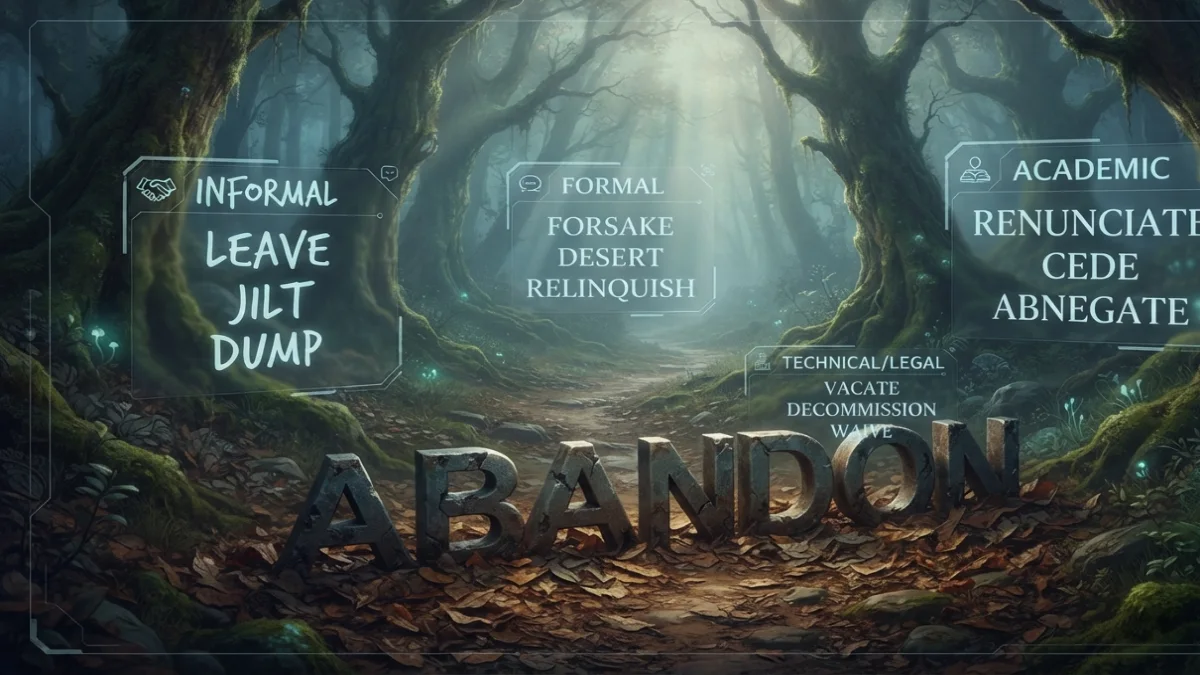
| Formal | Forsake, Relinquish, Renounce, Abdicate, Abjure, Surrender |
| Informal | Ditch, Dump, Bail out, Walk away, Cut loose, Drop out |
| Academic | Forswear, Renounce, Relinquish, Abjure, Forsworn, Leave off |
| Technical | Vacate, Withdraw, Abandonment, Desertion, Relinquishing |
Antonyms Section
| Antonym | Meaning | Example |
| Keep | To hold or retain | Keep your promises. |
| Maintain | Continue or preserve | Maintain your focus. |
| Support | Back up or uphold | Support your friends. |
| Hold | Retain possession | Hold the document carefully. |
| Stay | Remain in place | Stay at home. |
| Preserve | Protect from loss | Preserve your heritage. |
| Continue | Persist without stopping | Continue the task. |
| Uphold | Maintain or defend | Uphold the law. |
| Retain | Keep in possession | Retain your notes. |
| Protect | Guard from harm | Protect your ideas. |
Comparison Section
- Abandon vs Leave: Leave simply means to go away;Abandon usually implies leaving permanently
- Abandon vs Forsake: Abandon is general leaving; Forsake is more formal and emotional.
- Example: He abandoned the car. vs He forsook his beliefs.
- Abandon vs Relinquish: Relinquish is voluntary giving up, usually formal.
- Example: She relinquished her rights. vs She abandoned her luggage.
- Abandon vs Desert: Desert implies sudden leaving, often in crisis.
- Example: He deserted the post. vs He abandoned the village.
- Abandon vs Quit: Quit is casual and simple, often short term.
- Example: I quit smoking. vs I abandoned my plans.
- Abandon vs Walk away: Walk away emphasizes leaving a situation voluntarily.
- Example: She walked away from the deal. vs She abandoned the deal.
Examples of Abandon in Everyday Sentences
- He decided to abandon his old bike.
- She never abandons a friend in need.
- I had to abandon the trip due to rain.
- They abandoned the house during the storm.
- Don’t abandon your studies halfway.
Examples of Abandon in Phrases
- Abandon all hope
- Abandon ship
- Abandon the plan
- Abandon the idea
- Abandon the pursuit
Common Mistakes to Avoid
❌ Don’t treat every synonym as identical.
For example:
- Quit → stop doing something.
- Desert → leave someone who depends on you.
- Relinquish → formally give up ownership or control.
- Discard → throw away an object or idea.
- Forsake → literary or formal, often used in emotional or historical contexts.
Choosing the right synonym makes writing more accurate.
FAQs
1. What does abandon mean in simple words?
It means to leave or give up something completely.
2. Can I use abandon in formal writing?
Yes, especially with synonyms like forsake, relinquish, or renounce.
3. What’s a casual synonym for abandon?
Use ditch, walk away, or drop out in casual contexts.
4. Is abandon negative or positive?
Usually negative when leaving people or responsibilities, but can be positive when abandoning bad habits.
5. How can synonyms improve writing?
They make sentences more varied, expressive, and precise.
6. What is the opposite of abandon?
Common antonyms include:
- keep
- retain
- continue
- maintain
- preserve
- support
- uphold
7. Can abandon have a positive meaning?
Yes. In literature and the arts, with abandon means acting freely, enthusiastically, or without restraint.
Example:
The children laughed and danced with abandon.
Mini Vocabulary Growth Section
Learning synonyms for abandon:
- Improves writing & speaking by offering more precise word choices.
- Boosts blog & content readability with richer expression.
- Strengthens communication by showing vocabulary authority in essays, emails, or posts.
| Meaning | Best Synonyms |
|---|---|
| Leave behind | Leave, Desert, Forsake |
| Stop doing something | Quit, Discontinue, Give Up |
| Give up ownership | Relinquish, Renounce, Forfeit |
| Throw away | Discard, Cast Aside |
| Act freely (literary) | Freedom, Spontaneity, Uninhibitedness |
Conclusion
Practicing abandon and its synonyms daily can improve your writing, emails, essays, blogs, and even social media captions.
Use words like forsake, relinquish, or ditch to make your language precise and impactful. Don’t just memorize try incorporating these alternatives in conversations, notes, and creative writing.
The more you practice, the more naturally your vocabulary grows, making your English professional, clear, and expressive. Start small, and soon abandoning old habits in writing will feel effortless!