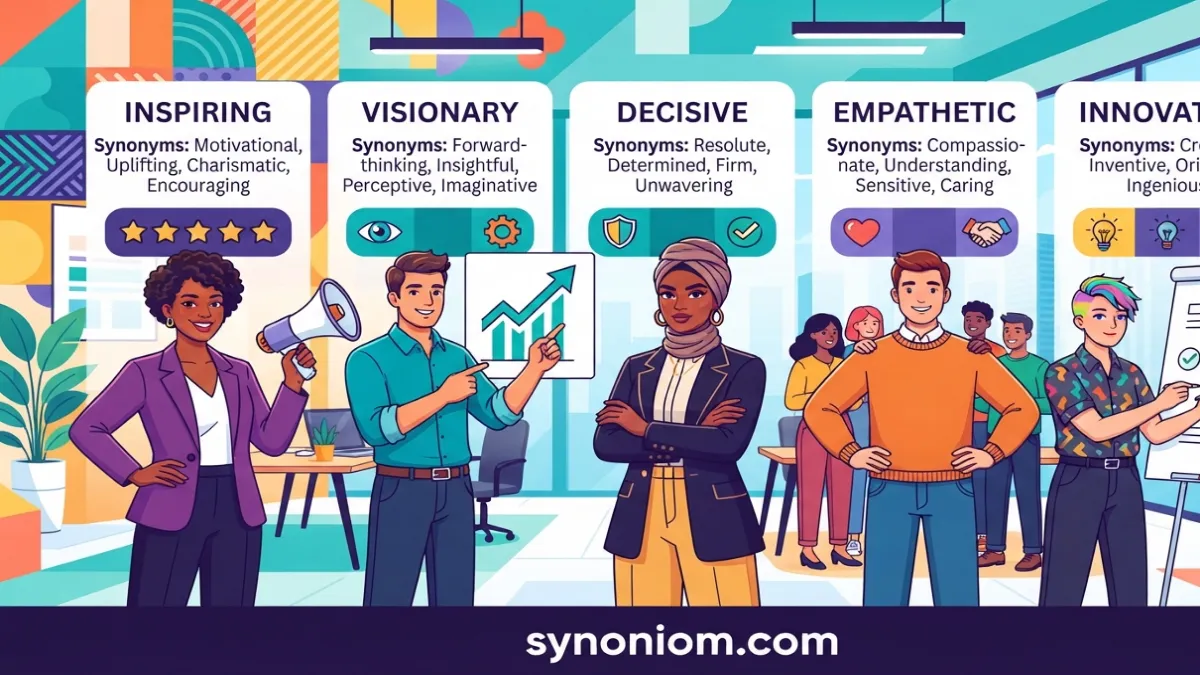
Have you ever written a sentence like, “She is a leading expert,” and wondered if there was a better or more interesting word to use?
Many English learners use the same vocabulary again and again because they do not know enough alternatives. Learning synonyms for “leading” can make your speaking and writing sound more natural, professional, and confident.
If you are writing a school essay, a business email, a social media post, or simply having a conversation, understanding similar words for “leading” helps you express ideas more clearly. Some synonyms sound formal, while others are better for casual speech or emotional situations.
In this guide, you will learn the meaning of “leading,” its tone and usage, useful synonym groups, antonyms, common phrases, mistakes to avoid, and many real life examples.
Featured Snippet Definition
The word “leading” usually means being the best, most important, most successful, or in control of others. It can describe a person, company, team, idea, or position.
For example:
- “She works for a leading technology company.”
- “He played the leading role in the movie.”
The meaning changes slightly depending on the context.
What is another word for leading?
Common synonyms for leading include top, premier, prominent, influential, guiding, managing, directing, and dominant. The best synonym depends on the context. For example, premier describes a highly ranked organization, while guiding describes someone who provides direction.
Which Synonym Should You Choose?
| If you mean… | Best Word | Why? |
|---|---|---|
| Best or most successful | Top | Simple and common |
| Highest quality | Premier | Formal and professional |
| Famous or important | Prominent | Highlights reputation |
| Having influence | Influential | Focuses on impact |
| Managing people | Guiding | Emphasizes support |
| Being in control | Dominant | Shows power |
| Directing a group | Managing | Workplace-focused |
Meaning, Tone & Context
Core Meaning of “Leading”
The word “leading” commonly refers to:
- Being first or most important
- Guiding or directing others
- Being highly successful or respected
- Being ahead of competitors
Tone of the Word
“Leading” is usually:
- Professional
- Positive
- Respectful
- Academic
- Business friendly
It is commonly used in:
- News articles
- Business writing
- School essays
- Professional introductions
- Marketing content
Where It Sounds Most Natural
You will often hear or see “leading” in sentences like:
- “a leading brand”
- “a leading scientist”
- “the leading cause”
- “a leading player in the market”
It sounds natural when discussing authority, success, importance, or influence.
Native Speakers Often Say
These combinations are very common:
- leading company
- leading brand
- leading expert
- leading role
- leading position
- leading figure
- leading cause
- leading researcher
- leading provider
- leading industry
Useful Collocations
Business
- leading company
- leading brand
- leading provider
- leading market position
- leading organization
Leadership
- leading a team
- leading a project
- leading role
- leading figure
- leading expert
Research & Education
- leading researcher
- leading scientist
- leading authority
- leading institution
Causes & Results
- leading cause
- leading factor
- leading reason
- leading contributor
When & How to Use “Leading”
Talking About Success
Use “leading” when someone or something is highly successful.
Examples:
- “Apple is a leading technology company.”
- “She is one of the leading researchers in biology.”
Talking About Control or Guidance
“Leading” can also describe directing people or activities.
Examples:
- “He is leading the discussion.”
- “The coach is leading the team.”
Talking About Importance
Sometimes “leading” means the main or most important thing.
Examples:
- “Smoking is a leading cause of lung disease.”
- “Education remains a leading issue in society.”
In Everyday Conversation
People also use it casually:
- “Who’s leading the game right now?”
- “She’s leading the project at work.”
Synonyms for Leading
| Synonym | Simple Meaning | Example Sentence |
| Main | Most important | Education is the main topic today. |
| Top | Highest in rank | She is a top student. |
| Chief | Primary or most important | He is the chief editor. |
| Primary | First in importance | Safety is our primary concern. |
| Principal | Main or leading | The principal reason was cost. |
| Dominant | Strongest or most powerful | That company is dominant in the market. |
| Influential | Able to affect others | She is an influential leader. |
| Foremost | Most important or respected | He is a foremost expert in science. |
| Premier | Best or first in status | They are a premier fashion brand. |
| Outstanding | Extremely good | She gave an outstanding performance. |
| Famous | Well known | He is a famous actor. |
| Notable | Worth noticing | She made notable progress. |
| Elite | High ranking or superior | They joined an elite group. |
| Superior | Better than others | This product is superior in quality. |
| Successful | Achieving goals | She is a successful entrepreneur. |
| Winning | Achieving victory | The team has a winning strategy. |
| Guiding | Showing direction | He played a guiding role. |
| Directing | Managing or controlling | She is directing the meeting. |
| Commanding | Having authority | He has a commanding presence. |
| Governing | Controlling officially | The governing committee met yesterday. |
| Heading | Being at the front | She is heading the department. |
| Front running | Currently ahead | The front running candidate spoke today. |
| Number one | Best or first | They are the number one seller online. |
| Major | Very important | Climate change is a major issue. |
| Key | Extremely important | Communication is key to success. |
| Prominent | Well known and respected | He is a prominent lawyer. |
| Respected | Admired by others | She is highly respected in her field. |
| Renowned | Famous and admired | The school is renowned worldwide. |
| Prestigious | Highly respected | He attended a prestigious university. |
| Authoritative | Trusted and expert | She gave an authoritative answer. |
| Powerful | Strong and influential | They became a powerful organization. |
| Trailblazing | Creating new paths | She is a trailblazing scientist. |
| Innovative | Introducing new ideas | The company is innovative and modern. |
| Advanced | More developed | They use advanced technology. |
| Champion | Best performer | He became the champion player. |
| First rate | Excellent quality | They offer first rate service. |
| Exceptional | Unusually good | She has exceptional talent. |
| Influencing | Affecting decisions | Social media is influencing trends. |
| Steering | Guiding direction | He is steering the company forward. |
| Managing | Controlling activities | She is managing the event. |
| Supervising | Watching over work | He is supervising the staff. |
| Executive | Related to leadership | She has an executive role. |
| Pinnacle | At the highest point | This award is the pinnacle of success. |
| Peak | Highest level | He reached peak performance. |
| Frontline | At the front position | Frontline workers helped the community. |
| High ranking | Having senior status | They met high ranking officials. |
| Strategic | Carefully planned | She made a strategic decision. |
| Acclaimed | Publicly praised | The author is widely acclaimed. |
| Celebrated | Famous and admired | He is a celebrated musician. |
| Trendsetting | Influencing trends | That brand is trendsetting in fashion. |
Important Synonym Groups
Formal Synonyms for Leading
These work well in academic or business writing:
- Principal
- Foremost
- Premier
- Prominent
- Authoritative
- Prestigious
Example:
- “She is a foremost scholar in the field.”
Informal Synonyms
These are more relaxed and conversational:
- Top
- Number one
- Winning
- Big name
Example:
- “He’s one of the top gamers online.”
Academic Synonyms
Useful in essays and research papers:
- Primary
- Principal
- Dominant
- Influential
- Major
Example:
- “Pollution remains a major environmental concern.”
Professional Synonyms
Common in workplaces and business settings:
- Executive
- Strategic
- Guiding
- Managing
- Directing
Example:
- “She is directing the marketing campaign.”
Emotional or Positive Synonyms
These add admiration or praise:
- Outstanding
- Exceptional
- Celebrated
- Renowned
- Acclaimed
Example:
- “The chef is renowned for creative dishes.”
Conversational Synonyms
Easy words used in daily English:
- Main
- Top
- Key
- Best
Example:
- “That’s the key reason I left.”
Slang or Casual Expressions
These are informal and common online:
- Boss
- Big shot
- MVP
- Head honcho
Example:
- “She’s the MVP of the whole team.”
Use these carefully because they are very casual.
Antonyms of Leading
| Antonym | Meaning | Example |
| Minor | Less important | It was a minor issue. |
| Weak | Not strong | The team looked weak today. |
| Inferior | Lower in quality | This version is inferior. |
| Secondary | Less important | Safety became a secondary concern. |
| Following | Coming after | Several companies are following the trend. |
| Supporting | Not the main role | He played a supporting character. |
| Unknown | Not famous | The artist was mostly unknown. |
| Unimportant | Not significant | The mistake was unimportant. |
| Average | Ordinary | The results were average. |
| Losing | Not winning | The losing side stayed quiet. |
Comparison Section
Leading vs Main
Both words show importance, but “leading” sounds stronger and more professional.
- “Main reason” = common everyday phrase
- “Leading reason” = more formal or analytical
Example:
- “Stress is the main problem.”
- “Stress is a leading cause of illness.”
Leading vs Influential
“Leading” often means top ranking or highly respected.
“Influential” focuses on the power to affect people or decisions.
Example:
- “She is a leading scientist.”
- “She is an influential scientist.”
A leading scientist may also be influential, but the meanings are slightly different.
Leading vs Guiding
“Leading” can mean being in charge.
“Guiding” focuses more on helping or directing gently.
Example:
- “He is leading the team.”
- “She is guiding new students.”
Leading vs Dominant
“Dominant” suggests power or control over others.
“Leading” sounds more positive and balanced.
Example:
- “The company is dominant in Asia.”
- “The company is a leading brand worldwide.”
Common Phrases & Expressions
1. Leading role
Meaning: The most important acting or participation role
Example:
- “She played the leading role in the drama.”
2. Leading expert
Meaning: A highly respected specialist
Example:
- “They interviewed a leading expert on climate change.”
3. Leading cause
Meaning: The main reason something happens
Example:
- “Poor diet is a leading cause of health problems.”
4. Take the lead
Meaning: Move into first position or become responsible
Example:
- “Maria decided to take the lead during the project.”
5. Lead the way
Meaning: Show others what to do
Example:
- “Small businesses are leading the way in innovation.”
6. Front runner
Meaning: The person or group currently ahead
Example:
- “She became the front runner in the competition.”
7. In the lead
Meaning: Currently winning
Example:
- “Our team is in the lead by two points.”
Common Mistakes to Avoid
Using Formal Synonyms in Casual Conversation
Some words sound too formal in everyday speech.
Too formal:
- “He is a foremost basketball player.”
More natural:
- “He is a top basketball player.”
Confusing “Leading” with “Bossy”
“Leading” is usually positive.
“Bossy” has a negative meaning.
Example:
- Positive: “She has strong leadership skills.”
- Negative: “She is too bossy.”
Using “Dominant” in Sensitive Situations
“Dominant” can sound aggressive.
Instead of:
- “He is the dominant teacher.”
Say:
- “He is the leading teacher.”
Repeating the Same Word Too Often
Avoid using “leading” in every sentence.
Instead, mix vocabulary naturally:
- leading
- major
- top
- prominent
- key
Common Mistakes
Mistake 1
❌ He is a leading person in my team.
✅ He is a leading member of my team.
Why?
“Leading person” sounds unnatural. Use leader, key member, or leading figure.
Mistake 2
❌ The company is leading because it is famous.
⚠️ Better:
The company is leading because it is successful and influential.
Why?
Leading means more than being known; it suggests importance or advantage.
Mistake 3
❌ She is leading of the project.
✅ She is leading the project.
Why?
“Leading” as a verb directly takes an object.
Mistake 4
❌ A dominant teacher helped students.
⚠️ Better:
A guiding teacher helped students.
Why?
Dominant can sound controlling. Guiding is more positive for mentorship.
Different Meanings of Leading
| Meaning | Example | Best Synonyms |
|---|---|---|
| Most important | Leading company | Top, premier |
| Providing direction | Leading a team | Guiding, managing |
| First or ahead | Leading the race | Ahead, winning |
| Causing something | Leading cause | Main, primary |
| Highly respected | Leading expert | Foremost, prominent |
FAQs
What is the best synonym for “leading”?
The best synonym depends on context. Common choices include “top,” “main,” “principal,” “foremost,” and “prominent.”
Is “leading” a formal word?
Yes, “leading” is usually considered professional and slightly formal, especially in business or academic writing.
Can “leading” describe people?
Yes. It often describes respected or successful people.
Example:
- “She is a leading doctor.”
What is the difference between “leading” and “main”?
“Main” is more general and conversational, while “leading” sounds more professional and emphasizes importance or influence.
Is “leading” always positive?
Usually yes, but not always.
Example:
- “Smoking is a leading cause of disease.”
Here, “leading” simply means “main” or “most common.”
Conclusion
Learning synonyms for “leading” is a simple way to improve your English vocabulary and sound more natural in conversations, essays, emails, and professional writing.
Instead of repeating the same word, you can choose alternatives based on tone and context. Words like “top,” “principal,” “prominent,” “influential,” and “guiding” all help you express ideas more clearly and confidently.
The best way to remember new vocabulary is to practice it in real situations. Try using one or two new synonyms each day in your writing or speaking. Over time, your English will become more fluent, varied, and expressive.