Have you ever written a paragraph and found yourself stuck using the word ordinary again and again?
Maybe you wanted to describe a simple day, a typical event, or a plain object but kept repeating the same word. That’s where knowing synonyms for ordinary becomes a lifesaver.
Ordinary means something normal, common, or not special. It’s simple, everyday language but overusing it can make writing dull.
For students, bloggers, content writers, and freelancers, using vibrant alternatives can make essays, articles, and social media captions more engaging.
In this guide, you’ll learn 50 powerful synonyms for ordinary, categorized for different contexts, with examples, subtle usage tips, and even antonyms. By the end, you’ll never struggle to replace ordinary in your writing or speech again.
Featured Snippet Definition
What is a synonym?
A synonym is a word that has a similar meaning to another word. Using synonyms makes writing and speaking more varied and expressive.
Definition of Ordinary:
- Ordinary means normal or usual, not special or unusual.
- Something ordinary is common in daily life, like simple objects or events.
- In writing or conversation, it refers to anything plain, typical, or standard.
What is another word for ordinary?
Common synonyms for ordinary include common, normal, typical, regular, average, usual, standard, routine, everyday, and conventional. The best synonym depends on whether you mean something normal, simple, or lacking uniqueness.
Content Structure
1. Ordinary = Normal or Usual
Best synonyms:
- normal
- typical
- usual
- regular
- standard
- common
Example:
It was just an ordinary meeting.
→ It was just a typical meeting.
2. Ordinary = Common or Frequently Seen
Best synonyms:
- common
- familiar
- everyday
- routine
- widespread
- general
Example:
This type of plant is ordinary in this region.
3. Ordinary = Average or Not Exceptional
Best synonyms:
- average
- mediocre
- modest
- plain
- unremarkable
- commonplace
Example:
The performance was ordinary.
→ The performance was average.
4. Ordinary = Simple or Basic
Best synonyms:
- simple
- basic
- plain
- modest
- humble
- uncomplicated
Example:
He lives an ordinary lifestyle.
5. Ordinary in Creative Writing
Better alternatives:
- mundane
- everyday
- routine
- familiar
- conventional
Example:
The story begins with an ordinary family facing an extraordinary challenge.
Contextual Usage: When and How to Use Ordinary
Ordinary is versatile:
- In writing: “It was an ordinary morning at school.”
- In emails: “The report contains ordinary updates for today.”
- In conversation: “I had an ordinary day, nothing exciting.”
Tip: Replace ordinary with a synonym depending on tone formal, casual, or creative.
Common Collocations
Everyday English
- ordinary person
- ordinary life
- ordinary day
- ordinary people
- ordinary situation
- ordinary experience
- ordinary routine
- ordinary things
Business & Professional Writing
- ordinary circumstances
- ordinary business operations
- ordinary activities
- ordinary process
- ordinary procedures
- ordinary expenses
Reviews & Descriptions
- ordinary quality
- ordinary performance
- ordinary design
- ordinary experience
- ordinary product
- ordinary service
Academic Writing
- ordinary language
- ordinary meaning
- ordinary behavior
- ordinary circumstances
- ordinary events
50 Synonyms for Ordinary
| Synonym | Meaning | Examples |
| Common | Happens often; normal | 1. It’s a common mistake to forget keys. 2. Pizza is a common dinner choice. |
| Usual | Typical; expected | 1. She followed her usual routine. 2. The usual bus was late today. |
| Typical | Normal type of something | 1. A typical Monday feels busy. 2. That’s a typical reaction to stress. |
| Average | Middle; not special | 1. He is an average student. 2. The movie got average reviews. |
| Everyday | Ordinary, routine | 1. She wore everyday clothes. 2. These are everyday chores. |
| Standard | Normal level or type | 1. Standard procedures are required. 2. He bought the standard model. |
| Routine | Regular or fixed pattern | 1. Morning exercise is part of her routine. 2. Routine maintenance keeps cars safe. |
| Plain | Simple; not fancy | 1. She wore a plain dress. 2. The cake was plain but tasty. |
| Regular | Usual or normal | 1. Regular practice improves skill. 2. He’s a regular at the cafe. |
| Modest | Not special or flashy | 1. They live a modest life. 2. His achievements were modest but steady. |
| Ordinary looking | Appearing plain | 1. An ordinary looking house hid a beautiful garden. 2. The ordinary looking bag was expensive. |
| Humdrum | Dull; lacking excitement | 1. His job felt humdrum. 2. The lecture was humdrum but necessary. |
| Commonplace | Seen or done often | 1. Smartphones are commonplace today. 2. It’s commonplace to check email daily. |
| Mediocre | Not very good; ordinary | 1. The movie was mediocre. 2. Her performance was mediocre, but improving. |
| Average Joe | An ordinary person | 1. He’s just an Average Joe. 2. Average Joe can enjoy simple pleasures. |
| Everyday life | Daily, normal | 1. Stress is part of everyday life. 2. She wrote about everyday life struggles. |
| Garden variety | Standard or typical | 1. A garden variety mistake. 2. It was a garden variety misunderstanding. |
| Mundane | Normal, boring | 1. The tasks were mundane. 2. Mundane chores filled her afternoon. |
| Unremarkable | Nothing special | 1. The hotel room was unremarkable. 2. His outfit was unremarkable but neat. |
| Familiar | Well known, normal | 1. She felt familiar comfort at home. 2. Familiar faces greeted him. |
| Conventional | Usual, standard | 1. Conventional methods work here. 2. He wore conventional attire. |
| Modest | Simple, not flashy | 1. They live in a modest home. 2. Her modest performance pleased the teacher. |
| Everyday occurrence | Normal event | 1. Traffic jams are an everyday occurrence. 2. Rain is an everyday occurrence in April. |
| Plain Jane | Ordinary person | 1. She felt like a Plain Jane. 2. A Plain Jane story can still be interesting. |
| Garden variety | Basic, typical | 1. It was a garden variety issue. 2. Such problems are garden variety at work. |
| Regular Joe | Common person | 1. He’s just a Regular Joe. 2. Regular Joe enjoys simple meals. |
| Pedestrian | Ordinary, dull | 1. His ideas were pedestrian. 2. A pedestrian design lacked flair. |
| Workaday | Everyday, routine | 1. The workaday schedule continued. 2. A workaday approach is practical. |
| Average looking | Plain in appearance | 1. He was average looking but kind. 2. An average looking chair fit the room. |
| Run of the mill | Ordinary, not special | 1. The product was run of the mill. 2. Run of the mill ideas often succeed. |
| Regular | Usual, typical | 1. He took the regular route home. 2. Regular users enjoy discounts. |
| Everyday object | Normal item | 1. A pen is an everyday object. 2. Everyday objects can inspire creativity. |
| Common place | Ordinary, usual | 1. This is a common place problem. 2. His views are common place. |
| Norm | Standard pattern | 1. It’s the norm to greet neighbors. 2. Following the norm ensures harmony. |
| Ordinary level | Typical standard | 1. Ordinary level skills are enough. 2. Ordinary level students need encouragement. |
| Standard issue | Normal, common | 1. Standard issue uniforms are required. 2. Standard issue tools are provided. |
| Average case | Typical example | 1. In the average case, results are positive. 2. Average case analysis helps planning. |
| Regular style | Normal format | 1. Regular style essays are expected. 2. Regular style fonts are easier to read. |
| Everyday type | Typical, normal | 1. Everyday type tasks include washing dishes. 2. Everyday type routines help organize life. |
| Common type | Normal kind | 1. A common type mistake occurred. 2. Common type fruits are widely available. |
| Unexceptional | Nothing special | 1. His performance was unexceptional. 2. An unexceptional view is still relaxing. |
| Everyday normal | Routine, usual | 1. Everyday normal activities include walking. 2. Everyday normal conversations are simple. |
| Ordinary world | Typical environment | 1. He lived in an ordinary world neighborhood. 2. Ordinary world settings can inspire stories. |
| Regular people | Average individuals | 1. Regular people face daily challenges. 2. Regular people enjoy ordinary joys. |
| Standard pattern | Typical method | 1. Standard pattern procedures were followed. 2. Standard pattern writing is easiest. |
| Normal | Not special; usual | 1. She had a normal breakfast. 2. It’s normal to feel nervous before exams. |
| Plain style | Simple, ordinary | 1. Plain style furniture looks neat. 2. Plain style design suits small homes. |
| Typical pattern | Regular habit | 1. A typical pattern day starts early. 2. Typical pattern routines improve efficiency. |
| Garden type | Ordinary, basic | 1. Garden type meals are simple. 2. Garden type homes are common in suburbs. |
Categorized Synonym Clusters
| Category | Synonyms |
| Formal | Conventional, Standard, Pedestrian, Unremarkable, Modest |
| Informal | Plain Jane, Average Joe, Garden variety, Run of the mill |
| Academic | Typical, Standard pattern, Norm, Average case, Ordinary level |
| Technical | Standard issue, Regular style, Everyday type, Average looking, Ordinary world |
Antonyms Section
| Antonym | Meaning | Example |
| Extraordinary | Very special or unusual | 1. Her performance was extraordinary. 2. An extraordinary sunset amazed everyone. |
| Exceptional | Better than normal | 1. He is an exceptional student. 2. The food was exceptional. |
| Unique | One of a kind | 1. Each artwork is unique. 2. She wore a unique dress. |
| Rare | Not common | 1. A rare bird appeared. 2. Rare talent deserves praise. |
| Remarkable | Worth noticing | 1. The story is remarkable. 2. A remarkable achievement was celebrated. |
| Special | Different from usual | 1. Today is a special day. 2. Special guests were invited. |
| Uncommon | Not ordinary | 1. An uncommon solution was found. 2. He showed uncommon courage. |
| Outstanding | Excellent; prominent | 1. She gave an outstanding performance. 2. The building is outstanding in design. |
| Distinctive | Clearly different | 1. His voice is distinctive. 2. A distinctive style attracts attention. |
| Extraordinary looking | Appearing very unusual | 1. An extraordinary looking sculpture stood in the park. 2. She wore an extraordinary looking gown. |
Comparison Section
Typical vs Ordinary: Both refer to normal, but typical implies representing a group or pattern.
- Ordinary: “It was an ordinary day.”
- Typical: “A typical Monday starts with emails.”
Ordinary vs Common: Common emphasizes frequency; ordinary emphasizes plainness.
- Ordinary: “An ordinary meal.”
- Common: “Common mistakes happen daily.”
Average vs Ordinary: Average relates to quantity or quality; ordinary relates to plainness.
- Ordinary: “An ordinary house.”
- Average: “An average student score.”
Ordinary vs Plain: Plain stresses simplicity and lack of decoration.
- Ordinary: “An ordinary morning.”
- Plain: “A plain cake.”
Mediocre vs Ordinary: Mediocre implies low quality; ordinary is neutral.
- Ordinary: “An ordinary effort.”
- Mediocre: “A mediocre effort disappointed the team.”
Examples of “Ordinary” in Everyday Sentences
- She had an ordinary lunch at the cafe.
- It was just an ordinary Monday morning.
- He wore ordinary clothes to the event.
- The hotel room looked ordinary but was comfortable.
- Ordinary people often do extraordinary things.
Examples of Ordinary in Phrases
- Ordinary life
- Ordinary citizen
- Ordinary task
- Ordinary day
- Ordinary object
Common Mistakes to Avoid
❌ Don’t use all synonyms in every situation.
For example:
- Mediocre has a negative meaning.
- Normal is usually neutral.
- Simple can be positive.
- Common only means frequent, not necessarily boring.
Choosing the right synonym improves writing accuracy.
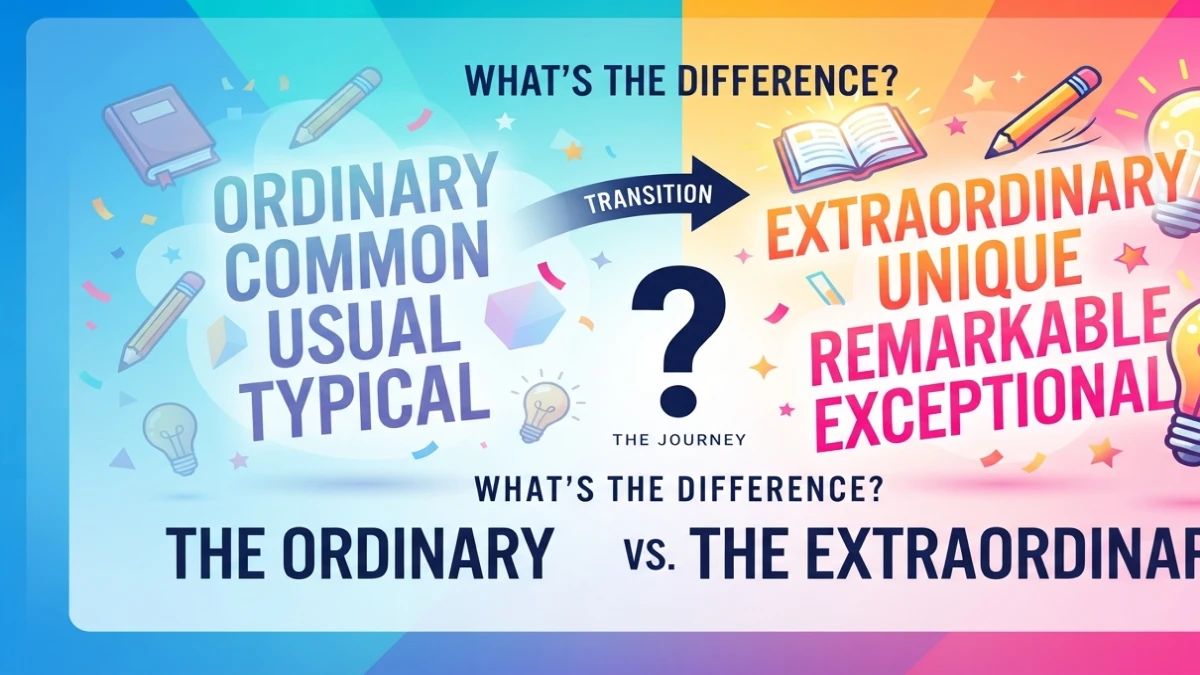
| Ordinary | Extraordinary |
|---|---|
| Normal | Exceptional |
| Common | Rare |
| Typical | Remarkable |
| Everyday | Unusual |
| Regular | Outstanding |
FAQs
1. What is a synonym for ordinary?
A synonym is a word like common, usual, or typical that has a similar meaning.
2. Can I use ordinary in formal writing?
Yes, but you may prefer formal synonyms like conventional, standard, or unremarkable.
3. How do ordinary and common differ?
Ordinary focuses on plainness; common emphasizes frequency.
4. Are there casual alternatives for ordinary?
Yes, informal options include Plain Jane, Average Joe, and run of the mill.
5. Why learn synonyms for ordinary?
Using varied words improves writing, speech, and communication clarity.
Mini Vocabulary Growth Section
Learning synonyms for ordinary:
- Improves writing: Makes essays, blogs, and emails engaging.
- Boosts readability: Readers enjoy varied word choice.
- Strengthens communication: Shows vocabulary authority in daily life.
- Motivates creativity: Helps describe routine experiences vividly.
Conclusion
Now that you’ve explored 50 synonyms for ordinary, it’s time to practice! Replace the word in emails, essays, blogs, captions, or daily conversations.
Try phrases like “ordinary life,” “plain task,” or “common mistake.” Learning these alternatives keeps writing fresh, helps you express ideas clearly, and builds confidence.
Using synonyms for ordinary daily is a small habit that makes a big difference. Keep experimenting, mixing formal and informal options, and soon your English will feel vibrant, precise, and professional without sounding repetitive.