“Don’t worry. It’s simple,” a teacher might tell a student before explaining a new grammar rule. At work, a colleague may say, “The process is straightforward.” In everyday conversation, someone might describe a room as “plain” or a recipe as “easy.”
These words share some meaning with simple, but they are not always interchangeable.
For example, easy describes something that does not require much effort, while plain often describes something without decoration. Similarly, straightforward suggests clarity and a lack of complication, whereas modest can describe something limited or not extravagant.
Therefore, learning synonyms for simple means more than memorizing a long list. You need to understand the small differences between them so you can choose the word that sounds natural in each situation.
This guide explains 50 useful alternatives, their meanings, common contexts, antonyms, phrases, and practical examples for school, work, writing, and everyday conversation.
Quick Answer
Simple usually means easy to understand, do, use, or deal with. It can also describe something plain, uncomplicated, modest, or not elaborate. The best synonym depends on what you mean: easy works for tasks, plain for appearance, and straightforward for clear instructions.
Meaning, Tone & Context
The word simple has several closely connected meanings.
1. Easy or not difficult
When something requires little effort or is easy to understand, simple can mean easy.
- This is a simple exercise.
- The instructions are simple to follow.
- She gave me a simple explanation.
In this sense, easy, effortless, uncomplicated, and straightforward may work depending on the sentence.
2. Not complicated
Simple can also describe something with few parts, steps, or complications.
- We need a simple solution.
- He designed a simple system.
- The problem looks simple.
Here, uncomplicated, basic, elementary, and straightforward can be useful alternatives.
3. Plain or not decorated
When you describe appearance, simple can mean plain or lacking elaborate decoration.
- She wore a simple black dress.
- They chose a simple design.
- The room has simple furniture.
In this context, plain, minimalist, unadorned, or understated may be more precise.
4. Modest or not luxurious
Simple can describe a lifestyle, meal, home, or event that does not involve luxury or extravagance.
- We had a simple dinner at home.
- They live a simple lifestyle.
- She wanted a simple wedding.
Here, modest, unpretentious, and low-key may fit naturally.
What tone does “simple” have?
Simple is usually neutral and extremely common. You can use it in casual conversations, schoolwork, workplace communication, and general writing.
However, context matters. Saying “a simple person” can sometimes suggest that someone lacks sophistication or has limited understanding. In some contexts, it can even sound negative. Therefore, choose a more precise word when you want to describe a person’s personality.
When & How to Use “Simple”
Use simple when you want to communicate an idea clearly without adding unnecessary complexity.
For tasks
- The test was simple.
- This recipe is simple to make.
Explanations
- Can you give me a simple explanation?
- She explained the rule in simple language.
Designs
- I prefer a simple website design.
- The logo has a simple shape.
For lifestyles
- He enjoys a simple life in the countryside.
- They chose a simple meal.
For solutions
- Let’s find a simple solution.
- Sometimes a simple answer works best.
However, avoid using simple words when a more exact word communicates your meaning better. For example, if you mean “clear and direct,” straightforward may work better. If you mean “without decoration,” plain or minimalist may be more accurate.
Another Word for Simple
The best alternative depends on the meaning you want.
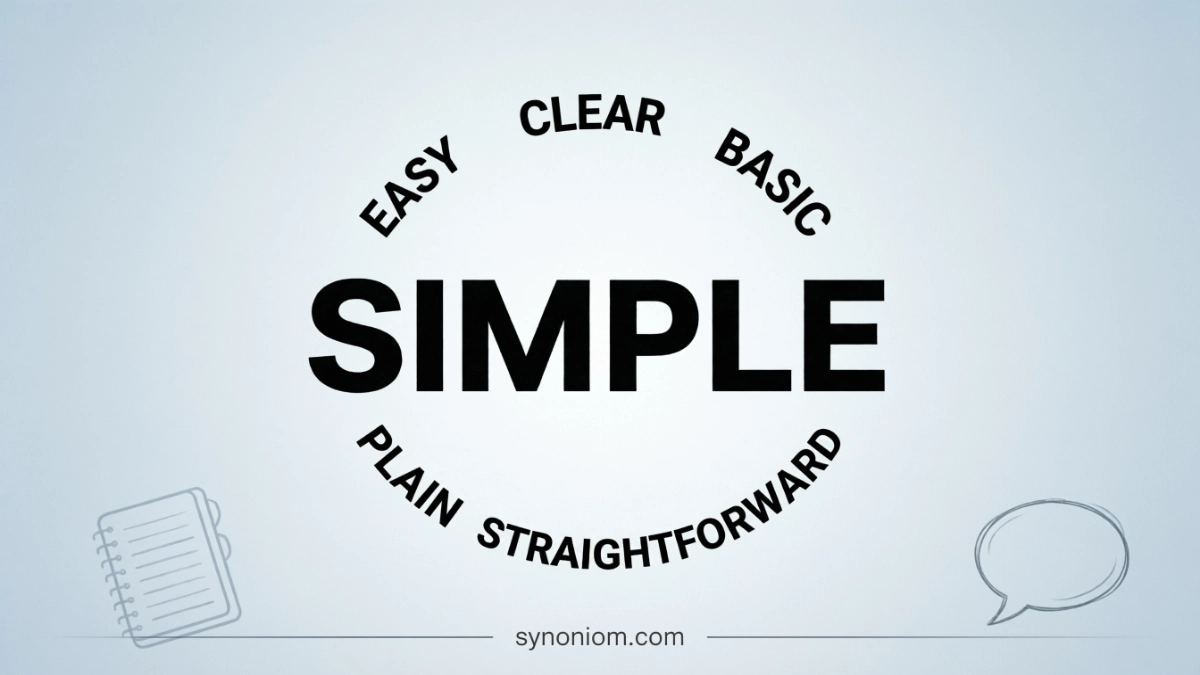
ITo describe something easy, consider easy, effortless, manageable, or painless. When the meaning is not complicated, straightforward, uncomplicated, basic, or elementary may fit. For a plain appearance, use plain, minimalist, unadorned, or understated. A modest style can be described as modest, unpretentious, humble, or low-key. When you want to express something clear and direct, clear, direct, or explicit can work well.
So, there is no single perfect synonym for every sentence. Instead, choose the alternative that matches your intended meaning.
When Not to Use This Word
Although simple is flexible, it can become vague when you need to communicate a specific idea.
For example:
- “The instructions are simple” means they are not difficult.
- “The instructions are straightforward” emphasizes clarity.
- “The instructions are concise” emphasizes brevity.
- “The instructions are basic” suggests they cover fundamental information.
Also, be careful when describing people. Saying “He is simple” may sound unclear or even insulting because listeners may interpret it as “naive,” “unsophisticated,” or “not intelligent.”
Instead, say exactly what you mean:
- He has a modest lifestyle.
- She has an uncomplicated personality.
- He prefers a low-key lifestyle.
- She explains things in a straightforward way.
Words Commonly Confused With “Simple”
Simple vs. Easy
Easy usually focuses on difficulty. Simple can focus on structure, design, or complexity.
- The question is easy.
- The question has a simple structure.
Simple vs. Basic
Basic often means fundamental or introductory. Simple means uncomplicated or easy to understand.
- We learned basic grammar.
- The grammar rule is simple.
Simple vs. Plain
Plain commonly describes appearance, taste, or language without decoration or extra features.
- She wore a simple dress.
- She wore a plain white dress.
The first sentence may simply mean uncomplicated in design. The second emphasizes the lack of decoration.
Simple vs. Straightforward
Straightforward means clear, direct, and uncomplicated.
- The task is simple.
- The instructions are straightforward.
The second sentence focuses more strongly on clarity and directness.
Best Synonym by Context
| Context | Best Synonym | Why It Works |
| Easy task | Easy | Shows low difficulty |
| Easy process | Effortless | Suggests very little effort |
| Clear instructions | Straightforward | Emphasizes clarity |
| Basic knowledge | Elementary | Refers to an introductory level |
| Basic design | Minimalist | Emphasizes simplicity and few elements |
| No decoration | Plain | Highlights lack of decoration |
| Elegant design | Understated | Shows restrained style |
| Modest lifestyle | Unpretentious | Suggests no desire to impress |
| Small, modest event | Low-key | Sounds natural in conversation |
| Clear explanation | Clear | Focuses directly on understanding |
| Short explanation | Concise | Focuses on brevity |
| Simple solution | Uncomplicated | Highlights lack of complexity |
| Simple system | Basic | Suggests fundamental features |
| Simple meal | Modest | Suggests something ordinary or limited |
| Simple instructions | Direct | Highlights clear communication |
Which Synonym Should You Choose?
First, identify what simple means in your sentence.
When discussing difficulty, easy or manageable is usually the best choice. For complexity, uncomplicated or straightforward can be more precise. In descriptions of appearance, plain, minimalist, or understated may fit. A lifestyle can be described as modest, unpretentious, or low-key. For basic knowledge, elementary or fundamental is more appropriate.
Most importantly, do not replace simple things automatically. Instead, ask yourself what specific quality you want the reader or listener to notice.
Real-Life Examples of “Simple” in Sentences
School
- The teacher gave us a simple explanation of fractions.
- This exercise looks simple, but it requires careful attention.
- Please use simple English in your presentation.
Workplace
- We need a simple solution to this problem.
- The new software has a simple interface.
- I created a simple checklist for the team.
Writing
- Use simple language when writing for beginners.
- The author uses a simple structure throughout the article.
- A simple example can make the idea easier to understand.
Conversation
- It’s simple: just press this button.
- I want a simple dinner tonight.
- We had a simple but enjoyable evening.
Synonyms and Contextual Alternatives for “Simple”
| Synonym | Simple Meaning | Example Sentence |
|---|---|---|
| 1. Easy | Not difficult | The exercise is easy to complete. |
| 2. Straightforward | Clear and uncomplicated | The instructions are straightforward. |
| 3. Uncomplicated | Not complex or difficult | We need an uncomplicated solution. |
| 4. Basic | Simple and fundamental | She has a basic understanding of Spanish. |
| 5. Plain | Without decoration or extras | He chose a plain white shirt. |
| 6. Clear | Easy to understand | Her explanation was clear. |
| 7. Direct | Straight to the point | He gave me a direct answer. |
| 8. Elementary | Basic and suitable for beginners | The students studied elementary mathematics. |
| 9. Effortless | Requiring little effort | She made the difficult task look effortless. |
| 10. Manageable | Easy enough to handle | The workload is manageable. |
| 11. Painless | Causing little difficulty or trouble | The registration process was painless. |
| 12. Convenient | Easy or practical to use | The online system is convenient. |
| 13. Accessible | Easy to understand or use | The book uses accessible language. |
| 14. Intuitive | Easy to understand without instruction | The app has an intuitive interface. |
| 15. Concise | Short and focused | Please give a concise explanation. |
| 16. Brief | Short in length or duration | She gave a brief summary. |
| 17. Minimal | Using very little | The design has minimal decoration. |
| 18. Minimalist | Using only a few essential elements | They created a minimalist website. |
| 19. Unadorned | Without decoration | The room had unadorned walls. |
| 20. Understated | Simple but tasteful | Her outfit was elegant and understated. |
| 21. Modest | Not large, expensive, or elaborate | They live in a modest home. |
| 22. Unpretentious | Simple and not designed to impress | The restaurant has an unpretentious atmosphere. |
| 23. Humble | Modest and not boastful | He comes from a humble background. |
| 24. Low-key | Quiet and not elaborate | We had a low-key celebration. |
| 25. Ordinary | Normal and not unusual | It was an ordinary weekday. |
| 26. Common | Frequently seen or experienced | This is a common method. |
| 27. Familiar | Well known or easily recognized | She used a familiar example. |
| 28. Natural | Not forced or artificial | His writing has a natural style. |
| 29. Fundamental | Basic and essential | Students need fundamental skills first. |
| 30. Rudimentary | Very basic or undeveloped | He has rudimentary computer skills. |
| 31. Unsophisticated | Lacking complexity or refinement | The system is still unsophisticated. |
| 32. Naive | Lacking experience or mature understanding | His naive approach caused problems. |
| 33. Artless | Natural and without artificiality | Her artless response felt sincere. |
| 34. Solvable | Able to be solved | The problem is solvable with careful work. |
| 35. Practical | Useful and easy to apply | We need a practical solution. |
| 36. Functional | Designed mainly to work effectively | The room has a simple, functional design. |
| 37. Streamlined | Made simpler and more efficient | The company streamlined the application process. |
| 38. Neat | Simple, orderly, and well arranged | She made a neat presentation. |
| 39. Orderly | Organized and easy to follow | The report has an orderly structure. |
| 40. Lucid | Very clear and easy to understand | The professor gave a lucid explanation. |
| 41. Explicit | Clearly stated and easy to understand | The instructions were explicit. |
| 42. Transparent | Open and easy to understand | The company uses a transparent process. |
| 43. Digestible | Easy to understand or absorb | The article presents the topic in a digestible way. |
| 44. User-friendly | Easy for people to use | The website has a user-friendly interface. |
| 45. Unassuming | Modest and not attention-seeking | The café has an unassuming appearance. |
| 46. Unpretentious | Simple and without showiness | We enjoyed an unpretentious meal. |
| 47. Sparse | Having very few elements | The room had sparse decoration. |
| 48. Bare | Lacking extra features or decoration | The walls were bare and white. |
| 49. Simplified | Made easier by reducing complexity | The guide provides a simplified explanation. |
| 50. Basic-looking | Plain and without elaborate features | The website has a basic-looking design. |
Important Note
These words do not all replace simple in the same situations. Use easy, manageable, or straightforward when something is not difficult. Choose plain, minimalist, unadorned, or understated when describing appearance or design. For basic knowledge or skills, elementary, fundamental, and rudimentary may fit better.
Be careful with words such as naive, unsophisticated, and rudimentary because they can suggest a lack of experience, development, or refinement. They are therefore not neutral replacements for simple in every context.
Synonym Groups & Usage Differences
Formal and Professional
In formal or professional writing, straightforward, uncomplicated, concise, explicit, transparent, functional, and streamlined can be useful.
For example:
- The application process is straightforward.
- The report provides a concise summary.
- The company introduced a streamlined procedure.
These choices often sound more precise than repeatedly using simple.
Academic
Academic contexts commonly use basic, elementary, fundamental, clear, concise, and accessible.
For example:
- Students first learn fundamental concepts.
- The textbook provides an accessible introduction to the subject.
However, academic writing does not always favor “simple” when a more specific term exists.
Conversational and Informal
In everyday speech, easy, clear, basic, low-key, plain, and straightforward sound natural.
- It’s pretty easy.
- Keep it simple.
- We had a low-key weekend.
Appearance and Design
When talking about visual style, use plain, minimalist, minimal, unadorned, understated, or unassuming.
These words differ slightly. Plain can mean lacking decoration, while minimalist often suggests an intentional design style.
Stronger vs. Weaker Meanings
Easy focuses on low difficulty. Effortless goes further and suggests that almost no effort is required.
Likewise, basic can suggest a limited level of features or knowledge, while elementary often specifically indicates an introductory level.
Emotional vs. Neutral
Most alternatives for simple are neutral. However, words describing people can become evaluative.
For example, modest is usually positive or neutral, while naive may suggest a lack of experience. Unsophisticated can also sound critical.
Modern vs. Old-Fashioned
Minimalist, user-friendly, streamlined, and low-key are common in modern contexts.
Words such as artless may sound more literary or less common in everyday conversation. Therefore, consider your audience before choosing them.
Slang
There is no major slang synonym that safely replaces simple across ordinary contexts. In casual speech, however, expressions such as easy-peasy can jokingly mean very easy.
For example:
- “The setup is easy-peasy.”
Use such expressions only in informal situations.
Antonyms of “Simple”
| Antonym | Meaning | Example |
| Complex | Having many connected parts | The system is complex. |
| Complicated | Difficult to understand or handle | The instructions are complicated. |
| Difficult | Not easy to do | The exam was difficult. |
| Challenging | Requiring effort or skill | The project was challenging. |
| Elaborate | Detailed and carefully developed | They planned an elaborate ceremony. |
| Sophisticated | Highly developed or complex | The software uses sophisticated technology. |
| Intricate | Having many small or connected details | The design is intricate. |
| Confusing | Difficult to understand | The explanation was confusing. |
| Advanced | Beyond a basic level | She is taking an advanced course. |
| Ornate | Highly decorated | The building has an ornate interior. |
Comparison Section
Subtle Meaning Differences
Simple is broad, while easy specifically emphasizes low difficulty.
- The design is simple.
- The test is easy.
A simple design may still take considerable skill to create.
Tone Differences
Simple usually sounds neutral. Plain can sound neutral, positive, or slightly negative depending on context.
- She chose a simple dress.
- She chose a plain dress.
The first focuses on uncomplicated style; the second can emphasize the absence of decoration.
Emotional Intensity
Some alternatives add an emotional or evaluative meaning.
Unpretentious often sounds positive because it suggests a lack of showiness. In contrast, naiveness can suggest limited experience.
Therefore:
- He prefers a simple lifestyle. — neutral
- He prefers an unpretentious lifestyle. — suggests modesty
- His simple understanding of the issue was incomplete. — potentially unclear
- His naive understanding of the issue was incomplete. — suggests lack of experience
Formality Level
Easy and basic work well in everyday conversation. Lucid, explicit, and streamlined can sound more formal or professional.
For example:
- “The instructions are easy.” — everyday
- “The instructions are straightforward.” — neutral/professional
- “The instructions are explicit.” — more precise/formal
Natural Usage Situations
Choose the word according to the noun.
- simple recipe → easy, uncomplicated
- simple design → minimalist, understated
- simple explanation → clear, straightforward
- simple lifestyle → modest, unpretentious
- simple process → streamlined, straightforward
- simple knowledge → basic, elementary
Common Phrases & Expressions
Keep It Simple
This means avoiding unnecessary complexity.
Example: “When you explain the topic, keep it simple.”
Simple as That
This means that something is exactly as stated, without additional complications.
Example: “Press this button, and the program starts. Simple as that.”
A Simple Matter of
This expression presents something as requiring a particular straightforward action.
Example: “Fixing the error is a simple matter of changing one setting.”
A Simple Solution
This means an uncomplicated way to solve a problem.
Example: “Adding a search box may provide a simple solution.”
A Simple Explanation
This means an explanation that avoids unnecessary complexity.
Example: “Can you give me a simple explanation of this rule?”
Keep Things Simple
This means avoiding unnecessary steps, details, or complications.
Example: “Let’s keep things simple and meet at the same place.”
Simple Life
This commonly describes a lifestyle with fewer complications, luxuries, or unnecessary possessions.
Example: “She enjoys a simple life in a quiet town.”
Common Mistakes to Avoid
Mistake 1: Treating every synonym as interchangeable
Easy, plain, basic, and straightforward do not have exactly the same meaning.
Instead, identify the quality you want to describe before choosing a replacement.
Mistake 2: Using “simple” for people without context
“He is simple” can confuse listeners or sound insulting.
Instead, specify the intended meaning:
- He is modest.
- He is inexperienced.
- He has an uncomplicated personality.
Mistake 3: Confusing simple with basic
Basic often means fundamental or introductory. It does not always mean easy.
- “I have basic computer skills” means my skills cover fundamental functions.
- “The software is simple to use” means the software does not require much effort to operate.
Mistake 4: Using formal words in casual conversation
Words such as lucid and explicit can sound unnecessarily formal in ordinary conversation.
Usually, clear, easy, or straightforward sounds more natural.
Mistake 5: Assuming simple always means positive
Sometimes simple describes something positively; at other times, it may suggest a lack of complexity, experience, or sophistication.
Always consider the context and the listener’s interpretation.
FAQs
What is the best synonym for “simple”?
There is no single best synonym. Easy works when you mean “not difficult,” straightforward works for clear processes, and plain works for something without decoration.
What is a synonym for simple in English?
Common synonyms include easy, straightforward, uncomplicated, basic, plain, clear, direct, and modest. The correct choice depends on the sentence.
Is “easy” the same as “simple”?
Not always. Easy mainly describes difficulty, while simple can also describe structure, appearance, design, or lifestyle.
What is a formal word for simple?
Depending on the context, straightforward, uncomplicated, concise, elementary, fundamental, or unpretentious can provide a more specific alternative.
What is the opposite of simple?
Common opposites include complex, complicated, difficult, elaborate, intricate, sophisticated, and challenging. The most suitable antonym depends on the meaning of simple in the sentence.
Conclusion
Learning synonyms for simple becomes much easier when you stop treating them as identical words. Instead, focus on the small difference each word communicates. Use easy when you mean low difficulty, straightforward when you mean clear and uncomplicated, and plain when you mean without decoration. Similarly, basic works well for fundamental knowledge, while minimalist suits a particular design style. In professional writing, precise choices such as concise, explicit, or streamlined can make your meaning clearer. Start by noticing these words in articles, conversations, schoolwork,