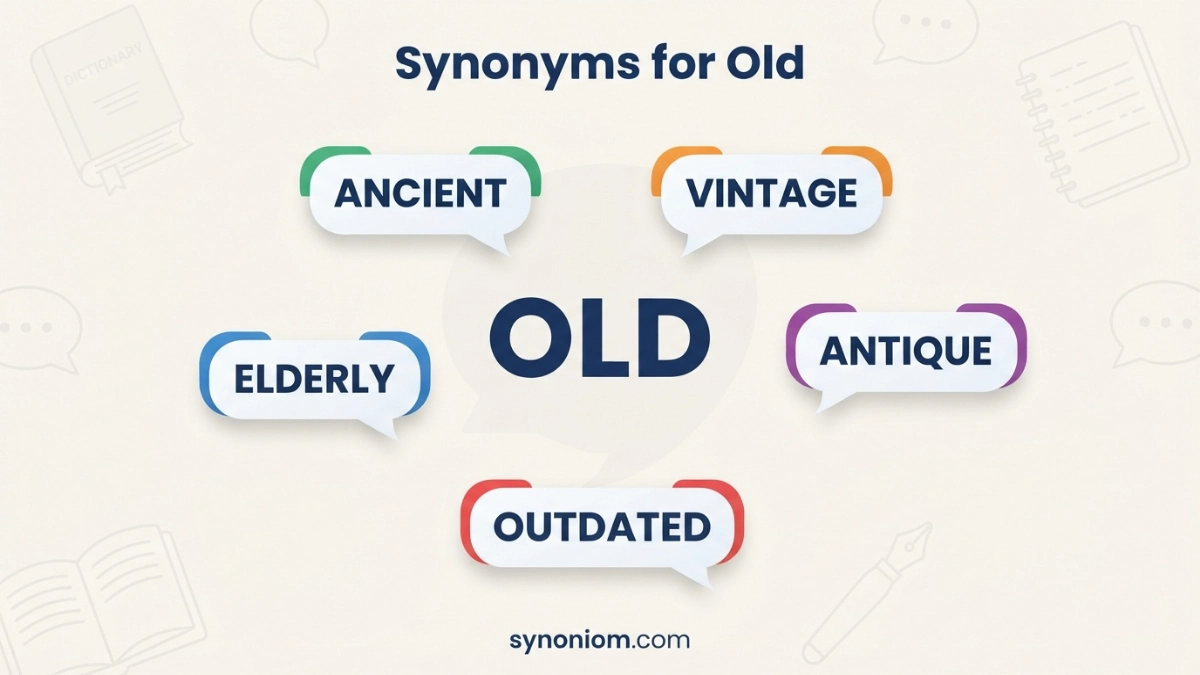
The best synonym depends on what you mean. For example, older people usually describes a person, while antique describes an old and valuable object, and outdated suggests that something is no longer suitable or modern.
Imagine a friend showing you a phone from ten years ago and saying, “This is my old phone.” You could simply use old, but perhaps you want to describe it more precisely. You might call it outdated, dated, or even vintage, depending on what you want to say.
Now imagine a different situation. You are talking about your grandfather. Saying “my old grandfather” can sound different from saying “my older people grandfather.” If you are describing an old building, words such as historic, ancient, weathered, or dilapidated may work better.
That is why learning synonyms for old requires more than memorizing a long list of words. Each alternative carries a slightly different meaning, tone, or feeling.
In this guide, you will learn useful alternatives to old, how they differ, when to use them, and which ones sound natural in everyday English.
Quick Answer
The word old describes something that has existed for a long time, has reached an advanced age, or is no longer new or modern. Depending on the context, alternatives include aged, ancient, antique, older people, former, outdated, vintage, traditional, and timeworn.
Meaning, Tone & Context
The basic meaning of old is something that has existed or been used for a long time.
For example:
- I found my old school notebook.
- We live in an old house.
- My grandfather is old.
- That is an old tradition.
- This computer is old and slow.
However, old has several related meanings.
1. Having existed for a long time
This is the most common meaning.
We visited an old castle.
Here, old simply tells us that the castle has existed for many years.
2. No longer new
When we talk about objects, old can mean something that has been used or owned for some time.
I need to replace my old laptop.
In this context, outdated, worn, or used might be more precise, depending on the situation.
3. Advanced in age
When old describes a person or animal, it can refer to age.
Her dog is very old.
However, when speaking politely about people, older people or aged may sometimes sound more appropriate.
4. From an earlier period
Old can also refer to something from the past.
This is an old English poem.
Depending on the context, ancient, historical, former, traditional, or archaic could express a more specific idea.
What tone does “old” have?
Old is neutral and extremely common. It works in everyday conversation, school writing, workplace communication, and many other situations.
However, some alternatives change the tone:
- aged → more formal or descriptive
- older people → generally polite when describing older people
- ancient → very old, often historical
- antique → old and usually valuable or collectible
- outdated → no longer modern or suitable
- vintage → old-fashioned in an attractive or desirable way
- decrepit → old and in poor condition
- timeworn → worn or weakened by long use or time
Therefore, choosing the right alternative helps you communicate the exact idea.
When & How to Use “Old”
Old is one of the most flexible adjectives in English. You can use it before nouns or after linking verbs.
Describing people
My grandfather is 82 years old.
She has an old friend from school.
Notice that old friend does not necessarily mean an older people friend. It can mean someone you have known for a long time.
Describing objects
I found an old photograph in a drawer.
He drives an old car.
Here, old could mean something from many years ago, something previously owned, or something no longer new.
Describing places
They bought an old house in the countryside.
Depending on the condition, you could instead say:
They bought a historic house.
or:
They bought a dilapidated house.
These sentences create very different impressions.
Describing ideas and traditions
This is an old family tradition.
Here, old means that the tradition has continued for a long time.
Describing information
That is an old story.
This could mean a story from long ago, but it could also mean information that people have heard many times.
Another Word for “Old”
There is no single replacement that works in every sentence.
For something that is very, very old, words like ancient or age-old are good choices.
To describe something that is no longer modern, use outdated, dated, or obsolete.
For something old but attractive or fashionable, vintage is often the right word.
An object that is old and valuable can be described as antique.
When something has become old through long use, consider worn, weathered, or timeworn.
To describe something from a previous period, you can use former, bygone, or historical, depending on the sentence.
If you mean from a previous period, try former, bygone, or historical, depending on the sentence.
So, rather than replacing old automatically, first ask yourself: What kind of old do I mean?
When Not to Use “Old”
Although old is correct in many situations, it can sometimes be too vague.
For example:
The building is old.
This sentence gives very little information. Is the building historic? Damaged? Beautiful? Abandoned? From the 1800s?
A more specific word can make your meaning clearer:
This building is historic.
An ancient structure stands here.
The property looks dilapidated.
Its design has a vintage feel.
Also, be careful when describing people. While old is grammatically correct, some contexts call for more respectful or precise language.
For example:
An older people man waited outside the clinic.
can sound more considerate than:
An old man waited outside the clinic.
The second sentence is not necessarily rude, but older people may be preferable in formal or respectful writing.
Words Commonly Confused With “Old”
Several words overlap with old, but they do not always mean exactly the same thing.
Old vs. Ancient
Old covers a very broad range of ages. Ancient usually suggests something from a very distant past.
I bought an old chair.
Archaeologists discovered an ancient city.
You would not normally call a chair ancient unless you intentionally mean that it comes from a very distant historical period.
Old vs. Antique
An antique is typically an old object that has collectible, historical, or artistic value.
She owns an old table.
She owns an antique table from the nineteenth century.
Therefore, every antique is old, but not everything old is an antique.
Old vs. Vintage
Vintage often describes something from an earlier period that has a distinctive or desirable style.
She wore an old dress.
She wore a vintage dress.
The second sentence suggests a particular style and often has a positive feeling.
Old vs. Outdated
Outdated means something is no longer modern, current, or suitable.
This is an old computer.
This computer is outdated.
The first sentence focuses on age. The second focuses on its lack of modern usefulness.
Old vs. older people
older people, generally refers to an older person.
An elderly woman sat near the window.
You would not normally use elderly for a house, phone, or tradition.
Best Synonym by Context
| Context | Best Alternative | Why It Works |
| An older person | Elderly | Polite and commonly used |
| Very distant history | Ancient | Suggests great age |
| Valuable old object | Antique | Suggests collectible or historical value |
| Attractive older style | Vintage | Often carries a positive feeling |
| No longer modern | Outdated | Focuses on lack of modern relevance |
| No longer useful | Obsolete | Stronger than outdated |
| Old tradition | Age-old | Emphasizes a very long history |
| Old building with history | Historic | Focuses on historical importance |
| Old-fashioned idea | Archaic | Suggests an outdated style or system |
| Old and damaged | Decrepit | Emphasizes poor condition |
| Old through use | Worn | Focuses on visible use |
| Old through exposure | Weathered | Often describes outdoor surfaces |
| Old-fashioned style | Old-fashioned | Direct and easy to understand |
| Long-established | Longstanding | Focuses on duration |
| From an earlier time | Bygone | Often literary or descriptive |
Which Synonym Should You Choose?
Start by identifying the exact meaning.
Bilkul. Main “If you mean” ki repeated openings ko change kar raha hoon, while keeping the meaning and structure natural.
When you simply mean not new, use old.
For something that is very old, words such as ancient, age-old, or antiquated may fit, depending on the context.
To describe an old person, older people or aged can be appropriate.
For an old object with value, choose antique.
When referring to an attractive style from the past, vintage is a good choice.
Something that is not modern or no longer suitable can be described as outdated.
When an item has completely lost its usefulness, obsolete may be the stronger choice.
Real-Life Examples of “Old” in Sentences
School
Our teacher showed us an old map of the country.
I found my old school diary yesterday.
Workplace
Please remove the old information from the report.
The company still uses an old computer system.
Writing
The story describes an old village surrounded by mountains.
The author uses an old tradition to explain the character’s beliefs.
Conversation
Do you still have your old phone?
That’s an old joke, but it still makes me laugh.
We are old friends from university.
Synonyms for Old Age and Time
| Synonym | Simple Meaning | Example Sentence |
|---|---|---|
| Aged | Having lived or existed for a long time | The aged building needs careful repairs. |
| Elderly | An older person | An elderly man helped me find the station. |
| Ancient | Extremely old; from a distant past | They explored an ancient temple. |
| Age-old | Existing for a very long time | They followed an age-old tradition. |
| Bygone | Belonging to an earlier time | The museum shows life in a bygone era. |
| Former | Having had a position or identity in the past | The former manager returned for a visit. |
| Previous | Existing or happening before the current one | Please compare this with the previous version. |
| Past | Belonging to an earlier time | We should learn from past mistakes. |
| Historic | Important in history | The city has several historic buildings. |
| Historical | Connected with history or the past | We studied historical documents. |
For Old Objects and Things
| Synonym | Simple Meaning | Example Sentence |
|---|---|---|
| Antique | An old collectible or valuable object | She bought an antique clock. |
| Vintage | From an earlier period and often stylish | He collects vintage cameras. |
| Timeworn | Worn or weakened by long use or time | The book had a timeworn cover. |
| Weathered | Changed or worn by exposure and time | The house had weathered wooden walls. |
| Worn | Damaged or changed through use | He sat on a worn leather chair. |
| Well-worn | Used so much that it shows wear | She carried a well-worn handbag. |
| Threadbare | Very worn from long use | The old sofa had threadbare fabric. |
| Battered | Damaged by repeated use or impact | He carried a battered suitcase. |
| Weather-beaten | Damaged or marked by weather | The weather-beaten fence needed paint. |
| Old-world | Suggesting an earlier historical style | The hotel has old-world charm. |
Synonyms for Old and No Longer Modern
| Synonym | Simple Meaning | Example Sentence |
|---|---|---|
| Outdated | No longer modern or suitable | This software is outdated. |
| Obsolete | No longer used because something better replaced it | The machine is now obsolete. |
| Antiquated | Very old-fashioned or behind modern standards | The office has an antiquated filing system. |
| Archaic | Very old-fashioned in language, ideas, or systems | Some of these legal terms are archaic. |
| Outworn | No longer useful, fresh, or effective | The writer rejected the outworn theory. |
| Old-fashioned | Characteristic of an earlier period | He has old-fashioned manners. |
| Antiquated-looking | Having a noticeably old-fashioned appearance | The equipment looked antiquated. |
For Long-Established Things
| Synonym | Simple Meaning | Example Sentence |
|---|---|---|
| Longstanding | Existing for a long period | They have a longstanding friendship. |
| Long-established | Existing successfully for a long time | It is a long-established local business. |
| Established | Accepted or developed over time | We followed an established procedure. |
| Enduring | Continuing for a long time | Their friendship has been enduring. |
| Lasting | Continuing for a considerable time | The experience made a lasting impression. |
| Perennial | Continuing or recurring over many years | The debate is a perennial issue. |
| Long-lived | Existing or lasting for a long time | The organization has been long-lived. |
| Old-established | Existing for a long time | The town has several old-established shops. |
Synonyms for Old Traditions and Customs
| Synonym | Simple Meaning | Example Sentence |
|---|---|---|
| Traditional | Following practices from the past | They prepared a traditional meal. |
| Traditionalist | Favoring established traditions | The group includes several traditionalists. |
| Time-tested | Proven effective over a long period | This is a time-tested method. |
| Time-honored | Respected because it has continued for generations | The ceremony follows a time-honored tradition. |
| Old-time | Belonging to an earlier period | They enjoyed an old-time country fair. |
| Age-old-fashioned | Very traditional and from the past | The community maintains age-old customs. |
For Experience and Long Practice
| Synonym | Simple Meaning | Example Sentence |
|---|---|---|
| Mature | Fully developed or experienced | The company has a mature business model. |
| Veteran | Experienced because of many years of involvement | She is a veteran teacher. |
| Seasoned | Highly experienced through long practice | He is a seasoned journalist. |
| Experienced | Having gained knowledge through time and practice | She is an experienced manager. |
| Venerable | Respected because of age and long history | The venerable institution has served the town for centuries. |
| Hoary | Very old, often used figuratively | The article repeats a hoary old argument. |
| Decrepit | Old and in very poor condition | They demolished the decrepit building. |
| Dilapidated | Old and badly damaged | We passed a dilapidated farmhouse. |
Note: Some alternatives above apply only to particular meanings of old. For example, older people normally describes people, antique normally describes objects, and obsolete focuses on usefulness rather than age.
Synonym Groups & Usage Differences
Formal and Professional
Words such as aged, longstanding, established, venerable, antiquated, and obsolete can appear in formal or professional writing.
For example:
The organization has a longstanding relationship with the university.
In professional writing, outdated and obsolete are particularly useful when discussing technology, policies, procedures, or information.
Academic
Academic writing often uses terms such as historical, ancient, archaic, longstanding, established, and traditional.
For example:
Researchers examined historical records from the region.
These words usually provide more precise information than simply using old.
Conversational
In everyday conversation, old, old-fashioned, outdated, worn, and vintage are especially natural.
That’s my old laptop.
Her jacket has a vintage look.
Simple words usually sound more natural when speaking casually.
Informal
Informal English often keeps the word old itself because it is flexible and familiar.
That’s an old story.
My old shoes finally broke.
The phrase old-school can also appear in casual English when someone likes traditional methods or styles.
Stronger vs. Weaker
Some words express much more than simple age.
Old is neutral.
Aged adds a sense of advanced age.
Ancient suggests extreme age.
Decrepit adds the idea of poor physical condition.
Obsolete adds the idea of being replaced or no longer useful.
For example:
an old computer
an outdated computer
an obsolete computer
These descriptions become increasingly specific.
Emotional vs. Neutral
Old is usually neutral.
Vintage often sounds positive or nostalgic.
Venerable people can express respect.
Decrepit usually carries a negative feeling because it suggests poor condition.
Bygone often creates a nostalgic or literary mood.
Therefore, the emotional effect matters when choosing an alternative.
Modern vs. Old-Fashioned
more natural
For a style that belongs to an earlier period, old-fashioned is a direct and easy choice.
When an item is no longer suitable because modern standards have changed, outdated is better.
Something that feels extremely old-fashioned may be described as antiquated or archaic.
Slang and Casual Expressions
There are no universally appropriate slang synonyms for old. However, casual expressions such as old-school can describe a traditional style, method, or attitude.
My dad is old-school when it comes to business.
Here, old-school does not simply mean “aged.” It means traditional or based on older ways of doing things.
Antonyms of “Old”
| Antonym | Meaning | Example |
| New | Recently made or obtained | I bought a new phone. |
| Young | Having lived for a short time | The young child smiled. |
| Modern | Related to the present time | They use modern technology. |
| Recent | Happening or appearing not long ago | This is a recent photograph. |
| Current | Existing or relevant now | Check the current information. |
| Fresh | New, recent, or recently produced | We received fresh information. |
| Brand-new | Completely new and unused | She bought a brand-new laptop. |
| Contemporary | Existing or happening in the present period | The museum features contemporary art. |
| Up-to-date | Containing the latest information | Make sure your records are up-to-date. |
Comparison Section
Old vs. Aged
Both can describe something that has existed for a long time. However, aged often sounds more formal or descriptive.
an old wine
an aged wine
The second phrase emphasizes that the wine has been stored and developed over time.
Old vs. Antique
Antique usually describes an old object that has historical, artistic, or collectible value.
I found an old chair.
I found an antique chair.
The second sentence suggests that the chair may have special value.
Old vs. Vintage
Vintage often has a positive or stylish feeling.
She owns an old car.
She owns a vintage car.
The first sentence simply describes age. The second suggests a desirable style from an earlier period.
Old vs. Outdated
Outdated focuses on modern relevance.
This is an old computer.
This computer is outdated.
The first sentence tells us about age. The second tells us that the computer no longer meets current needs.
Old vs older people,
older people, normally refers to people and can sound more respectful or formal.
An elderly woman entered the room.
You would not normally say:
an elderly house
Instead, use old, historic, ancient, or another suitable adjective.
Old vs. Ancient
Ancient is much stronger.
an old building
could describe a building from several decades ago.
an ancient building
suggests a structure from a very distant historical period.
Common Phrases & Expressions
Old Friend
An old friend is someone you have known for a long time.
I met an old friend at the supermarket yesterday.
The person does not have to be old.
Old-Fashioned
Old-fashioned describes something associated with an earlier style, habit, or way of thinking.
My grandmother has old-fashioned cooking methods.
Old-School
Old-school means traditional or based on older methods.
My teacher is old-school and prefers handwritten notes.
Old Habits Die Hard
This expression means that familiar habits can be difficult to change.
I still check my phone before bed. Old habits die hard.
The Good Old Days
This phrase refers nostalgically to a past period that someone remembers positively.
My parents often talk about the good old days.
Old News
Old news refers to information that people already know or that no longer feels new.
Don’t worry about the mistake. It’s old news now.
For Old Times’ Sake
This means doing something because of a pleasant connection to the past.
Let’s visit our old school for old times’ sake.
Common Mistakes to Avoid
1. Treating every synonym as interchangeable
You cannot replace old with ancient, antique, or elderly in every sentence.
My old teacher
can become:
My elderly teacher
if you mean the teacher is older.
But:
My ancient teacher
would usually sound humorous or incorrect unless you intentionally exaggerate.
2. Using “antique” for every old object
An object can be old without being an antique.
I have an old wooden chair.
This does not automatically mean the chair is an antique.
3. Confusing “vintage” with “outdated”
Vintage often suggests an attractive or desirable older style.
Outdated usually suggests that something no longer meets modern needs.
a vintage jacket
outdated software
4. Using “historic” when you only mean old
History suggests importance in history.
An old building is not necessarily historic.
5. Using “obsolete” just to mean old
Something can be old but still useful.
Obsolete means it is no longer used or useful because newer alternatives have replaced it.
FAQs
What is a good synonym for “old”?
It depends on your meaning. Aged, ancient, vintage, antique, outdated, elderly, and timeworn can all work in different contexts.
What is a polite word for an old person?
Elderly is commonly used in respectful or formal contexts. However, the best choice can depend on the situation and the person’s preferred description.
What is the opposite of old?
The most common opposite is new. When talking about people or living things, young can be the appropriate opposite.
Is “vintage” the same as “old”?
Not exactly. Vintage describes something from an earlier period, often with a desirable or distinctive style. Old simply describes age or lack of newness.
Is “ancient” stronger than “old”?
Yes. Ancient generally suggests an extremely long time ago, especially in historical or archaeological contexts. Therefore, it is much more specific than the general word old.
Conclusion
Learning synonyms for old becomes much easier when you focus on meaning instead of memorizing words in isolation. The simple word old can describe age, history, condition, tradition, style, or lack of modern usefulness.
However, alternatives such as ancient, antique, vintage, elderly, outdated, obsolete, historic, and timeworn allow you to express those ideas more precisely.
As you practice, pay attention to context. Ask yourself whether you are describing a person, object, building, tradition, technology, or idea. high contrast.