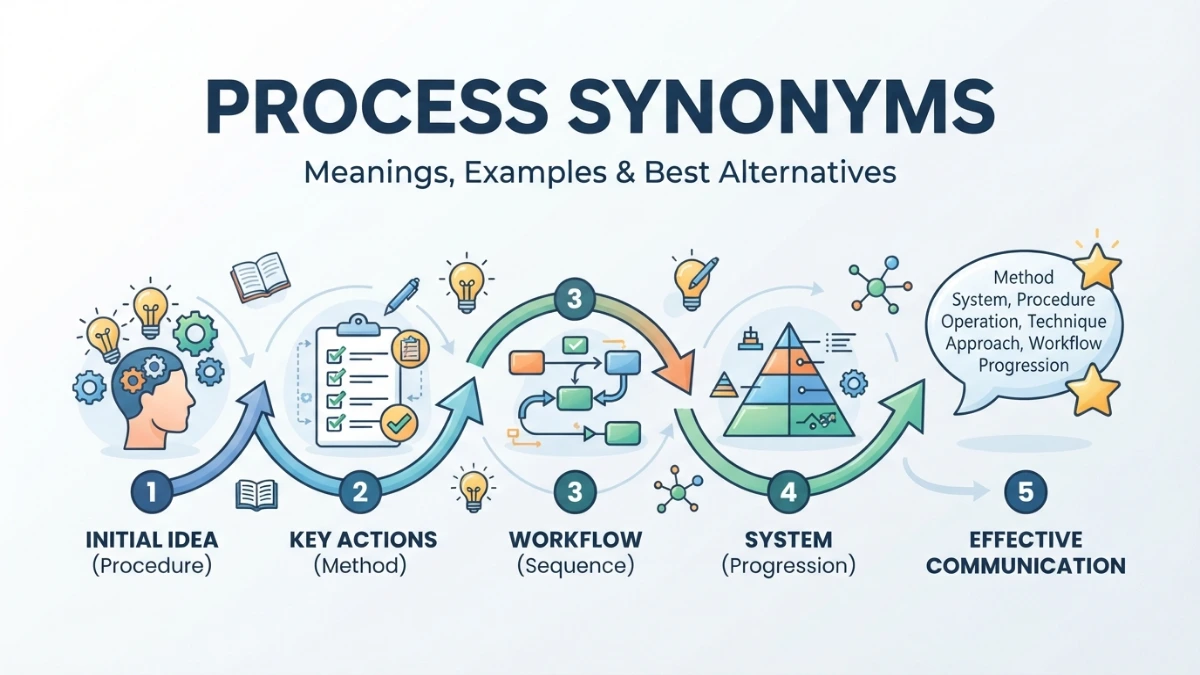
Imagine your teacher says, “Follow the process carefully,” your manager asks you to “improve the hiring process,” or a friend explains the “process of making bread.” The word process appears in all three situations, but its meaning changes slightly each time.
In one sentence, it can mean a series of steps. In another, it can describe an organized way of working. It can also describe a natural change, such as the process of learning a language.
That is why replacing process with any random synonym can make your sentence sound unnatural. For example, procedure works well for official instructions, while progression often describes development over time. Similarly, workflow fits workplace tasks, but it does not always replace process in everyday conversation.
So, in this guide, you will learn the most useful alternatives, their meanings, tone, and natural contexts. You will also see examples that show exactly when each word works best.
Quick Answer
A process is a series of actions, steps, or changes that lead to a particular result. Depending on the context, useful synonyms include procedure, method, system, approach, workflow, sequence, operation, routine, and procedure. The best alternative depends on whether you mean a set of steps, a way of doing something, or a natural change over time.
Meaning, Tone & Context
The noun process generally describes a series of actions, stages, or changes that produce a result.
For example:
“The application process takes about two weeks.”
Here, process means the complete series of steps involved in applying.
It can also describe a method of working:
“We need to improve our production process.”
In this sentence, it refers to the organized way a company produces something.
Finally, process can describe gradual change:
“Learning a new language is a long process.”
Here, the word refers to development that happens over time.
What tone does “process” have?
Process is a neutral and highly flexible word. It works in:
- Everyday conversation
- School and education
- Business
- Science
- Technology
- Academic writing
- Professional communication
- Technical instructions
Because it sounds neutral, you can use it in both casual and formal situations.
However, the best synonym changes with the context. Procedure sounds more official, method focuses on how something is done, and workflow focuses on how tasks move from one stage to another.
When & How to Use “Process”
Use process when you want to talk about connected steps, activities, or changes that lead toward an outcome.
For a series of steps
“The registration process is simple.”
This means registration involves several steps.
For workplace systems
“Our team is reviewing the hiring process.”
Here, the word refers to the complete system used to hire employees.
For natural development
“Recovery can be a slow process.”
The word describes gradual change rather than a fixed set of instructions.
As a verb
Process can also work as a verb.
“The bank will process your payment tomorrow.”
Here, process means to handle or deal with something through an organized system.
Another example is:
“The computer processes thousands of calculations every second.”
In technology, it means to handle or analyze information.
Another Word for Process
There is no single synonym that replaces process in every sentence. The most suitable alternative depends on what you want to emphasize.
If you mean official steps, use procedure.
“Follow the safety procedure.”
If you mean a way of doing something, use method.
“This method saves time.”
If you mean a connected set of workplace tasks, use workflow.
“The new workflow reduces delays.”
If you mean gradual development, use progression.
“The progression from beginner to advanced learner takes time.”
If you mean a particular way of approaching a problem, use approach.
“We need a different approach to customer service.”
When Not to Use This Word
Although process is versatile, sometimes a more precise word sounds better.
Avoid using process when you specifically mean one fixed instruction. In that situation, procedure may be clearer.
Instead of:
“What is the process for turning off this machine?”
You might say:
“What is the procedure for turning off this machine?”
Likewise, if you simply mean a way of doing something, method may communicate the idea more directly.
Instead of:
“What process did you use to solve the problem?”
you can say:
“What method did you use to solve the problem?”
However, process remains correct when you mean several connected actions rather than one particular technique.
Words Commonly Confused With “Process”
Process vs Procedure
A process usually covers a broader series of activities, while a procedure normally gives specific steps or instructions.
“The recruitment process takes several weeks.”
“The interview procedure has five steps.”
Process vs Method
A method means a particular way of doing something. A process often describes the complete sequence.
“We used a new method to test the product.”
“The testing process took three months.”
Process vs System
A system is an organized structure of connected parts. A process focuses more on the actions or stages that happen within that structure.
“The company has a good payment system.”
“The payment process is quick.”
Process vs Progression
Progression emphasizes movement or development from one stage to another.
“Her progression from beginner to expert was impressive.”
By contrast, processes can describe the entire journey without emphasizing advancement.
Best Synonym by Context
| Context | Best Synonym | Why It Fits |
| Official instructions | Procedure | Focuses on prescribed steps |
| General way of doing something | Method | Emphasizes how something is done |
| Workplace tasks | Workflow | Shows how tasks move between stages |
| Problem-solving | Approach | Emphasizes a chosen way of dealing with something |
| Organized operation | System | Highlights connected parts |
| Natural development | Progression | Focuses on movement between stages |
| Repeated work | Routine | Describes regularly followed actions |
| Technical work | Protocol | Often describes established rules or steps |
| Manufacturing | Production | Focuses on making goods |
| Scientific work | Methodology | Describes an organized approach to research |
Which Synonym Should You Choose?
Start by asking what process means in your sentence.
For official instructions, choose procedure instead.
When explaining how someone does something, use method or technique.
For work that moves from one task to another, workflow may be more appropriate.
In the context of gradual change, consider progression, development, or evolution, depending on the meaning.
A regular set of actions is better described as a routine.
Most importantly, never choose a synonym simply because a dictionary lists it. Always check the sentence, audience, and intended meaning first.
SEO readability improvement: The repeated sentence openings have been diversified, making the paragraph flow more naturally without changing its message.
Real-Life Examples of “Process” in Sentences
School
“The writing process includes planning, drafting, revising, and editing.”
“Learning mathematics is a gradual process.”
Workplace
“We need to make the hiring process faster.”
“The company changed its payment process.”
Writing
“The editing process helped improve the article.”
“Research is an important part of the writing process.”
Conversation
“Can you explain the process to me?”
“The whole process took less than an hour.”
50 Synonyms for “Process”
The following alternatives are useful in different contexts. They are not all interchangeable with process, so always consider the exact meaning.
| Synonym | Simple Meaning | Example Sentence |
| 1. Procedure | An established set of steps | “Follow the safety procedure carefully.” |
| 2. Method | A way of doing something | “This method works well for beginners.” |
| 3. System | An organized set of connected parts | “The company introduced a new payment system.” |
| 4. Approach | A way of dealing with something | “We need a practical approach to the problem.” |
| 5. Workflow | The way tasks move through a workplace | “The new workflow saves time.” |
| 6. Operation | An organized activity or function | “The operation runs around the clock.” |
| 7. Technique | A particular way of performing a task | “She learned a useful painting technique.” |
| 8. Methodology | A structured method, especially in research | “The study explains its research methodology.” |
| 9. Protocol | Official rules or steps to follow | “The laboratory follows a strict protocol.” |
| 10. Routine | Regularly repeated actions | “Checking emails is part of my morning routine.” |
| 11. Practice | A usual or established way of doing something | “The company follows good safety practices.” |
| 12. Practice method | An organized way to develop a skill | “The practice method helped students improve.” |
| 13. Systematic approach | An organized way of handling something | “We used a systematic approach to the investigation.” |
| 14. Course | A series of developments or events | “The project changed course after the meeting.” |
| 15. Sequence | Things arranged in an order | “Complete the steps in the correct sequence.” |
| 16. Series | A connected set of events or actions | “The repair requires a series of steps.” |
| 17. Set of steps | Several actions completed in order | “Cooking the dish involves a simple set of steps.” |
| 18. Stage | One part of a larger process | “The project is now at the final stage.” |
| 19. Cycle | A series that repeats | “The machine goes through a cleaning cycle.” |
| 20. Progression | Movement through stages | “Her progression was steady.” |
| 21. Development | Gradual growth or change | “Language development takes time.” |
| 22. Evolution | Gradual change over time | “The evolution of the technology was rapid.” |
| 23. Transformation | A significant change in form or condition | “The transformation took several months.” |
| 24. Transition | Movement from one state to another | “The transition to remote work was gradual.” |
| 25. Change | Movement from one condition to another | “The change happened slowly.” |
| 26. Advancement | Movement toward a more developed state | “The advancement of technology changed the industry.” |
| 27. Treatment | A process used to deal with a condition or material | “The treatment requires several sessions.” |
| 28. Handling | The act of dealing with something | “The careful handling of complaints matters.” |
| 29. Management | Organized control or handling | “Good time management improves productivity.” |
| 30. Preparation | Actions taken to get ready | “The preparation took two days.” |
| 31. Production | The process of making something | “Food production requires careful planning.” |
| 32. Manufacture | The organized making of products | “The manufacture of the parts takes place locally.” |
| 33. Assembly | Putting parts together | “The assembly of the furniture was easy.” |
| 34. Conversion | Changing something into another form | “The conversion to digital files took hours.” |
| 35. Transaction | A completed exchange or business action | “The transaction was processed quickly.” |
| 36. Implementation | Putting a plan into action | “The implementation of the policy began in June.” |
| 37. Execution | Carrying out a plan or task | “The successful execution required teamwork.” |
| 38. Application | Putting an idea or method into use | “The application of the new method improved results.” |
| 39. Progress | Movement toward a result | “The project is making good progress.” |
| 40. Journey | A period of development or change | “Learning a language is a long journey.” |
| 41. Path | A route toward a result or goal | “Education can provide a path to new opportunities.” |
| 42. Framework | A structure for organizing an activity | “The framework guides the research.” |
| 43. Mechanism | The way something works or produces an effect | “Scientists studied the mechanism behind the reaction.” |
| 44. Scheme | An organized plan or arrangement | “The recycling scheme reduced waste.” |
| 45. Program | An organized set of activities | “The training program lasts six weeks.” |
| 46. Regimen | A planned and regular course of activity | “The athlete follows a strict training regimen.” |
| 47. Campaign | An organized series of activities for a purpose | “The company launched a marketing campaign.” |
| 48. Initiative | An organized action designed to achieve a goal | “The school started a reading initiative.” |
| 49. Treatment course | A planned series of medical care | “The doctor recommended a short treatment course.” |
| 50. Operation sequence | A connected order of technical actions | “The machine follows an automatic operation sequence.” |
Synonym Groups & Usage Differences
Formal and Professional
Procedure, protocol, methodology, implementation, execution, framework, and operation often appear in professional, technical, academic, or official contexts.
For example:
“Employees must follow the safety procedure.”
These words can sound too formal in casual conversation.
Academic
Methodology, method, framework, progression, development, sequence, and approach commonly appear in academic writing.
For example:
“The researchers used a qualitative methodology.”
Here, methodology sounds more appropriate than the everyday word routine.
Conversational
In everyday speech, method, way, steps, routine, approach, and journey often sound natural.
“What method did you use?”
“Can you show me the steps?”
Stronger or More Specific Alternatives
Some words narrow the meaning rather than simply replacing process.
Procedure stresses instructions.
Workflow stresses movement between tasks.
Technique stresses skill.
Mechanism stresses how something works.
Progression stresses movement between stages.
Therefore, these words can make your sentence more precise.
Emotional vs Neutral
The process itself usually sounds neutral.
Words such as journey can sound more personal or emotional:
“Learning English is a journey.”
By contrast:
“Learning English is a process.”
The first sentence highlights personal experience, while the second focuses on development.
Modern vs Old-Fashioned
Most common alternatives, such as method, system, procedure, workflow, approach, and routine, remain current in modern English.
Some terms can sound specialized rather than old-fashioned. For example, regimen is still correct, but it appears more often in health, fitness, or structured training contexts than in ordinary conversation.
Slang
There is no widely used slang word that directly replaces process in standard English. Informal speakers may say ways or steps, but these are ordinary informal alternatives rather than true slang synonyms.
Antonyms
There is no perfect single antonym for process because the word has several meanings. However, these terms can express contrasting ideas in specific contexts.
| Antonym | Meaning | Example |
| Stagnation | Lack of development or movement | “The company experienced stagnation after years without change.” |
| Inaction | Failure to take action | “Inaction delayed the project.” |
| Disorder | Lack of organized arrangement | “The files were in complete disorder.” |
| Randomness | Lack of an organized pattern | “The results appeared to show randomness.” |
| Standstill | A complete stop in activity or progress | “Construction came to a standstill.” |
| Discontinuation | The act of stopping something | “The discontinuation of the service surprised customers.” |
These words do not oppose every meaning of the process, so use them according to context.
Comparison Section
Subtle Meaning Differences
Process is broad. It can describe a complete series of actions, stages, or changes.
Procedure is narrower because it usually refers to established steps.
“The application process took a week.”
“The application procedure has four steps.”
Tone Differences
The process sounds neutral and professional.
The method sounds practical.
Journey can sound more personal.
“Learning English is a process.”
“Learning English is a journey.”
The second version creates a more personal feeling.
Emotional Intensity
Most alternatives remain neutral. However, words such as journey, transformation, and struggle can add emotional or experiential meaning.
For example:
“Her learning journey was challenging.”
This sounds more personal than:
“Her learning process was challenging.”
Formality Level
Procedure, protocol, methodology, implementation, and regimen generally sound more formal or specialized.
Way, method, steps, and routine often sound more natural in everyday communication.
Natural Usage Situations
Use workflow for workplace task movement:
“We need to improve our workflow.”
Use technique for a specific skill:
“This technique makes painting easier.”
Use mechanism for how something functions:
“Scientists studied the mechanism of the reaction.”
Use progression for development:
“The progression from basic to advanced lessons is gradual.”
Common Phrases & Expressions
Process of Learning
This phrase describes gradual development through education or experience.
“The process of learning a language takes time.”
Step-by-Step Process
This describes something that happens through clearly ordered stages.
“The teacher explained the step-by-step process.”
Application Process
This refers to the stages involved in applying for something.
“The application process is completely online.”
Decision-Making Process
This means the stages people follow when choosing something.
“The team discussed its decision-making process.”
Hiring Process
This refers to the activities involved in recruiting and selecting employees.
“The hiring process includes two interviews.”
Trial-and-Error Process
This describes learning by trying different solutions and correcting mistakes.
“Programming can involve a trial-and-error process.”
Common Mistakes to Avoid
One common mistake is treating every synonym as interchangeable. Procedure and method may both relate to ways of doing things, but they emphasize different ideas.
Another mistake is using workflow for every kind of process. Workflow specifically relates to how tasks move through a system, especially in work environments.
Also, avoid using methodology simply because it sounds academic. In many everyday sentences, the method is clearer and more natural.
Finally, remember that process can work as both a noun and a verb. As a noun, it describes a series of actions or changes. As a verb, it can mean to handle, analyze, or deal with something.
“The bank processed my payment.”
FAQs
What is the best synonym for process?
There is no single best synonym. Procedure works well for official steps, method for a way of doing something, workflow for workplace tasks, and progression for development.
What is a simple word for process?
Way, steps, or method can be simpler alternatives, depending on the sentence. For example, “What method did you use?” can mean “How did you do it?”
Is procedure the same as process?
Not exactly. A procedure usually describes specific or established instructions, while a process can describe a broader series of activities or changes.
What is the difference between process and method?
A method is a particular way of doing something. A process often describes the larger sequence of actions involved.
Can process be used as a verb?
Yes. As a verb, process can mean to handle, analyze, or deal with something.
“The office will process your application tomorrow.”
Conclusion
Learning synonyms for processes becomes much easier when you focus on meaning rather than memorizing long word lists. Although words such as procedure,
method, system, workflow, approach, sequence, progression, and routine can sometimes replace process, each one emphasizes something slightly different.