Imagine a student saying, “This exam is hard.” A coworker might say, “That was a hard decision,” while someone touching a table might say, “This surface is hard.” The same word works in all three situations, but the best synonym changes with the meaning.
Learning these differences helps you sound more natural because hard is a very common word, but it does not always express the exact idea you want.
Quick Answer
Hard can mean difficult, physically firm, requiring a lot of effort, strict, or severe, depending on the context. Common synonyms include difficult, challenging, tough, demanding, arduous, firm, solid, strict, harsh, and strenuous. The best alternative depends on what you mean by “hard.”
Meaning, Tone & Context
The adjective hard has several common meanings in English.
1. Hard means difficult
This is probably the most common meaning. Something is hard when it requires a lot of skill, thought, time, or effort.
- The math problem was hard.
- Learning a new language can be hard.
- She faced a hard decision.
In these examples, words such as difficult, challenging, tough, demanding, or complicated may work.
2. Hard means physically firm
We also use hard for something that does not bend, break, or change shape easily.
- This chair is made of hard wood.
- The ground became hard after the cold if.
- The bread is too hard to eat.
Here, firm, solid, rigid, stiff, or dense may be more precise.
3. Hard means requiring a lot of effort
We often describe work, exercise, or activity as hard.
- They worked hard all day.
- She trains hard before every competition.
- That was a hard workout.
Depending on the sentence, alternatives include strenuous, demanding, exhausting, intense, or laborious.
4. Hard means strict or severe
The word can also describe a person, rule, punishment, or approach.
- The teacher is hard on students.
- The company has hard rules.
- The judge gave him a hard punishment.
In these cases, strict, stern, severe, or harsh may be more appropriate.
Tone and formality
Hard is neutral, extremely common, and suitable for everyday conversation, school, workplace communication, and most informal writing.
However, more precise alternatives can improve formal or academic writing. For example:
- Everyday: “The assignment was hard.”
- More precise: “The assignment was challenging.”
- Academic: “The research problem was complex.”
- Professional: “The project was demanding.”
So, you do not need to avoid it. Instead, choose another word when you want to express a more specific meaning.
When & How to Use “Hard”
Use hard when you want a simple, natural way to describe difficulty, physical firmness, effort, or severity.
Talking about difficult tasks
- This test is hard.
- Finding a new job can be hard.
- The final question was hard.
Talking about effort
- She worked hard for the exam.
- We tried hard to solve the problem.
- He studied hard last night.
Notice that hard can also work as an adverb. In “She worked hard,” it describes how she worked.
Talking about difficult experiences
- Losing a friend was hard for him.
- It was a hard time for the family.
- She had to make a hard choice.
Here, hard can carry an emotional meaning.
Talking about physical objects
- The floor is hard.
- This material is very hard.
- The candy became hard in the refrigerator.
Talking about strictness
- My parents were hard on me.
- The coach is hard on players who arrive late.
The expression hard on someone usually means treating someone strictly or criticizing them strongly.
Another Word for Hard
There is no single perfect replacement for hard because the word has several meanings.
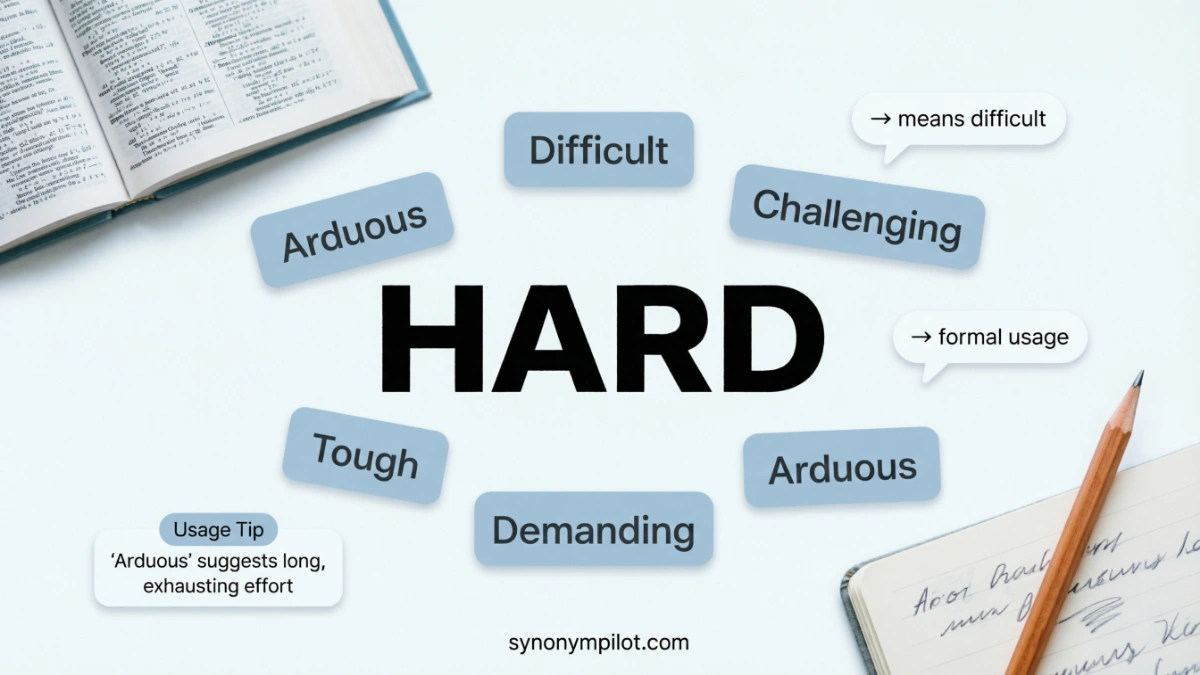
If you mean difficult, try:
- difficult
- challenging
- tough
- demanding
- arduous
If you mean physically firm, try:
- firm
- solid
- rigid
- stiff
- dense
If you mean strict or severe, try:
- strict
- stern
- severe
- harsh
- uncompromising
If you mean requiring a lot of effort, try:
- strenuous
- exhausting
- taxing
- laborious
- intense
Therefore, always check the meaning before replacing hard with a synonym.
When Not to Use This Word
Although hard is correct in many situations, another word may communicate your meaning more clearly.
For example, avoid using hard repeatedly in formal writing when you can be more specific.
Instead of:
The project was hard, and the research was hard.
You could write:
The project was demanding, and the research was complex.
Also, do not use hard when a synonym changes the meaning.
For example:
- Hard surface → firm/solid surface
- Hard exam → difficult/challenging exam
- Hard rules → strict rules
- Hard workout → strenuous workout
The best vocabulary choice depends on the noun and the intended meaning.
Words Commonly Confused With “Hard”
Hard vs. Difficult
Both can describe something that requires effort or skill.
- “This exam is hard.”
- “This exam is difficult.”
Hard sounds more conversational, while difficult often sounds slightly more formal.
Hard vs. Tough
Tough can mean difficult, but it often suggests that something requires strength, determination, or endurance.
- It was a difficult question.
- It was a tough journey.
Hard vs. Challenging
Challenging often suggests difficulty that tests your ability. It can sound more positive than hard.
- The course is hard.
- The course is challenging.
The second sentence can suggest that the course is difficult but also rewarding.
Hard vs. Harsh
Harsh usually describes unpleasant or severe conditions, treatment, criticism, or if.
- We had a hard day.
- We experienced harsh if.
Harsh is not a general synonym for every meaning of hard.
Hard vs. Firm
Firm usually describes something physically solid or steady.
- The mattress is firm.
- The mattress is hard.
However, firms can also describe a person’s position or decision.
Best Synonym by Context
| Context | Best Synonym | Why It Fits |
| Difficult exam | Difficult | Clear and neutral |
| Difficult project | Challenging | Suggests a test of ability |
| Very demanding task | Arduous | Emphasizes prolonged effort |
| Difficult physical activity | Strenuous | Focuses on physical effort |
| Difficult decision | Tough | Natural in conversation |
| Complicated problem | Complex | Focuses on many connected parts |
| Difficult situation | Trying | Emphasizes emotional difficulty |
| Firm surface | Solid | Focuses on physical structure |
| Hard material | Rigid | Suggests resistance to bending |
| Strict teacher | Stern | Focuses on serious behavior |
| Severe treatment | Harsh | Emphasizes unpleasant severity |
| Strict rules | Stringent | Suitable for formal contexts |
| Difficult workload | Taxing | Emphasizes mental or physical strain |
Which Synonym Should You Choose?
Start by asking what hard means in your sentence.
If something requires skill or thought, use difficult or challenging. If it requires sustained effort, demanding or arduous may fit better.
If you are describing physical material, consider solid, firm, rigid, or stiff. If you are describing strict behavior, choose strict, stern, severe, or harsh.
For everyday conversation, tough is often a natural alternative. For academic or professional writing, more precise words such as complex, demanding, challenging, or stringent can make your meaning clearer.
The goal is not to replace hard every time. Instead, choose a word that tells your reader exactly what kind of difficulty, firmness, effort, or severity you mean.
Real-Life Examples of “Hard” in Sentences
School
- This science chapter is hard to understand.
- The final exam was hard, but I prepared well.
- She studied hard for her English test.
Workplace
- We had a hard week because of the deadline.
- It was a hard decision for the manager.
- The team worked hard to finish the project.
Writing
- The author describes the hard conditions faced by the workers.
- The article discusses why learning grammar can be hard for beginners.
- The company faced a hard financial period.
Conversation
- “How was your interview?” “It was hard, but I think I did okay.”
- “Was the hike difficult?” “Yes, it was pretty hard.”
- “That sounds like a hard situation.”
50 Synonyms for “Hard”
The word “hard” has several meanings. It can describe something difficult, physically solid, demanding, strict, or requiring persistent effort. Because of these different senses, not every synonym works in every sentence.
Hard Meaning Difficult or Challenging
| Synonym | Simple Meaning | Example Sentence |
|---|---|---|
| 1. Difficult | Not easy to do or understand | This question is difficult. |
| 2. Challenging | Requires skill or effort | The course is challenging but useful. |
| 3. Tough | Difficult or demanding | We had a tough week. |
| 4. Demanding | Requires a lot of effort | Nursing can be a demanding job. |
| 5. Arduous | Very difficult and tiring | They completed an arduous journey. |
| 6. Strenuous | Requires strong physical effort | Running uphill is strenuous. |
| 7. Taxing | Uses a lot of energy or attention | The long meeting was taxing. |
| 8. Laborious | Requires long, careful effort | Data entry can be laborious. |
| 9. Grueling | Extremely tiring and difficult | The athletes completed a grueling training session. |
| 10. Exhausting | Makes you very tired | Moving house was exhausting. |
| 11. Complicated | Difficult because of many parts | The instructions are complicated. |
| 12. Complex | Has many connected or difficult parts | Climate change is a complex issue. |
| 13. Problematic | Difficult because it causes problems | The old system is problematic. |
| 14. Daunting | Difficult and slightly intimidating | The task looked daunting at first. |
| 15. Formidable | Very difficult to deal with | They faced a formidable challenge. |
Hard Meaning Demanding, Detailed, or Strict
| Synonym | Simple Meaning | Example Sentence |
|---|---|---|
| 16. Onerous | Difficult because it creates a heavy burden | The contract contains onerous requirements. |
| 17. Burdensome | Hard because it creates a burden | The paperwork became burdensome. |
| 18. Trying | Emotionally or practically difficult | It was a trying period. |
| 19. Uphill | Requiring continuous effort | Starting a business can be an uphill struggle. |
| 20. Intricate | Difficult because of fine details | The machine has an intricate design. |
| 21. Intense | Very strong or demanding | The workout was intense. |
| 22. Rigorous | Extremely thorough or demanding | Students followed a rigorous training program. |
| 23. Stringent | Very strict or demanding | The laboratory follows stringent safety rules. |
| 24. Exacting | Requiring great accuracy or skill | The job has exacting standards. |
| 25. Severe | Very serious or extreme | The region experienced severe conditions. |
Hard Meaning Firm, Solid, or Difficult to Bend
| Synonym | Simple Meaning | Example Sentence |
|---|---|---|
| 26. Firm | Solid but not completely rigid | The mattress feels firm. |
| 27. Solid | Strong and physically substantial | The table is made of solid wood. |
| 28. Rigid | Unable to bend or change easily | The plastic becomes rigid when cold. |
| 29. Stiff | Difficult to bend or move | The new shoes feel stiff. |
| 30. Dense | Closely packed and difficult to penetrate | The material is dense and heavy. |
| 31. Compact | Tightly packed together | The soil became compact after the rain. |
| 32. Unyielding | Does not bend or give way | The rock was unyielding. |
| 33. Inflexible | Not easily bent or changed | The metal frame is inflexible. |
| 34. Toughened | Made stronger or harder | The glass is toughened for safety. |
| 35. Robust | Strong and able to withstand difficulty | The system needs a robust design. |
Hard Meaning Strict, Severe, or Unforgiving
| Synonym | Simple Meaning | Example Sentence |
|---|---|---|
| 36. Stern | Strict and serious | The teacher gave a stern warning. |
| 37. Strict | Requires rules to be followed | The school has strict policies. |
| 38. Harsh | Severe or unpleasant | The hikers faced harsh weather conditions. |
| 39. Uncompromising | Refusing to change a position | The manager took an uncompromising approach. |
| 40. Unforgiving | Not allowing mistakes or weakness | The mountain trail is unforgiving. |
| 41. Relentless | Continuing without stopping | The team faced relentless pressure. |
Hard Meaning Working with Great Effort
| Synonym | Simple Meaning | Example Sentence |
|---|---|---|
| 42. Vigorous | Using a lot of energy | She gave the floor a vigorous scrub. |
| 43. Diligent | Working carefully and consistently | He is a diligent student. |
| 44. Industrious | Working hard and steadily | She is an industrious employee. |
| 45. Assiduous | Very careful and persistent | He made an assiduous effort to improve. |
| 46. Persistent | Continuing despite difficulty | Her persistent efforts finally helped. |
| 47. Tireless | Continuing without becoming tired | The volunteers made a tireless effort. |
| 48. Energetic | Showing a lot of energy | The children were energetic throughout the activity. |
| 49. Unrelenting | Continuing without becoming weaker | The workers faced unrelenting pressure. |
| 50. Tenacious | Continuing firmly despite difficulties | Her tenacious attitude helped her succeed. |
Synonym Groups & Usage Differences
Formal and Academic
For formal or academic writing, difficult, challenging, complex, rigorous, demanding, arduous, and stringent can be useful.
For example:
The researchers faced a complex problem.
This sounds more precise than simply saying:
The researchers faced a hard problem.
However, hard is still perfectly acceptable in many educational contexts.
Professional
At work, demanding, challenging, rigorous, taxing, exacting, and stringent can describe responsibilities, standards, procedures, or projects.
- The position is demanding.
- The company has stringent quality standards.
- The project required rigorous testing.
Conversational and Informal
Tough, hard, challenging, and intense commonly appear in everyday speech.
- “That was a tough interview.”
- “The exam was really hard.”
- “Today was intense.”
These choices sound natural in conversation.
Stronger vs. Weaker
Some alternatives express greater difficulty than ordinary hard.
A rough scale might be:
challenging → difficult → demanding → arduous → grueling
The exact intensity depends on context, but grueling usually suggests that something is extremely tiring and difficult.
Emotional vs. Neutral
Difficult is generally neutral.
Trying, daunting, tough, unforgiving, and harsh can add emotional or experiential meaning.
Compare:
It was a difficult year.
with:
It was a trying year.
The second sentence emphasizes that the experience was emotionally or practically difficult.
Physical Hardness
When hard describes an object or material, use words such as firm, solid, rigid, stiff, dense, compact, or unyielding, depending on the exact physical quality.
For example:
- Firm mattress
- Solid wood
- Rigid frame
- Stiff fabric
- Dense material
These are not interchangeable in every situation.
Slang
There is no need to force a slang category for hard. Some informal expressions use tough, but it is better treated as a common conversational synonym rather than slang.
Antonyms
| Antonym | Meaning | Example |
| Easy | Not difficult | The test was easy. |
| Simple | Easy to understand or do | The instructions are simple. |
| Effortless | Requiring almost no effort | She made the task look effortless. |
| Soft | Not physically firm | The pillow is soft. |
| Flexible | Able to bend or change | The material is flexible. |
| Gentle | Not harsh or severe | Use a gentle touch. |
| Lenient | Not strict | The teacher was lenient about the deadline. |
| Mild | Not severe or extreme | The if was mild. |
| Relaxed | Not strict or tense | The workplace has a relaxed atmosphere. |
Remember that antonyms also depend on the meaning. The opposite of hard as “difficult” is usually easy, while the opposite of physical hardness may be soft.
Comparison Section
Subtle Meaning Differences
Difficult focuses on lack of ease, while challenging often suggests that something tests your abilities.
The exam was difficult.
The exam was challenging, but I enjoyed it.
Demanding emphasizes the amount of effort required.
The course is demanding because students have several assignments each week.
Tone Differences
Hard and difficult are neutral. Tough sounds more conversational, while arduous sounds more formal.
It was a tough day.
It was an arduous journey.
Both communicate difficulty, but they suit different situations.
Emotional Intensity
Daunting suggests that something seems difficult or intimidating before you do it.
Speaking in front of 500 people felt daunting.
Grueling emphasizes extreme tiredness.
The workers completed a grueling twelve-hour shift.
Formality Level
Use hard and tough comfortably in everyday conversation. In academic or professional writing, challenging, complex, demanding, rigorous, or arduous may provide greater precision.
Natural Usage Situations
Choose the word that naturally fits the noun.
- Difficult question
- Challenging assignment
- Demanding job
- Arduous journey
- Strenuous exercise
- Harsh conditions
- Strict rules
- Solid surface
Although several of these words relate to hard, they do not all fit the same sentence.
Common Phrases & Expressions
Hard Work
Meaning: Work that requires considerable effort.
Example:
Success usually requires hard work and patience.
Work Hard
Meaning: Put a lot of effort into an activity.
Example:
She works hard to support her family.
Hard Time
Meaning: A difficult period in someone’s life.
Example:
He went through a hard time after losing his job.
Hard Decision
Meaning: A decision that is difficult to make.
Example:
Leaving the company was a hard decision.
Hard on Someone
Meaning: Treat someone strictly or criticize them strongly.
Example:
Try not to be too hard on yourself when you make mistakes.
Hard to Believe
Meaning: Difficult to accept as true.
Example:
It is hard to believe that the semester is already over.
Take the Hard Way
Meaning: Learn something through difficult experience rather than an easier method.
Example:
I learned the hard way that I should always save my work.
A Hard Nut to Crack
Meaning: A person or problem that is difficult to understand or solve.
Example:
The final puzzle was a hard nut to crack.
Common Mistakes to Avoid
1. Treating every synonym as interchangeable
Do not replace hard with harsh in every sentence. A difficult exam is not normally a “harsh exam.”
2. Using physical synonyms for difficulty
A rigid problem and a solid assignment do not normally mean a difficult problem or assignment.
3. Overusing formal words
Words such as arduous, assiduous, and onerous have specific uses. In everyday conversation, hard, difficult, or tough will often sound more natural.
4. Confusing “hard” with “hardly”
These words have very different meanings.
- She works hard. = She puts in a lot of effort.
- She hardly works. = She almost does not work.
5. Forgetting the adverbial use
In “He studied hard,” he describes the intensity of his studying. Do not automatically change it to hardly.
FAQs
What is the best synonym for hard?
For the meaning “difficult,” difficult is the safest direct synonym. However, challenging, tough, demanding, or arduous may be better when you want to express a more specific type or level of difficulty.
What is a simple word for hard?
Difficult is the simplest direct alternative when hard means “not easy.” In conversation, toughness is also very common.
Is “challenging” more positive than “hard”?
Often, yes. Challenging can suggest that something is difficult but useful, interesting, or rewarding. Hard simply describes the difficulty.
What is the opposite of hard?
It depends on the meaning. Easy is the usual opposite when hard means difficult. Soft is the opposite when hard describes physical texture.
Can I use “hard” in formal writing?
Yes. Hard is a normal English word and is not incorrect in formal writing. However, a more precise alternative such as difficult, complex, demanding, or rigorous can sometimes communicate your meaning more clearly.
Conclusion
The word hard is simple, common, and extremely useful, but its meaning changes with context. It can describe something difficult, physically firm, tiring, demanding, strict, or severe.
For everyday conversation, hard, difficult,
and tough are natural choices. In academic or professional writing, words such as challenging, complex, demanding, rigorous, or arduous can provide more precision.
Meanwhile, firm, solid, rigid, and stiff work better when you are talking about physical qualities.