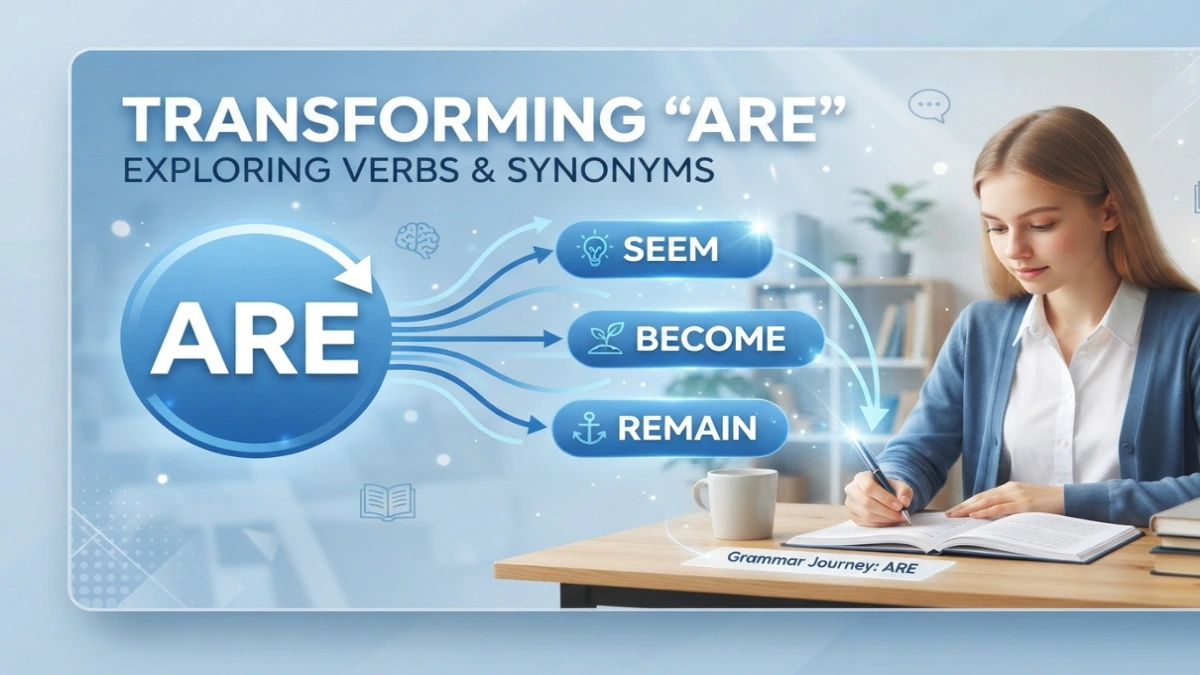
Have you ever noticed yourself using the word “are” over and over again while writing? Although are is one of the most common verbs in English, repeating it too often can make your sentences sound repetitive and less engaging.
The good news is that, depending on the context, you can often replace are with words like seem, remain, become, exist, appear, or feel to make your writing more natural and expressive.
In this guide, you’ll learn the best synonyms for are, when to use them, their meanings, real-life examples, and tips for choosing the right alternative in different situations.
FEATURED SNIPPET DEFINITION
What is meant by a synonym?
A synonym is a word that has the same or nearly the same meaning as another word.
What Is the Definition of synonyms of are?
There is no single synonym for are because it is a form of the verb be. However, depending on the sentence, words such as seem, remain, become, exist, appear, and feel can sometimes replace are while keeping a similar meaning.
Can You Replace “Are” in Every Sentence?
Not always.
The word are is a form of the verb be, so it cannot be replaced with the same word in every sentence.
Instead, choose an alternative based on what you want to express.
For example:
✔ They are happy.
✔We seem happy.
✔ They remain happy.
✔ They became happy.
Each sentence has a slightly different meaning, even though they are closely related.
Understanding “Are”
Are is the present tense form of the verb be used with:
- You
- We
- They
- Plural nouns
Examples:
- They are students.
- We are ready.
- The books are on the table.
The best replacement depends on the meaning of are.
CONTEXTUAL USAGE
When Should You Use Alternatives to “Are”?
Replacing are works best when you want to avoid repetition or make your writing more descriptive.
For example:
To describe appearance
She seems tired.
To describe change
The children became excited.
To describe a continuing state
They remain confident.
To describe existence
Many opportunities exist.
Always choose a word that matches the meaning of your sentence instead of replacing are automatically.
Words That Can Replace “Are”
Appearance
- seem
- appear
- look
- sound
Change
- become
- turn
- get
- grow
State
- remain
- stay
- continue
- keep
Existence
- exist
- live
- function
- operate
Alternatives for “Are” by Context
1. Are = Exist / Be Present
| Alternative | Example |
|---|---|
| Exist | Many opportunities exist today. |
| Remain | The rules remain important. |
| Stay | They stay focused on their goals. |
| Continue | They continue to work hard. |
2. Are = Describe a State
| Alternative | Example |
|---|---|
| Seem | They seem confident. |
| Appear | The results appear positive. |
| Look | They look prepared. |
| Feel | They feel comfortable. |
3. Are = Become / Change Into
| Alternative | Example |
|---|---|
| Become | They become successful with effort. |
| Turn | The leaves turn yellow in autumn. |
| Grow | They grow stronger over time. |
| Develop | Skills develop through practice. |
4. Are = Equal / Represent
| Alternative | Example |
|---|---|
| Equal | Two plus two equals four. |
| Represent | These symbols represent ideas. |
| Mean | These results mean success. |
| Indicate | The signs indicate progress. |
Common Collocations with “Are”
These phrases can help readers understand alternatives:
State & Condition
- are available
- are ready
- are important
- are necessary
- are responsible
- are aware
- are capable
- are interested
Formal Writing
- are considered
- are regarded as
- are known as
- are referred to as
- are associated with
- are related to
50 SYNONYMS LIST
| Synonym Word | Meaning | Examples |
| Exist | To be present or real | They exist in nature. / Many problems exist today. |
| Remain | To stay the same | We remain calm. / Prices remain high. |
| Seem | To appear a certain way | You seem tired. / They seem happy. |
| Become | To change into something | They become strong. / Kids become smart. |
| Represent | To stand for something | These represent ideas. / Colors represent feelings. |
| Appear | To look like | You appear sad. / He appears ready. |
| Feel | To sense emotionally | We feel good. / They feel excited. |
| Act | To behave in a way | They act smart. / Kids act silly. |
| Live | To stay alive | We live happily. / They live freely. |
| Stay | To remain in place | Stay calm. / They stay strong. |
| Stand | To be in position | We stand ready. / They stand united. |
| Work | To function | These work well. / Machines work fine. |
| Serve | To act as | They serve purpose. / Words serve meaning. |
| Function | To operate | Systems function properly. / Things function well. |
| Count | To matter | You count. / They count too. |
| Matter | To be important | These matter. / You matter. |
| Belong | To be part of | We belong here. / They belong together. |
| Continue | To keep going | We continue strong. / They continue working. |
| Grow | To develop | They grow fast. / Kids grow quickly. |
| Develop | To improve | Skills develop daily. / They develop ideas. |
| Look | To appear visually | You look tired. / They look ready. |
| Sound | To seem by hearing | You sound happy. / They sound confident. |
| Turn | To change into | They turn angry. / Weather turns cold. |
| Get | To become | They get tired. / We get ready. |
| Keep | To remain | Keep calm. / They keep quiet. |
| Prove | To show truth | They prove strong. / Ideas prove useful. |
| Show | To display | They show kindness. / Results show progress. |
| Indicate | To point out | Signs indicate danger. / Words indicate meaning. |
| Reflect | To show | Actions reflect values. / Words reflect feelings. |
| Demonstrate | To show clearly | They demonstrate skill. / Students demonstrate knowledge. |
| Reveal | To make known | Results reveal truth. / Faces reveal emotions. |
| Express | To show feelings | They express joy. / Kids express love. |
| Signal | To give sign | Lights signal danger. / Actions signal intent. |
| Illustrate | To explain with example | Stories illustrate ideas. / Pictures illustrate meaning. |
| Define | To explain meaning | Words define language. / Rules define actions. |
| Describe | To explain details | They describe scenes. / Writers describe feelings. |
| Portray | To show clearly | Movies portray life. / Stories portray emotions. |
| Convey | To communicate | Words convey ideas. / Messages convey feelings. |
| Imply | To suggest | Words imply meaning. / Actions imply intent. |
| Mean | To represent | This means truth. / It means success. |
| Equal | To be same as | Two plus two equals four. / These equal results. |
| Match | To be similar | They match perfectly. / Colors match well. |
| Fit | To be suitable | They fit here. / Ideas fit context. |
| Align | To agree | Views align well. / Goals align clearly. |
| Correspond | To match | Results correspond data. / Ideas correspond reality. |
| Agree | To be same | They agree fully. / Views agree well. |
| Relate | To connect | Stories relate life. / Ideas relate experience. |
| Connect | To link | These connect well. / People connect easily. |
| Link | To join | Words link ideas. / They link concepts. |
CATEGORIZED SYNONYM CLUSTERS
| Category | Synonyms |
| Formal | Represent, Demonstrate, Indicate, Convey, Illustrate |
| Informal | Look, Feel, Get, Act, Sound |
| Academic | Define, Describe, Reflect, Correspond, Imply |
| Technical | Function, Operate, Signal, Align, Link |
ANTONYMS SECTION
| Antonym | Meaning | Example |
| Disappear | To go away | The stars disappear. |
| Cease | To stop | They cease work. |
| End | To finish | The show ends. |
| Stop | To halt | Work stops early. |
| Vanish | To fade away | Clouds vanish quickly. |
| Leave | To go away | They leave soon. |
| Quit | To stop doing | He quits job. |
| Fail | To not succeed | They fail often. |
| Break | To stop working | Machines break down. |
| Collapse | To fall apart | Plans collapse suddenly. |
COMPARISON SECTION
The word “are” is a simple linking verb. But its synonyms add deeper meaning:
- Are vs Seem → “Seem” shows appearance (They seem happy vs They are happy).
- Are vs Become → “Become” shows change (They become strong).
- Are vs Remain → “Remain” shows no change (They remain calm).
- Are vs Exist → “Exist” shows presence (They exist here).
- Are vs Represent → “Represent” shows meaning (They represent ideas).
Using these correctly makes your writing richer and more precise.
Which Synonym Should You Choose?
Different situations require different alternatives.
| If you mean… | Use… |
|---|---|
| appearance | seem |
| change | become |
| staying the same | remain |
| existence | exist |
| feelings | feel |
| behavior | act |
Examples of “Are” in Everyday Sentences
- They are my best friends.
- We are ready for the test.
- You are very kind.
- These are beautiful flowers.
- The kids are playing outside.
Examples of Use in Phrases
- You are amazing
- We are together
- They are ready
- Things are changing
- People are talking
FAQs
Is “are” a linking verb?
Yes.
Are is a linking verb because it connects the subject with additional information rather than showing an action.
Is there one exact synonym for “are”?
No.
Because are is a form of the verb be, there is no single synonym that works in every sentence.
How can I avoid repeating “are” in writing?
Instead of repeating are, rewrite the sentence using words such as seem, become, remain, or exist, depending on the meaning.
Can I replace “are” with “is”?
No.
Is is used with singular subjects, while are is used with plural subjects and you.
What are synonyms of “are”?
They are alternative verbs like seem, remain, become, used instead of “are”.
Can I always replace “are”?
No, it depends on context and grammar.
Why should I learn these synonyms?
They improve writing and avoid repetition.
Are these synonyms useful in speaking?
Yes, they make your English sound natural and fluent.
Which synonym is most common?
“Seem” and “become” are widely used in daily English.
How can I avoid using are too much?
Use stronger verbs that show action or meaning, such as:
- demonstrate
- indicate
- represent
- create
- produce
- contain
What is the opposite of are?
The opposite depends on the sentence. Possible opposites include:
- are not
- do not exist
- disappear
- cease to be
MINI VOCABULARY GROWTH SECTION
Learning synonyms of are helps you:
- ✨ Improve writing and speaking
- ✨ Make blogs and essays more engaging
- ✨ Avoid repetition and boring sentences
- ✨ Build strong vocabulary and confidence
Small change → Big impact in communication!
CONCLUSION
Although are is one of the most common words in English, you don’t always have to repeat it. Depending on the meaning, alternatives such as seem, remain, become, exist, or appear can make your writing more varied and engaging.
The key is choosing a word that fits the context rather than replacing are automatically. As you practice using these alternatives, your writing will become clearer, more natural, and more expressive.