Have you ever tried to write a funny sentence but kept repeating the word “humor” again and again? I remember writing a blog post where every line had the same word, and it sounded boring fast.
That’s when I discovered how powerful synonyms for humor can be in making writing lively and engaging.
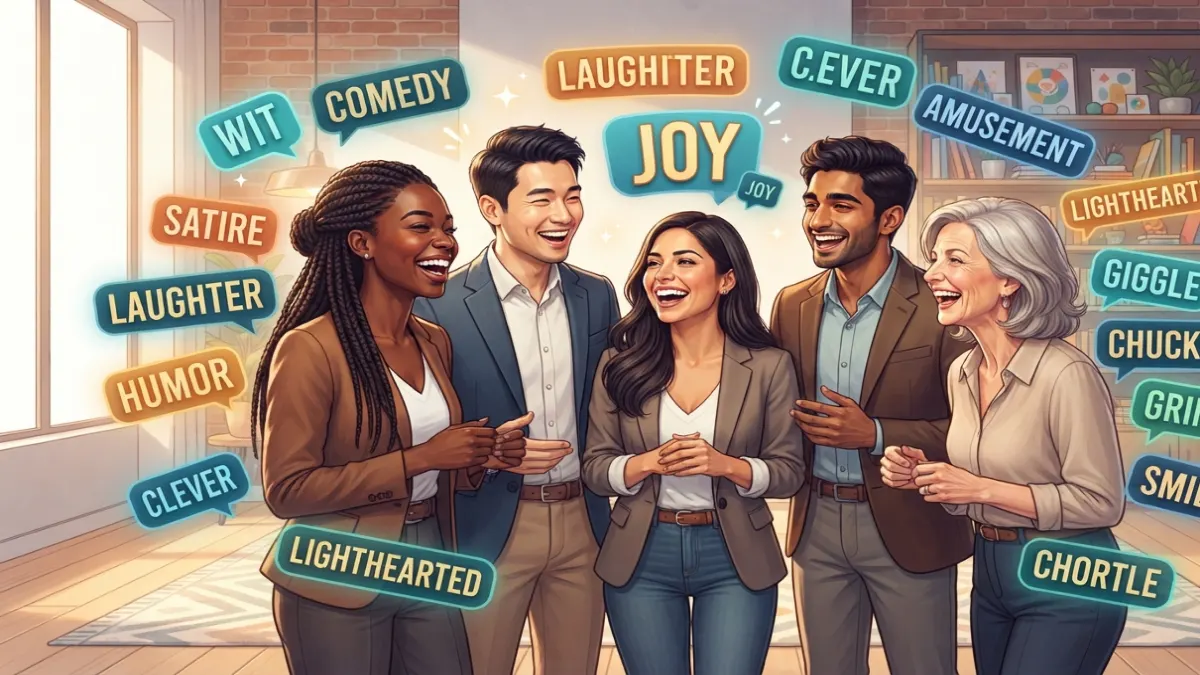
In simple words, humor means something funny or amusing that makes people laugh or smile. But in English, there are many ways to say it, like comedy, wit, or laughter.
Learning synonyms for humor helps students, bloggers, freelancers, and everyday English users write better and sound more natural.
If you are searching for funny writing words, humor vocabulary list, or English words for comedy, this guide will make everything easy and clear.
Featured Snippet:
What is meant by a synonym?
- A synonym is a word that has the same or nearly the same meaning as another word.
- It helps improve writing by avoiding repetition and making language richer.
What is the definition of synonyms for humor?
- Synonyms for humor are different words used to describe something funny, amusing, or entertaining.
- These words include terms like wit, comedy, and laughter, which express similar ideas in different ways.
CONTEXTUAL USAGE – When and How to Use Synonyms for Humor
You use synonyms for humor in writing, speaking, blogging, storytelling, and even emails when you want to sound creative instead of repeating the same word.
Examples:
- His sense of wit made the classroom more enjoyable.
- The movie was full of comedy and light moments.
- Her mirth spread happiness in the room.
Tip: Use formal synonyms like “wit” in essays and informal ones like “fun” in daily conversation.
Types of Humor (Highly Recommended for SEO)
Funny Humor
- funny
- amusing
- hilarious
- comical
Witty Humor
- witty
- clever
- sharp
- intelligent humor
Sarcastic Humor
- sarcastic
- ironic
- dry humor
- satirical
Light Humor
- light-hearted
- playful
- entertaining
- cheerful
50 SYNONYMS FOR HUMOR (WITH MEANING + EXAMPLES)
| Synonym | Meaning | Examples |
| Amusement | Feeling of fun or enjoyment | The game brought amusement to the kids. / Her story gave us amusement. |
| Comedy | Something funny meant to entertain | The film is pure comedy. / I enjoy comedy shows at night. |
| Wit | Smart and quick humor in speech | His wit impressed everyone. / She replied with sharp wit. |
| Laughter | Sound of laughing | Laughter filled the hall. / We heard loud laughter outside. |
| Mirth | Great happiness and joy | Mirth spread during the party. / His jokes brought mirth. |
| Fun | Enjoyable activity or feeling | We had fun at the picnic. / School trips are full of fun. |
| Jest | A joke or playful remark | He spoke in jest. / It was only a jest. |
| Banter | Friendly teasing conversation | Their banter was funny. / We enjoyed workplace banter. |
| Satire | Humor that criticizes | The book uses satire. / Satire can be powerful. |
| Parody | Funny imitation of something | The parody was hilarious. / They made a parody video. |
| Irony | Opposite of expected meaning | The irony made it funny. / Life’s irony is strange. |
| Sarcasm | Mocking humor | His sarcasm was sharp. / She replied with sarcasm. |
| Farce | Absurd comedy | The play was a farce. / It turned into a farce. |
| Ridicule | Making fun of someone | He faced ridicule. / Ridicule is not kind humor. |
| Mockery | Teasing or insulting humor | Mockery hurt his feelings. / The mockery was unfair. |
| Clowning | Acting silly for fun | Clowning made kids laugh. / Stop clowning around. |
| Drollness | Quiet and funny style | His drollness was unique. / The drollness amused us. |
| Levity | Light and playful mood | She spoke with levity. / Levity eased tension. |
| Jocularity | Cheerful joking behavior | His jocularity was loved. / Jocularity filled the room. |
| Joking | Saying funny things | He was joking all day. / Joking made us relax. |
| Humorfulness | Full of humor | His humorfulness is rare. / Humorfulness helps friendships. |
| Merriment | Joyful laughter and fun | Merriment filled the hall. / Merriment lasted all night. |
| Gaiety | Cheerful happiness | Gaiety was everywhere. / Her gaiety was contagious. |
| Playfulness | Fun and light behavior | Children showed playfulness. / Playfulness makes life better. |
| Lightheartedness | Carefree fun attitude | Her lightheartedness helped. / Lightheartedness is refreshing. |
| Waggishness | Playful joking style | His waggishness amused us. / Waggishness is charming. |
| Humorist style | Comic expression style | The humorist style worked well. / He used humorist style writing. |
| Jestfulness | Habit of joking | His jestfulness was fun. / Jestfulness lightened mood. |
| Comedy relief | Funny break in tension | The scene gave comedy relief. / Comedy relief helped audience. |
| Chuckles | Soft laughter | Chuckles came from the crowd. / Her joke caused chuckles. |
| Giggles | Light laughter | Giggles filled the room. / We shared giggles. |
| Snickers | Quiet laughs | Snickers came from the back. / He tried to hide snickers. |
| Smiles | Happy facial expression | Smiles spread quickly. / Her joke brought smiles. |
| Humorism | System of humor expression | Humorism shapes writing. / Humorism is artistic. |
| Comic relief | Humor in serious story | Comic relief helped mood. / The film used comic relief. |
| Joke telling | Sharing jokes | Joke telling is fun. / He enjoys joke telling. |
| Amusingness | Quality of being funny | The amusingness was high. / Amusingness attracted people. |
| Droll humor | Subtle funny style | Droll humor is smart. / He loves droll humor. |
| Jest humor | Playful joking tone | Jest humor made us laugh. / Jest humor is light. |
| Laughing matter | Something funny | It became a laughing matter. / Not everything is laughing matter. |
| Humor vibe | Funny atmosphere | The humor vibe was strong. / Party had humor vibe. |
| Comic tone | Funny style of speech | Comic tone worked well. / Comic tone made it fun. |
| Funfulness | State of being fun | The funfulness was great. / Funfulness improved mood. |
| Hilarity | Extreme amusement | Hilarity broke out suddenly. / Hilarity filled the room. |
| Jest mood | Playful emotional state | He was in jest mood. / Jest mood changed everything. |
| Joke spirit | Funny mindset | She has joke spirit. / Joke spirit makes friends. |
| Bantering tone | Playful teasing style | Bantering tone was fun. / They used bantering tone. |
| Laugh spirit | Mood of laughter | Laugh spirit spread fast. / Laugh spirit is powerful. |
| Humor spark | Trigger of laughter | Humor spark started jokes. / Humor spark lit the room. |
| Comic expression | Funny way of speaking | Comic expression worked. / Comic expression is creative. |
| Light comedy | Soft humorous style | Light comedy is relaxing. / We enjoy light comedy. |
CATEGORIZED SYNONYM CLUSTERS
| Category | Synonyms |
| Formal | Wit, Satire, Irony, Levity, Humorism |
| Informal | Fun, Joking, Banter, Giggles, Chuckles |
| Academic | Humorism, Satire, Irony, Comedy relief |
| Technical/Literary | Parody, Farce, Comic tone, Comic relief |
Common Collocations with “Humor”
Learning collocations helps you use “humor” naturally in writing, speaking, and storytelling. Here are some of the most common and useful expressions:
✔ Sense of Humor Expressions
- sense of humor
- good sense of humor
- strong sense of humor
- sense of humor in writing
👉 Example: A good sense of humor makes conversations more enjoyable.
✔ Types of Humor
- dry humor
- dark humor
- witty humor
- sarcastic humor
- subtle humor
👉 Example: His dry humor is not always understood by everyone.
✔ Descriptive Humor Qualities
- sharp humor
- clever humor
- good humor
- subtle humor
👉 Example: Her clever humor made the presentation more engaging.
✔ Writing & Communication Usage
- humor in writing
- sense of humor in writing
- use humor effectively
- light humor in writing
👉 Example: Writers often use subtle humor in writing to keep readers engaged.
ANTONYMS OF HUMOR
| Antonym | Meaning | Example |
| Sadness | Feeling of unhappiness | Sadness filled the room. |
| Seriousness | No fun or jokes | His tone showed seriousness. |
| Melancholy | Deep sadness | Melancholy was visible. |
| Gloom | Dark emotional state | Gloom covered the hall. |
| Sorrow | Emotional pain | Sorrow affected her voice. |
| Tragedy | Very sad event | The story turned into tragedy. |
| Anguish | Strong emotional pain | He felt deep anguish. |
| Dullness | Lack of interest or fun | The lecture had dullness. |
| Boredom | Lack of excitement | Boredom made them leave. |
| Grief | Deep sadness after loss | Grief replaced humor. |
COMPARISON SECTION
- Humor vs Wit: Humor is general fun, while wit is smart, sharp humor.
- Humor vs Comedy: Humor is feeling; comedy is structured entertainment.
- Humor vs Satire: Satire criticizes using humor, humor is broader.
- Humor vs Irony: Irony is saying opposite meaning; humor is wider.
- Humor vs Farce: Farce is exaggerated comedy, humor is more natural.
EXAMPLES OF HUMOR IN EVERYDAY SENTENCES
- His humor makes every class enjoyable.
- She used humor to lighten the mood.
- The teacher’s humor helped students learn better.
- Good humor improves friendships.
- Their humor made the meeting fun.
PHRASES USING SYNONYMS FOR HUMOR
- Sharp wit in conversation
- Light comedy show
- Friendly banter at work
- Dark satire in writing
- Sudden burst of laughter
FAQs
1. What are synonyms for humor?
They are words like wit, comedy, fun, and laughter that describe something funny.
2. Why should I learn synonyms for humor?
They improve writing, speaking, and vocabulary variety.
3. Is humor formal or informal?
It can be both depending on the synonym used.
4. What is the best synonym for humor in essays?
Wit, satire, and levity are best for formal writing.
5. Can humor synonyms be used in SEO writing?
Yes, they improve keyword variety and readability.
MINI VOCABULARY GROWTH SECTION
Learning synonyms for humor helps you:
- Improve writing and speaking skills
- Make blogs and content more engaging
- Sound more natural and professional
It also strengthens your vocabulary authority and makes communication clearer and more powerful.
CONCLUSION (120–130 words)
Learning synonyms for humor is a simple but powerful way to improve your English skills. Instead of repeating the same word, you can use wit, comedy, laughter, or satire to make your writing more colorful and engaging.
This helps in essays, blogs, social media captions, emails, and daily conversations. The more you practice these words, the more natural and confident your communication becomes.
If you are a student, blogger, freelancer, or English learner, using synonyms for humor will upgrade your vocabulary and writing style.
Try using these words every day in real sentences. With time, you will notice your English becoming richer, smoother, and more expressive.