Imagine a friend calls you and says, “I’m in a difficult situation. I don’t know what to do.”
The word situation works perfectly here, but sometimes you may want a more precise word. For example, predicament suggests a difficult problem, while scenario describes a possible set of events. In a formal report, circumstances may sound more appropriate, while in casual conversation, spot or fix can sound more natural.
That is why learning synonyms for situations is not simply about memorizing a long list of replacement words. Instead, you need to understand what each word means, how strong it sounds, and where people naturally use it.
In this guide, you’ll learn 50 useful alternatives to situations, along with simple meanings and realistic examples. You’ll also see which words work best in school, workplace, writing, and everyday conversation.
Quick Answer
A situation is a set of circumstances or conditions that someone faces at a particular time. Depending on the context, you can use words such as circumstance, condition, scenario, case, context, position, predicament, or state of affairs instead.
Meaning, Tone & Context
The noun situation refers to the circumstances, conditions, or state of affairs that exist at a particular time or in a particular place.
For example:
- “We need to understand the situation before making a decision.”
- “The situation at work has improved.”
- “She found herself in a difficult situation.”
The word has a neutral and flexible tone. You can use it in casual conversation, professional communication, academic writing, news reports, and everyday writing.
However, the best alternative depends on the exact meaning you want.
Situation vs. Circumstance
Circumstance usually focuses on a condition or fact that affects an event or person.
“Under these circumstances, we should wait.”
Situation vs. Scenario
Scenario often describes a possible or imagined set of events.
“Let’s consider the worst-case scenario.”
Situation vs. Predicament
Predicament means a difficult or unpleasant situation that requires a solution.
“He was in a difficult predicament.”
Situation vs. Context
Context means the surrounding information or conditions that help you understand something.
“You need to consider the historical context.”
So, although these words overlap, they do not always replace situations naturally.
When & How to Use “Situation”
You can use situation when you want to describe what is happening to someone, what is happening in a place, or the circumstances surrounding an event.
To describe a problem
“We need to solve this situation quickly.”
However, problem may sound more natural if the situation specifically involves something that needs fixing:
“We need to solve this problem quickly.”
To describe current conditions
“The financial situation has changed.”
Here, situation refers to someone’s overall circumstances.
To describe social circumstances
“She handled the difficult situation calmly.”
To discuss workplace conditions
“The manager explained the situation to the team.”
To discuss a possible event
For an imagined or possible set of events, scenario often works better:
“What would you do in this scenario?”
To describe a difficult position
If someone has limited choices, predicament or dilemma may communicate the meaning more precisely:
“She was in a difficult predicament.”
Therefore, choose the alternative that expresses the exact idea rather than replacing the situation automatically.
Another Word for Situation
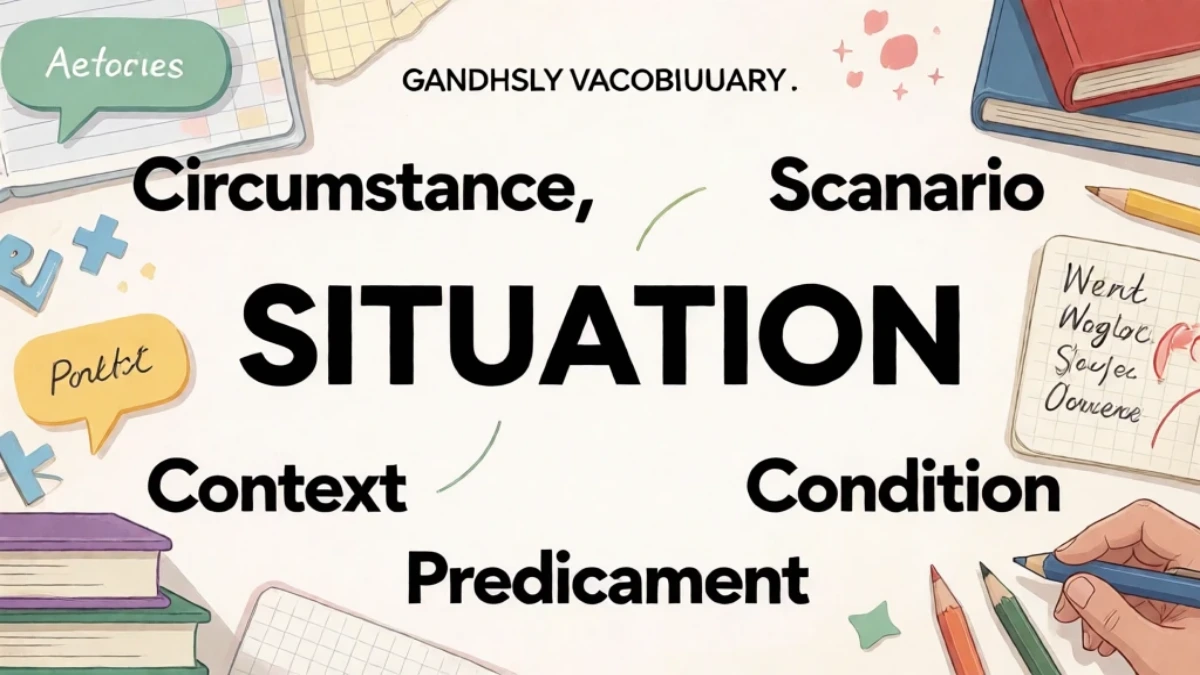
The best general alternatives include circumstance, condition, scenario, case, context, state of affairs, position, setting, predicament, and plight.
The right choice depends on your meaning.
If you simply mean “what is happening,” circumstance or state of affairs can work.
If you mean a possible event, choose a scenario.
If you mean a difficult problem, consider predicament, plight, or dilemma.
If you mean the surroundings in which something happens, the setting or environment may fit better.
For casual speech, spot, fix, jam, or bind can sometimes work, although these words have more specific meanings and should not replace situation in every sentence.
When Not to Use This Word
Although the situation is extremely useful, it can sometimes sound too general.
For example:
“We need to understand the situation.”
This sentence does not tell the reader much. If you know exactly what you mean, a more specific word can make your writing clearer.
Instead of:
“The company has a difficult situation.”
You could write:
“The company faces a financial problem.”
Instead of:
“This situation could happen next year.”
You could write:
“This scenario could happen next year.”
Likewise, avoid using situations when a more precise noun explains the idea better.
For example, dilemma describes a difficult choice between options, while predicament describes a difficult position. Neither word works as a universal replacement.
Words Commonly Confused With “Situation”
Several related words look similar but carry different meanings.
Situation vs. Circumstance
A situation describes the overall conditions or events affecting someone.
A circumstance usually describes a particular fact or condition that influences what happens.
“The situation is getting worse.”
“Under these circumstances, we cannot continue.”
Situation vs. Scenario
A scenario often describes a possible, imagined, or planned situation.
“We should prepare for several possible scenarios.”
Situation vs. Condition
A condition refers to a particular state or requirement.
“The building is in poor condition.”
Here, condition describes the state of the building rather than the broader events surrounding it.
Situation vs. Problem
A problem is something difficult that needs attention or a solution.
A situation can be neutral or positive.
“The current situation is peaceful.”
You would not normally call a peaceful situation a problem.
Best Synonym by Context
| Context | Best Choice | Why It Fits |
| General use | Circumstance | Describes surrounding conditions |
| Possible event | Scenario | Describes a possible set of events |
| Difficult position | Predicament | Clearly suggests difficulty |
| Difficult choice | Dilemma | Focuses on competing choices |
| Formal writing | Circumstances | Professional and precise |
| Academic writing | Context | Highlights surrounding information |
| Current conditions | State of affairs | Describes existing conditions |
| Physical surroundings | Setting | Focuses on where something occurs |
| Workplace | Circumstances | Works well in professional language |
| Casual speech | Spot | Informal way to describe a position |
| Serious hardship | Plight | Emphasizes suffering or difficulty |
| Immediate problem | Issue | Focuses on a matter requiring attention |
Which Synonym Should You Choose?
Start by asking yourself what you actually mean.
If you mean general circumstances, choose circumstances.
If you mean a possible future event, choose a scenario.
If you mean surrounding information, choose context.
If you mean a difficult position, choose predicament.
If you mean a difficult choice, choose a dilemma.
If you mean serious hardship, choose plight.
If you mean a specific matter that needs attention, choose an issue.
Meanwhile, keep a situation when you want a broad, neutral word. It often remains the most natural choice because it does not add a meaning that you did not intend.
Real-Life Examples of “Situation” in Sentences
School
“The teacher helped the students understand the situation.”
“We discussed how to handle a difficult situation during the group project.”
Workplace
“The manager explained the situation during the meeting.”
“We need more information before we respond to the situation.”
Writing
“The story places the main character in an unexpected situation.”
“The article examines the current economic situation.”
Conversation
“What would you do in my situation?”
“I understand your situation, and I want to help.”
Hard Meaning Strict, Severe, or Unforgiving
| Synonym | Simple Meaning | Example Sentence |
|---|---|---|
| 36. Stern | Strict and serious | The teacher gave a stern warning to the students. |
| 37. Strict | Requires rules to be followed | At our school, strict policies must be followed. |
| 38. Harsh | Severe or unpleasant | Hikers had to endure harsh weather conditions. |
| 39. Uncompromising | Refusing to change a position | The manager maintained an uncompromising approach during negotiations. |
| 40. Unforgiving | Not allowing mistakes or weakness | An unforgiving mountain trail can test even experienced hikers. |
| 41. Relentless | Continuing without stopping | Under relentless pressure, the team continued working toward its goal.v |
Synonym Groups & Usage Differences
Formal and Professional
For formal or professional writing, use words such as circumstances, conditions, circumstances, state of affairs, context, case, and position.
For example:
“Under the current circumstances, the company will postpone the launch.”
These choices work well in reports, emails, presentations, and official documents.
Academic
Academic writing often uses context, circumstances, conditions, case, scenario, and state of affairs.
“The behavior must be examined within its historical context.”
Here, context is more precise than the general word situation.
Conversational and Informal
In everyday conversation, situation, spot, fix, jam, and bind can sound natural.
“I’m in a bit of a jam right now.”
However, jam, fix, and bind are informal and should not normally replace situation in formal writing.
Stronger or More Specific Words
Some alternatives make the circumstances sound more serious.
The situation is neutral.
Difficulty suggests trouble.
Predicament suggests a difficult position.
Plight suggests serious hardship.
Crisis suggests a serious and often urgent problem.
“The country is facing a difficult situation.”
“The country is facing a crisis.”
The second sentence communicates much greater seriousness.
Emotional vs. Neutral
The situation is generally neutral.
Plight has a stronger emotional meaning because it highlights suffering or hardship.
“The organization discussed the situation.”
“The organization highlighted the plight of struggling families.”
Modern vs. Old-Fashioned
Most useful alternatives, such as scenario, context, circumstance, condition, issue, problem, and predicament, remain common in modern English.
Some literary words, such as affair, can sound more formal or old-fashioned depending on the sentence. Therefore, beginners should usually choose simpler alternatives unless the context calls for a particular style.
Slang
There is no single slang synonym that replaces a situation in every context. However, informal expressions such as jam, fix, and bind can describe a difficult situation.
“I’m in a bit of a bind.”
These expressions suit casual conversation rather than academic or professional writing.
Antonyms
Because situation is a broad noun, it does not have one perfect opposite. However, several words can express contrasting ideas in specific contexts.
| Antonym | Meaning | Example |
| Stability | A steady, secure condition | “The company finally achieved stability.” |
| Resolution | A problem brought to an end | “The dispute reached a resolution.” |
| Solution | An answer to a problem | “We found a practical solution.” |
| Certainty | Freedom from doubt | “The new evidence provided certainty.” |
| Order | A condition without confusion | “The manager restored order.” |
| Normality | A return to usual conditions | “The town slowly returned to normality.” |
| Peace | A state without conflict | “The agreement brought peace to the region.” |
| Calm | A peaceful condition | “The office became calm after the meeting.” |
These are not strict dictionary opposites in every context. Instead, they contrast with particular meanings that the situation can express.
Comparison Section
Subtle Meaning Differences
The situation gives a broad description of what is happening.
Circumstance emphasizes conditions surrounding an event.
Context emphasizes information needed to understand something.
Scenario focuses on a possible or imagined set of events.
“We need to understand the situation.”
“We need to understand the context.”
The first is broad; the second focuses on surrounding information.
Tone Differences
The situation has a neutral tone.
Predicament sounds more difficult.
Plight sounds more serious and emotional.
Jam sounds informal.
“She is in a difficult situation.”
“She is in a difficult predicament.”
Both sentences describe difficulty, but predicament emphasizes that she has been placed in a troublesome position.
Emotional Intensity
The word situation does not automatically indicate how serious something is.
By contrast:
- Difficulty = some trouble
- Predicament = a difficult position
- Dilemma = a difficult choice
- Crisis = serious and urgent difficulty
- Plight = serious hardship or suffering
Therefore, choose the stronger word only when the circumstances justify it.
Formality Level
For everyday speech:
“What’s the situation?”
For professional writing:
“The current circumstances require further review.”
For academic writing:
“The issue should be examined within its broader context.”
For informal conversation:
“I’m in a bit of a jam.”
Natural Usage Situations
- Scenarios work well when discussing possibilities or possible outcomes.
- For difficult choices, use dilemma.
- When someone faces a difficult position, predicament is a better choice.
- For surroundings or environments, settings is often more natural.
- A matter needs attention, issues can be used.
- If something needs a solution, problems is the clearer choice.
- When outside conditions affect an event, circumstances is usually the best fit.
Common Phrases & Expressions
In This Situation
Meaning: In the circumstances being discussed.
“In this situation, asking for help is sensible.”
In a Difficult Situation
Meaning: Facing troublesome circumstances.
“She helped me when I was in a difficult situation.”
In Your Situation
Meaning: Considering the circumstances another person faces.
“If I were in your situation, I would ask for more information.”
Current Situation
Meaning: What is happening now.
“The manager will explain the current situation.”
The Situation Is Getting Worse
Meaning: Current circumstances are becoming more difficult.
“We need to act because the situation is getting worse.”
Handle the Situation
Meaning: Deal with or manage what is happening.
“She stayed calm and handled the situation professionally.”
Assess the Situation
Meaning: Examine circumstances before deciding what to do.
“Take a moment to assess the situation.”
Situation at Hand
Meaning: The matter currently being considered.
“Let’s focus on the situation at hand.”
Common Mistakes to Avoid
Using Every Synonym Interchangeably
Not every synonym works in every sentence. A dilemma involves a difficult choice, while a scenario often describes a possible event.
Using Informal Words in Formal Writing
Words such as jam, fix, and bind work well in casual conversation but may sound too informal in an academic essay or business report.
Choosing “Crisis” for Every Serious Situation
A crisis normally suggests a particularly serious or urgent problem. Do not use it simply because something is difficult.
Confusing “Context” With “Situation”
Context provides surrounding information that helps explain something. A situation describes the circumstances themselves.
Adding Meaning That Was Not Intended
Words such as plight and predicament add negative meaning. If you want a neutral description, the situation may be better.
FAQs
What is the easiest synonym for situation?
Circumstance is one of the closest general alternatives. However, scenario, condition, case, and context may be better depending on the sentence.
What is a formal synonym for situation?
Circumstances, state of affairs, conditions, and context can work well in formal writing. The best choice depends on the intended meaning.
What is a synonym for a difficult situation?
Useful choices include predicament, difficulty, problem, plight, crisis, and challenge. Each one has a different level of seriousness or emphasis.
Is “scenario” the same as “situation”?
Not exactly. A scenario usually describes a possible, imagined, or planned set of events, while a situation has a broader meaning and can describe something happening now.
What is the difference between situation and circumstance?
A situation describes the overall conditions or events someone faces. A circumstance usually refers to a particular condition or fact that affects the situation.
Conclusion
Learning synonyms for situations becomes much easier when you focus on meaning rather than memorizing a long list. The word itself is neutral and flexible,
so it works in everyday conversations, school writing, professional communication, and many other contexts. However, more specific alternatives can make your English clearer.
Use scenario for a possible set of events, circumstance for surrounding conditions, context for background information, predicament for a difficult position, and dilemma for a difficult choice.