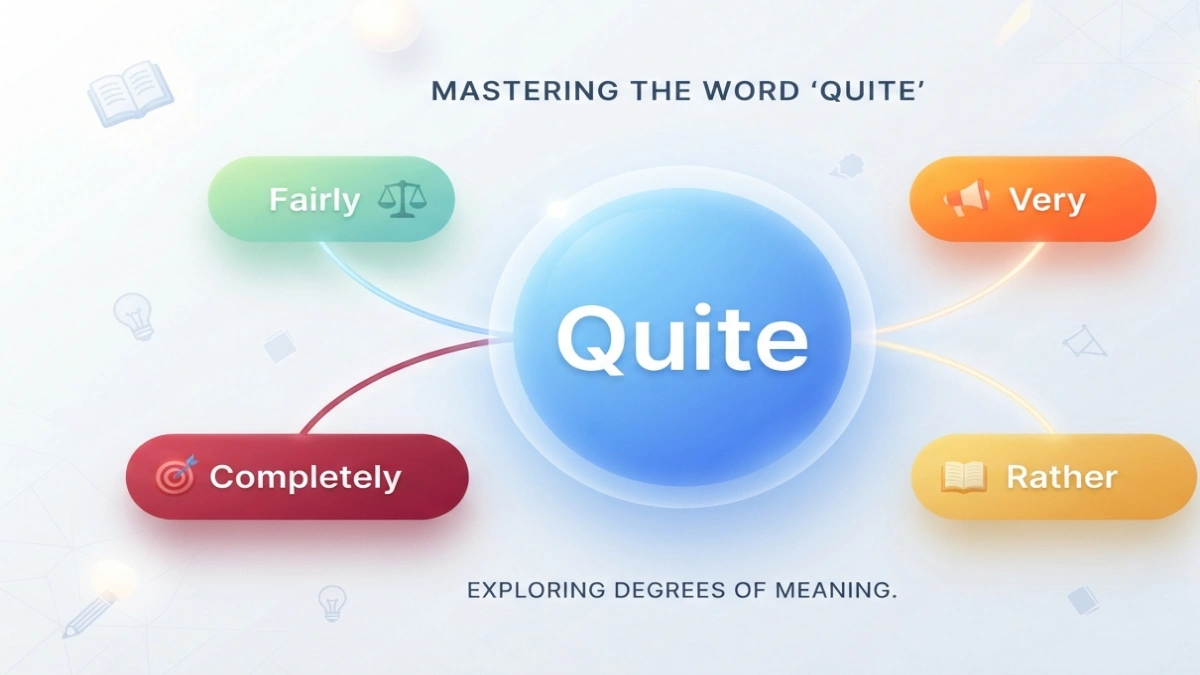
Have you ever written a sentence and kept repeating the word “quite” again and again? I remember editing a blog post where every second line had “quite” it felt boring and repetitive!
The word “quite” means a little, fairly, or completely, depending on how you use it. People use this small word quite often in daily English.
That’s why learning synonyms for quite can really improve your writing and speaking.
If you’re a student, blogger, freelancer, or just learning English, using different words instead of “quite” makes your sentences more interesting and clear.
In this guide, you’ll learn easy synonyms for quite, simple meanings, and real life examples you can use every day.
FEATURED SNIPPET DEFINITION
What does “synonym” mean?
A synonym is a word that has the same or nearly the same meaning as another word.
What Is the Definition of “Quite”?
Common synonyms for quite include fairly, rather, very, completely, entirely, fully, relatively, pretty, and somewhat. The best choice depends on whether quite means fairly, completely, or very.
CONTEXTUAL USAGE
When and How to Use “Quite”
You can use quite in:
- Writing essays or blogs
- Daily conversations
- Emails and messages
Examples:
- This book is quite interesting.
- Work has made me quite tired.
- The movie was quite good, not perfect.
Tip:
“Quite” can mean different things depending on tone.
In British English, it can mean completely, while in American English, it often means fairly.
1. Quite = Fairly / Moderately
Examples:
- fairly
- rather
- somewhat
- reasonably
- relatively
- moderately
- pretty
Example:
The exam was quite difficult.
2. Quite = Completely
Examples:
- completely
- entirely
- totally
- absolutely
- fully
- wholly
- perfectly
Example:
The room was quite empty.
3. Quite = Very (Informal)
Examples:
- very
- extremely
- really
- highly
- exceptionally
Example:
The movie was quite interesting.
Common Collocations with “Quite”
Learning collocations helps you use “quite” naturally in real English conversations and writing. Here are some common patterns:
✔ Quite + Adjective
- Quite good
- Quite easy
- Quite difficult
- Quite nice
- Quite important
👉 Example: The exam was quite easy for most students.
✔ Quite + Verb (less common but used in informal speech)
- Quite like
- Quite enjoy
- Quite agree
👉 Example: I quite like this new movie.
✔ Quite + A/An + Noun Phrase
- Quite a lot
- Quite a few
- Quite a bit
- Quite a surprise
- Quite an experience
👉 Example: There were quite a few people at the event.
✔ Formal vs Informal Usage Tip
- In British English, “quite” can mean very or moderately depending on tone.
- In American English, it usually means to some extent, not extreme.
Everyday English
- quite good
- quite bad
- quite easy
- quite difficult
- quite interesting
- quite common
- quite different
- quite simple
- quite clear
- quite useful
Academic Writing
- quite significant
- quite important
- quite effective
- quite evident
- quite likely
- quite possible
- quite challenging
Example:
The results were quite significant.
Business & Professional English
- quite successful
- quite competitive
- quite impressive
- quite beneficial
- quite efficient
- quite reliable
Example:
The new system proved quite efficient.
50 SYNONYMS LIST
| Synonym Word | Meaning | Examples |
| Fairly | A little but not too much | This test is fairly easy. / She is fairly happy today. |
| Rather | More than expected | It’s rather cold outside. / He was rather surprised. |
| Pretty | To a good degree | The food is pretty tasty. / I’m pretty sure about it. |
| Somewhat | A little bit | I feel somewhat tired. / The room is somewhat small. |
| Moderately | In a medium way | It’s moderately hot today. / He is moderately skilled. |
| Completely | Fully, 100% | I am completely ready. / The work is completely done. |
| Totally | Fully or entirely | She totally agrees. / I totally forgot. |
| Absolutely | Fully, strongly | This is absolutely right. / I absolutely love it. |
| Entirely | Fully, without exception | It’s entirely your choice. / I entirely agree. |
| Fully | 100% complete | The tank is fully filled. / I fully understand. |
| Highly | To a great level | Highly recommended. / He is highly skilled. |
| Extremely | Very much | It’s extremely hot. / She is extremely kind. |
| Very | A high degree | I am very happy. / This is very simple. |
| Really | Truly or very | It’s really good. / I really like it. |
| Considerably | Noticeably more | Prices increased considerably. / He improved considerably. |
| Significantly | In an important way | It changed significantly. / Sales dropped significantly. |
| Remarkably | In a surprising way | She is remarkably calm. / The result was remarkable. |
| Impressively | In a way that impresses | He worked impressively. / The design looks impressive. |
| Decently | In a good enough way | He did decently. / The room is decently clean. |
| Sufficiently | Enough for purpose | It’s sufficiently warm. / She prepared sufficiently. |
| Thoroughly | Fully and carefully | I thoroughly enjoyed it. / Clean it thoroughly. |
| Perfectly | In the best way | It fits perfectly. / She spoke perfectly. |
| Deeply | Strongly emotionally | I am deeply touched. / He was deeply hurt. |
| Greatly | To a large extent | It greatly helped me. / I greatly appreciate it. |
| Intensely | Strongly | He felt intensely happy. / She worked intensely. |
| Strongly | With power | I strongly agree. / He strongly opposed it. |
| Well | In a good way | I know him well. / It works well. |
| Decidedly | Clearly | It’s decidedly better. / She is decidedly calm. |
| Positively | Definitely | He is positively sure. / It’s positively amazing. |
| Virtually | Almost | It’s virtually done. / The task is virtually complete. |
| Practically | Almost completely | It’s practically finished. / I practically know it. |
| Essentially | Basically | It’s essentially the same. / He is essentially right. |
| Broadly | In general | It’s broadly correct. / I broadly agree. |
| Largely | Mostly | It’s largely true. / The work is largely done. |
| Nearly | Almost | It’s nearly ready. / I nearly forgot. |
| Almost | Very close | It’s almost done. / I almost fell. |
| Partly | In part | It’s partly true. / I partly agree. |
| Halfway | To some extent | I’m halfway done. / He halfway agreed. |
| To some degree | A little | It’s true to some degree. / I agree to some degree. |
| To an extent | Partially | It works to an extent. / I understand to an extent. |
| In part | Not fully | It’s correct in part. / He agreed in part. |
| Enough | As needed | It’s warm enough. / You worked enough. |
| Plenty | More than enough | There is plenty of time. / We have plenty. |
| So | Very (informal) | It’s so good. / I’m so tired. |
| Too | More than needed | It’s too hot. / He talks too much. |
| Real | Informal for very | It’s real nice. / She is real kind. |
| Awfully | Very (informal) | It’s awfully cold. / I’m awfully sorry. |
| Mighty | Very (informal) | That’s mighty fine. / He’s mighty strong. |
| Terribly | Very much | I’m terribly sorry. / It’s terribly wrong. |
| Incredibly | Hard to believe | It’s incredibly fast. / She is incredibly smart. |
CATEGORIZED SYNONYM CLUSTERS
| Category | Synonyms |
| Formal | Completely, Entirely, Significantly, Sufficiently, Thoroughly |
| Informal | Pretty, So, Real, Awfully, Mighty |
| Academic | Moderately, Considerably, Broadly, Largely, Essentially |
| Technical | Fully, Virtually, Practically, To an extent |
ANTONYMS SECTION
| Antonym | Meaning | Example |
| Slightly | Very little | I am slightly tired. |
| Barely | Almost not | I barely passed. |
| Hardly | Almost not | He hardly spoke. |
| Little | Not much | I know little about it. |
| Minimally | Very small amount | It changed minimally. |
| Partially | Not fully | The work is partially done. |
| Scarcely | Almost not | She scarcely smiled. |
| Rarely | Not often | I rarely go out. |
| Insufficiently | Not enough | It’s insufficiently prepared. |
| Incompletely | Not fully done | The task is incomplete. |
COMPARISON SECTION
Quite vs Very vs Rather vs Fairly vs Completely
- Quite: Flexible can mean fairly or fully
- Very: Always strong intensity
- Rather: Often shows surprise
- Fairly: Mild and balanced
- Completely: 100% full
Examples:
- It’s quite good (moderate)
- It’s very good (strong)
- It’s rather good (unexpectedly good)
- It’s fairly good (okay level)
- It’s completely good (fully perfect)
Use of “Quite” in Everyday Sentences
- I am quite happy today.
- This food is quite tasty.
- The exam was quite easy.
- She is quite busy right now.
- That movie was quite interesting.
Examples of Use of “Quite” in Phrases
- Quite a lot
- Quite enough
- Quite right
- Quite simple
- Quite sure
Common Mistakes to Avoid
❌ Don’t assume quite always means very.
Depending on context, it can mean:
- fairly
- rather
- completely
- entirely
Example:
- The house is quite large. (fairly large)
- The work is quite finished. (completely finished, in some varieties of English)
FAQs
1. Is “quite” formal or informal?
It can be both, depending on context.
2. Does “quite” mean very?
Sometimes yes, but not always it can mean fairly.
3. What is the best synonym for “quite”?
“Fairly” or “very” depending on context.
4. Can I use “quite” in essays?
Yes, but avoid overusing it.
5. Is “quite” common in daily English?
Yes, it is very common to use.
6. What is the opposite of quite?
Depending on context:
- hardly
- barely
- slightly
- not at all
- scarcely
7. Can I use quite in academic writing?
Yes. Quite is acceptable in academic writing, but in some cases, words like relatively, moderately, or considerably may sound more precise.
MINI VOCABULARY GROWTH SECTION
Learning synonyms for quite helps you:
- Improve writing and speaking with variety
- Boost blog readability and SEO ranking
- Sound more confident in communication
Using the right synonym makes your message clearer and more powerful.
| If you mean… | Best synonym |
|---|---|
| Moderately | Fairly |
| Slightly more than expected | Rather |
| Totally | Completely |
| Strong emphasis | Very |
| Formal writing | Relatively |
| Mild emphasis | Somewhat |
CONCLUSION
Now you know that “quite” is a small but powerful word with many meanings. By learning these synonyms for quite, you can expand your vocabulary and avoid repeating the same words in your writing.
Start practicing today. Use these words in your emails, essays, blog posts, social media captions, and daily conversations. As you use them more often, you will make your English sound more natural.
Continue learning and practicing regularly. Soon, you will express your ideas more clearly and make your English more engaging and effective.