Quick Answer
If you’re writing a story, improving your vocabulary, or simply trying to avoid repeating the word hide, choosing the right synonym can make your writing clearer and more natural. While words such as conceal, mask, camouflage, and cover up all relate to hiding something, each has its own meaning, tone, and grammar. This guide explains the most useful alternatives to hide, when to use them, and the common mistakes English learners should avoid.
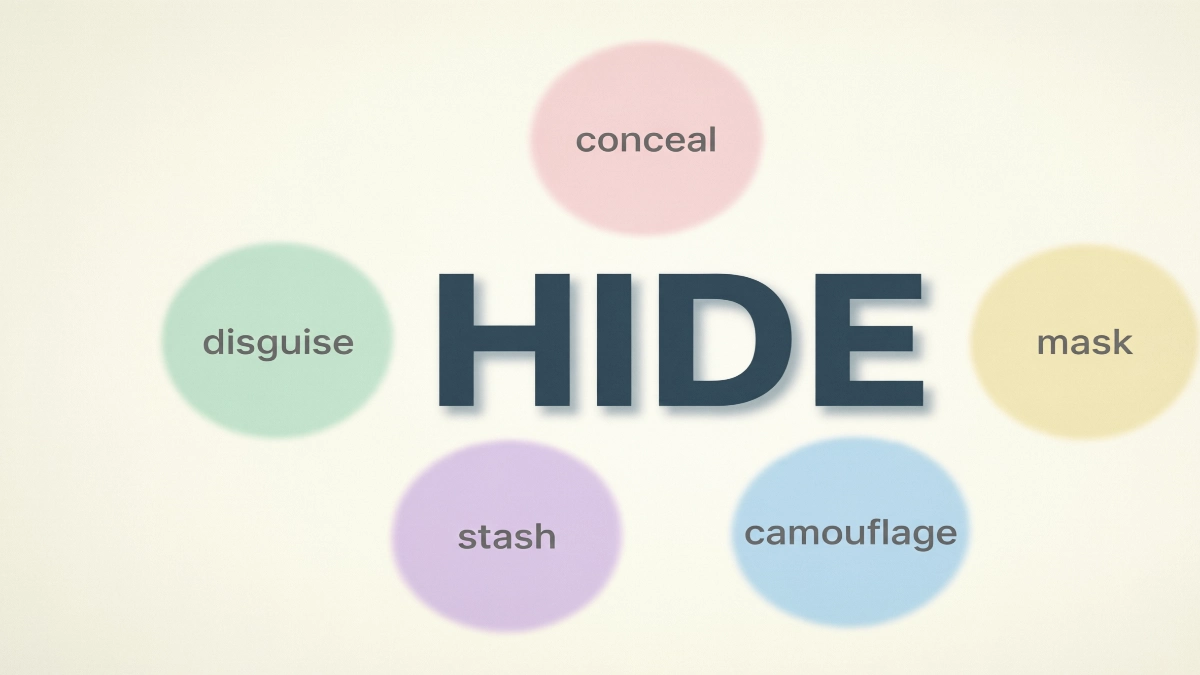
The most common synonyms for hide are conceal, cover up, disguise, mask, stash, tuck away, and camouflage. Conceal is the closest formal match, but it’s always used with an object (you conceal something), while hide can stand alone (“I hid”). Choose your word based on if you’re hiding an object, a feeling, or a person they aren’t always interchangeable.
Real Talk: When Do You Actually Need This Word?
A student once wrote in an essay: “The boy concealed behind the tree.” I circled it and wrote “concealed what?” She looked confused in her head, “conceal” and “hide” meant exactly the same thing, so if one worked, the other should too. That mix up is so common I now bring it up on purpose in the first week of any intermediate class.
That’s really the whole reason this word deserves its own lesson. Hide” seems simple, but the moment you swap in a synonym, English suddenly cares about grammar again. Some words need an object, some don’t, some are only for feelings, some are only for objects. Let’s sort it out properly.
Meaning, Pronunciation, Tone & Context
Hide (verb) means to put something or yourself where it can’t be seen or found, or to keep information secret so others don’t know about it.
Pronunciation: /haɪd/ rhymes with “ride” and “side.” No tricky sounds here, but learners sometimes forget the past tense is irregular: hide → hid → hidden, not “hided.”
Tone: completely neutral and everyday. You can use “hide” in casual conversation, in a children’s story, in a workplace email, or in an academic paper it never sounds too formal or too slangy. That neutrality is actually rare among the synonyms below, most of which lean either more formal or more casual.
How to Choose the Right Synonym for “Hide”
Not every synonym for hide works in every situation. The best choice depends on what you’re hiding and why you’re hiding it.
| If you’re hiding… | Best Synonyms |
| Yourself | hide, conceal yourself, lurk (if waiting secretly) |
| An object | conceal, stash, tuck away, secrete |
| A feeling | mask, conceal |
| A mistake or crime | cover up |
| Someone’s identity | disguise |
| Something by blending in | camouflage |
Before replacing hide, ask yourself:
- Am I hiding a person, object, feeling, or information?
- Does the situation sound formal or casual?
- Is the hiding innocent or deceptive?
Answering these questions makes choosing the right synonym much easier.
Is “Hide” a Verb or a Noun?
Most learners know hide as a verb, but it also has another meaning.
As a verb, hide means to keep yourself or something out of sight.
She hid behind the curtain.
As a noun, hide refers to the skin of an animal after it has been removed.
The boots were made from cowhide.
These two meanings are unrelated in everyday usage, so context tells you which one is intended.
Formal and Informal Alternatives to “Hide”
Some synonyms sound professional, while others fit everyday conversation.
Formal
- conceal
- secrete
- cloak
Neutral
- hide
- disguise
- mask
Informal
- stash
- tuck away
- cover up
Using the appropriate level of formality helps your writing sound more natural.
Hide vs. Conceal: What’s the Difference?
Although hide and conceal are close in meaning, they aren’t always interchangeable.
Hide is flexible and works in everyday English.
The child hid under the table.
Conceal is more formal and almost always requires an object.
She concealed the evidence.
You can say:
✔ She hid.
But not:
✘ She concealed.
Instead, say:
✔ She concealed herself.
Remember this simple rule:
- Hide can stand alone.
- Conceal usually needs something to conceal.
Everyday Ways to Say “Hide”
In everyday conversation, native speakers often use more casual expressions instead of hide.
Some common alternatives include:
- put away
- stash
- tuck away
- keep out of sight
- put somewhere safe
- keep under wraps (for secrets)
Examples:
Formal:
She concealed the documents.
Natural:
She put the documents away.
Formal:
He concealed the money.
Natural:
He stashed the money in a drawer.
When & How to Use It
“Hide” works two ways, and this is the detail most textbooks skip over:
- Without an object (intransitive): “The cat hid under the bed.”
- With an object (transitive): “She hid the presents in the closet.”
It also works with feelings and facts, not just physical objects: “He hid his disappointment” or “They hid the truth from the press.”
Common structures:
- hide (from someone) hide from the rain
- hide something (from someone) hide the keys from the kids
- go into hiding / be in hiding for people avoiding danger or attention
When Not to Use This Word
Avoid “hide” when you mean something more specific:
- If someone is hiding and waiting to do something, especially something bad, “hide” is too soft use lurk instead (“A man was lurking near the entrance”).
- If someone is just moving quietly to avoid being noticed (not necessarily hiding), use sneak, not “hide” (“She snuck out of the meeting”).
- In formal writing about deception at an official or legal level (governments, companies), “hide” can sound a little plain conceal or withhold often fit the register better.
- When writing formal reports or legal documents, verbs such as withhold, conceal, or suppress may communicate the intended meaning more precisely than hide.
Words Commonly Confused With It
- Lurk to wait somewhere secretly, often with bad intent. Not just “hide”; it adds a sense of waiting and menace. “The thief lurked in the alley” ≠ “The thief hid in the alley” (the second just means he wasn’t visible).
- Disappear to stop being visible or present, but not necessarily on purpose or by choice. You can disappear by accident; you can’t “hide” by accident.
- Sneak describes secretive movement, not the state of being hidden. “He snuck past the guard” doesn’t mean he hid it means he moved without being seen.
Synonyms Table
| Synonym | Meaning | Example Sentence |
| Conceal | To hide something on purpose, often information or an object (formal, always needs an object) | She concealed her true feelings during the interview. |
| Cover up | To hide a mistake, crime, or embarrassing fact (informal, often about wrongdoing) | The company tried to cover up the data breach. |
| Disguise | To change how something/someone looks or sounds so it isn’t recognized | He disguised his voice on the phone. |
| Mask | To hide an emotion or a smell/taste, or to physically hide part of your face | She masked her nervousness with a smile. |
| Stash | To hide something, usually in a safe or secret place (informal) | He stashed the cash under the mattress. |
| Tuck away | To put something in a hidden or safe spot (informal, often casual/domestic) | She tucked the letter away in a drawer. |
| Camouflage | To hide by blending in with the surroundings (used literally for animals/soldiers, and figuratively) | The lizard camouflaged itself against the bark. |
| Secrete | To hide something carefully (formal, less common, mostly written English) | The documents were secreted in a hidden safe. |
| Cloak | To hide something, especially in an abstract or dramatic way (formal/literary) | The negotiations were cloaked in secrecy. |
| Bury | To hide something, often by covering it or putting it deep among other things | The scandal was buried under years of paperwork. |
Synonym Groups
Formal / written: conceal, secrete, cloak Everyday / informal: stash, tuck away, cover up Literal (physical objects, appearance): camouflage, disguise, tuck away, bury Figurative (feelings, facts, secrets): conceal, mask, cover up, cloak
By Purpose
Physical hiding
- hide
- camouflage
- stash
- tuck away
- bury
Hiding information
- conceal
- cover up
- withhold
- suppress
Hiding emotions
- mask
- conceal
Changing appearance
- disguise
- camouflage
Best Synonym by Context
| Context | Best Word | Why |
| Hiding an emotion | Mask | Specifically used for feelings, not objects |
| Hiding a mistake or wrongdoing | Cover up | Carries the connotation of avoiding blame |
| Hiding physically by blending in | Camouflage | Implies matching the surroundings, not just concealment |
| Hiding an object casually | Stash / tuck away | Natural, everyday phrasing |
| Formal or written context | Conceal | Neutral, professional register |
If you’re not sure which to pick, ask: am I hiding a thing, a feeling, or a fact and how formal does this need to sound? That answers most of the choice for you.
Antonyms Table
| Antonym | Meaning | Example |
| Reveal | To make something known or visible | She revealed the surprise at dinner. |
| Expose | To uncover something, often wrongdoing (slightly stronger/more negative than “reveal”) | The report exposed years of fraud. |
| Show | To let something be seen (neutral, everyday) | He showed his ticket at the door. |
| Uncover | To find or make visible something that was hidden | Investigators uncovered new evidence. |
| Disclose | To formally share information (formal, often legal/business contexts) | The company disclosed its earnings. |
Common Collocations with “Hide”
Some natural combinations include:
- hide the truth
- hide your feelings
- hide evidence
- hide money
- hide behind an excuse
- hide in plain sight
- hide from the police
- hide from danger
- hide under the bed
- hide inside
- hide your identity
- hide a secret
- hide your face
Learning these collocations will help you sound more natural in both speaking and writing.
Common Phrases & Collocations
- hide and seek the children’s game. “The kids played hide and seek in the garden.”
- hide something from someone “I don’t want to hide anything from you.”
- come out of hiding “The fugitive finally came out of hiding.”
- in hiding “The family has been in hiding since the incident.”
- hidden agenda a secret motive. “I think he has a hidden agenda.”
- hide your feelings “She’s good at hiding her feelings.”
Common Mistakes to Avoid
- Using “concealed” without an object: ❌ “I concealed behind the door.” ✅ “I hid behind the door” or “I concealed myself behind the door.”
- Writing “hided” instead of “hid” or “hidden.” “Hide” is irregular.
- Using “camouflage” for hiding a lie or a mistake it only works for physical blending in, literal or metaphorical (like an animal or a soldier), not for cover ups or secrets.
- Confusing “hide” with “lurk” lurking always implies waiting, often with bad intent; simply being hidden doesn’t.
Real Life Examples
School: “The student hid his phone under the desk during the test.” Workplace: “The manager was accused of covering up the budget shortfall.” Writing (fiction): “The spy disguised himself as a waiter to slip past security.” Conversation: “Where did you stash the remote? I can’t find it anywhere.”
FAQs
What is another word for hide in writing?
Depending on the context, common alternatives include conceal, mask, cover up, disguise, stash, and camouflage. The best choice depends on if you’re hiding an object, a feeling, or information.
What is the difference between “hide” and “mask”?
Hide is a general word that means to keep something out of sight. Mask usually means to cover or disguise an emotion, smell, taste, or appearance rather than completely remove it from view.
Can “hide” be used for emotions?
Yes. English speakers often say hide your feelings, hide your disappointment, or hide your fear. However, a mask is often a more natural choice when talking about emotions.
Is “hide” a regular or irregular verb?
Hide is an irregular verb.
- Base form: hide
- Past tense: hid
- Past participle: hidden
Avoid using hided, which is incorrect.
Is “conceal” more formal than “hide”?
Yes. “Hide” works in any situation, but “conceal” tends to appear in writing, reports, or more serious speech it can sound a bit stiff in casual conversation.
What’s the difference between “hide” and “cover up”?
“Cover up” almost always implies something negative: a mistake, a scandal, a crime. “Hide” is neutral and can apply to anything, good or bad.
Why do people say “hidden” instead of “hided”?
Because “hide” is an irregular verb: hide → hid → hidden. This is one of the more commonly mispronounced/misspelled irregular past participles for learners.
Conclusion
Hide” looks like one of the easiest words in English, but its synonyms show why vocabulary isn’t just about swapping words with the same meaning. Conceal needs an object. Camouflage is about blending in, not lying. Covering up almost always signals guilt. Once you notice these small differences, your writing and speaking both get more precise and more natural.
The best way to lock these in is to use each word in your own sentence today. Pick one from the table above, write a sentence about your own day, and notice how the meaning shifts slightly depending on which word you chose.
Hide is one of the most useful everyday verbs in English, but it isn’t always the best choice. Depending on what you’re hiding a person, an object, a feeling, or a secret words such as conceal, mask, camouflage, stash, or cover up may express your meaning more accurately. Instead of memorizing long lists of synonyms, focus on understanding when each word sounds natural. The more you notice these differences in books, conversations, and your own writing, the more confident you’ll become in choosing the right word every time.