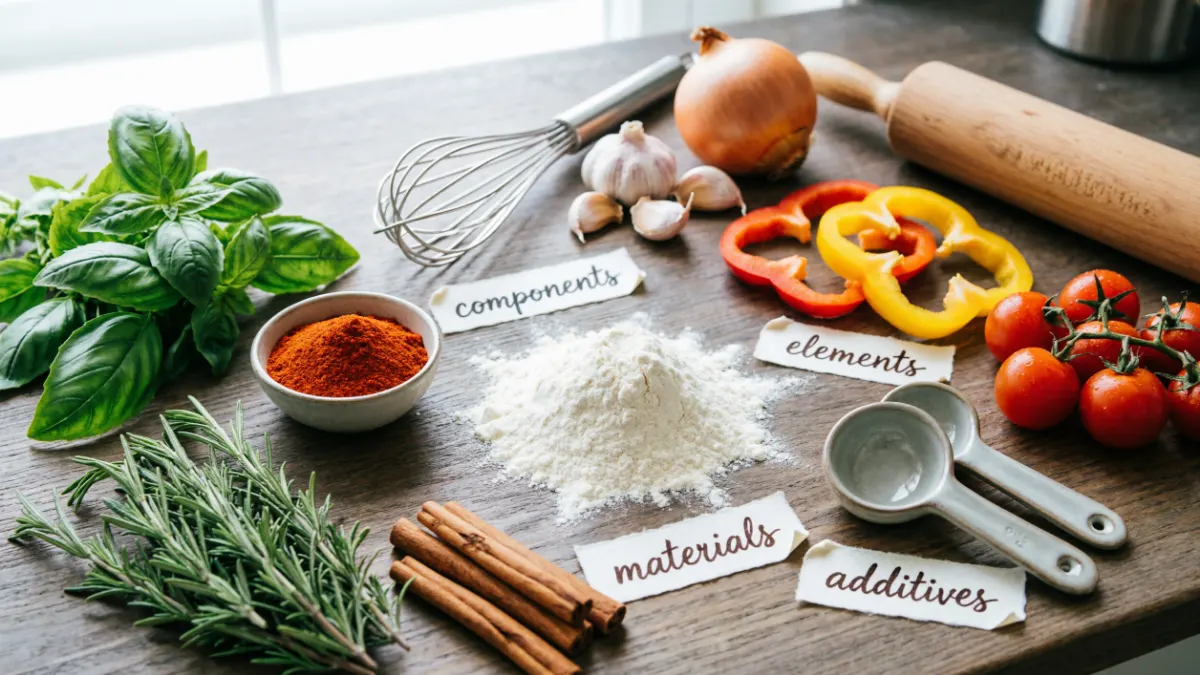
Ever found yourself writing a recipe, food blog, or science report and repeating the word ingredients over and over? I know I have. While creating a cooking article, I noticed that every paragraph used the same word, making the writing feel repetitive and dull.
That’s when I started using synonyms for ingredients. Simple alternatives like components, elements, constituents, and materials made the article sound smoother and much more professional.
If you’re a student, blogger, chef, recipe writer, or English learner, knowing the right synonym helps you avoid repetition and choose words that perfectly fit the context.
Featured Snippet:
What is meant by a synonym?
A synonym is a word that has the same or nearly the same meaning as another word. For example, “big” and “large.”
Which synonym for ingredients should you use?
If you’re talking about…
recipes → ingredients, seasonings, spices
science → components, constituents, compounds
manufacturing → materials, inputs, substances
nutrition → nutrients, food components
CONTEXTUAL USAGE
When and How to Use Synonyms for Ingredients
You use these synonyms when writing recipes, food blogs, product descriptions, or science reports.
Examples:
- “List all the components of the cake mixture.”
- “The recipe includes natural elements like fruits and nuts.”
- “Check the contents before baking.”
Tip: Use formal synonyms in academic writing and simple words in daily conversation.
50 SYNONYMS LIST
| Synonym Word | Meaning | Examples |
| Components | Parts used to make something | The cake has many components. / List all components clearly. |
| Elements | Basic parts of a mixture | Water is an element in drinks. / Identify the elements first. |
| Constituents | Main forming parts | Flour is a key constituent. / The constituents are natural. |
| Materials | Things used to build or make | We need cooking materials. / Buy fresh materials. |
| Contents | Items inside something | Check the contents of the mix. / The contents are listed. |
| Substances | Types of matter used | The drink has natural substances. / Avoid harmful substances. |
| Additives | Extra items added | Additives improve flavor. / Some additives are natural. |
| Compounds | Combined chemical parts | The compound is safe. / Mix compounds carefully. |
| Raw materials | Unprocessed basic items | Raw materials are fresh. / Use good raw materials. |
| Supplies | Things provided for use | Cooking supplies are ready. / Bring all supplies. |
| Fixings | Informal cooking items | Add fixings to the sandwich. / Fresh fixings taste better. |
| Inputs | Items used in a process | Inputs are measured well. / Check all inputs first. |
| Portions | Parts used in mixture | Each portion is equal. / Divide portions carefully. |
| Mixture parts | Parts of a mix | Mixture parts are blended. / Stir mixture parts slowly. |
| Recipe ingredients | Things in a recipe | Recipe ingredients are listed. / Gather recipe ingredients. |
| Food substances | Items used in food | Food substances are fresh. / Store food substances properly. |
| Cooking elements | Parts used in cooking | Cooking elements are ready. / Mix cooking elements well. |
| Formulas | Structured mixtures | The formula is simple. / Follow the formula carefully. |
| Agents | Active parts in mixture | Yeast is a raising agent. / Agents improve texture. |
| Bases | Main foundational parts | Milk is a base. / Use natural bases. |
| Extracts | Natural derived parts | Vanilla extract is used. / Add fruit extracts. |
| Flavorings | Taste improving items | Flavorings enhance taste. / Natural flavorings are best. |
| Seasonings | Items for taste | Seasonings are added. / Use mild seasonings. |
| Herbs | Plant based items | Herbs add aroma. / Fresh herbs are used. |
| Spices | Flavor enhancing items | Spices improve taste. / Add mild spices. |
| Blends | Mixed items | The blend is smooth. / Use spice blends. |
| Mix ins | Added extra items | Chocolate mix ins are added. / Try fruit mix ins. |
| Fillers | Extra volume items | Fillers increase quantity. / Avoid heavy fillers. |
| Core components | List of parts | Core components are ready. / Check core components. |
| Food components | Parts of food | Food components are healthy. / Identify food components. |
| Nutrients | Healthy food parts | Nutrients are important. / Fruits contain nutrients. |
| Diet items | Food used in diet | Diet items are fresh. / Healthy diet items matter. |
| Kitchen items | Cooking related things | Kitchen items are ready. / Organize kitchen items. |
| Recipe components | Parts of recipe | Recipe components are listed. / Mix recipe components. |
| Baking elements | Baking related items | Baking elements are measured. / Add baking elements. |
| Culinary parts | Cooking parts | Culinary parts are simple. / Prepare culinary parts. |
| Organic matter | Natural materials | Organic matter is used. / Use organic matter. |
| Edibles | Items you can eat | Edibles are fresh. / Store edibles safely. |
| Staples | Basic food items | Staples include flour. / Stock kitchen staples. |
| Goods | Items used in making | Goods are imported. / Use quality goods. |
| Raw inputs | Basic inputs | Raw inputs are fresh. / Measure raw inputs. |
| Forming agents | Creating elements | Yeast is a forming agent. / Use forming agents. |
| Binding agents | Stick together items | Egg is a binding agent. / Binding agents help texture. |
| Enhancers | Items that improve quality | Flavor enhancers are added. / Use natural enhancers. |
| Infusions | Soaked flavor items | Herbal infusions are used. / Try fruit infusions. |
| Add ins | Extra added items | Add ins improve taste. / Chocolate add ins are popular. |
| Mix elements | Parts of mixture | Mix elements are combined. / Stir mix elements. |
| Cooking inputs | Inputs used in cooking | Cooking inputs are fresh. / Check cooking inputs. |
CATEGORIZED SYNONYM CLUSTERS
| Category | Synonyms |
| Formal | Constituents, Components, Elements, Substances, Inputs |
| Informal | Fixings, Mix ins, Add ins, Staples |
| Academic | Compounds, Formulas, Nutrients, Organic matter |
| Technical | Agents, Additives, Binding agents, Forming agents |
ANTONYMS OF INGREDIENTS
| Antonym | Meaning | Example |
| Finished product | Completed item | The finished product is ready. |
| Waste | Unused material | Throw away waste carefully. |
| Output | End result | The output is perfect. |
| Result | Final form | The result looks good. |
| Product | Completed item | The product is sold. |
| Pure item | Single item | Use pure item only. |
| Single unit | One item | Each single unit matters. |
| Empty mix | No content | The bowl is empty mix. |
| Refuse | Unwanted material | Remove refuse properly. |
| Residue | Leftover material | Clean residue well. |
COMPARISON SECTION
Ingredients vs Components
Ingredients are individual items used to prepare food, medicine, or another mixture.
Components are broader and often describe parts of machines, systems, or scientific mixtures.
Example:
Cake ingredients include flour, sugar, and eggs.
Engine components include pistons and valves.
Ingredients vs Constituents
Constituents is a formal word used mainly in science and chemistry.
Ingredients is more common in everyday English.
Ingredients vs Materials
Materials are used to build things.
Ingredients are used to prepare things.
Common Collocations with Ingredients
Examples
active ingredients
fresh ingredients
natural ingredients
secret ingredients
essential ingredients
organic ingredients
high-quality ingredients
main ingredients
recipe ingredients
simple ingredients
EXAMPLES OF “INGREDIENTS” IN EVERYDAY SENTENCES
- The ingredients are fresh and natural.
- She listed all ingredients carefully.
- We bought ingredients for the cake.
- Healthy ingredients improve taste.
- Always check ingredients before cooking.
EXAMPLES OF USE OF SYNONYMS FOR INGREDIENTS IN PHRASES
- Natural food components
- Organic recipe elements
- Cooking mix ins list
- Baking materials set
- Herbal flavoring agents
Common Mistakes
1.Wrong
The machine has many ingredients.
✅ Correct
The machine has many components.
2.Wrong
Concrete ingredients
✅ Correct
Concrete materials
3.Wrong
Cake constituents (daily conversation)
✅ Better
Cake ingredients
Expert Tip
When writing recipes or food blogs, use ingredients because it’s the word readers expect. In scientific or technical writing, choose components, constituents, or substances depending on the context. Using the right word makes your writing clearer and more professional.
FAQs
1. What is another word for ingredients?
Another word for ingredients depends on the context. Common synonyms include components, constituents, elements, materials, substances, and contents. In cooking, ingredients is the most natural choice, while components and constituents are often used in scientific or technical writing.
2. What is a formal word for ingredients?
Formal alternatives to ingredients include constituents, components, elements, substances, and materials. These words are commonly used in academic, scientific, medical, and technical writing. The best option depends on what you are describing and the context of your sentence.
3. What is the difference between ingredients and components?
Ingredients are the individual items used to prepare food, drinks, medicines, or mixtures. Components is a broader term that refers to the parts of any system, product, or object. For example, flour is an ingredient in a cake, while a keyboard is a component of a computer.
4. Can ingredients mean parts?
Yes. In many situations, ingredients can mean the parts that make up a recipe, mixture, or product. However, for machines, buildings, or electronic devices, words like components, parts, or materials are usually more accurate than ingredients.
5. What are ingredients called in science?
In science, ingredients are often called components, constituents, substances, compounds, or elements, depending on the subject. For example, chemistry usually uses compounds or substances, while biology and environmental science may use components or constituents.
6. What are ingredients called in chemistry?
In chemistry, ingredients are commonly referred to as reactants, compounds, substances, chemicals, or constituents. The correct term depends on the experiment or chemical process being described. Scientists rarely use the word ingredients except in everyday explanations
7. What is the opposite of ingredients?
The opposite of ingredients is usually finished product, final product, output, or result, depending on the context. Ingredients are the materials used to make something, while the finished product is what remains after all the ingredients have been combined.
8. What is another word for food ingredients?
Common alternatives to food ingredients include recipe components, cooking ingredients, food components, culinary ingredients, seasonings, herbs, spices, and recipe essentials. The best synonym depends on whether you are writing a recipe, a food blog, or a nutrition article.
9. Are ingredients and materials the same?
Not exactly. Ingredients are the items used to prepare food, drinks, medicines, or mixtures. Materials is a broader term that can refer to anything used to build, manufacture, or create something. Every ingredient is a material, but not every material is an ingredient.
10. Can constituents replace ingredients?
Yes, constituents can replace ingredients in formal, academic, or scientific writing. However, in everyday English and cooking, ingredients sounds much more natural. For recipes and food blogs, it is usually better to use ingredients instead of constituents.
MINI VOCABULARY GROWTH SECTION
Learning synonyms for ingredients improves your writing fluency, speaking confidence, and vocabulary strength. It helps bloggers create more engaging content and improves SEO readability. Using varied words also makes communication clearer, more professional, and more interesting for readers.
CONCLUSION
Building a strong vocabulary isn’t about memorizing long word lists it’s about knowing which word fits each situation.
If you’re writing a recipe, a science report, a product description, or a food blog, choosing the right synonym for ingredients makes your writing clearer, more engaging, and more professional.
Start by replacing one repeated word at a time, and before long, using precise vocabulary will become second nature.