“Come home when you finish work.”
In this sentence, home means more than a building. It refers to the familiar place where someone lives and feels comfortable. That is why choosing another word for home depends heavily on what you want to express.
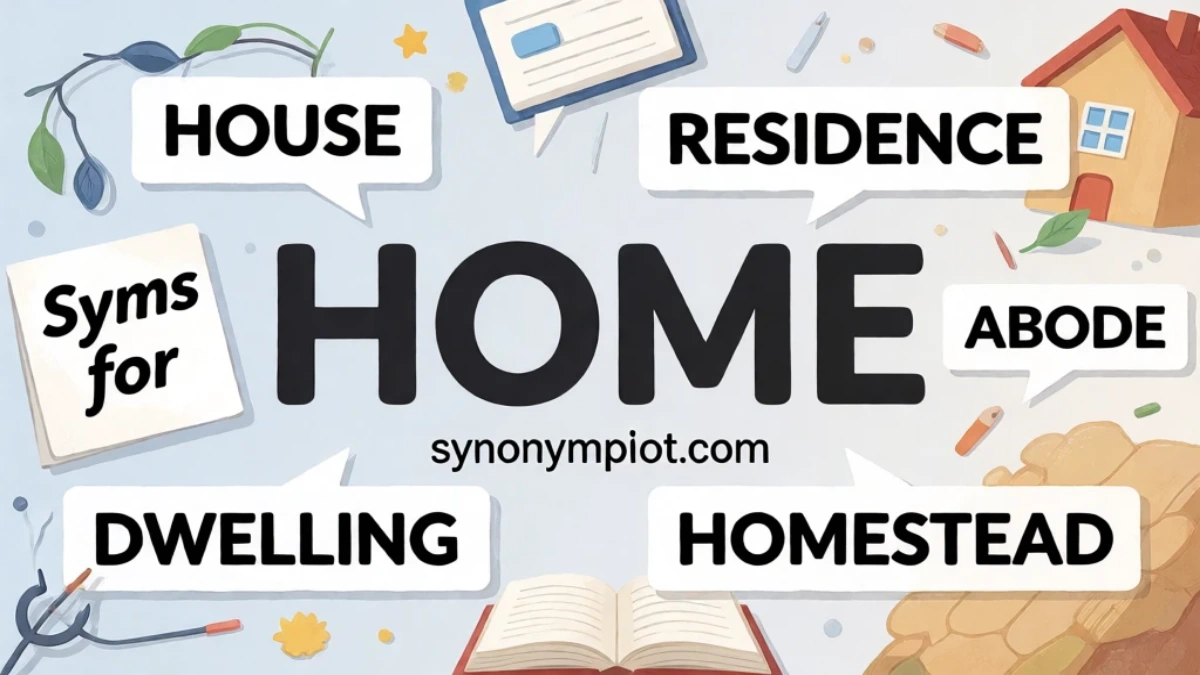
For example, house usually describes a physical building, while residence sounds more formal. Abode can sound literary, whereas dwelling is common in legal, academic, or descriptive contexts. Meanwhile, apartment, cottage, and bungalow describe particular types of places where people live.
Therefore, learning synonyms for home is not simply about memorizing a long list of replacement words. Instead, it is about understanding which alternative sounds natural in each situation.
This guide explains 50 useful alternatives, their meanings, tone, and everyday usage. You will also learn which words work best in school writing, professional communication, conversation, creative writing, and descriptions of different types of homes.
Quick Answer
Home means the place where a person lives, especially a place that feels safe, familiar, and personal. Depending on the context, you can use words such as house, residence, dwelling, abode, homestead, apartment, or lodging as alternatives, but each word has a slightly different meaning or tone.
Meaning, Tone & Context
The word home usually refers to the place where someone lives. However, it can also describe the feeling of belonging, safety, comfort, and familiarity connected with that place.
Consider these examples:
- “I am going home after work.”
- “My home is near the city center.”
- “She finally found a home where she felt comfortable.”
- “They made their new apartment feel like home.”
The word is extremely common and works naturally in everyday English.
Tone of “home”
Home is:
- Common: used frequently in everyday English
- Conversational: natural in ordinary speech
- Neutral: suitable for most general situations
- Emotional: can express comfort, belonging, or affection
- Professional: acceptable when the context concerns someone’s living arrangements
- Academic: usable, although more precise terms such as residence or dwelling may sometimes be better
The most important point is that home and house are not always interchangeable.
A house is usually a physical building.
A home is the place where someone lives and may also carry an emotional meaning.
For example:
“They bought a new house.”
This focuses on the building.
“They finally found a home.”
This can focus on both the place and the feeling of belonging.
When & How to Use “Home”
Use home when you are talking naturally about where someone lives or where someone feels they belong.
Everyday conversation
- “I need to go home.”
- “Are you at home?”
- “She stayed home today.”
- “Welcome home!”
- “What time will you be home?”
These expressions sound natural because home is one of the most common everyday words for a person’s living place.
Talking about family life
You can also use home when discussing family and domestic life.
- “The children helped clean the home.”
- “He grew up in a small home.”
- “Their home is always full of visitors.”
Talking about emotional belonging
In emotional or creative writing, home can describe a strong feeling of belonging.
- “After years of traveling, she finally felt at home.”
- “The village still feels like home.”
- “His grandmother’s kitchen always felt like home.”
Important grammar point
Some expressions use home without to:
- “I went home.”
- “She came home.”
- “They stayed home.”
We normally do not say “I went home” in standard English.
However, to can appear when home has a modifier:
- “I went to my new home.”
- “She returned to her childhood home.”
Another Word for Home
The best alternative depends on your meaning.
For a physical place where someone lives, house, residence, or dwelling may work well.
In formal contexts, residence or domicile is more appropriate.
A warm or literary tone can be created with abode or homestead.
For a specific type of home, choose a precise term such as apartment, cottage, bungalow, villa, townhouse, or cabin.
For example:
- Home → “I am going home.”
- House → “They bought a large house.”
- Residence → “The official residence is outside the city.”
- Apartment → “She rents an apartment downtown.”
- Cottage → “They spent the weekend in a small cottage.”
When Not to Use This Word
Although home is extremely flexible, it is not always the most precise choice.
Avoid using home when you need to identify a specific physical structure or housing arrangement.
For example:
Less precise:
“The company provides a home for its employees.”
Better:
“The company provides accommodation for its employees.”
Similarly, in a legal or official document, residence, domicile, or another precise term may be more appropriate.
You should also avoid replacing every occurrence of home with a synonym. Many alternatives change the meaning, tone, or level of formality.
For example:
“I am going home.”
Changing this to:
“I am going to my abode.”
is grammatically possible in a very unusual context, but it does not sound natural in ordinary conversation.
Words Commonly Confused With “Home”
House vs. Home
A house is generally a physical building. A home can mean the building, but it often includes the idea of belonging and personal comfort.
- “They painted their house.”
- “They love their home.”
Residence vs. Home
Residence is more formal and focuses on the place where someone officially or physically lives.
- “Please provide your current residence.”
- “I am going home.”
Apartment vs. Home
An apartment is a particular type of housing unit. It can be someone’s home, but not every home is an apartment.
- “My apartment is on the fifth floor.”
- “I am going home.”
Household vs. Home
A household refers to the people living together and, in some contexts, the domestic unit they form. It does not simply mean the physical place.
- “The household includes four people.”
- “The home has four bedrooms.”
Homeland vs. Home
A homeland means a person’s or group’s native country or land. It has a much broader meaning than someone’s individual home.
- “She returned to her homeland.”
- “She returned to her home.”
Best Synonym by Context
| Context | Best Alternative | Why It Works |
| Everyday conversation | House | Common and natural for a physical building |
| General writing | Residence | Neutral and slightly formal |
| Formal documents | Residence | Precise and professional |
| Legal context | Domicile | Refers to an established legal home |
| Academic writing | Dwelling | Useful for describing housing |
| Literary writing | Abode | More poetic or old-fashioned |
| Rural setting | Homestead | Suggests a home and surrounding land |
| Temporary stay | Lodging | Focuses on a place provided for staying |
| Workplace communication | Residence | Clear and professional |
| Apartment living | Apartment | Identifies a specific housing type |
| Luxury housing | Villa | Describes a particular type of large home |
| Small rural home | Cottage | Suggests a small, often traditional house |
| Single-story home | Bungalow | Identifies a specific architectural type |
| Shared urban housing | Flat | Common British English term |
| Warm emotional writing | Hearth | Can symbolize family and domestic warmth |
Which Synonym Should You Choose?
Start with the meaning you want to communicate.
In normal conversation, home is usually the most natural choice.
When referring to the physical building, house is often more appropriate.
For formal writing, residence can be a useful alternative.
Academic discussions about housing may call for the more precise term dwelling.
In creative writing, abode, homestead, or hearth can create a particular atmosphere.
However, avoid choosing a synonym simply because it sounds more sophisticated. A simple word that fits the context is usually better than an impressive word that sounds unnatural.
Real-Life Examples of “Home” in Sentences
School
- “I finished my homework at home.”
- “Our teacher asked us to write about our home.”
- “I left my textbook at home.”
Workplace
- “I will finish the report at home.”
- “She works from home twice a week.”
- “Please update your home address in the system.”
Writing
- “After many years away, he returned home.”
- “The old house had been her childhood home.”
- “The village remained a peaceful home for generations.”
Conversation
- “Are you home yet?”
- “What time are you coming home?”
- “Make yourself at home.”
- “I just want to go home and rest.”
50 Synonyms and Contextual Alternatives for “Home”
| Synonym | Simple Meaning | Example Sentence |
| 1. House | A building where people live | They bought a small house near the park. |
| 2. Residence | A place where someone lives | Her residence is close to the university. |
| 3. Dwelling | A place used for living | The village contains many traditional dwellings. |
| 4. Abode | A person’s home; often literary | The travelers returned to their humble abode. |
| 5. Domicile | A person’s established legal home | The form asks for your permanent domicile. |
| 6. Homestead | A home, often with surrounding land | Their family homestead has stood for decades. |
| 7. Lodging | A place where someone stays | The students found affordable lodging nearby. |
| 8. Accommodation | A place provided for living or staying | The university provides accommodation for students. |
| 9. Quarters | Living or residential rooms | The workers were given comfortable quarters. |
| 10. Premises | A building or property used for a purpose | Staff members cannot live on the business premises. |
| 11. Apartment | A home in a larger building | She rents an apartment downtown. |
| 12. Flat | An apartment, especially in British English | They moved into a modern flat. |
| 13. Condo | A privately owned apartment unit | He bought a condo near the station. |
| 14. Condominium | A privately owned unit in a larger development | They purchased a condominium by the coast. |
| 15. Townhouse | A house joined to neighboring houses | They live in a three-story townhouse. |
| 16. Cottage | A small house, often in the countryside | We stayed in a quiet cottage. |
| 17. Bungalow | A usually single-story house | Her grandparents live in a bungalow. |
| 18. Villa | A large or attractive detached house | The family rented a villa for the summer. |
| 19. Cabin | A small, simple house | They built a wooden cabin in the mountains. |
| 20. Chalet | A mountain-style house | The tourists rented a chalet near the ski resort. |
| 21. Manor | A large country house | The historic manor attracts many visitors. |
| 22. Mansion | A very large, impressive house | The mansion overlooks the lake. |
| 23. Farmhouse | A house connected with a farm | They renovated the old farmhouse. |
| 24. Estate | A large property including a home and land | The family owns a country estate. |
| 25. Retreat | A place used for rest or escape | The cabin became their weekend retreat. |
| 26. Shelter | A place offering protection or housing | The organization provides shelter for families. |
| 27. Haven | A safe or peaceful place | The garden became a quiet haven for her. |
| 28. Sanctuary | A place offering safety or peace | Their home felt like a sanctuary after a difficult day. |
| 29. Hearth | A home symbolized by its fireplace or family life | The story celebrates life around the hearth. |
| 30. Household | A domestic living unit or the people in it | The household has three adults. |
| 31. Living quarters | Rooms used as living space | The building includes separate living quarters. |
| 32. Housing | Places or arrangements for people to live | The city needs more affordable housing. |
| 33. Accommodation unit | A specific place designed for living | Each accommodation unit has a private kitchen. |
| 34. Lodgings | A place where someone temporarily stays | The visitors found comfortable lodgings. |
| 35. Room | A space where someone may live or stay | He rented a room near campus. |
| 36. Place | An informal way to refer to someone’s home | Come over to my place tonight. |
| 37. Property | A building or land owned by someone | They recently bought a property outside town. |
| 38. Address | The location of someone’s home | Please send the package to my home address. |
| 39. Base | A place someone regularly returns to | The city became their base during the trip. |
| 40. Base of operations | A central place from which activities happen | The team used the apartment as a base of operations. |
| 41. Homing place | A place to which someone returns | The island became a familiar homing place for the birds. |
| 42. Native place | The place where someone was born or raised | She returned to her native place after many years. |
| 43. Birthplace | The place where someone was born | The museum stands near his birthplace. |
| 44. Family home | A home associated with one’s family | They gathered at the family home for dinner. |
| 45. Childhood home | The home where someone grew up | She visited her childhood home last summer. |
| 46. Permanent residence | A place where someone lives long-term | He listed his permanent residence on the form. |
| 47. Temporary residence | A place where someone lives for a limited time | The hotel served as her temporary residence. |
| 48. Place of residence | The place where someone currently lives | The application requires your place of residence. |
| 49. Residential property | Property designed for people to live in | They are searching for a residential property. |
| 50. Living space | An area used for everyday living | The apartment provides plenty of living space. |
Note: Several words in this table are not perfect one-for-one substitutes for home. Instead, they are context-specific alternatives that describe a home, type of residence, living arrangement, or closely related concept. This distinction matters if you want accurate English.
Synonym Groups & Usage Differences
Formal
For formal writing, residence, domicile, place of residence, permanent residence, and residential property are useful.
For example:
“Please provide your current place of residence.”
This sounds more appropriate on an official form than “Please provide your home.”
Informal and Conversational
In everyday English, home, house, place, and place of residence in certain situations are common, although place is much more casual.
“Come over to my place tonight.”
This sounds natural in conversation.
Academic
Academic and research writing often uses dwelling, housing, residential property, and living space when discussing accommodation or living conditions.
“The study examined housing conditions in urban areas.”
Professional
In workplace or administrative contexts, residence, accommodation, premises, domicile, and place of residence can be useful.
“Employees must provide their current residential address.”
Literary and Emotional
Words such as abode, hearth, haven, sanctuary, and homestead can create a stronger emotional or literary effect.
For example:
“The old farmhouse remained a haven for the family.”
These words should not replace home in every sentence. Instead, they add a specific mood or image.
Stronger vs. Weaker
There is no simple strength scale for most alternatives to home. Instead, they emphasize different aspects.
- House → physical structure
- Residence → formal living location
- Haven → safety and comfort
- Sanctuary → protection and peace
- Homestead → family, land, and heritage
- Abode → literary sense of dwelling
Modern vs. Old-Fashioned
Apartment, condo, townhouse, and residential property are common in modern contexts.
By contrast, abode and hearth can sound literary or old-fashioned depending on the sentence.
Slang
There is no need to force slang alternatives into this list. Common casual expressions such as my place already provide a natural informal alternative.
Antonyms
There is no single perfect antonym for home, because the opposite depends on the intended meaning.
| Antonym | Meaning | Example |
| Homelessness | The condition of having no stable home | The program helps people experiencing homelessness. |
| Displacement | Being forced or moved away from one’s home | The flood caused widespread displacement. |
| Exile | Being forced to live away from one’s homeland or home | The writer spent years in exile. |
| Unhousing | Removal from stable housing | Rising costs can contribute to unhousing. |
| Uprooting | Being removed from a familiar home or environment | The move caused a painful sense of uprooting. |
Notice that these are mostly conceptual opposites, rather than simple dictionary opposites.
Comparison Section
Home vs. House: Subtle Meaning Differences
Home can describe both a physical place and a feeling of belonging.
The house usually focuses on the physical building.
“They bought a house.”
“They finally found a home.”
The first sentence emphasizes the property. The second can suggest emotional belonging.
Home vs. Residence: Tone Differences
Home sounds natural and personal.
Residence sounds more formal and objective.
“I am going home.”
“Please provide your current residence.”
Therefore, residence works particularly well in official documents and professional contexts.
Home vs. Abode: Emotional Intensity
Home can sound warm and personal.
Abode is more literary and can sound playful or formal depending on context.
“Welcome to our home.”
“Welcome to our humble abode.”
The second sentence often has a humorous or deliberately old-fashioned tone.
Home vs. Dwelling: Formality Level
Dwelling is more technical or descriptive than home.
“The family lives in a small dwelling.”
This sounds more objective than:
“The family lives in a small home.”
Home vs. Accommodation: Natural Usage Situations
Accommodation usually refers to a place or arrangement for staying or living.
“The company arranged accommodation for the employees.”
You would not normally replace home with accommodation in an emotional sentence such as:
“My grandmother’s house will always feel like home.”
Common Phrases & Expressions
Make Yourself at Home
Meaning: Feel comfortable and relaxed in someone else’s home.
Example:
“Come in and make yourself at home.”
Go Home
Meaning: Return to the place where you live.
Example:
“I am tired, so I think I will go home early.”
Feel at Home
Meaning: Feel comfortable and relaxed in a place.
Example:
“The friendly staff made me feel at home.”
Home Away From Home
Meaning: A place that feels as comfortable and familiar as your own home.
Example:
“The small hotel became our home away from home.”
Bring Something Home
Meaning: Take something back to your home.
Example:
“I brought some fresh bread home for my family.”
Hit Home
Meaning: Affect someone strongly or personally.
Example:
“Her story about losing her job really hit home.”
Home Sweet Home
Meaning: A warm expression showing happiness about returning home.
Example:
“After two weeks of traveling, it was finally home sweet home.”
Common Mistakes to Avoid
Mistake 1: Using “house” and “home” as exact equivalents
They overlap, but they are not identical.
Use a house when the physical building matters. Use home when the place where someone lives or the feeling of belonging matters.
Mistake 2: Saying “go to home”
In ordinary English, say:
“I am going home.”
Not:
“I am going home.”
However, say:
“I am going to my new home.”
Mistake 3: Using formal synonyms in casual conversation
Saying:
“I am returning to my residence.”
is grammatical, but it sounds unusually formal in everyday conversation.
Usually, say:
“I am going home.”
Mistake 4: Treating “abode” as an everyday synonym
Abode is understandable, but it is much less common than home or house. It often works better in literary, humorous, or playful writing.
Mistake 5: Assuming every housing word means “home”
An apartment, cottage, villa, or bungalow can be a home, but each describes a particular type of property.
FAQs
What is the best synonym for home?
There is no single best synonym for every situation. House works well for a physical building, residence suits formal contexts, and dwelling works well in descriptive or academic writing.
What is a formal word for home?
Residence is one of the most useful formal alternatives. Domicile is also formal and commonly appears in legal contexts.
What is another word for home in English?
Common alternatives include house, residence, dwelling, abode, homestead, accommodation, lodging, apartment, flat, and place. However, their meanings and contexts differ.
Is “house” the same as “home”?
Not exactly. A house usually refers to a physical building, while home can refer to both a living place and the emotional idea of belonging.
What is a good synonym for home in writing?
The best choice depends on your sentence. Use residence for formal writing, dwelling for academic or descriptive writing, abode for literary writing, and house when you mean the physical building.
Conclusion
Learning synonyms for home becomes much easier when you focus on context instead of memorizing words alone. In everyday conversation, home remains the most natural choice because it can express both a living place and a sense of belonging. However, house is useful when you mean the physical building tone.
You can also choose more specific words such as apartment, cottage, bungalow, villa, townhouse, or cabin when you want to describe a particular type of residence. Therefore, try noticing these differences when you read