Imagine someone saying, “It’s really hot today,” while another person says, “This curry is hot,” and a friend says, “That singer is hot right now.”
The word hot appears in all three sentences, but it does not mean exactly the same thing. In the first sentence, it describes temperature. Secondly, it refers to spicy food. In the third, it means popular or highly attractive.
That is why choosing another word for hot can sometimes be confusing.
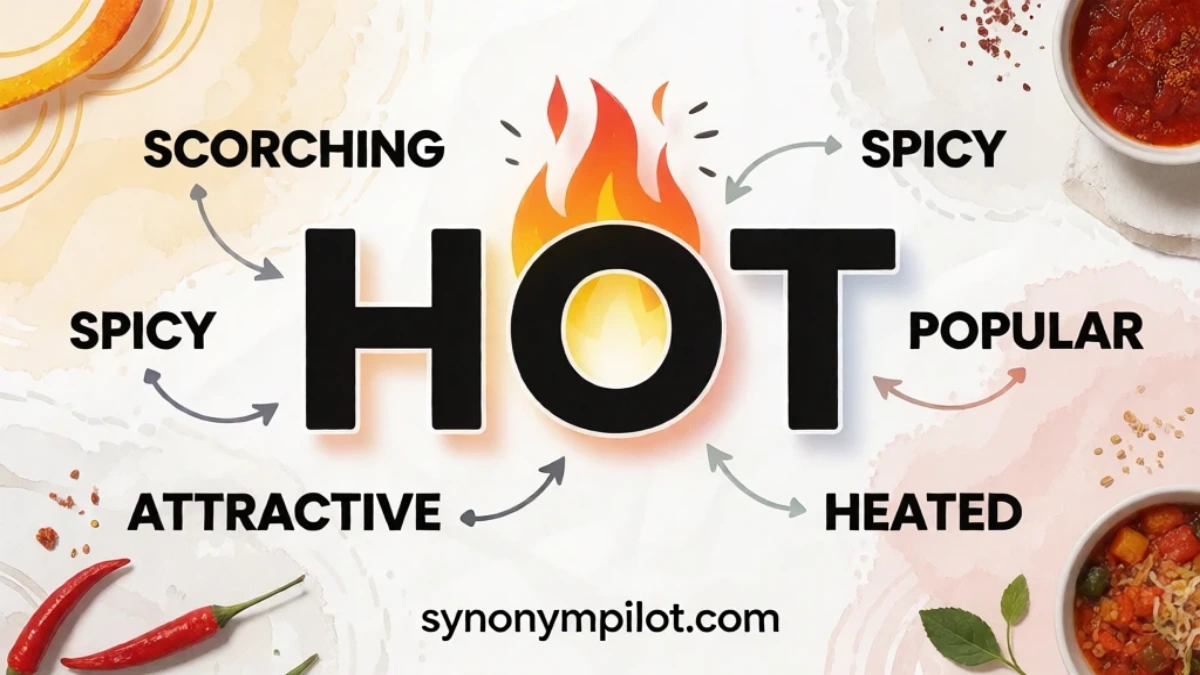
For example, you can say scorching for extremely high temperatures, spicy food, attractive for someone’s appearance, and popular for something receiving a lot of attention. These alternatives make your meaning clearer and can also make your English sound more precise.
In this guide, you will learn 50 useful synonyms and alternatives for hot, along with simple meanings, examples, usage differences, common phrases, antonyms, and practical examples for school, work, writing, and conversation.
Quick Answer
Hot usually means having a high temperature, such as hot tea or a hot day. Depending on context, it can also describe spicy food, an attractive person, something popular, or a situation that is intense or urgent. The best synonym depends on the meaning you want.
Meaning, Tone & Context
The word hot is a common adjective with several meanings.
1. High in temperature
This is the most basic meaning. Something is hot when its temperature is high.
- The soup is hot.
- It is hot outside.
- Be careful—the pan is hot.
Depending on intensity, you could use warm, heated, scorching, boiling, blazing, or sweltering.
However, these words are not interchangeable in every sentence. For example, warm is usually much less intense than hot, while scorching suggests extreme heat.
2. High-temperature if
When talking about if, hot describes uncomfortable or unusually high temperatures.
It was extremely hot yesterday.
Possible alternatives include:
- scorching
- sweltering
- blazing
- roasting
- boiling
These words are especially useful when you want to show that the heat is intense.
3. Spicy food
Hot can also describe food that contains a lot of chili or other strong spices.
This sauce is really hot.
In this context, spicy, fiery, peppery, and pungent may sometimes work, although their meanings are not identical.
For example, spicy directly describes food with strong spices, while peppery specifically suggests a pepper-like taste.
4. Attractive appearance
In informal English, hot can describe someone who is sexually attractive or physically appealing.
Everyone thought the actor was hot.
More neutral alternatives include attractive, good-looking, handsome, beautiful, or stunning, depending on the person and context.
Because hot can sound informal or sexual in this sense, choose a more neutral word in professional or formal writing.
5. Popular or fashionable
We also use hot to describe something that is currently very popular or receiving a lot of attention.
That is one of the hottest new restaurants in town.
Here, alternatives include popular, trendy, fashionable, in-demand, and sought-after.
6. Urgent or intense
Finally, hot can describe something involving strong activity, pressure, competition, or urgency.
The investigation is a hot topic in the news.
In such situations, words like intense, urgent, heated, or contentious may be more precise.
Overall, hot is informal and extremely common. Therefore, it works naturally in everyday conversation, but more precise alternatives are often better in academic and professional writing.
When & How to Use “Hot”
Use hot when the context makes the intended meaning clear.
Talking about temperature
The coffee is still hot.
Don’t touch the oven; it is hot.
Talking about if
It gets very hot here in July.
For stronger emphasis:
It was scorching hot all afternoon.
Talking about food
Be careful. This curry is hot.
If you mean strong spices rather than temperature, spicy is often clearer:
This curry is very spicy.
Talking about attractiveness
In casual conversation:
That actor is considered hot.
However, in formal writing, attractive or good-looking is usually more appropriate.
Talking about popularity
That new app is hot right now.
This means the app is attracting a lot of attention or interest.
Talking about competition or conflict
The competition is getting hot.
Here, heated or intense may communicate the idea more clearly.
Another Word for Hot
There is no single replacement that works in every situation.
For high temperature, words such as heated, scorching, sweltering, or blazing can work well.
When referring to something spicy, spicy or, in certain contexts, fiery is more suitable.
To describe someone or something attractive, consider attractive, good-looking, handsome, beautiful, or stunning.
A popular person, style, or product can be described as trendy, fashionable, or in-demand.
For something intense or urgent, heated, intense, urgent, or pressing may be appropriate.
Therefore, the best alternative depends on the exact sentence.
When Not to Use This Word
Although hot is very common, it is not always the clearest choice.
Avoid it when you need a precise temperature description
Instead of:
The water is hot.
You might write:
The water is boiling.
if it has reached boiling point.
Avoid informal meanings in formal writing
Instead of:
The new employee is hot.
Use a more precise and appropriate description if you are discussing someone’s appearance.
Avoid ambiguity with food
If you mean chili heat rather than temperature, spicy is often better:
The sauce is spicy.
This makes your meaning immediately clear.
Avoid vague descriptions in academic writing
Instead of:
The issue is hot.
You could write:
The issue is controversial.
or:
The issue is receiving considerable public attention.
The more precise word usually communicates your idea better.
Words Commonly Confused With “Hot”
Several words overlap with hot, but they are not exact replacements.
Hot vs. Warm
Warm means pleasantly or moderately high in temperature. Hot usually indicates a higher temperature.
The water is warm.
The water is hot.
Hot vs. Spicy
Hot can describe spicy food, but it can also describe temperature.
The soup is hot.
This could mean high temperature.
The soup is spicy.
This clearly refers to its flavor.
Hot vs. Boiling
Boiling refers specifically to a liquid reaching its boiling point or, informally, to extreme heat.
The water is boiling.
You cannot always replace hot with boiling.
Hot vs. Heated
Heated can mean physically made hotter, but it can also describe an emotional argument or disagreement.
They had a heated argument.
Here, heated does not mean that the argument had a high physical temperature.
Hot vs. Attractive
When hot describes a person, it usually has a stronger and more informal meaning than attractive.
She is attractive.
is generally more neutral than:
She is hot.
Best Synonym by Context
| Context | Best Alternative | Why It Works |
| High temperature | Heated | Clearly relates to increased temperature |
| Very high temperature | Scorching | Shows extreme heat |
| Extremely hot if | Sweltering | Emphasizes uncomfortable heat |
| Hot if | Blazing | Suggests powerful, intense heat |
| Pleasantly warm | Warm | Much milder than hot |
| Spicy food | Spicy | Directly describes strong spices |
| Very spicy food | Fiery | Suggests strong chili heat |
| Attractive person | Attractive | Neutral and widely appropriate |
| Attractive man | Handsome | Common for male appearance |
| Attractive woman | Beautiful | Common for female appearance |
| Very attractive | Stunning | Strong positive description |
| Popular trend | Trendy | Suggests current fashion or popularity |
| Popular product | In-demand | Emphasizes strong demand |
| Popular topic | Trending | Focuses on current attention |
| Intense argument | Heated | Describes strong emotion or disagreement |
| Urgent issue | Pressing | Emphasizes the need for quick action |
Which Synonym Should You Choose?
First, identify what hot means in your sentence.
If you are talking about temperature, choose based on intensity. Use warm for mild heat, hot for high heat, and scorching or sweltering for extreme heat.
If you are describing food, use spicy when you mean strong spices. Use fiery when you want a more vivid description.
If you are describing appearance, use attractive, good-looking, handsome, or beautiful when you want a neutral tone. In casual speech, hot is possible, but it can sound more personal or sexual.
If you are talking about popularity, use popular, trendy, fashionable, or in-demand.
Finally, if you mean conflict or strong emotion, heated and intense are usually more precise.
Real-Life Examples of “Hot” in Sentences
School
The classroom became hot after the heating system was turned on.
Our teacher asked us why some deserts have such hot climates.
Workplace
The coffee machine makes very hot drinks.
The meeting became hot when the two teams disagreed about the budget.
Writing
The region experiences hot summers and mild winters.
The article discusses several hot topics in modern technology.
Conversation
“Is the tea hot?”
“Yes, give it a few minutes to cool down.”
“That restaurant is really hot right now.”
“Do you mean the food is spicy, or is the restaurant popular?”
This last example shows why context matters.
Synonyms and Contextual Alternatives for “Hot”
| Synonym | Simple Meaning | Example Sentence |
|---|---|---|
| 1. Warm | Slightly hot or comfortably heated | The room feels warm this morning. |
| 2. Heated | Made or becoming hot | The heated water was ready for the bath. |
| 3. Scorching | Extremely hot | We walked home under the scorching sun. |
| 4. Sweltering | Extremely hot and uncomfortable | It was sweltering inside the small room. |
| 5. Blazing | Very hot and intense | The blazing afternoon sun made everyone tired. |
| 6. Boiling | Extremely hot | The boiling water filled the pot with steam. |
| 7. Roasting | Very hot and uncomfortable | We spent the roasting afternoon indoors. |
| 8. Searing | Extremely hot or intensely burning | The searing heat made it difficult to walk outside. |
| 9. Torrid | Extremely hot, especially in weather | The region experienced a torrid summer. |
| 10. Sultry | Hot and humid | It was a sultry evening by the coast. |
| 11. Fiery | Very hot, spicy, or intense | The restaurant served a fiery chili sauce. |
| 12. Spicy | Having a strong, hot flavor | I ordered a spicy chicken curry. |
| 13. Peppery | Having a strong pepper flavor | The soup had a peppery taste. |
| 14. Piquant | Pleasantly sharp or spicy in flavor | The sauce had a piquant flavor. |
| 15. Zesty | Having a lively, sharp flavor | The chef added a zesty dressing to the salad. |
| 16. Attractive | Pleasant or appealing in appearance | She has an attractive smile. |
| 17. Good-looking | Pleasant to look at | He is a good-looking young man. |
| 18. Handsome | Attractive, especially when describing a man | Her brother is tall and handsome. |
| 19. Beautiful | Very pleasing in appearance | The bride looked beautiful. |
| 20. Gorgeous | Extremely attractive or impressive | She wore a gorgeous dress. |
| 21. Stunning | Extremely attractive or impressive | The actress looked stunning on the red carpet. |
| 22. Striking | Noticeably attractive or impressive | He has a striking appearance. |
| 23. Alluring | Very attractive and appealing | The model had an alluring appearance. |
| 24. Appealing | Attractive or interesting | The new product has an appealing design. |
| 25. Charming | Pleasant and attractive | The little town has a charming atmosphere. |
| 26. Sexy | Sexually attractive | The character is presented as sexy and confident. |
| 27. Popular | Liked or followed by many people | That song is very popular. |
| 28. Trendy | Very fashionable or modern | They opened a trendy café downtown. |
| 29. Fashionable | Following current styles | She bought a fashionable jacket. |
| 30. In-demand | Wanted by many people | Skilled programmers are in demand. |
| 31. Sought-after | Strongly desired | The designer is highly sought-after. |
| 32. Trending | Receiving a lot of attention online | The topic is trending online. |
| 33. Current | Happening or relevant now | The course covers current technology trends. |
| 34. Prominent | Important and noticeable | Climate change remains a prominent topic. |
| 35. Intense | Extremely strong | The competition became intense. |
| 36. Fierce | Very strong or aggressive | The two teams faced fierce competition. |
| 37. Heated | Emotionally strong or angry | They had a heated discussion. |
| 38. Urgent | Requiring immediate attention | We need an urgent response. |
| 39. Pressing | Needing attention soon | Housing is a pressing issue in the city. |
| 40. Critical | Extremely important or serious | The patient is in critical condition. |
| 41. Explosive | Likely to become suddenly intense | The political debate became explosive. |
| 42. Contentious | Likely to cause disagreement | The proposal remains a contentious issue. |
| 43. Burning | Very important or urgent | They discussed the burning question of costs. |
| 44. Live | Happening or broadcast at the present time | The website provides live updates. |
| 45. Active | Currently operating or happening | The investigation is still active. |
| 46. Fresh | New or recently developed | The team presented fresh ideas. |
| 47. New | Recently introduced or developed | The company launched a new product. |
| 48. Exciting | Creating strong interest or enthusiasm | The startup has an exciting new project. |
| 49. Sensational | Extremely exciting or attention-grabbing | The newspaper published a sensational story. |
| 50. Red-hot | Extremely popular, successful, or intense | The company has a red-hot new product. |
Synonym Groups & Usage Differences
Formal and Academic
Words such as torrid, contentious, prominent, critical, and pressing can work well in formal contexts, depending on their meaning.
For example:
The region experienced a torrid summer.
However, everyday speakers usually prefer very hot or scorching.
Informal and Conversational
Hot, roasting, gorgeous, hot, and red-hot can appear in casual conversation, although their meanings differ.
For example:
It is roasting today!
sounds more conversational than:
The temperature is extremely high today.
Professional
In professional writing, precise words are usually better.
Use urgent, pressing, critical, in-demand, prominent, or current when they accurately express your intended meaning.
For example:
This is a pressing business concern.
is clearer than:
This is a hot business concern.
Stronger vs. Weaker
For physical temperature:
warm → hot → scorching → sweltering
This sequence generally moves from milder to more intense heat.
For attractiveness, the difference is less objective because these descriptions depend heavily on personal opinion and context.
Emotional vs. Neutral
Heated, fiery, and explosive can carry stronger emotional associations.
By contrast, intense can be more neutral:
The competition was intense.
Compared with:
The argument was heated.
Modern vs. Older or Less Common
Trending, in-demand, and red-hot are common in modern media and everyday language.
Torrid is correct but less common in ordinary conversation. It often appears in formal, literary, or descriptive writing.
Slang
Hot itself can function as informal slang when describing an attractive person or something currently very popular.
For example:
That new band is hot right now.
Because slang changes quickly, however, context matters. In formal writing, choose a more precise alternative.
Antonyms
| Antonym | Meaning | Example |
| Cold | Having a low temperature | The water is cold. |
| Cool | Slightly cold or pleasantly low in temperature | The evening air is cool. |
| Chilly | Uncomfortably cold | It was chilly outside. |
| Freezing | Extremely cold | The water is freezing. |
| Icy | Extremely cold or covered with ice | The road was icy. |
| Mild | Neither very hot nor very cold | We had mild if today. |
| Bland | Lacking strong spicy flavor | The soup tastes bland. |
| Unpopular | Not liked by many people | The idea became unpopular. |
| Calm | Without strong conflict or emotion | The discussion remained calm. |
| Unimportant | Not significant or urgent | The issue seemed unimportant. |
Remember that antonyms depend on the meaning. Cold is an antonym of hot when discussing temperature, while bland can contrast with hot when hot means spicy.
Comparison Section
Hot vs. Warm: Subtle Meaning Difference
Both describe temperature, but warm is milder.
The tea is warm, so it has some heat but is still comfortable to drink.
By comparison, hot means the tea has a higher temperature and may need to cool before drinking.
The temperature is higher, and you may need to wait before drinking it.
Hot vs. Spicy: Meaning and Usage
Hot can refer to temperature or chili heat.
Spicy specifically refers to strong spices or chili-like heat.
The soup is hot.
This could mean its temperature is high.
The soup is spicy.
This means its flavor is strong.
Hot vs. Scorching: Emotional Intensity
Scorching is much stronger than ordinary hot when describing temperature.
It is hot today.
It is scorching today.
The second sentence suggests extreme heat.
Hot vs. Attractive: Tone and Formality
When describing a person, hot is informal and can have a sexual meaning.
Attractive is more neutral and appropriate in many formal contexts.
The actor is attractive.
This sounds more neutral than:
The actor is hot.
Hot vs. Popular: Different Usage Situations
When hot means popular, it suggests that something is receiving strong attention at the moment.
That new restaurant is hot right now.
Popular is more direct and neutral:
That restaurant is popular.
Hot vs. Heated: Emotional Context
Heated often describes arguments, discussions, debates, or disagreements.
They had a heated argument.
You would not normally replace heated with hot in this sentence.
Common Phrases & Expressions
Hot if
Meaning: if with high temperatures.
We stayed indoors because of the hot if.
Hot Water
Meaning: Water with a high temperature; it can also have figurative meanings in some expressions.
The hotel provides hot water all day.
Hot and Spicy
Meaning: Food that has both strong chili heat and noticeable spice.
I love hot and spicy noodles.
Hot Topic
Meaning: A subject receiving a lot of attention or discussion.
Artificial intelligence is a hot topic in education.
Hot Seat
Meaning: A difficult or uncomfortable position where someone faces questions, pressure, or responsibility.
The manager was in the hot seat during the meeting.
Hot Off the Press
Meaning: Very new information or news that has just been published.
Here is the latest report, hot off the press.
Strike While the Iron Is Hot
Meaning: Take action while a good opportunity still exists.
The product is getting attention, so we should strike while the iron is hot.
Common Mistakes to Avoid
1. Using “hot” when you mean “spicy”
If you are talking about chili flavor, spicy is often clearer.
Incorrect for clear meaning:
The curry is hot.
Better when referring specifically to spices:
The curry is spicy.
2. Using “boiling” for everything
Boiling is stronger and more specific than hot. Do not use it simply because something feels warm or hot.
3. Using “hot” formally to describe appearance
Although it is common in casual speech, hot can sound overly personal or sexual when describing someone’s appearance. Attractive is generally more neutral.
4. Confusing “hot” and “heated”
A heated argument involves strong emotion. It does not mean that the argument has a high physical temperature.
5. Choosing a synonym without checking intensity
Do not automatically replace hot with scorching, sweltering, or boiling. These words suggest stronger heat.
FAQs
What is the best synonym for hot?
There is no single best synonym. For temperature, warm, scorching, or sweltering may fit depending on intensity. For food, spicy is often best, while attractive can work when describing someone’s appearance.
What is a stronger word for hot?
For physical temperature, scorching, sweltering, blazing, and searing are stronger alternatives. The right choice depends on what you are describing.
What is another word for hot if?
You can describe hot if as scorching, sweltering, blazing, roasting, or torrid. Among these, sweltering strongly suggests uncomfortable heat.
What is another word for hot food?
If you mean high temperature, use heated, steaming, or boiling, depending on the situation. If you mean chili flavor, spicy or fiery may be more appropriate.
Is “hot” formal or informal?
Hot is commonly used in both everyday and formal contexts when referring to a high temperature. However, some uses are more informal. For example, describing someone as hot to mean attractive is generally more casual than using attractive.
Conclusion
The word hot is simple, but its meaning changes with context. It can describe high temperature, spicy food, attractive people, popular trends, intense competition, or urgent situations. Therefore, the best synonym depends on exactly what you want to say.
or physical temperature, try warm, scorching, sweltering, or blazing when the level of heat changes. For food, spicy and fiery can make your meaning clearer.