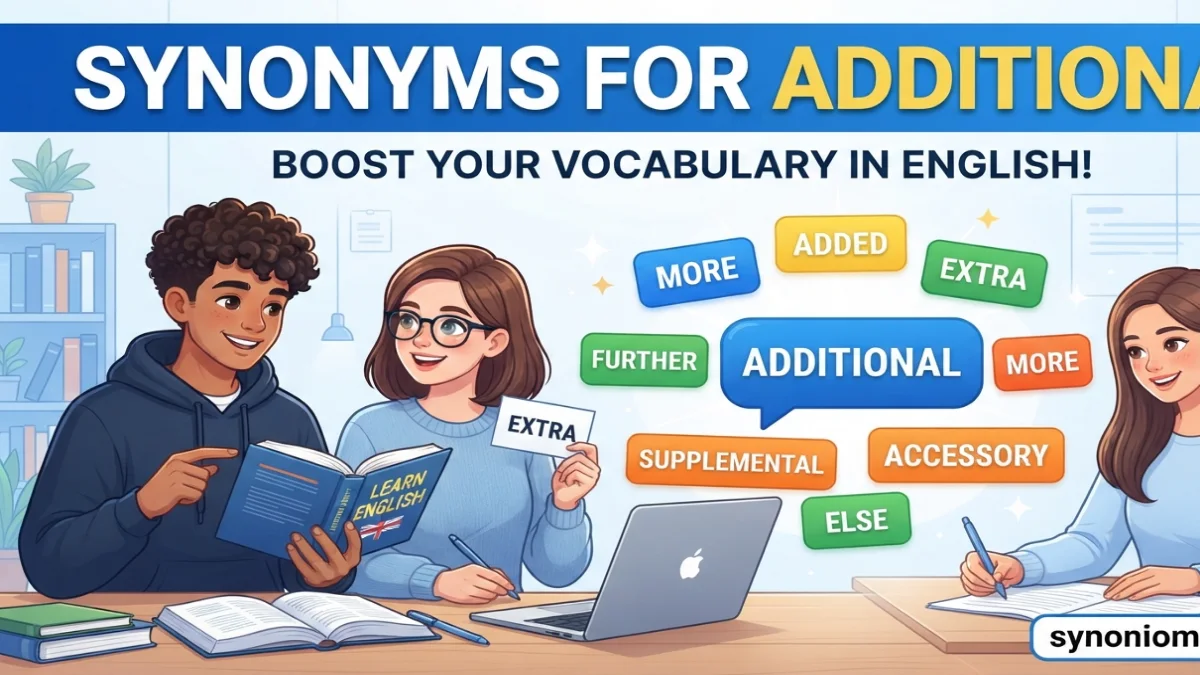
Have you ever written the word “additional” again and again in an essay, email, or social media post?
Many English learners do this because they are unsure which other words mean the same thing.
Learning synonyms for “additional” can make your speaking and writing sound more natural, professional, and interesting.
If you are writing a school assignment, sending a work email, or chatting online, using different vocabulary helps you communicate more clearly and confidently.
In this guide, you will learn the meaning of “additional,” when to use it, the best alternative words, common mistakes, useful phrases, and simple examples you can use in daily English.
Featured Snippet Definition
“Additional” means extra, added, or more than what already exists. It is used when something is included beyond the original amount or idea.
For example:
- “We need additional chairs for the guests.”
- “Please provide additional information.”
The word is common in formal, academic, and professional English.
What is another word for additional?
Common synonyms for additional include extra, further, supplementary, added, more, another, supplemental, and bonus. The best synonym depends on the context. Further is common in formal writing, while extra is more natural in everyday conversation.
Useful Collocations
Academic
- additional research
- additional evidence
- additional reading
- supplementary materials
Business
- additional costs
- additional investment
- additional funding
- added value
Everyday English
- extra time
- extra help
- another chance
- more information
Customer Service
- additional services
- bonus features
- optional extras
- extra benefits
Which Synonym Should You Choose?
| If you mean… | Best Word | Why? |
|---|---|---|
| More than expected | Extra | Everyday English |
| Formal writing | Further | Academic and professional |
| Supporting information | Supplementary | Reports and research |
| Something newly included | Added | General writing |
| One more item | Another | Everyday conversation |
| Optional benefit | Bonus | Marketing and products |
Meaning, Tone & Context
Core Meaning of “Additional”
The word “additional” refers to something added to what is already present. It shows increase, extension, or extra support.
Example:
- “The teacher gave additional homework.”
This means the homework was added to the existing work.
Tone of the Word
“Additional” usually sounds:
- Formal
- Professional
- Neutral
- Academic
It is commonly used in:
- Business emails
- School writing
- Reports
- Instructions
- Customer service communication
Where It Sounds Most Natural
You will often hear or read “additional” in situations like:
- Workplace communication
- Academic writing
- Online forms
- News articles
- Official announcements
Example:
- “Additional details will be shared tomorrow.”
In casual conversation, people often use simpler alternatives like:
- extra
- more
- added
| Situation | Best Alternative |
|---|---|
| Everyday conversation | Extra |
| Academic writing | Further |
| Research papers | Supplementary |
| Business reports | Added |
| Marketing | Bonus |
| Customer support | Additional |
When & How to Use “Additional”
In School Writing
Students often use “additional” when adding ideas or evidence.
Example:
- “The article includes additional research about climate change.”
In Business Communication
Professionals use it in emails and reports.
Example:
- “Please contact us if you need additional support.”
In Everyday Conversation
In casual speech, people may replace it with “extra.”
Example:
- “Do you want additional fries?”
- More natural casual version:
- “Do you want extra fries?”
In Online Communication
The word is also common in websites and forms.
Example:
- “Enter additional comments below.”
Synonyms for Additional
| Synonym | Simple Meaning | Example Sentence |
| Extra | More than needed | “We ordered extra pizza.” |
| Added | Included later | “There are added benefits.” |
| More | Greater amount | “Do you need more time?” |
| Further | Beyond what exists | “Further discussion is needed.” |
| Supplementary | Supporting something | “Read the supplementary notes.” |
| Spare | Available for use | “Do you have a spare pen?” |
| Fresh | Newly added | “She shared fresh ideas.” |
| Other | Different or more | “Any other questions?” |
| Bonus | Something additional as a reward | “Employees received a bonus payment.” |
| Expanded | Made larger | “The company launched expanded services.” |
| Supplemental | Added for completion | “Students received supplemental materials.” |
| Increased | Made bigger | “There is increased demand.” |
| New | Recently added | “The app has new features.” |
| Accessory | Extra supporting item | “The phone includes accessories.” |
| Auxiliary | Providing help or support | “Auxiliary staff assisted visitors.” |
| Side | Secondary or added | “She started a side project.” |
| Backup | Reserved for support | “Keep a backup battery.” |
| Reserve | Saved for later use | “The team has reserve players.” |
| Extension | Added continuation | “We requested an extension.” |
| Appended | Attached at the end | “The file contains appended notes.” |
| Enlarged | Made greater | “They need an enlarged workspace.” |
| Plus | Added advantage | “The job offers health insurance plus bonuses.” |
| Peripheral | Secondary or supporting | “Peripheral topics were discussed.” |
| Secondary | Less important but added | “Secondary issues remain.” |
| Optional | Not required but available | “Optional classes are offered.” |
| Excess | More than necessary | “There was excess food.” |
| Duplicate | An extra copy | “Please bring a duplicate form.” |
| Alternative | Another option | “We found an alternative plan.” |
| Extensionary | Expanding further | “The policy took an extensionary approach.” |
| Complementary | Completing or enhancing | “The hotel offers complementary services.” |
| Accompanying | Going together | “Read the accompanying guide.” |
| Remaining | Left over | “Use the remaining money carefully.” |
| Over | Beyond a limit | “Costs went over budget.” |
| Added on | Included afterward | “The software has added on features.” |
| Supplementary | Additional support | “Supplementary lessons helped students.” |
| Ancillary | Providing extra support | “Ancillary services are available.” |
| Adjunct | Connected as an addition | “The lab is an adjunct facility.” |
| Attachable | Able to be added | “The bag has attachable straps.” |
| Broadened | Expanded in range | “The program has broadened options.” |
| Enriched | Improved with additions | “The course includes enriched content.” |
| Heightened | Increased level | “Security measures were heightened.” |
| Inclusive | Containing more | “The package is more inclusive.” |
| Supplementing | Adding support | “He is supplementing his income.” |
| Reinforcing | Strengthening further | “Reinforcing arguments were presented.” |
| Overflow | Extra amount beyond limit | “The overflow crowd waited outside.” |
| Add on | Extra feature or service | “The game offers add on content.” |
| Carry over | Continued addition | “There was carry over work.” |
| Attached | Connected additionally | “See the attached document.” |
| Expanded | Made wider or bigger | “Expanded seating is available.” |
| Extra added | Added in addition | “Customers received extra added value.” |
Important Synonym Groups
Formal Synonyms
These work well in professional or academic writing.
- supplementary
- supplemental
- ancillary
- further
- auxiliary
- appended
- complementary
Example:
- “Supplementary documents are attached for review.”
Informal Synonyms
These are common in daily conversations.
- extra
- more
- bonus
- spare
- plus
Example:
- “Can I get extra sauce?”
Academic Synonyms
Useful for essays and research papers.
- further
- supplementary
- additional
- expanded
- ancillary
Example:
- “Further research is required.”
Professional Synonyms
Best for workplace communication.
- added
- supplemental
- auxiliary
- expanded
- complementary
Example:
- “The company provides added support for employees.”
Emotional or Expressive Synonyms
These can sound more emotional or persuasive.
- bonus
- enriched
- heightened
- fresh
Example:
- “The trip gave us enriched experiences.”
Conversational Synonyms
Natural for spoken English.
- more
- extra
- other
- plus
Example:
- “Do you need more help?”
Slang or Casual Expressions
Very casual alternatives people use online or socially.
- plus up
- add on
- bonus stuff
Example:
- “The update comes with bonus stuff.”
Antonyms of Additional
| Antonym | Meaning | Example |
| Less | Smaller amount | “We need less sugar.” |
| Fewer | Smaller number | “There are fewer students today.” |
| Limited | Restricted amount | “Parking space is limited.” |
| Basic | Simple without extras | “We chose the basic package.” |
| Original | Existing first | “Use the original version.” |
| Primary | Main or first | “Our primary goal is safety.” |
| Essential | Absolutely necessary only | “Pack only essential items.” |
| Minimum | Smallest possible amount | “Minimum effort was required.” |
| Reduced | Made smaller | “The price was reduced.” |
| Standard | Normal without extras | “The standard plan is cheaper.” |
Comparison Section
Additional vs Extra
Both words mean “more,” but “extra” sounds more casual.
Examples:
- Formal: “Additional information is required.”
- Casual: “Do you have extra paper?”
Additional vs Further
“Further” often suggests continuing or going deeper.
Examples:
- “Additional chairs were brought in.”
- “Further investigation is necessary.”
Additional vs Supplemental
“Supplemental” usually means added to improve or complete something.
Examples:
- “Students received supplemental reading materials.”
This sounds more academic than “additional.”
Additional vs More
“More” is simpler and more common in speech.
Examples:
- “I need more water.”
- “I need additional information.”
The second sentence sounds more formal.
Additional vs Ancillary
“Ancillary” means supporting or secondary.
Example:
- “The hotel offers ancillary services like laundry.”
This word is mainly used in business or technical writing.
Common Phrases & Expressions
Additional Information
Meaning: More details or facts.
Example:
- “Please provide additional information about your experience.”
Additional Cost
Meaning: Extra money required.
Example:
- “Delivery may involve an additional cost.”
Additional Support
Meaning: Extra help or assistance.
Example:
- “Students can request additional support from teachers.”
Additional Time
Meaning: More time than originally given.
Example:
- “The manager allowed additional time for the project.”
Additional Charges
Meaning: Extra fees or payments.
Example:
- “There may be additional charges for late delivery.”
Additional Resources
Meaning: Extra materials or tools.
Example:
- “The website offers additional resources for learners.”
Additional Benefits
Meaning: Extra advantages.
Example:
- “Employees receive additional benefits after one year.”
Common Mistakes to Avoid
Using “Additional” in Very Casual Speech
While correct, it can sound too formal in daily conversation.
Less natural:
- “Can I have additional ketchup?”
More natural:
- “Can I have extra ketchup?”
Confusing “Further” and “Farther”
- “Further” is usually for ideas or discussion.
- “Farther” is for physical distance.
Correct:
- “Further explanation is needed.”
Overusing the Same Word
Repeating “additional” too many times makes writing boring.
Instead of:
- “Additional support and additional resources provide additional benefits.”
Use variation:
- “Extra support and supplementary resources provide added benefits.”
Using Formal Synonyms in Casual Chat
Words like “ancillary” or “supplementary” may sound strange in normal conversation.
Too formal:
- “I need supplementary fries.”
Natural:
- “I need extra fries.”
Common Mistakes
Mistake 1
❌ Additional and another always mean the same thing.
✅ Another usually refers to one more item, while additional can refer to any extra amount.
Mistake 2
❌ Using bonus as a synonym in every situation.
✅ Bonus works only when referring to an extra benefit or reward.
Mistake 3
❌ Further is always better than additional.
✅ Both are correct, but further often sounds more formal.
Mistake 4
❌ Using supplementary in casual conversation.
⚠️ Better:
Use extra or additional in everyday English.
Better Alternatives to “Additional” in Common Sentences
| Instead of… | Try… |
|---|---|
| Additional information | Further information |
| Additional details | More details |
| Additional support | Extra support |
| Additional resources | Supplementary resources |
| Additional cost | Extra cost |
| Additional training | Further training |
FAQs
What is the best synonym for “additional”?
The best synonym depends on the situation. “Extra” is best for casual speech, while “supplementary” or “further” work better in formal writing.
Is “additional” formal or informal?
“Additional” is mostly formal or neutral. It is very common in professional and academic English.
Can I use “extra” instead of “additional”?
Yes, in many situations. “Extra” sounds more natural in conversation.
Example:
- “Extra time”
- “Additional time”
Both are correct.
What is an academic synonym for “additional”?
Common academic alternatives include:
- further
- supplementary
- supplemental
- ancillary
Is “additional” positive or negative?
The word itself is neutral. The meaning depends on the sentence.
Positive:
- “Employees received additional benefits.”
Negative:
- “There were additional problems.”
Conclusion
Learning synonyms for “additional” is a simple way to improve your English vocabulary and sound more natural in different situations.
Instead of repeating the same word, you can choose alternatives like “extra,” “further,” “supplementary,” or “added” depending on the tone and context.
Practice using these words in emails, school assignments, conversations, and social media posts.
The more you use them in real life, the more confident and fluent your English will become.