I remember reading a story about someone struggling with dark thoughts, and the words they used to describe their feelings were limited.
Often, writers, students, and bloggers face a problem: repetition. Using the word suicide too often can make your writing sound dull or insensitive.
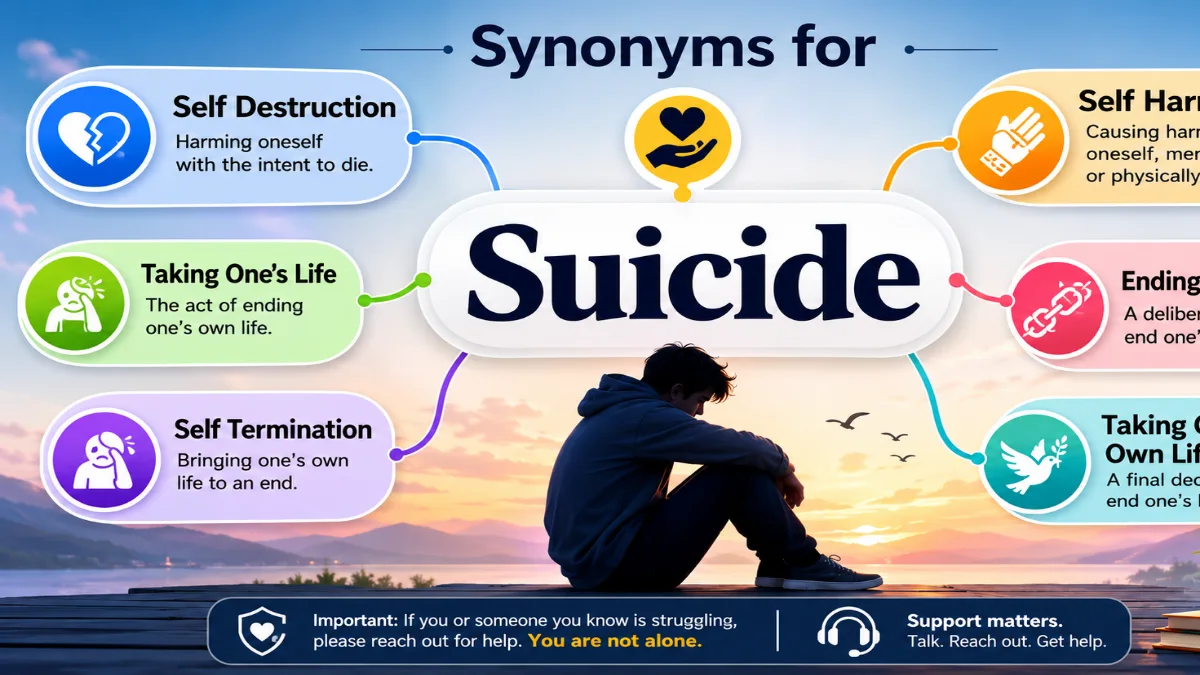
In simple words, suicide means ending one’s life intentionally. It’s a serious topic, but knowing the right synonyms and variations can help writers, mental health content creators, and freelancers communicate clearly and sensitively.
Using alternative words also improves SEO, blog readability, and vocabulary richness.
This article will guide you through 50+ synonyms for suicide, their meanings, examples, and contextual usage so you never have to search elsewhere.
Featured Snippet Definition
What is a Synonym?
A synonym is a word that has the same or nearly the same meaning as another word.
What Is the Definition of Suicide?
- Suicide is the act of intentionally ending one’s own life.
- It can also refer to self destruction in a figurative sense.
What is another word for suicide?
Depending on the context, related terms include self-destruction, self-inflicted death (formal), and self-harm resulting in death (medical or descriptive contexts). However, these expressions are not always interchangeable, so it’s important to choose the term that matches the context.
Which Term Should You Choose?
| If you are writing about… | Best Term | Why? |
|---|---|---|
| General English | Suicide | The standard and clearest term |
| Medical writing | Self-inflicted death | More clinical and descriptive |
| Psychological discussion | Self-destructive behavior | Refers to harmful behavior, not necessarily death |
| Literary analysis | Self-destruction | Often metaphorical or symbolic |
| News or academic writing | Suicide | Preferred for clarity and accuracy |
Contextual Usage: When and How to Use “Suicide”
| Context | Usage | Example | Practical Tip |
| Writing | Use to describe characters or situations | “The novel depicted the character’s suicide sensitively.” | Avoid triggering words; maintain tone. |
| Blogging / SEO | Improve keyword variations for articles | “Understanding suicide prevention is critical for mental health blogs.” | Mix with synonyms like self harm, self destruction to rank better. |
| Conversation | Sensitive discussions | “He spoke about his struggles without mentioning suicide directly.” | Use indirect synonyms if discussing casually. |
| Professional Context | Reports, research | “The report analyzes suicide rates among teens.” | Stick to formal or clinical terms. |
Main Synonyms Section (50+ Words)
| Word | Meaning | Example |
| Self destruction | Deliberate harm to oneself | “Addiction can lead to self destruction.” |
| Self harm | Inflicting injury on oneself | “Self harm is a serious mental health concern.” |
| Taking one’s life | Ending one’s life intentionally | “He was found taking his life after the accident.” |
| Ending it all | Informal way to describe suicide | “She felt hopeless and considered ending it all.” |
| Self slaughter | Literary/formal term | “The poem explored self slaughter as a tragic theme.” |
| Auto destruction | Figurative self damage | “His obsession led to auto destruction over time.” |
| Self termination | Clinical/formal | “The study included cases of self termination.” |
| Self inflicted death | Direct, descriptive | “The research focused on self inflicted death statistics.” |
| Voluntary death | Neutral/legal term | “Voluntary death is discussed in ethical debates.” |
| Self annihilation | Figurative, dramatic | “The novel depicts self annihilation as despair.” |
| Self execution | Rare/formal | “Historical texts mention self execution in legends.” |
| Self ending | Simple alternative | “The story hinted at a possible self ending.” |
| Fatal self act | Formal, medical | “Fatal self act cases are rising globally.” |
| Own demise | Figurative/poetic | “His own demise was foreshadowed early in life.” |
| Self elimination | Formal/clinical | “Self elimination statistics were analyzed.” |
| Self obliteration | Dramatic/literary | “The character’s self obliteration shocked readers.” |
| Personal extinction | Poetic/literary | “A tale of personal extinction and regret.” |
| Self extermination | Formal | “The report studied self extermination patterns.” |
| Intentional death | Neutral/formal | “Intentional death can stem from mental illness.” |
| Self sacrifice (fatal) | Figurative, contextual | “In literature, self sacrifice can tragically turn fatal.” |
| Assisted self death | Clinical/ethical | “Assisted self death is debated legally.” |
| Self removal | Euphemistic | “The story referred to self removal subtly.” |
| Self destruction act | General term | “The poem highlighted the self destruction act.” |
| Self liquidation | Rare/formal | “Self liquidation appears in historical texts.” |
| Self termination act | Clinical | “Self termination act is a sensitive subject.” |
| Taking one’s exit | Euphemism | “He quietly contemplated taking his exit.” |
| Life ending act | Formal | “Life ending act cases require care and study.” |
| Self abandonment | Figurative | “Self abandonment often precedes crisis.” |
| Fatal self choice | Clinical | “Fatal self choice decisions are analyzed in psychology.” |
| Final act | Poetic/neutral | “Her final act ended tragically.” |
| Self immolation | Literal & figurative | “Protesters have used self immolation historically.” |
| Life cessation | Formal/clinical | “Life cessation in teens is alarming.” |
| Self inflicted fatality | Clinical | “The report documented self inflicted fatalities.” |
| Deliberate self killing | Formal | “Deliberate self killing is studied in criminology.” |
| Self annihilative act | Rare/literary | “The novel portrays a self annihilative act.” |
| Fatal self harm | Clinical | “Fatal self harm requires urgent intervention.” |
| Suicide attempt | Attempted action | “The teenager survived a suicide attempt.” |
| Self destroying behavior | Figurative | “Self destroying behavior often signals distress.” |
| Intentional self death | Clinical | “Intentional self death cases were examined.” |
| Self execution act | Historical/rare | “Legends mention self execution acts.” |
| Self cancellation | Euphemistic/literary | “The poem reflects self cancellation of existence.” |
| Self voiding | Figurative/poetic | “The concept of self voiding appears in philosophy.” |
| Self termination scenario | Clinical | “The psychologist studied self termination scenarios.” |
| Life ending choice | Neutral/formal | “Life ending choice requires careful discussion.” |
| Self decapitation (figurative) | Dramatic/literary | “Self decapitation was symbolic in the story.” |
| Own life ending | Simple alternative | “He feared his own life ending decision.” |
| Suicide act | Direct | “Suicide act statistics have risen.” |
| Self hurting | Informal | “She felt self hurting tendencies.” |
| Self obliterating act | Literary | “A self obliterating act defines tragic heroes.” |
| Intentional self damage | Clinical | “Intentional self damage is a warning sign.” |
| Self perishing | Rare/formal | “Historical texts discuss self perishing.” |
| Self dying | Informal/literal | “The novel hints at self dying.” |
| Self death | Neutral/formal | “Self death is a sensitive topic in psychology.” |
| Fatal self choice | Clinical/poetic | “Fatal self choice affects families deeply.” |
| Life self termination | Clinical | “Life self termination is analyzed in studies.” |
| Self inflicted fatal act | Clinical | “Self inflicted fatal acts are rising.” |
Antonyms Section (10–15 Words)
| Word | Meaning | Example |
| Survival | Staying alive | “His survival inspired hope in everyone.” |
| Living | Continuing life | “Choosing living over despair is courageous.” |
| Thriving | Flourishing | “She is thriving despite hardships.” |
| Perseverance | Continuing despite difficulties | “Perseverance saved him from harm.” |
| Life preservation | Keeping life safe | “Life preservation is the primary goal.” |
| Self protection | Protecting oneself | “Self protection prevents harm.” |
| Safety | Being unharmed | “Safety measures helped prevent accidents.” |
| Endurance | Lasting through difficulties | “Endurance helps overcome crises.” |
| Longevity | Long life | “Longevity comes from careful choices.” |
| Health | Being well physically/mentally | “Health is wealth.” |
Comparison Section
| Keyword vs Word | Difference | Example |
| Suicide vs Self harm | Suicide ends life, self harm may not | “Self harm signals distress, but suicide ends life.” |
| Suicide vs Assisted death | Assisted death involves external help | “Assisted death is legal in some countries; suicide is personal.” |
| Suicide vs Risky behavior | Risky behavior may not end life | “Risky behavior is dangerous but differs from suicide.” |
| Suicide vs Overdose | Overdose may be accidental | “Overdose could be accidental, unlike intentional suicide.” |
| Suicide vs Self destruction | Self destruction is broader | “Self destruction includes habits beyond suicide.” |
Categorized Synonym Clusters
| Formal | Informal | Academic | Technical | Advanced |
| Self termination | Ending it all | Intentional death | Fatal self act | Self annihilation |
| Voluntary death | Taking one’s exit | Suicide attempt | Life ending act | Self obliteration |
| Self inflicted death | Own demise | Intentional self death | Self inflicted fatality | Self execution |
| Self destruction | Self ending | Assisted self death | Deliberate self killing | Self liquidation |
Context Based Variations
| Context | Explanation | Example |
| For People | Describing individuals | “His story reflects personal suicide struggles.” |
| For Places | Reporting in locations | “The city recorded high suicide rates this year.” |
| For Situations | Describing events or acts | “The tragic situation ended in suicide.” |
Adverb / Other Word Forms
| Word | Form | Example |
| Suicidal | Adjective | “He expressed suicidal thoughts.” |
| Suicidally | Adverb | “He acted suicidally without thinking.” |
| Self destructive | Adjective | “Her self destructive habits worried friends.” |
Noun Forms / Related Terms
| Term | Meaning | Example |
| Suicidality | Risk or tendency | “Suicidality should be monitored by professionals.” |
| Suicide attempt | Action of trying | “After a suicide attempt, he received counseling.” |
| Self harm | Related behavior | “Self harm often precedes suicidal ideation.” |
Situation Based Usage (Advanced)
| Context | Explanation | Example |
| Health / Harm | Mental health discussions | “Awareness can prevent suicide and self harm.” |
| Risk / Uncertainty | Decision making | “High risk teens may show signs of suicidal behavior.” |
| Hidden / Indirect | Euphemisms or literature | “The poem hints at suicide without naming it.” |
Common Phrases
- Preventing suicide
- Suicide prevention
- Contemplating suicide
- Suicide awareness
- Suicide attempt
- Risk of suicide
- Suicidal ideation
- Talking about suicide
- Suicidal behavior
- Coping with suicide
Other Languages (Optional)
| Language | Word | Notes |
| Spanish | suicidio | Direct translation |
| French | suicide | Similar usage |
| German | Selbstmord | Formal |
| Italian | suicidio | Formal |
| Japanese | 自殺 (jisatsu) | Literal |
Common Mistakes
Mistake 1
Treating self-destruction as an exact synonym for suicide.
✅ Why?
Self-destruction is often metaphorical and may describe damaging habits, careers, or relationships rather than suicide.
Mistake 2
❌ Using dramatic or sensational language.
✅ Better:
Use clear, neutral, and respectful terminology, especially in educational or informational writing.
Mistake 3
❌ Assuming every related word has the same meaning.
✅ Why?
Medical, psychological, literary, and legal contexts often require different terminology.
Common Collocations
These are commonly used in educational, medical, or academic writing:
- suicide prevention
- suicide risk
- suicide awareness
- suicide prevention programs
- suicide prevention efforts
- suicide prevention education
- suicide research
- suicide statistics
- suicide intervention
- suicide prevention resources
FAQs
Q1: What are polite alternatives to the word suicide?
A: Phrases like taking one’s life, self termination, or voluntary death are sensitive options.
Q2: Can “self harm” be used instead of suicide?
A: Only when discussing non fatal actions; suicide ends life.
Q3: Why use synonyms for suicide in writing?
A: To avoid repetition, enhance readability, and maintain sensitivity.
Q4: Are there formal and informal synonyms?
A: Yes. Self termination is formal, ending it all is informal.
Q5: Can people use these synonyms in professional contexts?
A: Yes, especially formal or clinical terms like self inflicted death or intentional death.
Q6: What is the difference between suicide and assisted death?
A: A person ends their own life independently, while legal or medical assistance may contribute to an assisted death.
Q7: Are there euphemistic ways to mention suicide?
A: Yes, phrases like taking one’s exit or life ending act are subtle and sensitive.
Conclusion
Understanding synonyms for suicide is crucial for writers, bloggers, and professionals who want to communicate clearly and sensitively.
Using a variety of terms from formal phrases like self termination to conversational ones like ending it all can help avoid repetition, improve vocabulary, and make content more engaging.
Context matters: medical, literary, or casual discussions require different choices. Remember, these words are powerful tools; they must be used with empathy and awareness. By practicing these synonyms, related terms, and phrases, you can enrich writing while being mindful of sensitive topics. Use this guide to confidently enhance your language and write with precision.