NFT stands for Non Fungible Token. An NFT is a type of digital certificate that a blockchain stores to prove you own a one-of-a-kind digital item, such as artwork, music, a video clip, or even a tweet.
You’ve probably seen the term NFT in headlines about million dollar digital art sales, video game items, or celebrity collectibles. But the abbreviation itself confuses a lot of people, especially the word “non fungible.” This guide breaks down exactly what each part of the term means, how NFTs actually work, and why the concept matters beyond the hype.
By the end, you’ll understand the full meaning of NFT, how it differs from cryptocurrency, and how to talk about NFTs correctly in everyday conversation.
NFT Meaning: Breaking Down Each Word
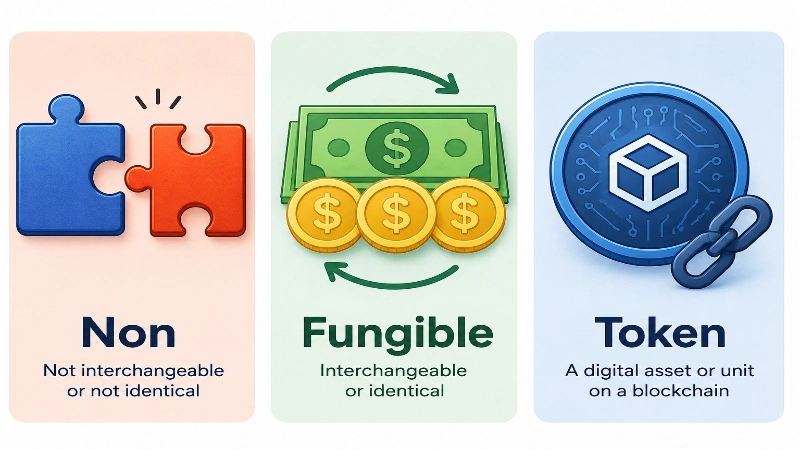
To understand NFT, it helps to look at each word separately.
The term “non-fungible” describes something that cannot be replaced by an identical item because it is unique. Think of an original painting. There’s only one, and swapping it for a different painting changes its value and identity completely.
Token refers to a digital record or unit of data. In this context, a token stores a small piece of information on a blockchain, a secure, shared digital ledger that many computers maintain.
Put together, a Non Fungible Token is a unique digital record that represents ownership of one specific item, and no other token can substitute for it.
Fungible vs. Non Fungible: A Simple Comparison
The easiest way to understand “non fungible” is to compare it to something fungible.
| Fungible Item | Non Fungible Item |
| A dollar bill (any $1 bill has the same value as another) | An original signed baseball from a specific game |
| Bitcoin (1 BTC always equals 1 BTC) | A one of a kind digital painting |
| A share of common stock | A house with a unique address and history |
| A grain of rice | A rare trading card in mint condition |
Fungible items are interchangeable. Non fungible items are not, because each one carries its own identity, history, or characteristics.
How an NFT Actually Works
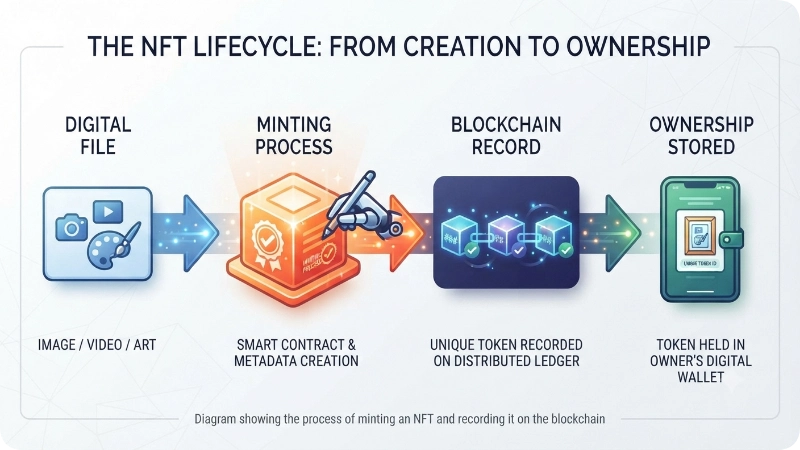
An NFT is not the digital file itself. It’s a record that points to the file and confirms who owns it.
Here’s the basic process:
- Creation (minting) A creator uploads a digital file, such as an image or song, to a platform that turns it into an NFT. This step is called minting.
- Blockchain recording The platform records details about the NFT on a blockchain, including a unique identifier, the creator’s information, and ownership history.
- After creators mint the NFT, they can list it on a marketplace, where buyers purchase it using cryptocurrency.
- Ownership transfer When a sale happens, the blockchain updates to show the new owner.The blockchain records every transaction publicly and prevents anyone from secretly altering it.
Because the blockchain keeps a permanent, transparent history, anyone can verify who owns an NFT and trace its past sales.
What Can Be Turned Into an NFT
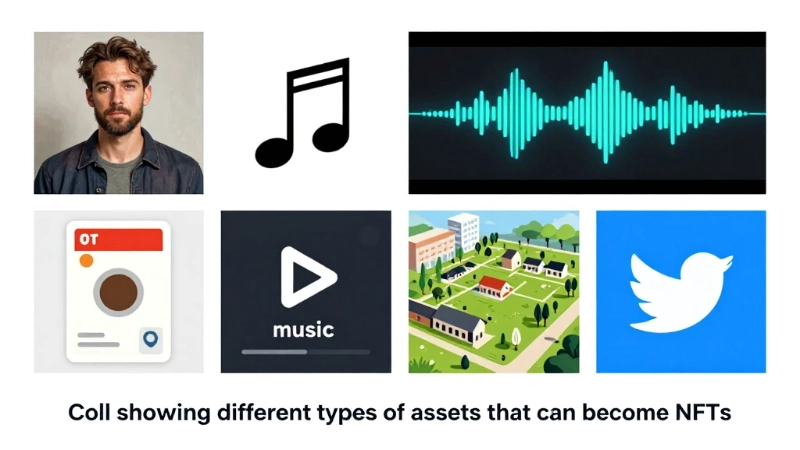
NFTs are not limited to digital art. Almost any unique digital or digitally represented item can become one.
- Digital art and illustrations Original artwork sold as a single edition or limited series.
- Music and audio clips Songs, beats, or voice recordings sold directly by artists.
- Video game items Skins, weapons, or characters that players truly own and can trade outside the game.
- Collectible cards and avatars Profile picture projects and trading card sets.
- Event tickets and memberships Access passes that double as proof of attendance or club membership.
- Domain names and virtual land Ownership records for web addresses or plots in virtual worlds.
The common thread is uniqueness. If an item can be identified as one distinct thing rather than one of many identical copies, it can potentially be represented as an NFT.
NFT vs. Cryptocurrency: Why People Mix Them Up
NFTs and cryptocurrencies both live on blockchains, which is why people often lump them together. But they work differently.
| Feature | Cryptocurrency (e.g., Bitcoin) | NFT |
| Fungibility | Fungible one coin equals another | Non fungible each token is unique |
| Purpose | Used as money or a store of value | Used to prove ownership of a specific item |
| Divisibility | Can be split into smaller units | Usually cannot be divided |
| Value basis | Market supply and demand for the currency | Uniqueness, rarity, and demand for that specific item |
A simple way to remember it: cryptocurrency works like cash, while an NFT works like a deed or a certificate of authenticity.
Common Misunderstandings About NFTs
Several misconceptions come up again and again, so it’s worth addressing them directly.
“Buying an NFT means you own the copyright.” This usually isn’t true. In most cases, buying an NFT gives you ownership of the token and often a license to display the item, but the original creator typically retains the copyright unless the terms specifically transfer it.
“Anyone can just save the image, so NFTs are pointless.” Saving a copy of an image is easy, but that copy doesn’t carry the verified ownership record. The value of an NFT comes from the provenance and authenticity the blockchain confirms, similar to how a print of a famous painting isn’t the same as owning the original.
Many people believe NFTs are only for art and collectibles. While art was the first major use case to gain mainstream attention, people and organizations now use NFTs for ticketing, identity verification, real estate records, and supply chain tracking.
How to Pronounce and Use “NFT” Correctly
NFT is pronounced by saying each letter individually: en eff tee. It is not read as a single word.
“People typically use NFT as a noun in both singular and plural forms.”
- Singular: “She minted an NFT of her painting.”
- Plural: “The collection includes ten thousand NFTs.”
People also commonly use “NFT” as a modifier before another noun, as in “NFT marketplace” or “NFT collection.”
Quick Summary
- NFT stands for Non Fungible Token.
- “Non fungible” means unique and not interchangeable with something identical.
- A blockchain stores a “token” as a digital record.
- NFTs prove ownership of a specific digital or digitally linked item, not the item’s copyright.
- They differ from cryptocurrency because each NFT is one of a kind, while coins like Bitcoin are interchangeable.
FAQs
Does NFT stand for anything other than Non Fungible Token?
No. Non Fungible Token is the standard and only widely recognized meaning of the abbreviation in the technology and finance world.
Is an NFT the same as the picture or file I see online?
No. The NFT is the ownership record on the blockchain.Creators usually store the image, video, or audio file separately and link it to the token.
Can someone copy an NFT?
Anyone can copy or screenshot the digital file linked to an NFT, but no one can duplicate the original token or its verified ownership history on the blockchain.
Do I need cryptocurrency to buy an NFT?
In most cases, yes. Most NFT marketplaces require payment in a specific cryptocurrency, though some platforms have started accepting standard payment methods.
Are NFTs a good investment?
NFT values can rise or fall significantly and depend on demand, the creator’s reputation, and market trends. As with any collectible or emerging asset, prices can be unpredictable, so it’s worth researching carefully before buying.
What blockchain hosts most NFTs?
Ethereum hosts many NFTs, though other blockchains also support them, each offering different fees and technical standards.
Can NFTs serve purposes other than art or collectibles?
Yes. Businesses and developers are exploring NFTs for ticketing, verifying identity, tracking real world assets, and confirming authenticity in supply chains.
Conclusion
NFT stands for Non Fungible Token, a digital record that proves ownership of something unique. Once you understand that “non fungible” simply means one of a kind and a “token” is just a secure digital record, the entire concept becomes much easier to follow.
If you’re browsing digital art marketplaces or just trying to make sense of the term in the news, you now have a clear, accurate picture of what NFT really means and how it works in practice.