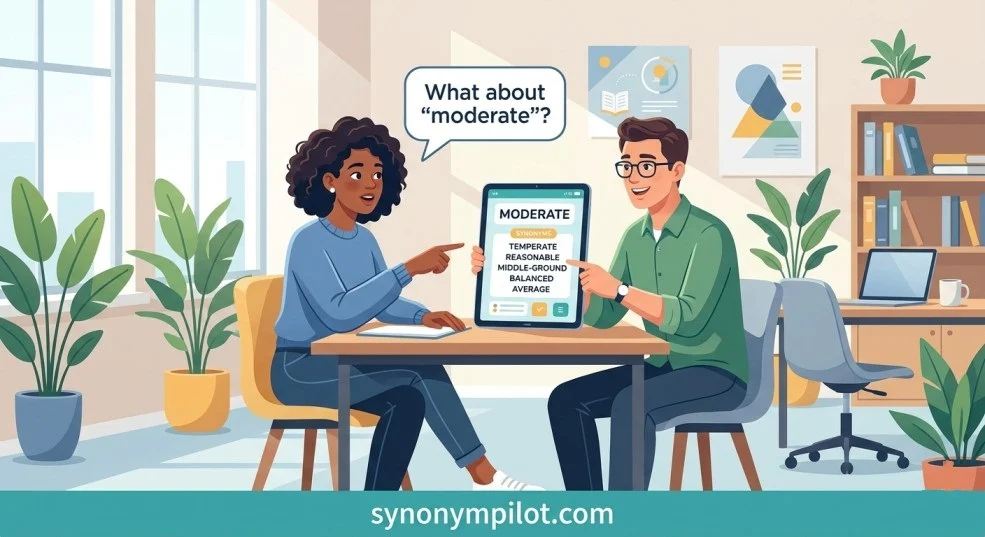
Have you ever wanted to describe something as “not too much and not too little”? That is where the word moderate becomes useful. People use it in school essays, blogs, conversations, and even business writing.
Learning synonyms for moderate can make your English sound smarter and more natural. It also helps students, writers, bloggers, and English learners avoid repeating the same word again and again.
The word moderate usually means average, balanced, calm, or reasonable. Depending on the sentence, it can describe weather, behavior, opinions, prices, or actions.
In this guide, you will learn simple meanings, examples, antonyms, comparisons, and 50 useful synonyms in an easy mobile friendly format.
Featured Snippet Definition
What is a synonym?
A synonym is a word that has the same or nearly the same meaning as another word.
For example, “small” and “tiny” are synonyms because they express a similar idea.
What does moderate mean?
Moderate means not extreme, average in amount, or balanced in behavior.
It often describes something calm, reasonable, or between two extremes.
When & How to Use “Moderate”
The word moderate is commonly used in:
- school writing
- blogging
- business communication
- daily conversations
- weather reports
Real Life Examples
- “The weather will stay moderate this week.”
- “She follows a moderate diet.”
- “His opinion was moderate and fair.”
- “The store offers products at moderate prices.”
50 Synonyms for Moderate
| Synonym | Simple Meaning | Example |
| Average | Normal or typical | “The class got average scores.” |
| Balanced | Equal and steady | “She has a balanced lifestyle.” |
| Calm | Peaceful and quiet | “He stayed calm during the meeting.” |
| Reasonable | Fair and sensible | “That sounds reasonable.” |
| Mild | Not strong or harsh | “The sauce has a mild flavor.” |
| Medium | In the middle size | “I ordered a medium pizza.” |
| Fair | Just and balanced | “The teacher gave a fair grade.” |
| Temperate | Not extreme in climate | “The region has temperate weather.” |
| Controlled | Kept under limit | “She showed controlled emotions.” |
| Limited | Not too much | “The event had limited seating.” |
| Measured | Done carefully | “He gave a measured response.” |
| Sensible | Wise and practical | “That is a sensible plan.” |
| Stable | Firm and balanced | “Prices remained stable.” |
| Neutral | Not taking sides | “She stayed neutral.” |
| Soft | Gentle and light | “The music was soft.” |
| Light | Not heavy or strong | “We had a light lunch.” |
| Conservative | Careful and traditional | “He took a conservative approach.” |
| Restrained | Controlled and calm | “Her reaction was restrained.” |
| Modest | Not large or extreme | “They live in a modest home.” |
| Slight | Small in amount | “There was a slight change.” |
| Gentle | Soft and calm | “He spoke in a gentle tone.” |
| Even | Smooth and equal | “The road became even.” |
| Casual | Relaxed and simple | “They had a casual chat.” |
| Ordinary | Common and normal | “It was an ordinary day.” |
| Standard | Usual or regular | “We used standard rules.” |
| Typical | Common example | “That is a typical response.” |
| Steady | Regular and stable | “Business showed steady growth.” |
| Rational | Logical and sensible | “She made a rational decision.” |
| Practical | Useful and realistic | “That is a practical idea.” |
| Middle ground | Between extremes | “They found a middle ground solution.” |
| Moderate sized | Neither big nor small | “They bought a moderate sized car.” |
| Average priced | Not expensive | “The hotel is average priced.” |
| Cool | Slightly cold | “The evening felt cool.” |
| Pleasant | Comfortable and enjoyable | “The weather was pleasant.” |
| Acceptable | Good enough | “Your work is acceptable.” |
| Civil | Polite and respectful | “They stayed civil during debate.” |
| Tolerable | Easy enough to handle | “The pain was tolerable.” |
| Manageable | Easy to control | “The workload is manageable.” |
| Disciplined | Carefully controlled | “She follows a disciplined routine.” |
| Unbiased | Fair and neutral | “The judge stayed unbiased.” |
| Moderate tempered | Calm personality | “He is moderate tempered.” |
| Controlled temperature | Not too hot or cold | “Keep food at controlled temperature.” |
| Regulated | Properly controlled | “The system is regulated.” |
| Decent | Fairly good | “They earn a decent income.” |
| Composed | Calm and relaxed | “She looked composed.” |
| Thoughtful | Careful and considerate | “He gave a thoughtful answer.” |
| Flexible | Able to adjust | “The schedule is flexible.” |
| Careful | Avoiding extremes | “Be careful with spending.” |
| Smooth | Calm and easy | “The meeting went smoothly.” |
| Level headed | Calm and sensible | “She is level headed.” |
| Moderate risk | Safe enough | “This is a moderate risk investment.” |
</div>
Categorized Synonym Clusters
Formal Synonyms
- Reasonable — “The manager gave a reasonable explanation.”
- Measured — “She made a measured statement.”
- Temperate — “Canada has temperate weather in some regions.”
- Restrained — “His response was restrained.”
- Rational — “They made a rational choice.”
Informal Synonyms
- Cool — “The weather feels cool today.”
- Light — “I prefer a light breakfast.”
- Casual — “We had a casual meeting.”
- Soft — “Play soft music.”
- Decent — “That was a decent movie.”
Academic Synonyms
- Balanced — “Balanced arguments improve essays.”
- Neutral — “Researchers should stay neutral.”
- Stable — “The economy stayed stable.”
- Controlled — “Scientists used controlled testing.”
- Regulated — “The process is regulated.”
Technical Synonyms
- Controlled temperature — “Medicines need controlled temperature storage.”
- Moderate risk — “Banks classify it as moderate risk.”
- Manageable — “The system load is manageable.”
- Disciplined — “A disciplined method improved results.”
- Standard — “The machine follows standard settings.”
Antonyms of Moderate
| Antonym | Meaning | Example |
| Extreme | Very strong or high | “The heat became extreme.” |
| Excessive | Too much | “He spent excessive money.” |
| Harsh | Rough or severe | “The punishment was harsh.” |
| Intense | Very powerful | “They faced intense pressure.” |
| Radical | Very different or extreme | “She supports radical changes.” |
| Violent | Aggressive and forceful | “The storm turned violent.” |
| Severe | Very serious | “The weather was severe.” |
| Unlimited | Without limits | “The package offers unlimited access.” |
| Wild | Out of control | “The crowd became wild.” |
| Overdone | Too much effort or style | “The decoration looked overdone.” |
</div>
Comparison Section
Moderate and mild are similar, but mild usually describes soft weather, flavors, or behavior.
Example: “mild weather.”
Moderate and reasonable both suggest balance, but reasonable focuses more on logic and fairness.
Example: “a reasonable decision.”
Moderate and average both mean not extreme, but average mainly describes common levels or numbers.
Example: “average income.”
Moderate and balanced are close, but balanced suggests equal control between two sides.
Example: “balanced diet.”
Moderate and temperate are similar in climate discussions, but temperate is more formal and scientific.
Example: “temperate climate.”
Examples of Use of Moderate in Phrases
- moderate climate
- moderate exercise
- moderate prices
- moderate opinion
- moderate behavior
- moderate growth
- moderate spending
FAQs
What is the best synonym for moderate?
The best synonym depends on the sentence. Common choices are balanced, reasonable, and mild.
Is moderate a positive word?
Yes. It usually describes something balanced, calm, or sensible.
Can moderate describe a person?
Yes. It can describe someone calm, fair, or not extreme in opinions.
What is the opposite of moderate?
Words like extreme, harsh, and intense are common antonyms.
Why should I learn synonyms for moderate?
Learning synonyms improves writing, avoids repetition, and makes communication more natural.
Mini Vocabulary Growth Section
Learning synonyms for moderate helps you speak and write with more confidence.
Using different words improves essays, blog posts, emails, and conversations. It also makes your content easier to read and more engaging for readers.
Strong vocabulary helps students, writers, bloggers, and professionals sound more natural and skilled in English communication.
Conclusion
Understanding synonyms for moderate can improve both your writing and speaking skills. Instead of repeating the same word, you can choose better alternatives like balanced, reasonable, mild, or temperate depending on the situation.
Practice using these words in emails, school essays, blogs, and daily conversations. The more you use them, the more natural your English will sound.
A strong vocabulary also helps readers enjoy your content and understand your ideas more clearly. Keep learning new synonyms every day to become a more confident English user.