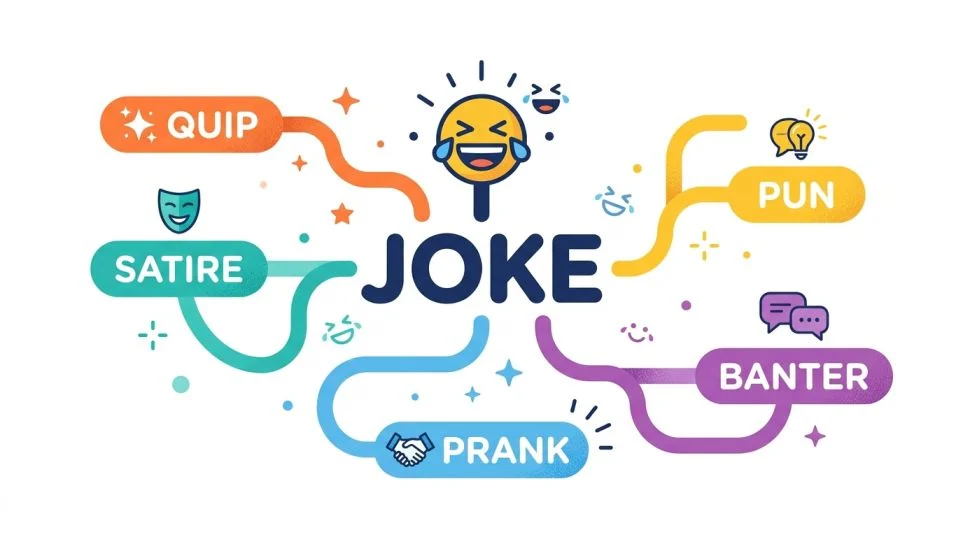
I remember telling a story in class, trying to be funny, but my friends just stared blankly. The problem wasn’t my humor it was my limited vocabulary.
Using the word joke repeatedly can make your writing or conversation feel flat, boring, or predictable.
A joke is more than just something funny. It can be a witty remark, playful teasing, or a clever story. Knowing different ways to express it makes your language richer, sharper, and more engaging.
If you are a student, blogger, freelancer, or writer, exploring synonyms for joke helps you sound smarter and keeps your audience entertained.
In this article, we’ll cover 50+ synonyms, real life examples, antonyms, contextual usage, and expert tips that instantly upgrade your writing and conversation.
Featured Snippet Definition
What is a Synonym?
A synonym is a word that has the same or nearly the same meaning as another word.
Definition of “Joke”
- A thing said or done to provoke laughter.
- A playful or witty remark.
- Something not meant to be taken seriously.
When and How to Use “Joke”
Writing: Use in stories, articles, or scripts to describe humor.
Blogging / SEO: Adds conversational tone and keeps readers engaged.
Conversation: Helps lighten mood or create rapport.
Professional context: Subtle humor can ease tension, but be careful with sensitive topics.
Examples:
- Writing: “The comedian’s joke had the audience in stitches.”
- Conversation: “That was a funny joke you just told!”
- Professional: “He made a small joke to break the ice before the meeting.”
Practical Tip: Use context appropriate synonyms to vary your language and avoid repetition.
Main Synonyms Section (50+ Words)
| Word | Meaning | Example |
| Jest | Something said to amuse | “He made a jest about the weather.” |
| Quip | A clever remark | “Her quip had everyone laughing.” |
| Gag | A funny act or trick | “The magician’s gag surprised the kids.” |
| Pun | A wordplay joke | “He made a pun about time.” |
| Wisecrack | A sarcastic remark | “His wisecrack lightened the tension.” |
| Banter | Playful teasing | “Their friendly banter lasted hours.” |
| Prank | A mischievous trick | “She pulled a harmless prank on him.” |
| Satire | Humor with critique | “The article is a satire on politics.” |
| Parody | Imitation for humor | “The video is a parody of a popular show.” |
| Humor | General funniness | “Her humor brightened the room.” |
| Anecdote | Short funny story | “He told a funny anecdote about school.” |
| Mockery | Making fun of someone | “The speech used mockery cleverly.” |
| Skit | Short performance | “They performed a skit during the event.” |
| Lampoon | Public satire | “The magazine lampooned celebrity culture.” |
| Jestful | Full of jokes | “He had a jestful attitude.” |
| Repartee | Quick witty response | “Their repartee was hilarious.” |
| Chuckle | Soft laugh or joke | “She gave a small chuckle at the joke.” |
| Gibe | Taunting joke | “He made a gibe about her outfit.” |
| Jape | Playful trick | “They played a harmless jape on their friend.” |
| Wise | Witty or clever | “He made a wise comment about the situation.” |
| Humorist | Someone skilled at joking | “The humorist kept the audience engaged.” |
| Comedy | Performance designed to amuse | “The comedy show was a hit.” |
| Laugh | Something that makes you laugh | “It was a laugh from start to finish.” |
| Fun | Enjoyable or playful remark | “They had fun exchanging jokes.” |
| Jestbook | Collection of jokes | “The library had an old jestbook.” |
| Hoax | Deceptive joke | “The article was actually a hoax.” |
| Irony | Subtle humor | “The irony in his joke was brilliant.” |
| Play | Light hearted act | “Their play was full of jokes.” |
| Trick | Practical joke | “He played a trick on his friend.” |
| Wit | Clever humor | “Her wit impressed everyone.” |
| Crack | Quick joke | “He cracked a joke at dinner.” |
| Jestingly | In a joking manner | “He spoke jestingly about the incident.” |
| Bantering | Using playful humor | “They were bantering all night.” |
| Giggle | Small laugh | “She couldn’t stop giggling at the joke.” |
| Punny | Full of puns | “He told a punny joke about animals.” |
| Lighthearted | Not serious, fun | “The lighthearted joke lifted spirits.” |
| Funny | Causes laughter | “That was a really funny joke.” |
| Comic | Relating to comedy | “The comic performance was excellent.” |
| Humorous | Amusing | “His humorous story charmed everyone.” |
| Jocular | Fond of joking | “He was always jocular with colleagues.” |
| Laughable | Worth laughing at | “The situation was laughable.” |
| Hilarious | Extremely funny | “Her joke was hilarious.” |
| Side splitter | Makes you laugh hard | “It was a side splitter of a joke.” |
| Bellylaugh | Loud laugh | “Everyone had a bellylaugh at his joke.” |
| Crack up | Something funny | “The show was a total crack up.” |
| Jestful | Full of fun | “He shared a jestful anecdote.” |
| Tease | Joke at someone’s expense | “She liked to tease him gently.” |
| Comic relief | Humor to reduce tension | “The scene provided comic relief.” |
| Humorist | Skilled in humor | “The humorist wrote witty stories.” |
| Witty remark | Clever, amusing comment | “His witty remark made us laugh.” |
Antonyms Section (10 Words)
| Word | Meaning | Example |
| Serious | Not funny | “His tone was serious, no joke.” |
| Stern | Strict, unsmiling | “She gave a stern look.” |
| Grave | Somber or solemn | “The situation was grave.” |
| Solemn | Formal, not playful | “They had a solemn discussion.” |
| Sad | Unhappy or gloomy | “The news was sad, not funny.” |
| Tragic | Causing sorrow | “It was a tragic event.” |
| Formal | Proper, not humorous | “The formal letter had no jokes.” |
| Literal | Exact, no humor | “He took my comment literally.” |
| Earnest | Serious intent | “She was earnest in her request.” |
| Dull | Lacking humor | “The lecture was dull and dry.” |
Comparison Section
| Keyword vs Word | Difference | Example |
| Joke vs Pun | Pun is a wordplay; joke can be general humor | “He made a pun about the clock, not just a joke.” |
| Joke vs Prank | Prank is a practical trick; joke can be verbal | “The prank involved fake spiders, unlike the joke he told.” |
| Joke vs Quip | Quip is short & witty; joke can be a story | “Her quip was clever, the joke longer.” |
| Joke vs Satire | Satire criticizes humorously; joke may not | “The cartoon is satire, not just a joke.” |
| Joke vs Banter | Banter is ongoing playful talk; joke is one off | “Their banter lasted hours, with multiple jokes.” |
Categorized Synonym Clusters
| Formal | Informal | Academic | Technical | Advanced |
| Satire | Prank | Anecdote | Lampoon | Repartee |
| Parody | Gag | Humor | Jestbook | Jocular |
| Mockery | Quip | Comedy | Hoax | Side splitter |
| Jest | Chuckle | Wit | Pun | Comic relief |
Context Based Variations
| For People | Explanation | Example |
| Comedian | Someone skilled at jokes | “The comedian made the crowd laugh.” |
| For Places | Explanation | Example |
| Comedy club | Venue for humor | “We went to a comedy club last night.” |
| For Situations | Explanation | Example |
| Icebreaker | Joke to ease tension | “A joke broke the ice in the meeting.” |
Adverb / Other Word Forms
| Form | Example |
| Jestingly | “He commented jestingly.” |
| Jocularly | “She spoke jocularly to her friend.” |
| Humorously | “He humorously described the event.” |
| Punfully | “He punfully made his point.” |
Noun Forms / Related Terms
| Related Noun | Meaning | Example |
| Humorist | Person skilled at humor | “The humorist entertained the audience.” |
| Jest | Act of joking | “His jest made everyone smile.” |
| Quip | Witty remark | “Her quip impressed the class.” |
Situation Based Usage (Advanced)
| Context | Explanation | Example |
| Health / harm | Avoid sensitive jokes | “Avoid jokes about illness in hospitals.” |
| Risk / uncertainty | Risky humor | “Political jokes can backfire.” |
| Hidden meaning | Subtle humor | “His joke had a hidden message.” |
Common Phrases Using “Joke”
- Make a joke
- Play a joke on
- Joke around
- Inside joke
- Bad joke
- Practical joke
- Joke of the day
- Running joke
- Joke teller
- Joke’s on you
Other Languages (Optional)
| Language | Translation |
| Spanish | Broma |
| French | Blague |
| German | Witz |
| Italian | Scherzo |
| Japanese | 冗談 (Jōdan) |
FAQs
Q1: What is the best synonym for joke in formal writing?
A: Jest, satire, parody, or lampoon are best for formal contexts.
Q2: Can a joke be serious?
A: Usually no, but satire or irony can carry a serious message humorously.
Q3: What is the difference between joke and pun?
A: A pun uses wordplay; a joke may be a story, quip, or act meant to amuse.
Q4: How can I use jokes professionally?
A: Use light, harmless jokes or icebreakers to ease tension.
Q5: Are all synonyms interchangeable?
A: Not always; choose based on context (formal, informal, witty, or playful).
Conclusion
Using synonyms for joke instantly upgrades your writing, blogging, or daily conversation. From witty quips and playful gags to satire and pranks, a rich vocabulary helps you connect with readers and listeners.
Experiment with different words in various contexts, and you’ll notice your language becoming more engaging, versatile, and memorable.
Remember: the right word at the right moment can turn a simple joke into a powerful tool for connection, humor, and creativity.