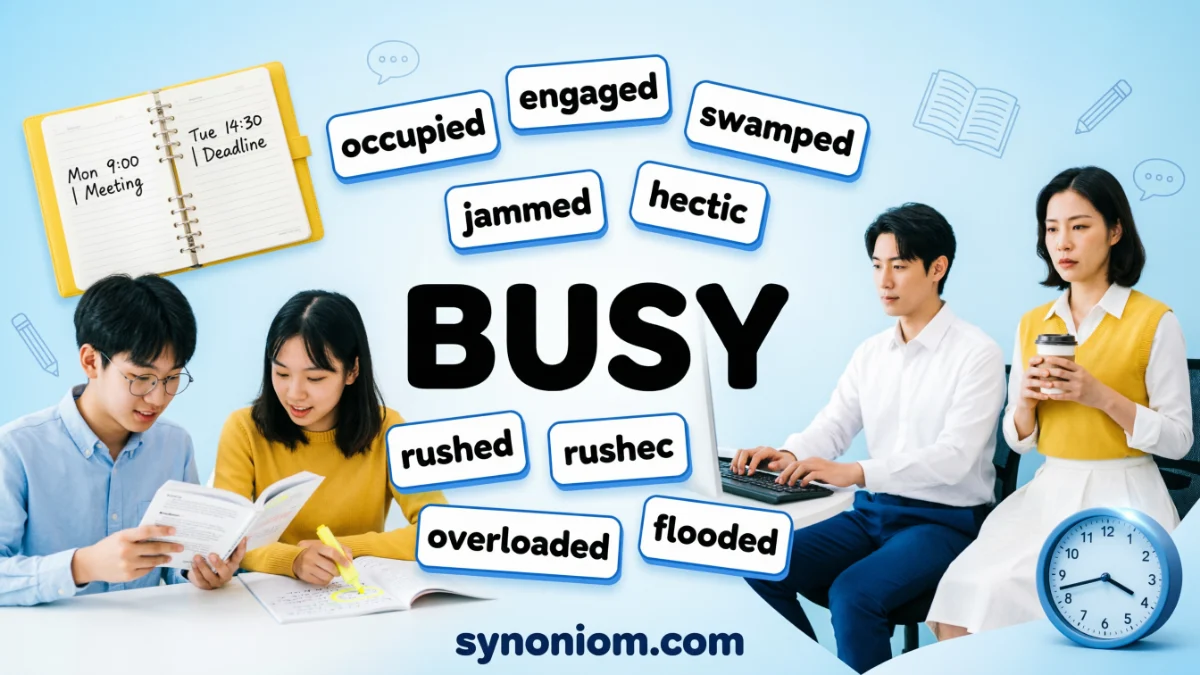
You text a friend, and they reply, “Sorry, I’m busy right now.” At work, your manager says, “It’s been a busy week.” In school, students often say, “I’m too busy to finish everything today.”
The word “busy” appears everywhere in English because people constantly talk about schedules, work, responsibilities, and activities.
However, repeating the same word again and again can make your speaking and writing sound flat. That is why learning synonyms of “busy” helps you sound more natural, expressive, and confident.
Some alternatives sound professional, while others feel casual, emotional, or conversational.
In this guide, you’ll learn the meaning of “busy,” how to use it correctly, 50 useful synonyms, common mistakes, antonyms, phrases, and practical examples for real life communication.
Featured Snippet Definition
The word “busy” describes someone or something actively occupied with work, tasks, activities, or responsibilities. It often means a person does not have much free time.
For example:
- “She’s busy preparing for exams.”
- “The restaurant gets busy on weekends.”
“Busy” can describe people, places, schedules, phones, roads, or periods of time.
Meaning, Tone & Context
Core Meaning
“Busy” usually means:
- actively doing something
- occupied with tasks
- full of activity
- not available because of responsibilities
Tone
The word works in many tones and situations:
- Casual conversation
- Professional communication
- Academic writing
- Workplace discussions
- Friendly texting
- Everyday speaking
It is generally neutral, although context can make it sound positive or stressful.
Where “Busy” Sounds Most Natural
People commonly use “busy” when talking about:
- Work schedules
- School assignments
- Family responsibilities
- Social plans
- Crowded places
- Active environments
Examples:
- “I’ve been busy all morning.”
- “The airport looks busy today.”
- “She’s busy with a new project.”
When & How to Use “Busy”
Use “busy” when someone or something has a lot happening.
Talking About People
Examples:
- “My father is busy at work.”
- “I’m busy studying for finals.”
Talking About Places
Examples:
- “The café gets busy during lunch.”
- “The streets were busy after the concert.”
Talking About Time Periods
Examples:
- “December is always a busy month.”
- “We had a busy weekend.”
Common Sentence Structures
- busy + with + noun
“She’s busy with homework.” - busy + verb + ing
“They’re busy preparing dinner.”
Helpful Tip
“Busy” does not always mean productive. Someone can feel busy but still accomplish very little.
Synonyms
| Synonym | Simple Meaning | Example Sentence |
| Occupied | Doing something | She’s occupied with office work right now. |
| Engaged | Involved in activity | He’s engaged in an important discussion. |
| Active | Full of activity | The market stays active at night. |
| Working | Doing a job or task | I’m working on a school project today. |
| Swamped | Extremely overloaded | She’s swamped with assignments this week. |
| Overloaded | Having too much work | The team feels overloaded before deadlines. |
| Tied up | Not available | Sorry, I’m tied up at the moment. |
| Buried | Deeply involved in work | He’s buried in paperwork today. |
| Snowed under | Overwhelmed with tasks | I’m snowed under with emails lately. |
| Hustling | Working hard continuously | Small business owners are always hustling. |
| Running around | Constantly moving or working | I’ve been running around all day. |
| Hard at work | Working seriously | The engineers are hard at work. |
| Productive | Completing useful tasks | She had a productive afternoon. |
| Industrious | Very hardworking | He’s an industrious employee. |
| Diligent | Careful and hardworking | Maria is diligent with every project. |
| Assiduous | Consistently hardworking | The researcher remained assiduous throughout the study. |
| Laboring | Working physically or mentally | Workers were laboring in the heat. |
| Occupied elsewhere | Busy somewhere else | The manager is occupied elsewhere right now. |
| Preoccupied | Mentally focused on something | She seemed preoccupied during class. |
| In demand | Needed frequently | Skilled designers are currently in demand. |
| On the go | Constantly active | Parents are often on the go. |
| Up to your ears | Extremely busy | I’m up to my ears in homework. |
| Flat out | Working very hard | We’ve been working flat out all week. |
| Stretched | Lacking enough time | The staff feels stretched during holidays. |
| Pressed | Limited by time | I’m pressed for time today. |
| Overworked | Working too much | Nurses often feel overworked. |
| Hectic | Full of stressful activity | We had a hectic morning at the office. |
| Chaotic | Very disorganized and active | The station looked chaotic during rush hour. |
| Eventful | Full of activity | It was an eventful day at school. |
| Full | Having no free space or time | My schedule is completely full. |
| Booked | Reserved or unavailable | The doctor is fully booked today. |
| Scheduled | Planned with activities | We have a scheduled meeting tomorrow. |
| Engrossed | Deeply focused | He was engrossed in reading. |
| Immersed | Completely involved | She’s immersed in her studies. |
| Committed | Dedicated to tasks | They’re committed to completing the project. |
| Dedicated | Giving full effort | She’s dedicated to her work. |
| Focused | Concentrating carefully | The students stayed focused during exams. |
| Attentive | Paying close attention | He remained attentive throughout the lesson. |
| Tireless | Never seeming to stop | Volunteers worked tirelessly after the storm. |
| Energetic | Full of energy | The children stayed energetic all afternoon. |
| Lively | Active and exciting | The downtown area feels lively at night. |
| Thriving | Growing actively | Local businesses are thriving this year. |
| Moving | Constantly active | The production line kept moving nonstop. |
| Fast paced | Happening quickly | She enjoys a fast paced workplace. |
| Dynamic | Full of energy and change | The company has a dynamic environment. |
| Buzzing | Full of activity | The café was buzzing with customers. |
| Packed | Extremely full or crowded | The train was packed this morning. |
| Crowded | Full of people | The mall gets crowded on weekends. |
| Jam packed | Completely full | Our schedule is jam packed this month. |
| Slammed | Extremely busy suddenly | Restaurants get slammed during dinner hours. |
Important Synonym Groups
Formal Synonyms
These fit professional and academic writing:
- Occupied
- Engaged
- Diligent
- Industrious
- Assiduous
- Committed
Example:
- “The research team remained engaged throughout the project.”
Informal Synonyms
These sound casual and natural in conversations:
- Swamped
- Tied up
- Running around
- Slammed
- Packed
Example:
- “I’m swamped with homework tonight.”
Academic Synonyms
Useful in essays and formal discussions:
- Productive
- Focused
- Dedicated
- Immersed
- Attentive
Example:
- “The students remained focused during the lecture.”
Professional Synonyms
Common in workplaces and business settings:
- Occupied
- Scheduled
- Booked
- Pressed
- Overloaded
Example:
- “The consultant is fully booked this week.”
Emotional Synonyms
These often show stress or pressure:
- Overworked
- Hectic
- Stretched
- Snowed under
Example:
- “Many employees feel overworked during peak season.”
Conversational Synonyms
Natural for daily speech:
- Busy
- On the go
- Hard at work
- Running around
Example:
- “I’ve been on the go since morning.”
Slang or Very Casual Synonyms
These sound very informal:
- Slammed
- Swamped
- Up to your ears
Example:
- “I’m slammed with projects today.”
Antonyms
| Antonym | Meaning | Example |
| Free | Available | I’m finally free this evening. |
| Idle | Not active | The machines stayed idle overnight. |
| Relaxed | Calm and unstressed | She felt relaxed after vacation. |
| Available | Ready to help or meet | The teacher is available after class. |
| Unoccupied | Not being used or busy | Several seats remained unoccupied. |
| Resting | Taking a break | He’s resting after work. |
| Calm | Peaceful and quiet | The office looked calm today. |
| Inactive | Not operating | The account has been inactive for months. |
| Leisurely | Slow and relaxed | We enjoyed a leisurely afternoon walk. |
| Unscheduled | Not planned | I finally had an unscheduled weekend. |
Comparison Section
“Busy” vs “Occupied”
Both mean someone is doing something. However, “occupied” sounds more formal and professional.
Examples:
- Casual: “I’m busy today.”
- Formal: “She’s currently occupied.”
“Busy” vs “Hectic”
“Hectic” adds stress, pressure, and chaos.
Examples:
- “I had a busy morning.”
(many tasks) - “I had a hectic morning.”
(many stressful tasks)
“Busy” vs “Productive”
Someone can be busy without accomplishing much. “Productive” means completing useful work.
Examples:
- “I stayed busy all day.”
- “I had a productive day.”
“Busy” vs “Engaged”
“Engaged” often suggests focused involvement, especially in formal situations.
Example:
- “Students remained engaged during the workshop.”
It sounds more positive and professional than “busy.”
Common Phrases & Expressions
1. Busy as a bee
Meaning: Extremely active and hardworking
Example:
- “She was busy as a bee preparing for the event.”
2. Busy schedule
Meaning: A timetable full of activities
Example:
- “Doctors usually have busy schedules.”
3. Keep busy
Meaning: Continue doing activities
Example:
- “I read books to keep busy during holidays.”
4. Busy doing something
Meaning: Actively involved in a task
Example:
- “He’s busy fixing the car.”
5. Too busy for
Meaning: Having no time available
Example:
- “She’s too busy for long meetings today.”
6. Busy line
Meaning: A phone line currently in use
Example:
- “I tried calling, but the line was busy.”
Common Mistakes to Avoid
Using “Busy” for Every Situation
Repeating “busy” too often makes writing repetitive.
Instead of:
- “I’m busy with work, and my office is busy too.”
Try:
- “I’m occupied with work, and the office is crowded.”
Confusing “Busy” and “Productive”
Being busy does not always mean achieving results.
Example:
- “I answered emails all day, but I wasn’t productive.”
Using Slang in Formal Writing
Avoid slang like “slammed” or “swamped” in academic essays or professional reports.
Incorrect Prepositions
Correct:
- “Busy with homework”
- “Busy preparing dinner”
Incorrect:
- “Busy on homework”
FAQs
Is “busy” positive or negative?
It can be either. Sometimes it means productive and active, while other times it suggests stress or pressure.
What is the best formal synonym for “busy”?
“Occupied” is one of the most natural formal alternatives.
Can “busy” describe places?
Yes. It often describes crowded or active places.
Example:
- “The restaurant was busy tonight.”
Is “swamped” stronger than “busy”?
Yes. “Swamped” means extremely busy or overloaded.
What is a casual synonym for “busy”?
Common casual alternatives include:
- tied up
- on the go
- slammed
- swamped
Conclusion
Learning different synonyms of “busy” helps you express yourself more clearly and naturally in English.
While “busy” works perfectly in everyday communication, using alternatives like “occupied,” “swamped,” “productive,” or “engaged” adds variety and precision to your speaking and writing.
The best synonym depends on the situation. Professional settings often require formal words, while casual conversations sound better with relaxed expressions.
Therefore, understanding tone and context is just as important as learning vocabulary itself.
Try using one new synonym each day in conversations, messages, essays, or workplace communication.
Over time, these words will become part of your natural English vocabulary. As a result, your speaking and writing will sound smoother, richer, and more confident in real life situations.